Personal Loan Settlement Process: First Call to Final Letter
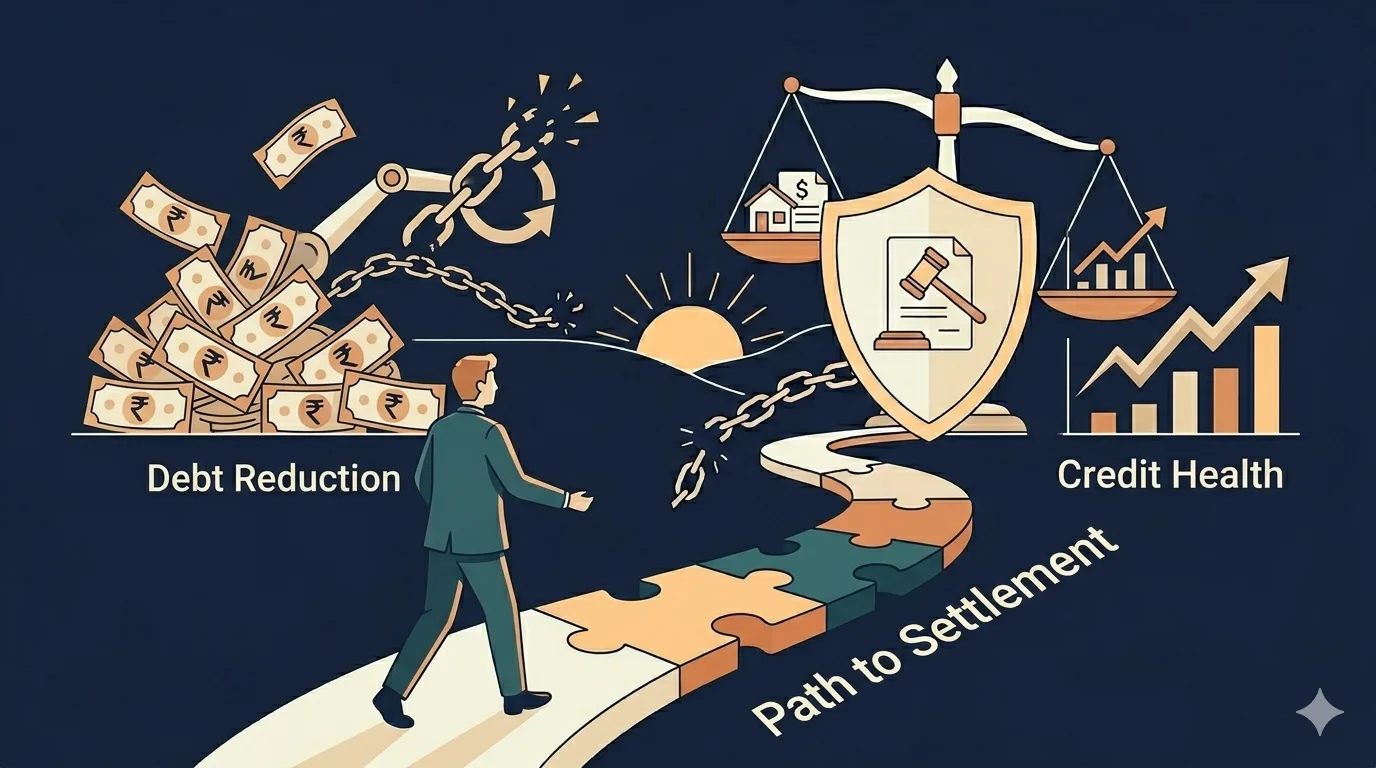
The personal loan settlement process is the series of steps between your first conversation with the bank and the settlement letter that confirms your loan is settled. It covers a hardship request, a written offer, one lump-sum payment and a clearance letter (NOC). Banks and financial companies may consider a settlement request when an account is under financial stress. Approval depends on the lender’s policy, the borrower’s circumstances and the details of the account. A settlement is not guaranteed.

Mohit Juneja
Reviewed by FREED India, Debt Resolution Specialists
 4.7/5
 ₹3,200Cr+
 20,000+
 20,00,000+4.7/5₹3,200Cr+20,000+20,00,000+
KEY TAKEAWAYS

The personal loan settlement process runs from your first call to the bank to the settlement letter.
Banks only consider it when you genuinely cannot repay in full, not when repayment is merely tight.
Pay nothing until the settlement terms are in writing, signed by an authorised bank officer.
The loan is marked “Settled”, not “Closed”, and the mark can stay up to 7 years.
FREED helps eligible people settle unsecured loans at up to 50%* less. The bank decides final terms.
What Is the Personal Loan Settlement Process?
Settlement is not something a borrower chooses out of preference. Banks and financial companies only consider it in genuine financial difficulty, when you truly cannot repay the full amount. The personal loan settlement process is the path from your first talk with the bank. It ends with the letter that confirms the loan is settled.
It has six stages:
Prepare. Gather your loan statement, hardship papers and a lump sum you can really pay.
First conversation. Reach the bank’s collections team and ask how it handles settlement requests.
Written request. Send a short letter that states your situation and the amount you can pay.
Offer and negotiation. The bank reviews your papers and sends its offer in writing.
Payment. Pay the agreed amount once, by a traceable method, before the deadline.
Settlement letter and NOC. Collect proof that the loan is settled, plus a clearance letter (called NOC).
Many people call this the personal loan OTS process. OTS (one-time settlement, paying it once and the matter ends) is the same idea. Our guide to one-time settlement explains who qualifies. RBI treats a negotiated settlement as a valid way to resolve a stressed loan. See its directions for NBFCs and commercial banks.
This process is for you if you cannot repay in full and see no near-term recovery. Say ₹4,00,000 is outstanding on your loan. A waiver of up to 50%* would mean paying as little as ₹2,00,000. The real figure depends on your bank and on what you can pay in one go.
If you still pay every EMI, even with effort, settlement is not your path. The Loan Consolidation Plan fits that situation better. For people who cannot pay, FREED’s Loan Settlement Plan supports each stage below on unsecured loans.
*Rates and ranges shown are indicative. Final terms decided by the bank. FREED is not a Loan Provider. No outcome is guaranteed. Please verify directly with your bank.
Preparation comes before any call, so that is where we start.

Wondering where you stand in the settlement process?
Talk to a FREED counsellor about your loan.
Book My Free CallWhat Should You Do Before Calling the Bank About Settlement?
Think of it as four things in your hand before you dial. A bank takes a request seriously when the papers are ready. Requirements vary by bank, so treat this as a starting list, not a fixed one.
A written outstanding statement. Ask the bank for it, or pull it from your loan account. It should show principal (what you borrowed), interest and penal charges (late fees) as separate lines. This gives you a clear number to work from.
Proof of your difficulty. This can be a job-loss or salary-cut letter, medical bills, and 3 to 6 months of bank statements. The statements should show the drop in your income. Banks look at these papers before they look at any offer.
ID and address proof, plus any notices you received. Keep every recovery or legal notice in the same folder. The bank may ask for them, and you will want dates handy.
A lump sum you can really pay. Work out an amount you can arrange in one go, from savings or family help. A promise you cannot keep makes the next conversation harder.
Next, look at your credit report. Surprises here can derail the talk. Your report may show missed payments or a status you did not expect. Credit Insights runs on Experian, so it shows your credit report and what is driving your score.
One more point. Banks expect you to have tried softer options first. Ask about a lower EMI, more repayment time or a short payment pause. Do not stop paying on purpose to improve your terms. That only adds penal charges and hurts your score.
Many banks also have a standard form for this request. The loan settlement application guide shows what such forms usually ask. You are ready. Now comes the first call.
Not sure you have the right papers?
A FREED counsellor can walk through your loan with you.
Check your optionsWhat Happens in the First Conversation With the Bank?
Most guides skip this stage, yet it is where many people get stuck. Call the bank’s collections or loan recovery department. Contact your lender through its official customer-care channel and ask which department handles settlement requests. Follow the lender’s stated process and keep a record of your communication.
Ask for three things on that first call:
The bank’s process for a settlement request. Ask which team handles it and what the next step is.
A current outstanding statement. You need this to match against your own numbers.
How to submit your request in writing. Ask for the email address or branch that takes it.
Then follow two rules. First, note the name, designation and date of every call. Second, send a short email after each call that sums up what was said. A written trail protects you later.
Now the honest part. The person on the phone usually cannot approve anything. Expect to hear “submit it in writing”. This is by design. RBI’s 2023 framework asks banks to follow a board-approved policy. Under it, the approving authority sits at least one level above the officer who sanctioned the loan. The officer who sanctioned the loan cannot approve its settlement. Nobody on a first call can promise you an outcome, and the bank may still decline.
Recovery calls may continue during this stage. That is common while the request is pending. Our guides on RBI rules for recovery agents and recovery harassment explain what agents may and may not do.
If calls turn abusive or threatening, or an agent visits without following protocol, FREED Shield is open to anyone, enrolled or not, to document and report it.

Freed Expert Tip
After every call, email a two-line summary of what was said. A written trail protects you later.
See how FREED helps with paperworkHow Do You Write the Settlement Request to the Bank?
The letter does not need fancy words. It needs facts, in a calm tone. No pleading and no threats.
A good request includes these six things:
Your loan account number. Put it at the top so the right team finds it fast.
The current outstanding amount. Use the figure from the bank’s own statement.
Why repayment stopped. Write one factual paragraph, such as a job loss with dates.
A clear statement that you cannot repay in full. Say it plainly, in one line.
The lump sum you can pay. Name a number you can really arrange.
A request for the terms in writing. Ask the bank to send its offer on its letterhead.
Send the letter to the branch or to the collections email the bank named on your first call. Keep proof of sending, such as a sent-mail copy or a courier receipt. A bank may ask for more papers after reading it. That is a normal step, not a rejection.
A few do-nots. Do not exaggerate your hardship. Do not attach documents you cannot back up. Do not promise an amount you cannot pay.
Want a full sample? Our guide on how to write a loan settlement letter to a bank walks through the wording. A debt settlement letter sample shows another layout. Use them as a guide and change the details to match your case.
Once the letter is in, the bank takes over for a while.
How Does the Bank Make and Negotiate a Settlement Offer?
Behind the scenes, the bank reviews your hardship papers and loan history. Then an approving authority decides. You will mostly wait during this time, so keep your phone and email checked.
The offer should arrive in writing, on the bank’s letterhead, with an authorised signature. A verbal offer on a call is not an offer yet. Never pay on one.
Negotiation is allowed. You can counter an offer if you can show what you are able to pay, with papers to back it up. The bank may go back and forth a few times. The final number is the bank’s decision. Our guide on how to negotiate a personal loan settlement shows how the conversation usually goes.
The settlement offer may address interest, charges and principal, depending on the lender’s policy and assessment of the account. Check the written offer to see exactly which amounts are being waived and what you must pay. Banks may waive up to 50%* of what you owe. For a typical range, see what a settlement percentage usually looks like.
Before you accept, the signed loan settlement agreement must show four things:
The settlement amount. It should match what you agreed, to the rupee.
A statement that the balance is waived. This confirms you owe nothing more on this loan.
The payment deadline. You need a clear date by which you must pay.
The reporting status. It should say the account will be reported “Settled”.
Our guide on what a settlement letter includes helps you check each line.
Under the RBI’s 8 June 2023 framework, a compromise settlement where payment of the agreed settlement amount takes more than three months is treated as restructuring for prudential purposes. Confirm the payment schedule and its consequences in the lender’s written offer before accepting it.
*Rates and ranges shown are indicative. Final terms decided by the bank. FREED is not a Loan Provider. No outcome is guaranteed. Please verify directly with your bank.

What the Law Says
RBI says a settlement paid over more than 3 months is treated as a restructuring, so ask for a short, clear payment window.
Know what your signed agreement must showHow Do You Pay and Get the Settlement Letter?
Payment is where most people feel relief. It is also where a small slip costs the most. Follow these rules in order:
Pay only after you hold the signed agreement. A call, a message or a verbal promise is not enough. The paper protects you if anything is disputed later.
Pay by bank transfer or demand draft. Both leave a trace. Never pay in cash, even if someone offers a “discount” for it.
Keep every receipt. Save the transfer slip or draft copy with your agreement. You may need them when you ask for your letters.
Pay within the stated deadline. If you cannot make it, tell the bank in writing before the date passes.
After payment, you must receive two papers. The first is the settlement letter, which confirms the amount you paid and that the loan is settled in full. The second is the NOC (clearance letter), which shows the bank has no further claim on this loan. The matter is not done until both are in your hands.
A good settlement letter shows the amount paid, the waiver, the “Settled” status, the date and an authorised signature. Our final settlement letter format guide lists what to check. Do not treat one format as the only correct one, since banks differ. The NOC and clearance letter guide explains the second paper. If you are unsure what the bank may add on top, read about loan settlement charges.
The bank then reports the loan as “Settled” to the credit bureaus. The update usually takes a few weeks.
What if the bank refuses to issue the letter? Raise it in writing first, with your payment proof attached. If you get no reply, use the bank’s grievance channel. Keep copies of every message.
Want help with the paperwork and follow-ups?
FREED counsellors guide you through each stage.
Book My Free CallWhat Should You Check After the Settlement Letter?
The letter is in your hand, but a few checks remain. Do them while the papers are fresh.
Store two copies of your letter and NOC. Keep one physical copy and one scanned copy. You may need them years from now.
Check your credit report after a few weeks. The status should read “Settled”, with the right amount and date. If anything is wrong, you want to catch it early.
Dispute errors, with the NOC as proof. Write to the bank and the bureau, and attach your letters.
Watch for stray collection calls. Calls should stop once the bank updates its records. Our guide on calls after a loan is settled explains what to do if they do not.
Now the honest cost. “Settled” is not “Closed”. The mark can stay on your report for up to 7 years. A “Settled” status can affect your credit profile and may make future lenders more cautious. The effect on your score varies by individual credit history and scoring model, so no fixed point reduction can be promised. The guide on how a settlement affects your credit score goes deeper. Our piece on the settlement remark on your report explains what you can and cannot change.
Rebuilding starts with small habits. Keep your other accounts current. Borrow carefully. Check affordability with the EMI Score before any new loan, since it rates your EMI load from 0 to 100.
Expect a wait before fresh credit too. Banks apply a cooling period after a settlement, and the length is set by each bank’s policy. Nobody can promise you a recovery date, so take it one month at a time.
What Can Go Wrong During the Personal Loan Settlement Process?
This part is short and protective. None of it is meant to scare you. Most problems come from rushing, so slow down at each stage. Picture a caller who says the offer ends tonight and asks you to pay now. A real bank offer comes on paper, with time to read it. Pressure to pay on the spot is your cue to pause and check.
Paying someone who is not an authorised bank official. Pay only to the bank’s own account, named in your written agreement.
“Settlement agencies” that take money upfront. Some take an advance and then stop answering. Read how to evaluate a loan settlement agency before you sign with anyone.
Paying before you have the written agreement. A verbal promise cannot be shown to anyone later.
Paying in cash. There is no trace, so there is no proof.
Treating a write-off as a settlement. A written-off loan can still be owed. See what “written off” means in CIBIL.
Agreeing to an amount you cannot pay in one go. Missing the deadline can undo the whole deal.
A settlement is not complete without the settlement letter and the NOC. Check that you hold both before you call the matter finished.
Here is the whole process on one page:
Stage | Who you deal with | What you must get in writing |
Prepare | Your own records and the bank’s portal or branch | An outstanding statement with principal, interest and penal charges split out |
First call | The bank’s collections or recovery team | The name, designation and date of the person you spoke to, plus your own email summary |
Written request | The collections email or branch the bank named | Proof that you sent the letter, and an acknowledgement if the bank gives one |
Offer and negotiation | The bank’s approving authority, through the collections team | A signed offer on letterhead with the amount, waiver, deadline and “Settled” status |
Payment | The bank, by transfer or demand draft | A payment receipt for every rupee paid |
Settlement letter and NOC | The bank’s collections or loan team | A settlement letter and an NOC, both signed |
Rates and ranges shown are indicative. Final terms decided by the bank. FREED is not a Loan Provider. No outcome is guaranteed. Please verify directly with your bank.
How Does FREED Help With the Personal Loan Settlement Process?
The FREED Loan Settlement Plan, also called the Debt Resolution Program or “Settle My Loans” in the app, covers unsecured loans only. FREED describes it this way: “Helps borrowers move from financial distress to a structured path toward resolving their debt and rebuilding their financial future.”
Here is how the Loan Settlement Plan lines up with the stages above:
FREED reviews your full financial picture. That means your loans, income, expenses and what you can repay.
You get a personalised plan. It is built around your numbers, not a template.
You save a fixed monthly amount into a Special Purpose Account (SPA). An independent trusteeship company holds the SPA. It is your own savings pool.
Once enough corpus builds, FREED negotiates with the bank. FREED also prepares documents and drafts letters for you.
You approve every settlement before any payout. The bank decides the final terms, and you accept or decline.
On acceptance, the payment is made and the bank issues a settlement letter.
This takes time. Savings come first, and that cannot be rushed. The order in which your loans are settled is flexible and follows your priority. FREED charges a fee only on a successful settlement. Our guide on how to speed up the loan settlement process covers what you can do on your side.
Banks may waive up to 50%* of what you owe. Whatever the bank agrees to, the final terms are the bank’s call.
*Rates and ranges shown are indicative. Final terms decided by the bank. FREED is not a Loan Provider. No outcome is guaranteed. Please verify directly with your bank.
20,000+ accounts settled | 20,00,000+ customers counselled | ₹3,200 Cr+ debt managed
Not ready to talk yet?
Start with your credit report. It shows what banks see.
Check My Credit ReportSources
Claim in the blog | Source |
A negotiated settlement is a valid resolution for a stressed loan (NBFCs) | |
A negotiated settlement is a valid resolution for a stressed loan (banks) | RBI Commercial Banks Resolution of Stressed Assets Directions, 2025 |
Settlements are approved under a board-approved policy by an authority above the sanctioning officer | |
A settlement paid over more than 3 months is treated as restructuring |

Mohit Juneja
Mohit Juneja writes educational content at FREED on debt management, credit scores, loan repayment, and borrowing best practices. His content is shaped by expert insights and industry knowledge, helping readers better understand their financial options and make informed decisions.
mohit.juneja@freed.care

FREED is India's trusted loan management platform. Founded in 2020 and headquartered in Gurugram, FREED has counselled 20 lakh+ people on personal loans, credit cards, and app loans. FREED charges fees only on successful settlement, not upfront. FREED does not handle secured loans (home loans, car loans, gold loans).
Media Mentions