Can I Get a Loan After Settlement? What Banks Check
Yes, you can get a loan after settlement, but approval depends on the bank. Banks check your “Settled” status, current score, time since settlement, payment record since then and how much of your income already goes to EMIs. RBI also sets a minimum cooling period before a bank takes fresh exposure after a compromise settlement.

Mohit Juneja
Reviewed by FREED India, Debt Resolution Specialists
 4.7/5
 ₹3,200Cr+
 20,000+
 20,00,000+4.7/5₹3,200Cr+20,000+20,00,000+
KEY TAKEAWAYS

Can I get a loan after settlement? Yes, but approval depends on the bank and your recent record.
Banks check the “Settled” status, current score, time since settlement and your income against EMIs.
RBI sets a minimum cooling period before a bank takes fresh exposure after a compromise settlement.
On-time payments, low card use and a short list of applications help you rebuild.
Check affordability and your report first. Rejected applications can lower your score further.
Can You Get a Loan After Settlement?
Yes, you can. Settlement does not bar you from borrowing for life, but it does make approval harder for a period.
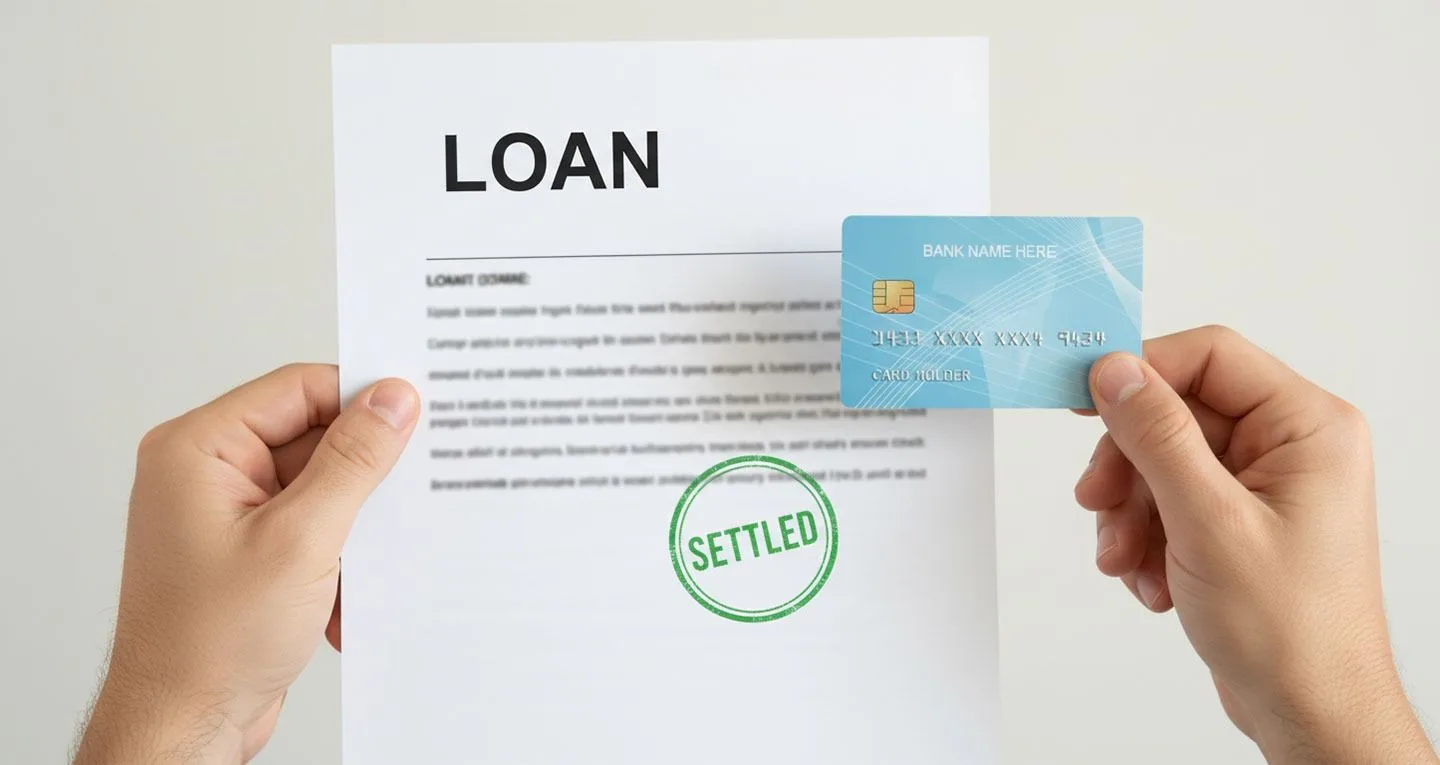
The reason is simple. Your account shows “Settled”, not “Closed”. To a bank reading your report, that means the loan was cleared for less than the full amount. That is a real mark, and there is no point pretending otherwise. It is also not the end of your borrowing.
Here is what usually changes:
Approval is more selective, and some applications will be declined.
If you are approved, the price may be higher.
Unsecured loans (no asset kept as security) are harder to get than secured ones.
No page can tell you the date you will be approved. Each bank and NBFC (non-bank loan company) sets its own rules. Two of them can read the same report and decide differently. If you want to see how banks think about a settled account, our guide on how banks view settled accounts goes through it. The score side is covered in the impact of debt settlement on credit score.
One more honest line. FREED is not a loan provider and does not arrange loans. This page helps you prepare, so that when you apply, you apply once and apply well. So what do banks actually check?

Planning a loan after settlement?
Talk to a FREED counsellor about your other debts first.
Book My Free CallWhat Do Banks Check When You Apply for a Loan After Settlement?
Banks differ, and none of them publishes a full checklist. But these are the things that come up again and again.
What the bank checks | What it sees on your report or papers | What you can do about it |
Account status and written-off amount | “Settled” and the portion the bank waived | Keep your settlement letter and NOC (no objection certificate, the bank’s proof you owe nothing more) handy |
Current credit score | Your score today, judged against that bank’s own cut-off | Check your report and fix wrong entries |
Time since settlement | The settlement date on the account | Ask the bank in writing what it expects |
Payment record since settlement | Clean months, or late marks | Pay every EMI and bill on time |
Share of income going to EMIs | FOIR (fixed obligations to income ratio, how much of your salary goes to EMIs) | Keep EMIs well under 50% of take-home pay |
Income proof | Salary slips, bank statements, ITR | Keep recent copies in one folder |
Number of recent applications | Hard enquiries (a record each time a bank checks your report for a loan) | Apply less often |
Type of loan | Secured or unsecured | Consider a loan backed by your own asset |
Rates and ranges shown are indicative. Final terms decided by the bank. FREED is not a Loan Provider. No outcome is guaranteed. Please verify directly with your bank.
Now the part most people miss. Generally, recent behaviour counts for more and more as time passes. A settled mark from three years ago, followed by thirty-six clean months, tells a different story from one made last quarter. Banks are not only asking what happened. They are asking what you are like now.
The 50% line is worth repeating, because it decides many applications. If more than half your take-home pay already goes to EMIs, a new loan is a hard sell. Read how FOIR is calculated and why it matters, how a hard enquiry affects your score, and what debt-to-income ratio means for you.
Is There a Waiting Period Before You Can Borrow Again After Settlement?
There is no single national wait that applies to every loan. But there is one firm rule you should know about.
After a compromise settlement (an agreement where the bank accepts less than the full dues), a bank or NBFC must keep a cooling period before it takes fresh exposure to you. Under RBI’s June 2023 framework, that cooling period has a floor of 12 months for non-farm credit. Banks can set a longer period in their own board-approved policy. For farm credit, each bank decides the period itself.
Newer RBI Directions have since been issued, so ask the bank whether anything has changed.
Other banks and NBFCs apply their own policies. Some may ask for more time. Others may be flexible. So ask directly, and ask in writing, what the bank requires before it will consider you.
And one warning. The 12-month floor is a minimum, not a promise. Twelve months passing does not mean approval. A bank can still say no if your payment record, income or existing EMIs do not fit. Our guide to bank loan settlement rules explains more of the framework.
Which Loans Are Easier to Get After Settlement, and Which Are Harder?
This depends on the bank, so read both lists as “usually”, never “always”.
Usually easier to get
Loans backed by your own asset, such as gold or a fixed deposit. The bank holds something of yours as security, so its risk is lower.
A secured credit card (a card issued against a fixed deposit). It lets you show fresh, clean payments.
Small consumer or two-wheeler loans.
Any loan with a strong co-applicant. A guarantor or co-applicant adds their own record to the application, so read how a guarantor affects your CIBIL score.
Usually harder to get
Unsecured personal loans.
Premium credit cards.
Large home loans.
Unsecured business loans.
If you want to weigh the two types, see secured vs unsecured personal loans. For cards, read credit card options for bad credit and whether you can use a credit card after debt settlement.
A caution on instant loan apps. Approval is quick, the cost is usually high, and some apps do not report in a way that helps your score. If an app’s recovery calls turn abusive or threatening, FREED Shield is open to anyone and offers legal support. Our page on loan app harassment explains your rights.

What the Law Says
After a compromise settlement, RBI requires a cooling period before a bank takes fresh exposure to you, with a floor of 12 months for non-farm credit.
Check your optionsHow Do You Rebuild Your Score After Settlement?
Rebuilding is slow and a little boring. That is the good news, because boring works. Here are seven steps.
Check your credit report and dispute wrong entries.
A loan showing twice or a wrong balance can hold you back. Our guide on fixing wrong entries shows how.Pay every EMI and bill on time.
Payment history is the biggest part of your score.Get a secured card and use it lightly.
Buy small things and pay the full bill each month.Keep card usage low.
Under 30% of your limit is commonly advised. See the credit utilization ratio limit.Avoid new applications while you rebuild.
Every application can add an enquiry.Keep income documents tidy.
Recent salary slips and statements save time later.Build a small emergency buffer.
One surprise bill should not cost you an EMI.
On timing: banks send updates to credit bureaus on set dates every month. Credit-report updates depend on the applicable reporting requirements and when your lender submits account information. Check the latest RBI directions and your credit bureau’s guidance for the current reporting schedule. Allow time for a payment or account-status change to appear on your report.
Repair has no fixed timeline, because it depends on the rest of your profile. Our guide on how long a CIBIL score takes to update explains the lag.
To see what is moving your score, open Credit Insights. It reads your credit report and shows what helps and what hurts. For a full plan, read steps to rebuild your credit score after a loan default.
Are You in a Loan Trap? Quick Check
Move the slider to your total EMIs as a % of monthly salary. See your debt stress level instantly.
EMIs as % of Monthly Salary
How Much Loan Can You Afford Before You Apply?
A small loan you repay on time builds more trust than a big one that gets rejected. A rejected application can add an enquiry to your report without helping you at all. So start small.
Here is a three-step self-check:
Add up every EMI you pay each month, including card minimums.
Divide that total by your take-home pay.
Keep the result well under 50%, and remember to include the new EMI you plan to take.
Any debt you still owe elsewhere counts in this sum. That includes loans you have not settled yet.
Want a quicker read? FREED’s EMI Score scores affordability from 0 to 100. It uses your income, savings, existing EMIs and the monthly EMI you plan to take. It takes about a minute, and it can save you from a rejection. For more on safe limits, read how much unsecured loan you can actually manage.
What Mistakes Make It Harder to Get a Loan After Settlement?
None of these are crimes. They are just easy to make when you are in a hurry.
Applying to many banks at once. Each application can add an enquiry, and many rejections drag the score down.
Skipping the NOC and settlement letter. Without them, you cannot prove the loan is done. See the clearance letter guide.
Never checking your report for errors. A wrong entry can cost you an approval.
Relying on instant loan apps. They are fast, but the cost is high and they may not help your score.
Missing a single EMI on another account. One late payment resets the story you are trying to tell.
Closing every credit account. With no active history, there is nothing to build on.
Assuming the 12-month floor means approval. It is a minimum wait, not a guarantee.
A small emergency fund prevents several of these. Read why an emergency fund matters.
What If You Still Have Other Loans Running After Settlement?
Take the options in order. They are not equals.
If you are still paying every EMI but feel stretched, a consolidation plan may help. A new loan from a lending partner pays off your existing unsecured loans and card dues. You are left with one EMI and one date. A consolidation loan may simplify repayments, but its effect on your credit profile depends on the lender’s reporting and your repayment behaviour. Check the current eligibility criteria, credit-score requirements, fees and terms of FREED’s Loan Consolidation Plan before deciding whether it suits your circumstances.
If this sounds like you, you are probably more like Priya than Ramesh: still paying, but running out of room.
If other loans are already overdue and paying in full is genuinely not possible, settlement is the last option. It carries the same “Settled” trade-offs covered above. Settling several loans in a row stacks the marks, so order and timing matter. Which loan to settle first is your decision and depends on your priorities. See how to settle multiple personal loans.
Situation | What may fit | Effect on credit report |
Still paying but stretched | Consolidation plan, or a lower EMI request | Usually improves with on-time payments |
Already overdue, no way to repay in full | Settlement, as the last option | Shows as “Settled” |
Settled and rebuilding | Secured card, small loan, on-time payments | Improves slowly with a clean record |
Rates and ranges shown are indicative. Final terms decided by the bank. FREED is not a Loan Provider. No outcome is guaranteed. Please verify directly with your bank.
How Does FREED Help When You Want a Loan After Settlement?
Let us be clear about scope. FREED is not a loan provider and does not arrange loans. Here is what it does for people who still carry unsecured debt.
There are two plans. The FREED Loan Settlement Plan (also called the Debt Resolution Program or “Settle My Loans”) and the Loan Consolidation Plan (“Reduce My EMI”).
On the settlement path, FREED reviews your full financial picture and builds a personalised plan. You save a fixed monthly amount into a Special Purpose Account (SPA) held by an independent trusteeship company. When the corpus is enough, FREED negotiates with the bank. The bank decides the final terms, and you approve each settlement before any payout. It takes time, because the savings come first.
Banks may reduce dues by up to 50%*. FREED charges a fee only on successful settlement. After settlement, retain the settlement letter and payment receipts, confirm that you receive the applicable NOC or closure documentation, and check your credit report for accurate account reporting. Follow the programme agreement to understand which post-settlement tasks are your responsibility.
Rates and ranges shown are indicative. Final terms decided by the bank. FREED is not a Loan Provider. No outcome is guaranteed. Please verify directly with your bank.
For a self-check before any application, use Credit Insights and the EMI Score together. To learn more, read about the Loan Settlement Plan and how to evaluate a loan settlement agency before signing.
20,000+ accounts settled | 20,00,000+ customers counselled | ₹3,200 Cr+ debt managed
Sources
Claim | Source |
Cooling period after compromise settlement, 12-month floor for non-farm credit | |
Banks report on set reference dates each month from 1 July 2026 | RBI Credit Information Reporting amendment dated 4 Dec 2025 (primary link to be confirmed) |

Mohit Juneja
Mohit Juneja writes educational content at FREED on debt management, credit scores, loan repayment, and borrowing best practices. His content is shaped by expert insights and industry knowledge, helping readers better understand their financial options and make informed decisions.
mohit.juneja@freed.care

FREED is India's trusted loan management platform. Founded in 2020 and headquartered in Gurugram, FREED has counselled 20 lakh+ people on personal loans, credit cards, and app loans. FREED charges fees only on successful settlement, not upfront. FREED does not handle secured loans (home loans, car loans, gold loans).
Media Mentions