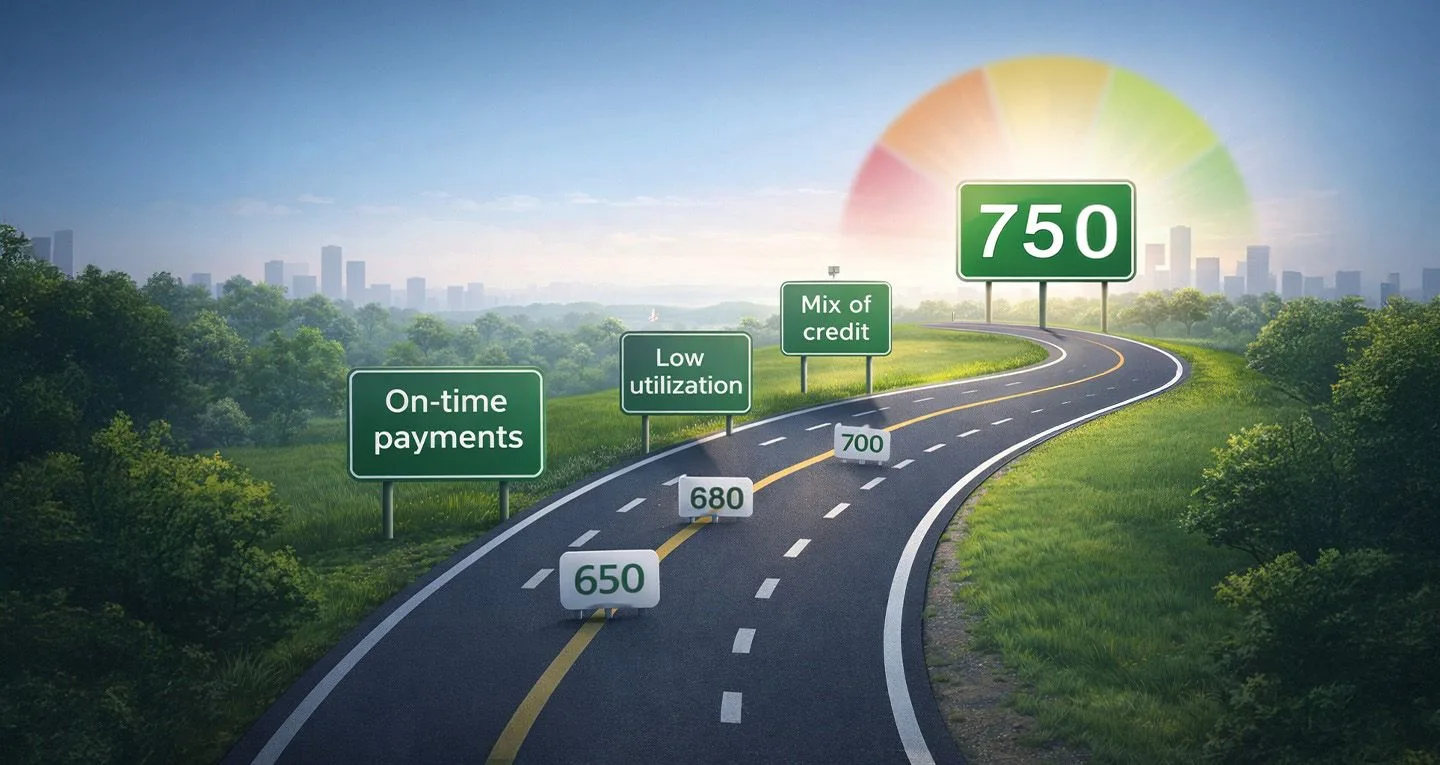
Credit Utilisation Ratio: How Much of Your Limit You Should Use
Credit utilisation ratio is your outstanding credit card balance divided by your total credit limit, shown as a percentage. Keeping it below 30%, ideally 10-20%, signals responsible credit use to lenders and protects your CIBIL score.

Mohit Juneja
Reviewed by FREED India, Debt Resolution Specialists
 4.7/5
4.7/5 ₹3,200Cr+
 20,000+
 20,00,000+4.7/5₹3,200Cr+20,000+20,00,000+
KEY TAKEAWAYS

Credit utilization ratio = outstanding balance ÷ total credit limit × 100
Ideal range: below 30%, with 10-20% considered the sweet spot for CIBIL
Credit utilisation can influence your CIBIL score, although the exact weight is not publicly disclosed.
Credit utilisation can influence your CIBIL score, although the exact weight is not publicly disclosed.
0% utilisation isn't ideal either; it gives lenders nothing to judge your credit behaviour on
What Is Credit Utilisation Ratio?
The formula is simple: outstanding balance divided by total credit limit, multiplied by 100. No hidden variables, no adjustment for how long you've had the card, no weighting for what you actually bought with it. Just balance against limit, expressed as a single percentage.
Say your credit limit is ₹1,00,000, and your current outstanding balance sits at ₹30,000. Divide the balance by the limit, ₹30,000 ÷ ₹1,00,000, and you get 0.30. Multiply by 100, and your utilisation ratio is 30%. That's the number bureaus and lenders actually look at, not what you spent last month, not your total credit line across every product you hold, just this one ratio between what you owe right now and what you're allowed to owe at this exact moment.
This applies specifically to revolving credit, credit cards and credit lines you can draw on repeatedly, not to term loans like a personal loan or a car loan, which carry a fixed EMI and a fixed schedule instead of a fluctuating limit that resets as you repay. It's also calculated in two distinct ways, once across every card you hold combined into a single blended figure, and once for each card entirely on its own, which matters more than most people realise and gets its own detailed section further down this page.
Worth being precise about the terminology here too, since CIBIL score and credit score often get used interchangeably even though the distinction between the two actually matters when you're reading a lender's rejection reason or comparing numbers across different apps that each pull from different bureaus.

See Where Your Utilisation Stands
Quick check against your actual limit and balance.
Check My UtilisationWhy Credit Utilisation Ratio Matters for Your CIBIL Score
Utilisation measures something payment history doesn't, and that distinction is easy to miss if you've only ever been told to "pay on time and you'll be fine." Payment history tells a lender whether you clear your bills on schedule. Utilisation tells them something else entirely: how reliant you already are on borrowed money right now, today, independent of whether every single bill has been settled without a day's delay.
That distinction is the whole reason this ratio carries real weight in how your score gets built. It makes up roughly 25-30% of your CIBIL score, second only to payment history itself, which sits at the very top of every scoring model used across Indian bureaus. A high ratio reads as "credit hungry" to a lender even when your payment record is completely spotless, because it points to finances that are already stretched thin before a single late payment has even had the chance to happen. Someone using 85% of their limit every month, on time, every time, without exception, still looks riskier on paper than someone using 15%, because the first person has almost nowhere left to absorb an unexpected expense, a medical bill, a sudden repair, without borrowing even more on top of what's already committed.
This isn't a crisis-stage warning, and it's worth being clear about that. Most people checking their utilisation ratio right now are doing exactly the right thing at exactly the right time, well before it becomes an actual problem, not scrambling to fix it after a rejection has already landed. Understanding where your score actually sits within CIBIL's overall range bands helps put a specific utilisation number into real context, since a 30% ratio matters differently for someone already sitting at 780 versus someone hovering closer to 650. So the real question worth answering next is the practical one: how much of your limit should you actually be using, day to day, not just in theory.
How Much of Your Credit Limit Should You Use?
Goal | Utilization Range |
General healthy use | 10-30% |
Optimising your score before a big loan | Under 10% |
Red-flag zone, needs attention | Above 30% |
Danger zone | Above 50% |
For everyday use, staying under 30% keeps you in reasonably healthy territory without requiring you to think about it constantly. If you're actively trying to push your score up ahead of something specific, a home loan application, a car loan, anything where every additional point genuinely matters to the rate you're offered, tightening that further to under 10% gives you the best realistic shot at showing up favourably in a lender's internal assessment. And 0% isn't actually the goal either, despite how that might sound intuitively. A card that's never used gives bureaus nothing at all to judge your credit behaviour on, no signal of responsible repayment, no evidence you can be trusted with revolving credit, and some visible, moderate usage genuinely helps more than a card sitting completely untouched in a drawer.
A rule of thumb you can act on immediately, today, without waiting for anything: if your limit is ₹1 lakh, keep your balance under ₹30,000 for general healthy use, and under ₹10,000-₹20,000 specifically if you're trying to raise your score before a big loan application coming up in the near future. If your card limit is different, the same percentages scale directly; the ₹ figures change; the underlying math stays identical.

Per-Card vs Overall Utilisation: Why Both Matter
This is the part most explainers skip past entirely, and it's the part that actually changes what you should do about your own specific cards, not just your overall number.
Say you hold two cards, each with a ₹50,000 limit, ₹1,00,000 combined between them. Card one carries a ₹5,000 balance, a 10% individual ratio, comfortably healthy on its own. Card two carries a ₹40,000 balance, an 80% individual ratio, deep into danger-zone territory by itself. Blend them together, and your overall utilisation looks like a manageable 45%, not great, but not alarming either at first glance. That blended number is hiding something important, though: card two, sitting at 80% on its own, can drag your score down harder than a smooth 45% figure would ever suggest, because bureaus and lenders check both the combined number and each card, not just the average someone might glance at.
A maxed or near-maxed card specifically has an outsized effect on CIBIL, often more than the overall percentage implies, which is why the fix has to work at the individual-card level, not just the combined one. Spread new spending across your cards instead of loading one until it's nearly maxed, and when you do have a balance to pay down, prioritise whichever single card carries the highest individual ratio first, not just whichever balance feels largest in rupee terms. A ₹40,000 balance sitting at 80% utilisation on a smaller-limit card deserves attention before a ₹45,000 balance sitting at only 20% on a card with a much larger limit, even though the second number looks bigger on the statement.
What Raises or Lowers Your Utilisation Ratio
A few things push it up, and a few things bring it back down. Worth knowing both directions plainly, since half the frustration people feel with this ratio comes from not realising which of their own habits are working against them.
What raises it:
- New spending on any card, obviously, but also small recurring charges you've genuinely forgotten about; subscriptions and auto-debits add up faster than they feel like they should over a few months.
- A bill sitting unpaid past the statement generation date, even if you go on to clear it well before the actual due date arrives.
- Closing a card you don't use anymore. This shrinks your total available limit even though your balance elsewhere hasn't changed at all, which pushes the ratio up purely on paper.
What lowers it:
- Paying down your balance before the statement generation date, not just the due date, since The balance reported to the bureau depends on the lender’s reporting date and process.
- Requesting a credit limit increase while keeping your balance flat; this changes the denominator in your favour without requiring you to spend a single rupee less.
- Spreading a large purchase across two cards instead of loading it all onto one at once.
- Keeping unused cards open rather than closing them, for the same reason closing one raises the ratio.
If you're genuinely doing all of this consistently, month after month, and your utilisation still won't come down, the underlying issue may not be spending habits at all. It may be too many EMIs pulling from limited income every month, not a ratio you simply haven't managed carefully enough. Legally reducing pressure on an existing personal loan EMI is worth understanding as a separate lever here, since freeing up monthly cash flow elsewhere often does more for your utilisation than any card-specific trick.
Freed Expert Tip
Pay down your balance before the statement generation date, not just before the due date. That's the number reported to bureaus.
Understand exactly what counts as your outstanding balance
What Are Your Options if Utilisation Stays High
Work through this in order, since the right fix depends entirely on what's actually driving the number in your specific case, not on a generic checklist.
First, the fixes already covered above. Paying down before the statement date, spreading spending across cards, requesting a limit increase while keeping balances flat. For most people, this genuinely is enough, and it usually shows visible results within a few billing cycles once it's applied consistently rather than as a one-time fix.
Second, if the real issue is multiple cards and loans eating into limited income, not spending habits themselves, that's a fundamentally different problem than utilisation on its own, and it needs a different kind of fix entirely. This is where FREED's Debt Consolidation Program applies. One lower EMI replaces several separate balances, which lowers utilisation by actually clearing the underlying debt rather than just reshuffling which card happens to carry it this month. If persistent high balances have already started dragging your score down more broadly, understanding what specifically causes a bad CIBIL score and how to reverse it is worth reading alongside this, since utilisation is rarely the only factor at play by the time it's become a stubborn problem.
Third, and only for genuine inability to repay, not high utilisation by itself, settlement exists as a last resort. It's not a first response to a stretched utilisation ratio, and it's not presented here as equal to consolidation in any way; it's a separate path built for a genuinely different situation than the one most readers checking their utilisation ratio are actually in.
Are You in a Loan Trap? Quick Check
Move the slider to your total EMIs as a % of monthly salary. See your debt stress level instantly.
EMIs as % of Monthly Salary
How FREED Helps
If your utilisation is high because of spending habits alone, the fixes already covered above are genuinely enough for most readers here; no need to look any further than that for now.
But if the real picture underneath is several cards and loans pulling from the same limited income every single month, no amount of statement-date discipline fixes that on its own, no matter how carefully you time your payments. FREED’s Debt Consolidation Program can assess whether you may qualify to combine eligible debts into one loan. FREED may connect eligible applicants with a lending partner, which independently decides the approval, loan amount, interest rate, tenure and EMI. If approved, consolidation may make repayments easier to manage. However, a lower EMI or improvement in your credit score is not guaranteed.” FREED's fee here is success-based, charged only once the consolidation actually goes through; nothing upfront if it doesn't.
For readers facing genuine inability to repay rather than a stretched utilisation ratio, settlement remains a separate last-resort path, not something explored further here.
FREED has counselled over 20,00,000 customers, settled more than 20,000 accounts, and managed over ₹3,200 Cr in debt to date.

Tips to Keep Your Utilisation Ratio Healthy
A few habits, all of them easy to build once you actually know what's being measured and when.
- Pay down your balance before the statement generation date, not just before the due date. The statement date is what gets reported to bureaus, clearing your dues after that date but before the due date still shows a high balance on your report for that entire cycle.
- Don't close old cards you don't use anymore. Closing one shrinks your total available limit, which can push your ratio up even if your actual spending hasn't changed at all.
- Spread a large purchase across two cards rather than maxing out one. This keeps every individual card's ratio in healthier territory instead of spiking one of them into red-flag range.
- Recheck your utilisation roughly once a month. Bureaus refresh reported data approximately every 15 days under current RBI guidelines, so your number moves faster than the old monthly cycle used to allow for, and checking regularly means you catch a creeping balance before it becomes a habit.
- If your minimum due keeps climbing even while you're "managing" it, it's worth understanding exactly how the minimum due amount is calculated, since paying only the minimum every month is one of the quietest ways a utilisation ratio creeps upward without feeling like a decision at all.

What the Law Says
Under current RBI guidelines, credit bureaus must refresh reported data roughly every 15 days, so a pay-down shows up in your score faster than under the older monthly reporting cycle.
See exactly how this reporting cycle affects your scoreUtilization Ratio Bands and What They Signal
Utilization Range | What It Signals | Best For |
0% | No usage data for bureaus to judge | Not ideal, avoid |
1-10% | Best-case, active but light use | Pre-loan score optimisation |
10-30% | Healthy, normal responsible use | Most cardholders day to day |
30-50% | Red-flag zone, may drag score | Needs attention, pay down |
50%+ | Danger zone, reads as credit-hungry | Immediate pay-down or review |
Note: Ranges are market convention used across bureaus and lenders, not a CIBIL-issued hard rule.
Rates and ranges shown are indicative. Final terms are decided by the bank. FREED is not a Loan Provider. No outcome is guaranteed. Please verify directly with your bank.
Sources
Claim in Blog | Source |
|---|---|
Credit bureaus refresh reported data roughly every 15 days (fortnightly), not the older monthly cycle | RBI/2024-25/60, DoR.FIN.REC.No.32/20.16.056/2024-25, Aug 8, 2024, effective Jan 1, 2025 rbi.org.in link |

Mohit Juneja
Mohit Juneja writes educational content at FREED on debt management, credit scores, loan repayment, and borrowing best practices. His content is shaped by expert insights and industry knowledge, helping readers better understand their financial options and make informed decisions.
mohit.juneja@freed.care

FREED is India's trusted loan management platform. Founded in 2020 and headquartered in Gurugram, FREED has counselled 20 lakh+ people on personal loans, credit cards, and app loans. FREED charges fees only on successful settlement, not upfront. FREED does not handle secured loans (home loans, car loans, gold loans).
Media Mentions