Bad CIBIL Score: Causes and How to Fix It
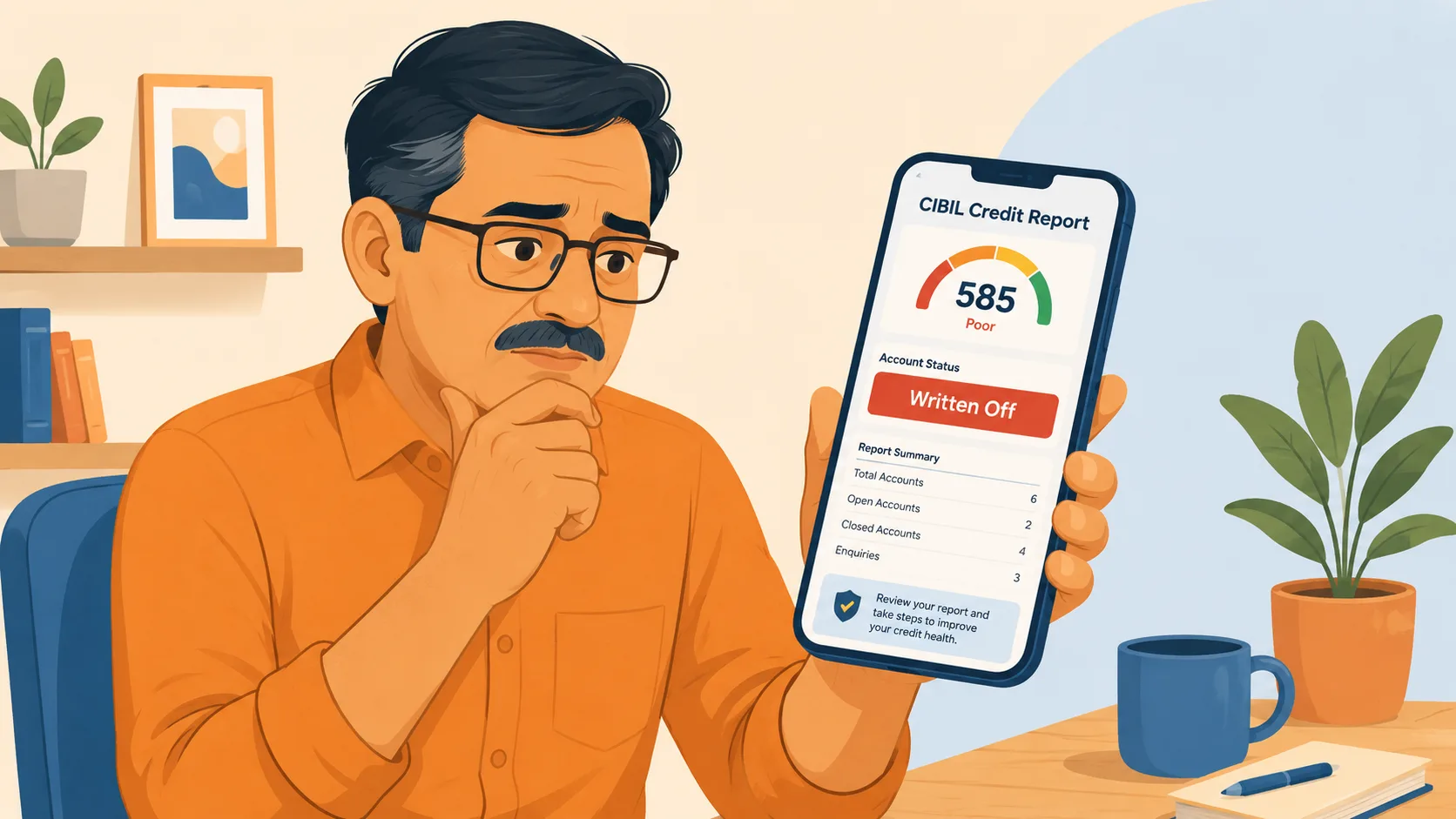
A bad CIBIL score is generally any score below 650 on the 300–900 scale, most often caused by missed EMIs, high credit card usage, loan defaults, or errors in your credit report. It can be fixed. The right approach depends on whether you're still able to pay or genuinely cannot.
Mohit Juneja
Reviewed by FREED India, Debt Resolution Specialists
 4.7/5
4.7/5 ₹3,200Cr+
 20,000+
 20,00,000+4.7/5₹3,200Cr+20,000+20,00,000+
KEY TAKEAWAYS

A bad CIBIL score falls below 650, with anything under 550 considered very poor.
Payment history is widely considered one of the most important factors influencing your credit score.
Credit utilisation above 30% of your limit is one of the most common causes.
What Counts as a Bad CIBIL Score in India?
Band | Score Range |
Very Poor | 300–549 |
Poor | 550–649 |
Average | 650–699 |
Good | 700–749 |
Excellent | 750–900 |
Anything below 650 is generally treated as a bad score. Below 550 is often labelled very poor, and at this level, most bank systems reject an application automatically, before it even reaches a human. Some NBFCs still approve credit from around 650, but at meaningfully higher interest rates, commonly in the 18 to 24% per annum range, to offset the risk they're taking on.
Two very different situations can land you in this same range. One is a temporary rough patch: a few missed EMIs, a credit card balance that kept rolling, an error sitting quietly on your report. The other is a genuine default, where a loan has gone unpaid long enough to be marked as bad by the bank. Both show up as a bad score, but the right way to fix each one is completely different, and that difference matters more than the number itself.
Are You in a Loan Trap? Quick Check
Move the slider to your total EMIs as a % of monthly salary. See your debt stress level instantly.
EMIs as % of Monthly Salary
What Causes a Bad CIBIL Score?
- Missed or late EMI and credit card payments. This is the single biggest factor behind most bad scores. Even one or two slips over a few months, if they keep recurring, start pulling the number down steadily.
- Credit utilisation consistently above 30% of your limit. Using more of your available credit than that signals to the bureau that you may be stretched, even if you're paying every bill in full.
- Multiple hard enquiries in a short window. Multiple hard enquiries within a short period may negatively influence your credit profile.
- A loan default or write-off after sustained non-payment. Once an account crosses 90 days of missed payments, it's classified as an NPA (loan marked as bad by the bank), and the damage here is far more severe than a single late payment.
- Errors in your credit report. A wrongly reported DPD (Days Past Due), a duplicate account, or a loan that isn't even yours can quietly hold your score down for reasons that have nothing to do with your real repayment behaviour.
- A very short or non-existent credit history. The bureau simply doesn't have enough data yet to score you confidently, which can look similar to a low score even though nothing has actually gone wrong.
Some of these causes are habit-driven and fixable in a few months. Others point to a genuine default that needs a structured resolution. Working out which of these actually applies to you is the real first step, and the fastest way to do that is to look at your own report directly.
How Much Does a Default or Write-Off Hurt Your Score?
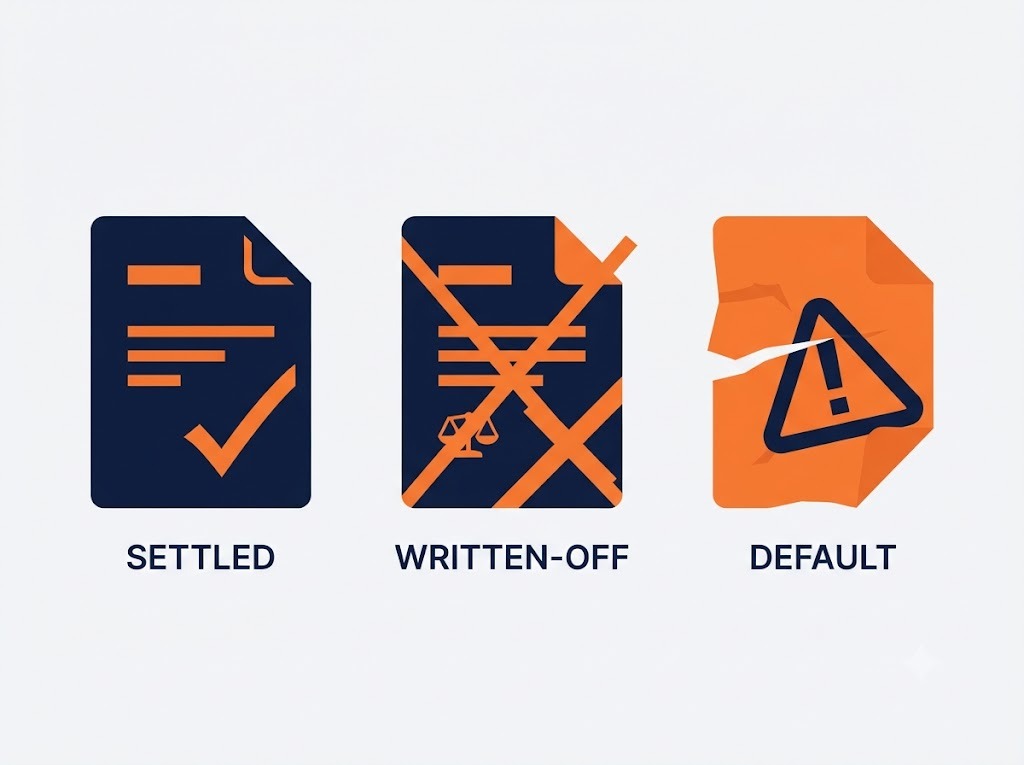
Status | What It Means | Typical Score Impact | How Long Does It Stay |
SUB (Sub-Standard) | 90 days to 12 months overdue | 100–250 points | Until resolved |
Written Off | The bank has given up collecting after sustained non-payment, typically 180+ days | 100–150 points | Up to 7 years |
Settled | Paid via a negotiated reduced amount, not the full sum owed | 75–100 points | Up to 7 years |
The gap between "Written Off" and "Settled" is worth understanding, because future lenders read them differently. A written-off account signals the bank simply stopped pursuing the debt, with no resolution on record. A settled account, while it still lowers your score and leaves a "Settled" mark for up to 7 years, at least shows the account reached a closed, negotiated outcome. Lenders reviewing an application later tend to view a settled account somewhat less harshly than one that was written off and left unresolved.
None of these statuses can be removed early just by asking. The only route to correcting an entry ahead of schedule is if it's genuinely wrong, a payment misreported, an account that isn't yours, in which case a dispute with the bureau is the right move, not a request to the bank for early removal.

What the Law Says
Under the Credit Information Companies (Regulation) Act, 2005, lenders must update your credit bureau record within a set window of any change in your loan status.
How to Check Your Correct CIBIL Score & Dispute ErrorsHow to Check What's Actually Hurting Your Score

Freed Expert Tip
Checking your own CIBIL report never lowers your score. Do it every few months, not just before a loan application.
Check your reportWhat Are Your Options to Fix a Bad CIBIL Score
Whatever caused your score to drop, a few habit fixes come first for everyone. Pay every EMI and bill on time from here on, bring your utilisation below 30% of your limit, stop applying for new credit for a while, and dispute any errors you found in the previous step. These four alone move most temporary dips in the right direction over a few months.
Beyond that, the right next step depends on which situation you're actually in.
If you're still current on your payments but juggling multiple EMIs across different loans and cards, and the real strain is the combined monthly outgo rather than any single bad account, a balance transfer can help if your profile still qualifies for a lower rate on one loan. For many people in this position, FREED's Loan Consolidation Plan may be an option, depending on their financial situation and the lending partner's assessment. If eligible, a consolidation loan may help combine eligible unsecured debts into a single repayment plan. Final loan terms, including the EMI, depend on the lending partner's assessment.
If you've already defaulted and genuinely cannot repay in full, no matter how you rearrange your budget, loan settlement is the path that exists for that specific situation. Banks only consider settlement when repaying in full has become genuinely impossible, not as a shortcut or a smart move for someone who could still manage another way. Loan settlement may affect your credit profile. FREED may support eligible borrowers through a structured loan settlement process, subject to the lender's willingness to negotiate. Any settlement outcome depends on the lender's decision.
Consolidation and settlement are not interchangeable, and they are not both right for the same person. One is for people still paying and need a smarter structure. The other is for people who genuinely cannot pay at all.
Rates and ranges shown are indicative. Final terms are decided by the bank. FREED is not a Loan Provider. No outcome is guaranteed. Please verify directly with your bank.

See Which Path Fits Your Situation
Free assessment, consolidation or settlement, no pressure.
Start My Free Debt AssessmentHow FREED Helps
FREED works with two different programs, and which one fits you depends entirely on whether you're still paying or genuinely cannot.
If you're still paying, but stretched thin: FREED's Loan Consolidation Plan (also known as "Reduce My EMI") assesses your full financial profile, matches you to a suitable lending partner from its network, and manages the entire process end to end. If approved by the lending partner, a consolidation loan may help combine eligible debts into a single repayment plan. Final loan terms, including the EMI, depend on the lending partner's assessment.
If you've already defaulted and cannot repay in full, FREED's Loan Settlement Plan ("Settle My Loans") works with your bank to close the loan for a reduced, one-time amount instead of the full outstanding balance — so you're not stuck under debt you genuinely can't repay. You stay in control throughout: your savings toward the settlement sit in your own account with an independent trustee, not with FREED, and nothing gets paid out to a lender without your sign-off. FREED handles the negotiation and paperwork, and follows the case through until it's correctly reported to the credit bureau.
FREED doesn't rebuild your CIBIL score for you directly. What it does is help you see exactly what's dragging your score down and guide you to the right resolution path for your situation — you can check where you currently stand with FREED's

Tips to Prevent Your Score From Dropping Further
- Automate every EMI and bill payment. A missed payment is rarely intentional; it's usually a forgotten due date, and autopay removes that risk entirely.
- Keep utilisation under 30%, ideally. Maintaining healthy repayment habits consistently helps strengthen your overall credit profile over time.
- Do not close old accounts that are in good standing. Credit history length matters, and an old account quietly working in your favour is worth keeping open.
- Space out new credit applications. Each rejection creates a hard enquiry, and hard enquiries stacking up in a short window compound whatever problem you're already trying to fix.
- Recheck your report every few months once you've made changes. Bureaus typically refresh your data every 30 to 45 days, so give the changes time to actually show up before assuming nothing is working.
A realistic recovery timeline runs anywhere from 6 to 18 months, depending on what caused the drop in the first place. A bad score is a starting point, not a life sentence, and the fix looks different for everyone depending on where they actually stand.
Sources
Confirmed. Claim to source table, no em dashes:
Claim in Article | Source |
|---|---|
Bad CIBIL score generally means below 650, very poor below 550 | Industry-convention band framing, consistent across bureau/lender explainer sources used throughout this project, no single official bureau publication, article's own DATA FLAG already covers this |
Full band table: Very Poor 300 to 549, Poor 550 to 649, Average 650 to 699, Good 700 to 749, Excellent 750 to 900 | Same industry-consensus classification used across earlier articles in this set, no single primary source, cutoffs vary slightly by bureau/lender |
Some NBFCs approve credit from around 650, rates commonly 18 to 24% p.a. | this doesn't match current advertised prime NBFC rates (10 to 13% p.a. for Bajaj Finance, Tata Capital per creditmitra.in, paisabazaar.com/bajaj-finserv). Worth checking whether this range applies specifically to weaker-profile NBFC lending, not standard NBFC pricing. |
Payment history is one of the most important factors in score calculation | Consistent across all bureau methodology sources reviewed throughout this project |
Credit utilisation above 30% is a common cause of a bad score | General financial-planning guidance, widely repeated, not a hard regulatory figure |
Multiple hard enquiries in a short window can negatively affect score | Standard bureau-wide fact, consistent across all prior sourcing in this project |
Account crosses 90 days overdue, classified as NPA | groww.in/p/non-performing-assets; hdbfs.com/customer-services/npa-classification-norms |
Written-off status stays on report up to 7 years from date of reporting, even after settling | airtel.in/blog/personal-loan/decoding-the-written-off-status-in-your-cibil-report; freed.care/blog/how-long-does-cibil-keep-defaulter-records; freed.care/blog/what-is-written-off-in-cibil |
Settled status also stays up to 7 years | moneyview.in/cibil-score/how-to-remove-write-off-from-cibil; freed.care/blog/how-long-does-cibil-keep-defaulter-records |
Settled account is generally viewed less harshly by future lenders than a written-off one | freed.care/blog/how-long-does-cibil-keep-defaulter-records ("Settled" hurts less than "written-off," same 7-year window) |
Genuine errors can be disputed with the bureau rather than requesting early removal from the bank | Standard bureau dispute process, consistent across all prior sourcing (CIBIL, RBI compensation framework) |
Lenders must update your bureau record within a set window of a status change (CICRA 2005) | Related but not identical figure found: RBI circular RBI/2023-24/72 sets a 21-day window for the lender (CI) to send corrected data after a dispute, not a general "any change in loan status" window. The broader lender-to-bureau reporting cadence itself is now roughly weekly per the amended Credit Information Reporting Directions (effective July 1, 2026). Worth clarifying which specific obligation this sentence is referring to before publishing. |
Disputes typically resolved within roughly 30 days under RBI rules | RBI circular RBI/2023-24/72, DoR.FIN.REC.48/20.16.003/2023-24, confirmed via cibil.com/framework-for-compensation, righttoinformation.wiki/cibil-score-dispute-correction-2026 |
Bureaus typically refresh data every 30 to 45 days | Outdated. Current sourced data shows reporting has moved to fortnightly and now weekly (effective July 1, 2026, per business-standard.com/amp/finance/news/rbi-extends-credit-information-reporting-norms-july-1-2026). The 30 to 45 day figure reflects the old pre-2025 cycle. Worth updating this line to match the rest of your content set, which already gets this right elsewhere. |
FREED finds a reporting error in roughly 4 out of every 10 customer reports checked | Internal FREED data, not externally verified, confirm with internal team before publishing, correctly flagged already in your draft |
Recovery timeline of 6 to 18 months, depending on cause | Not independently sourced this session, general industry framing, no single primary citation, correctly flagged already in your draft |
Soft enquiry (self-check) never lowers score, only hard enquiry does | Standard bureau-wide fact, consistent across all prior sourcing in this project |

Mohit Juneja
Mohit Juneja writes educational content at FREED on debt management, credit scores, loan repayment, and borrowing best practices. His content is shaped by expert insights and industry knowledge, helping readers better understand their financial options and make informed decisions.
mohit.juneja@freed.care

FREED is India's trusted loan management platform. Founded in 2020 and headquartered in Gurugram, FREED has counselled 20 lakh+ people on personal loans, credit cards, and app loans. FREED charges fees only on successful settlement, not upfront. FREED does not handle secured loans (home loans, car loans, gold loans).
Media Mentions