How to Settle a Personal Loan When You Have More Than One
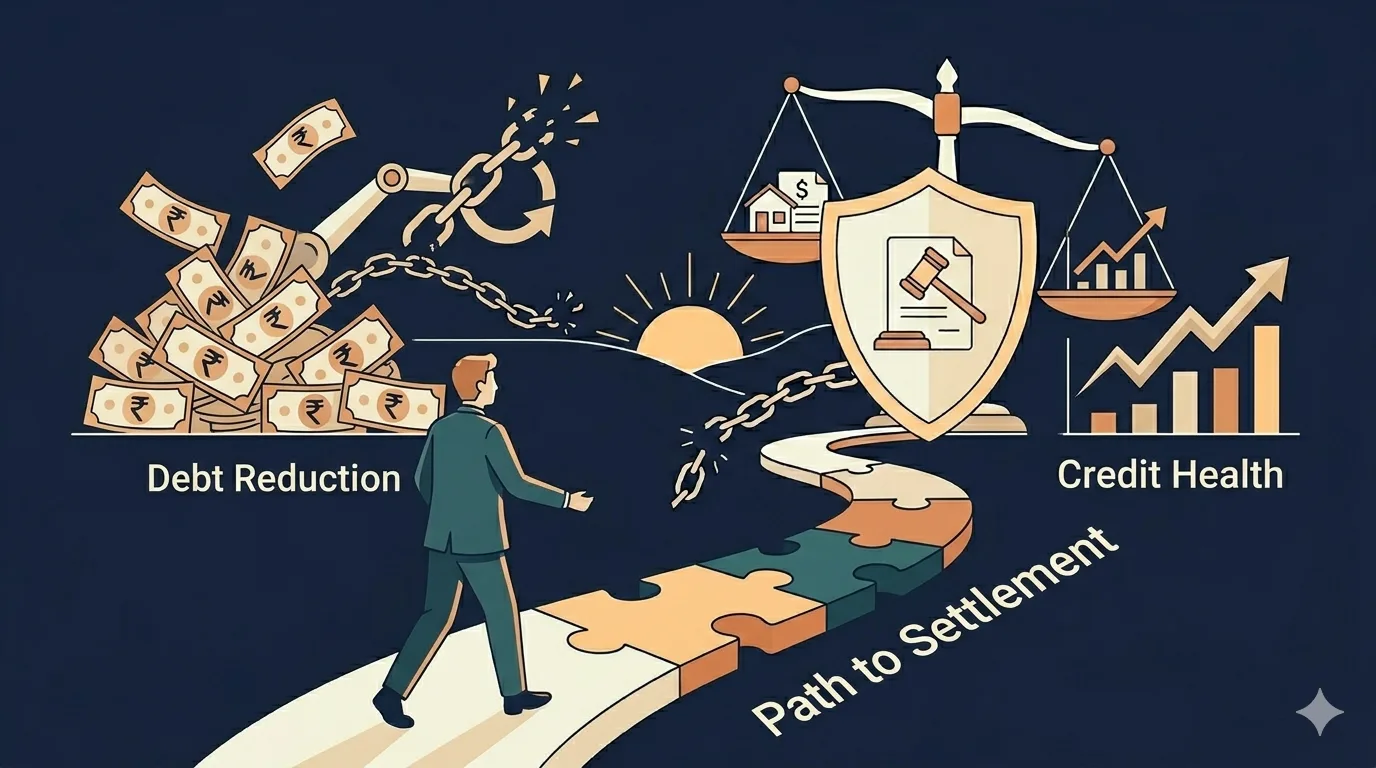
To settle a personal loan, you negotiate with your bank or NBFC to accept a reduced lump sum as full and final payment instead of the full outstanding amount. When you have more than one personal loan, this same process repeats separately for each one, in an order that protects you the most.

Mohit Juneja
Reviewed by FREED India, Debt Resolution Specialists
 4.7/5
4.7/5 ₹3,200Cr+
 20,000+
 20,00,000+4.7/5₹3,200Cr+20,000+20,00,000+
Key Summary

Learning how to settle a personal loan starts with one lender at a time, even when you owe several.
Settlement is only for borrowers genuinely unable to repay in full, banks do not offer it out of preference.
If a cheque issued toward a legally enforceable debt is dishonoured, Section 138 of the Negotiable Instruments Act may apply if the statutory conditions and notice requirements are satisfied. The provision carries a maximum punishment of two years' imprisonment, a fine up to twice the cheque amount, or both.
The order you settle in changes how much damage builds up while you wait.
Every settlement needs a signed letter before any payment, regardless of how many loans you're closing.
What It Actually Means to Settle a Personal Loan
Settlement is not something a borrower chooses out of preference. It becomes relevant only once repaying in full has become genuinely difficult, not because a reduced payment sounds like an easier or faster way out of an otherwise manageable loan.
At its core, settlement is a negotiated reduced payment, not a waiver of the full debt. Your bank or NBFC agrees to accept a specific lump sum, less than what you actually owe, as full and final closure of the account. Worth being precise about one thing here: once this happens, the loan gets marked "Settled" with the credit bureau afterward, not "Closed." That distinction genuinely matters to future lenders, "Closed" signals a loan repaid in full on its original terms, while "Settled" signals the bank accepted less than what was owed, and that difference shapes how the account reads on your file for years afterward.
Here's what's worth understanding upfront if you're carrying more than one personal loan: the process itself doesn't change based on how many loans you have. Each negotiation, each hardship letter, each settlement offer, follows the same fundamental mechanics whether it's your only loan or the third of five you're working through. What genuinely changes with multiple loans isn't the process, it's the planning around it, specifically the order you tackle them in, and how you fund each negotiation as you move through your list.
Why the Order You Settle in Matters When You Have Multiple Loans
Settling the highest-risk loan first, not the largest one and not the smallest one, is what actually limits how much extra damage accumulates while your other accounts sit and wait their turn.
Accounts closer to default, or already escalated to a formal legal notice, compound faster in real consequences. Every additional week an already-severe account sits untouched brings it further collection or legal escalation, formal legal proceedings, or handover to an external recovery agency, stages that are considerably harder to walk back from once triggered. Accounts still in early delinquency, by contrast, genuinely have more room. For many regulated lending accounts, 90 days past due is an important NPA classification threshold. However, it is not a universal settlement trigger. Whether a lender considers settlement depends on its own policies, the borrower's circumstances and the stage of the account.
A worked example makes this concrete. Say you're carrying two personal loans, one for ₹90,000, 45 days overdue, and another for ₹1,50,000, 150 days overdue. A write-off is an accounting treatment and does not by itself mean that the borrower no longer owes the debt. The ₹90,000 loan, still relatively early in its delinquency, has genuine room to wait a few additional months without the same escalating risk attached to it. This isn't about deliberately delaying either account, it's about recognising which one is actually running out of runway faster and directing your limited resources there first.
How to Settle a Personal Loan, Step by Step
Step 1: Confirm you are genuinely unable to repay in full.
Look honestly at your income, your expenses, and what's actually left over each month. Settlement is for real hardship, not a shortcut around a loan that's simply inconvenient but still genuinely manageable.
Step 2: Know exactly what you owe.
Ask your bank for a full statement. Write down what you originally borrowed, what interest has accrued since, and what late fees are currently showing, separately for each loan if you're carrying more than one.
Step 3: Work out what you can realistically pay as a lump sum.
Add up any savings, any help available from family, or funds you can realistically set aside monthly toward one specific account. This number sets the honest ceiling for what you can offer, not an optimistic guess.
Step 4: Contact the lender and explain your situation.
Ask the lender for the appropriate authorised team or channel that handles settlement requests. State your hardship plainly and propose a lump sum you can genuinely afford to pay.
Step 5: Negotiate the amount and get it in writing.
The lender may propose an amount that is different from what you can afford. Explain your financial position clearly and negotiate only within an amount you can realistically pay.
FREED's counsellors handle this negotiation and the accompanying paperwork with each bank or NBFC on the customer's behalf, once savings in the SPA (Systematic Payment Approach) are sufficient to begin.
Step 6: Pay and collect your closure document. Pay exactly what the letter states, through a traceable method like a bank transfer. Get a No Dues Certificate or settlement confirmation afterward, this is your proof the account is genuinely resolved.
Step 7: If you have more loans, repeat with the next highest-risk account. Move to the next lender on your list using these same steps, funded by whatever capacity frees up once the first settlement is complete.
What to Do Before You Even Reach Settlement
Settlement sits at the end of a ladder, and it's worth working through the earlier rungs honestly before assuming it's the right move for every loan on your list.
If you are still current and qualify, refinancing or a balance transfer may reduce the cost of borrowing. If multiple repayments are becoming difficult but full repayment remains realistic, consolidation may be worth exploring. If full repayment is no longer realistically affordable, settlement may be considered.
Debt consolidation comes next. FREED's Debt Consolidation Program merges eligible unsecured loans into a single, lower monthly EMI, built for borrowers still paying but genuinely stretched thin across multiple accounts. Consolidation can simplify multiple repayments for eligible borrowers, but no specific CIBIL outcome is guaranteed. Its effect depends on how the existing accounts and new facility are reported and on subsequent repayment behaviour.
Settlement only enters the picture once repaying in full is genuinely not possible, not as an earlier option skipped past because it feels more direct.
It's worth stating this plainly: settlement and consolidation solve genuinely different problems for genuinely different borrowers. They address different financial situations and should not be treated as interchangeable solutions.
Comparison Table: Balance Transfer vs Debt Consolidation vs Loan Settlement
Option | Who It's For | CIBIL Impact | What Happens |
Balance Transfer | Still paying, workable credit score | No negative impact | One loan moves to a lender with a lower rate |
Debt Consolidation | Still paying, over-leveraged across loans | Score improves | New loan pays off all eligible existing loans, one lower EMI |
Loan Settlement | Genuinely unable to repay in full | Score drops, "Settled" mark up to 7 years | Bank accepts a reduced lump sum as full and final payment |
Rates and ranges shown are indicative. Final terms decided by the bank. FREED is not a Loan Provider. No outcome is guaranteed. Please verify directly with your bank.
How FREED Helps When You Are Settling More Than One Personal Loan
FREED's Loan Settlement Plan, also known as the Debt Resolution Program or "Settle My Loans," is built for exactly this situation, more than one personal loan, each needing its own carefully sequenced negotiation.
The mechanism is a fixed monthly savings plan, an SPA, held in an independently managed account. FREED negotiates with each lender only once the corpus built up is sufficient to fund a credible offer, and you authorise every single settlement before any payout happens, nothing moves without your explicit sign-off at each step.
Worth being upfront: this takes real time, especially with more than one loan involved, since the same fund has to stretch across several sequential negotiations rather than being deployed against every account at once. FREED isn't working from some insider knowledge that banks don't otherwise share, it's doing the prioritisation and negotiation legwork on your behalf, following the same risk-based ranking covered throughout this article.
FREED has settled 20,000+ accounts and managed ₹3,200 Cr+ in debt. The fee is success-based, applying only once a settlement actually completes.
What Happens to Your Credit Score After Settling?
A loan reported as "Settled" can negatively affect your credit profile because it indicates that the lender accepted less than the full amount originally owed. The effect varies from borrower to borrower and depends on factors including your existing credit history and how other accounts are managed afterward.
If you settle multiple loans, each account may be reported separately, so your credit profile can reflect multiple settled accounts. There is no fixed number of points your score will fall or a guaranteed timeline for recovery.
Over time, responsible credit behaviour, including making payments on active accounts on time and managing new borrowing carefully, can support your credit profile.
Both continued defaults and settlement can have serious credit consequences. Settlement should therefore be considered only after assessing whether full repayment or another restructuring option is realistically possible. Sitting on unresolved defaults isn't a way to protect your score, it tends to compound the damage rather than avoid it. There is no fixed timeline for credit recovery. Consistent, on-time repayment and responsible use of remaining credit can support your credit profile over time.
Because settling multiple loans genuinely happens one at a time, your score may dip more than once, spaced out over several months, rather than absorbing one single hit all at once. A settlement can have a significant negative effect on your credit profile, but the size of the impact varies by individual credit history and the accounts involved.
Source
Claim | Source |
A bounced cheque given toward an EMI can trigger Section 138 of the Negotiable Instruments Act, a criminal complaint punishable with imprisonment up to 2 years, a fine up to twice the cheque amount, or both | Negotiable Instruments Act, 1881, Section 138 |
Banks and NBFCs decide settlement terms individually under RBI's regulatory framework, there is no bureau-mandated priority order across lenders | RBI/2023-24/40, DOR.STR.REC.20/21.04.048/2023-24, Framework for Compromise Settlements and Technical Write-offs, June 8, 2023 |
Mohit Juneja
Mohit Juneja writes educational content at FREED on debt management, credit scores, loan repayment, and borrowing best practices. His content is shaped by expert insights and industry knowledge, helping readers better understand their financial options and make informed decisions.
mohit.juneja@freed.care

FREED is India's trusted loan management platform. Founded in 2020 and headquartered in Gurugram, FREED has counselled 20 lakh+ people on personal loans, credit cards, and app loans. FREED charges fees only on successful settlement, not upfront. FREED does not handle secured loans (home loans, car loans, gold loans).
Media Mentions