Debt Settlement Loan: What It Is and When to Consider One
Learn what a debt settlement loan is, how it works, when borrowers may consider one, and what to know before using it to manage or settle debt.

Mohit Juneja
Reviewed by FREED India, Debt Resolution Specialists
 4.7/5
4.7/5 ₹3,200Cr+
 20,000+
 20,00,000+4.7/5₹3,200Cr+20,000+20,00,000+
Key Takeaways

A debt settlement loan most commonly refers to a personal loan used to consolidate multiple debts: 1 EMI, 1 date, 1 amount
Debt consolidation generally requires a relatively healthy credit profile to qualify for competitive rates.
Credit card revolving interest runs 30–44% annually; a personal loan for consolidation typically costs 10–24%, and that interest gap is the saving
Loan settlement may affect future borrowing eligibility and leave a 'Settled' status on the credit report.
Settlement is not something a borrower chooses out of preference; it is an exit for genuine inability to pay, not a shortcut
What Exactly Is a Debt Settlement Loan and Why Does the Name Confuse People?
The phrase "debt settlement loan" means two things. One of them is a real loan. The other isn't a loan at all.
Meaning 1 Debt Consolidation Loan. You take a single personal loan and use it to pay off multiple existing debts, credit cards, personal loans, or BNPL (buy now, pay later) dues all at once. You still owe the full amount. But now it's one EMI, one bank, one monthly date. And if your new interest rate is lower than what you were paying across those separate debts, you also spend less overall. This is what most people searching for "debt settlement loan" are actually looking for.
Meaning 2 Loan Settlement (OTS). This is not a loan. It's a negotiated agreement between you and your bank. The bank agrees to accept a reduced lump-sum amount to resolve an overdue account that has already been classified as an NPA (loan marked as bad by the bank, usually after 90 days of missed EMIs). Your total dues go down. But so does your CIBIL score.
The two meanings attract two different readers. Someone like Priya, still paying her 3 credit cards, barely managing, and wanting one cleaner EMI, is looking for a consolidation loan. Someone like Ramesh, with multiple missed EMIs, recovery calls every day, and no realistic path to paying in full, is looking for loan settlement.
This blog covers both. In that order.
The numbers tell you quickly which category you're in. Credit card revolving interest runs 30–44% annually (verify current ICICI, HDFC rates before publishing). A personal loan for consolidation typically costs 10–24% annually, depending on your CIBIL score and bank. Replace 3 credit cards at 36% interest with one personal loan at 14%, and you've saved 22 percentage points on that entire debt. That saving is real, but only if the new consolidated EMI fits within your monthly budget. If it doesn't, a new loan won't solve anything.
When Does a Personal Loan for Debt Settlement (Consolidation) Make Sense?
This section is for Priya.
She has 2 or 3 high-interest loans or credit card bills. She's still paying, but a large share of her monthly take-home salary. Her CIBIL score is still above 700. She has a stable income. She just wants relief from the complexity and the interest.
A consolidation loan works for her specifically because her problem is the interest rate, not cash flow. She can pay. She just wants to pay less.
The case is clearest when she's replacing credit card debt. Credit cards running at 30–44% annual interest replaced by a personal loan at 14–16% can save ₹30,000–₹35,000 on a ₹2 lakh consolidation over 24 months (source: DMI Finance; writer to verify and recalculate before publishing). That's money she would otherwise have sent to the bank as pure interest charges.
For mainstream banks, you'll generally need a CIBIL score of 700+ to access a competitive unsecured personal loan. Some NBFCs may consider 650+, but at higher rates. Below 650, this option gets harder.
The EMI burden test is simple. Your new consolidated loan EMI must stay below 50% of your monthly take-home income. If it doesn't, consolidation hasn't solved the problem it's just moved it.
Consolidation does NOT work if:
- Your CIBIL has already dropped below 680 due to missed payments
- Your income is irregular, and you're not sure you can commit to a fixed EMI
- The new loan EMI would still be unaffordable at any rate you qualify for
Radical honesty here: taking a new loan to pay off old ones only works if the problem is high interest, not inability to pay. Those are two very different situations.
How Does a Debt Consolidation Loan Work in India: Step by Step?
If you qualify (CIBIL above 700, stable income, and total outstanding manageable as one loan), here's how to use a consolidation loan correctly.
- Calculate total outstanding across all debts. Write down every loan, credit card, personal loan, and BNPL with the outstanding balance, interest rate, and monthly EMI for each.
- Check your CIBIL score for free. Your score is available once a year at cibil.com at no charge (verify current access policy before publishing). Know your number before you approach any bank.
- Compare consolidation loan offers carefully. Key variables: interest rate (annual percentage rate), processing fee (typically 0.5–2% of loan amount), foreclosure charges if you want to repay early, and repayment flexibility. Don't just look at the EMI number; the total cost matters.
- Apply and use disbursed funds immediately to close existing debts. This is the step most people get wrong. The moment the consolidation loan is credited, use it to pay off every debt it was meant to replace. Don't keep the money in your account for even a day. One by one, close each outstanding balance.
- Collect a written closure confirmation from each bank. Request a No Dues Certificate (clearance letter) for every debt you've paid off. These update your CIBIL record to "Closed" status within 30–45 days.
- Set up auto-pay on the new consolidation loan immediately. One missed payment on the new loan undoes months of credit repair. Automate the EMI from day one.
- Keep paid-off credit cards closed or reduce their limits. Once a card is paid off with consolidation funds, don't start spending on it again. The easiest way to undo consolidation progress is to re-accumulate the same balances.

FREED Expert Tip
After using a consolidation loan to pay off credit cards, request a written closure confirmation from each bank. This updates your CIBIL record to "Closed", not just "Settled", and helps ensure the account is accurately reported as closed.
Read more about the loan closure processWhat If Your CIBIL Score Is Too Low to Get a Consolidation Loan?
This is where the options narrow, but they don't disappear.
If your CIBIL is between 650 and 680, some NBFCs and digital banks may still approve you, but at higher interest rates, likely above 24% annually. That rate is still cheaper than the credit card interest running at 30–44%. If the math still works out in your favor, it may be worth considering.
If you own property, a Loan Against Property (LAP) can offer rates as low as 8.5–9.5% annually. This is a powerful consolidation tool for those who have an asset to pledge. One important note: LAP is a secured loan. FREED handles only unsecured loan resolution, personal loans, credit cards, and BNPL. A secured loan like LAP is outside FREED's scope entirely.
If you'd rather not take a new loan at all, a Debt Management Program (DMP) may suit you. Instead of borrowing again, a DMP creates a structured monthly repayment plan negotiated with multiple banks. You pay a single amount each month across all your debts, without adding to your outstanding balance. FREED's Debt Consolidation Program works similarly for eligible borrowers.
If multiple loans are already overdue with no realistic repayment path, you may be in settlement territory. That's the next section.
Credit card and personal loan delinquencies have been rising. TransUnion CIBIL's Credit Market Indicator for Q3 2024 confirmed that defaults increased across consumption-led products including credit cards.

What the Law Says
RBI mandates that all banks must have a board-approved, transparent policy for compromise settlements.Banks cannot settle outside this policy arbitrarily. If you are in genuine financial difficulty, you can formally request the bank to consider a settlement — but approval remains at the bank's discretion.
RBI Circular DOR.STR.REC.20/21.04.048/2023-24, June 8, 2023What Is the Difference Between a Debt Settlement Loan and Actual Loan Settlement?
This is the section most other blogs skip. It matters.
Settlement is not something a borrower chooses out of preference. Banks and financial companies only consider it when you are in genuine financial difficulty and are truly unable to repay the full amount. It is a last resort, not a shortcut.
A consolidation loan reorganises your debt. You still owe every rupee you borrowed. The bank gets paid in full. Your CIBIL record shows the original accounts as "Closed" once paid off, the best possible status. The only short-term CIBIL impact is a minor hard inquiry when the new loan is processed.
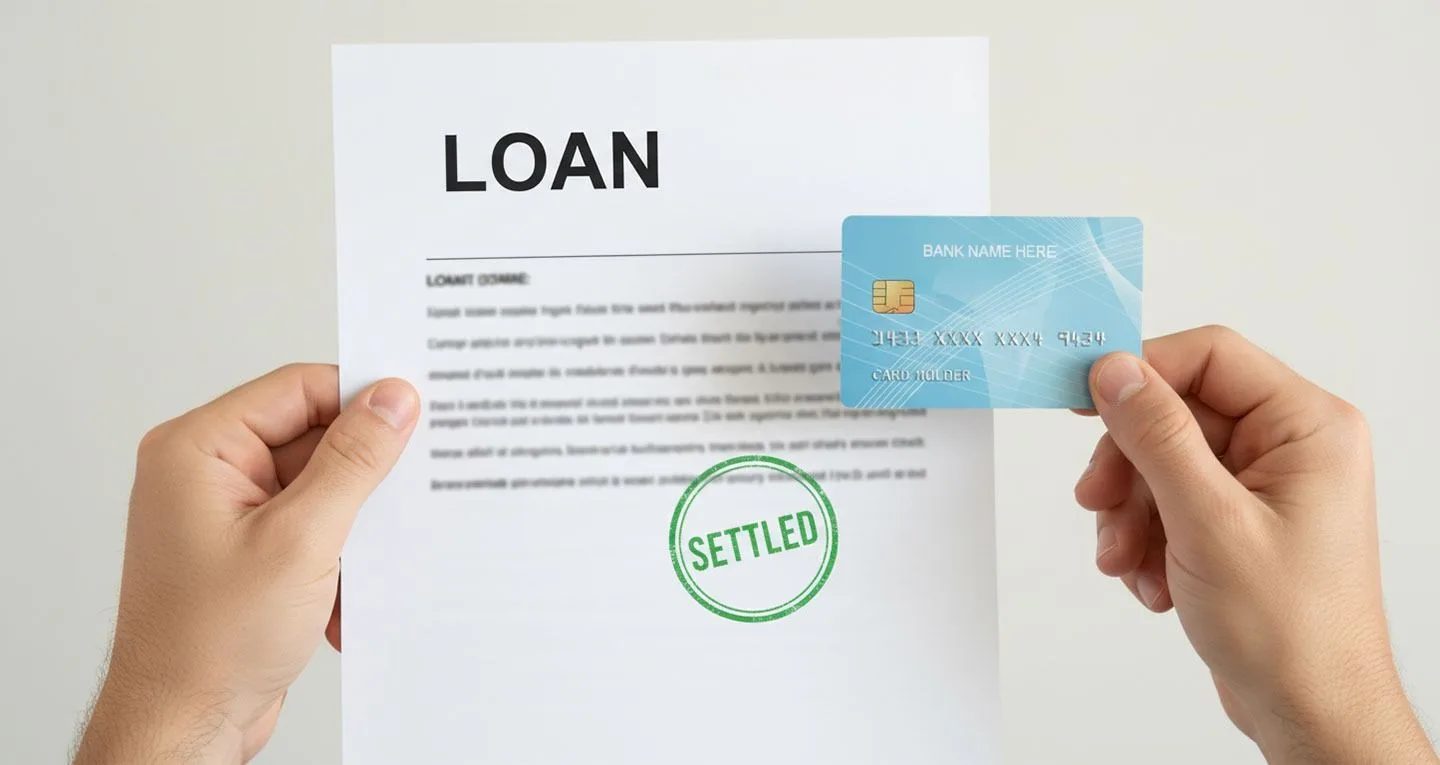
Loan settlement (OTS) resolves your debt for less than what you owe. The bank agrees to accept a reduced amount up to 50%* off your outstanding because the alternative (NPA, write-off, or legal action) is worse for them too. But the cost to you is real. Your CIBIL score drops 75–150 points. Your account is marked "Settled" on your credit report, and that mark stays for up to 7 years.
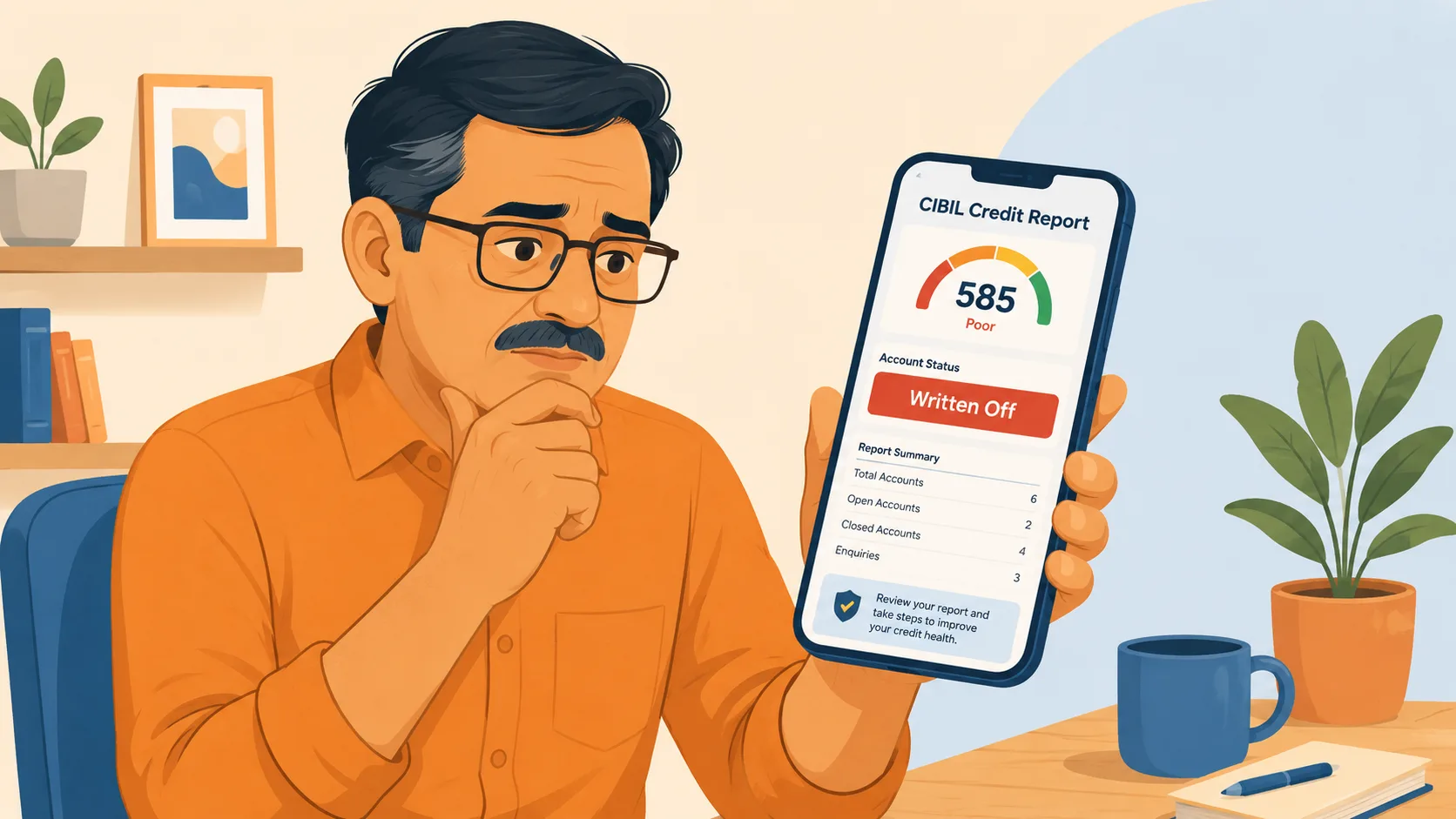
There is a hierarchy on your CIBIL report. Closed is the best outcome. Settled is manageable but carries a cost. "Written Off" is the worst; it signals the bank gave up trying to recover anything. Future banks read these marks before approving any credit.
The decision fork is simple. If you can still service your debt even with strain, consolidation keeps you whole. If you genuinely cannot pay and no income recovery is foreseeable, settlement ends the spiral without adding to it.
EMIs above 50% of take-home income, multiple missed payments, recovery agents calling daily, and no realistic income path forward; those are Ramesh's signs. They don't point toward a new loan. They point toward settlement.
What Are the Signs That You Need Settlement, Not Another Loan?
If the following signs apply to you, another loan will deepen the problem, not solve it. These aren't signs of failure. There are signs that the debt was unsustainable, and the right exit is resolution, not more credit.
- Your total EMIs already exceed 50% of your monthly take-home income. When all your EMIs combined with credit cards, personal loans, and BNPL eat up more than half your salary, the debt is structurally unmanageable. A new loan adds another EMI to a pile that's already too heavy.
- Your CIBIL score has already dropped below 650. Unsecured consolidation loans are essentially unavailable at reasonable rates at this level. Seeking a new loan here adds interest cost without solving the underlying repayment problem.
- You've already missed 2 or 3 EMIs. Multiple missed payments mean you're already under pressure with existing banks. A new loan from another bank won't stop the existing bank's collection process. Both will run simultaneously.
- Your loan has crossed 90 days of non-payment. At 90 days, a loan is classified as NPA (a loan marked as bad by the bank). At that stage, the account enters a more formal recovery process. Getting an unsecured loan from another bank becomes extremely unlikely.
- Your income has stopped or dropped with no clear recovery timeline. Temporary hardship, a rough patch that will genuinely resolve, is different from structural inability to pay. Settlement is for the latter.
How Does Actual Loan Settlement Work and What Does FREED Do for You?
Settlement is not something a borrower chooses out of preference. Banks and financial companies only consider it when you are in genuine financial difficulty and are truly unable to repay the full amount. It is a last resort, not a shortcut.
Here is how loan settlement, formally called OTS (one-time settlement, paying it once, and the matter ends), actually works.
Once your loan has been classified as NPA, the bank is open to discussing a settlement rather than pursuing an expensive legal recovery process. A settlement offer means the bank accepts a reduced lump sum up to 50%* off your outstanding balance to resolve the account. Your account is then marked "Settled" on your CIBIL report.
This is where FREED comes in as a service that supports borrowers throughout the settlement process. FREED counsellors prepare your documents, manage the back-and-forth with the bank, review every settlement offer before it reaches you, and make sure the settlement letter is correctly worded to help ensure settlement documentation is completed correctly. FREED charges fees only after a settlement is successfully completed. No upfront cost.
One practical challenge with settlement: you need a lump sum ready. That's not easy when you've been unable to pay EMIs. FREED's Special Purpose Account addresses this directly. It's a structured savings program where you set aside a fixed amount every month, building the settlement corpus over time. Once the fund is ready, FREED moves forward with the negotiation and settlement process.
After settlement: with disciplined credit behavior, a secured credit card (backed by a fixed deposit), paid in full every month, CIBIL recovery to 650–700+ typically takes 2–3 years.
FREED handles only unsecured debt: personal loans, credit cards, and app loans. Secured loans, home loans, car loans, loan against property are outside FREED's scope.
Are You in a Loan Trap? Quick Check
Move the slider to your total EMIs as a % of monthly salary. See your debt stress level instantly.
EMIs as % of Monthly Salary
What Helps Whether You Choose Consolidation or Settlement?
Both paths lead somewhere better than where you are now. A few things help either way.
If you chose consolidation:
Set up auto-pay on the new loan before you do anything else. Even one missed payment on the consolidation loan undoes months of credit repair work. Once the existing debts are paid off, don't reopen or spend on those credit cards. Keep your credit utilisation below 30% of any remaining card limit; this is the single most impactful ongoing CIBIL lever once you're stable.
If you chose settlement:
After the settlement is done, check your CIBIL report after 30–45 days. Confirm the "Settled" status is correctly reflected. If anything still shows as overdue despite your No Dues Certificate (NDC), raise a formal dispute with the credit bureau immediately. The fastest CIBIL rebuild tool post-settlement is an FD-backed secured credit card. Use it for small purchases and pay in full every month for 12–24 months.
Common to both:
Document everything in writing. Every payment, every confirmation, every closure letter. Deal only through official bank channels. Don't make verbal commitments to recovery agents; anything agreed must be in writing from the bank, not from a caller who may not represent the bank's final position.
Debt Consolidation Loan vs. Loan Settlement: Which Is Right for You?
Factor | Debt Consolidation Loan | Loan Settlement (OTS) |
What it does | Combines multiple debts into one lower-interest loan | Bank accepts a reduced lump sum to resolve the overdue account |
Full outstanding | Still owed, just reorganized. | Reduced by up to 50%* |
CIBIL requirement | Typically 700+ for good rates | No minimum account, already NPA |
CIBIL impact | Minor temporary impact; improves with on-time payments | 75–150 point drop; "Settled" stays up to 7 years |
Who it's for | Borrower is still paying but wants a lower interest rate / single EMI | Borrower with a genuine inability to pay, all other options exhausted |
Monthly outgo | One new EMI (typically lower than the combined previous EMIs) | No ongoing EMIs after the settlement payment |
FREED's role | Not applicable; consolidation is a separate bank product | FREED handles the full OTS process; fees only on success |
About FREED
FREED is India's first debt relief company. Since 2020, FREED has counselled over 20 lakh people across India dealing with unsecured loan stress, credit cards, personal loans, BNPL, and app loans. FREED charges fees only on successful settlement. No upfront cost.
FREED does not handle secured loans, home loans, car loans, gold loans, or loan against property.

Mohit Juneja
Mohit Juneja writes educational content at FREED on debt management, credit scores, loan repayment, and borrowing best practices. His content is shaped by expert insights and industry knowledge, helping readers better understand their financial options and make informed decisions.
mohit.juneja@freed.care

FREED is India's trusted loan management platform. Founded in 2020 and headquartered in Gurugram, FREED has counselled 20 lakh+ people on personal loans, credit cards, and app loans. FREED charges fees only on successful settlement, not upfront. FREED does not handle secured loans (home loans, car loans, gold loans).
Media Mentions