When Does Your CIBIL Score Update?
Your CIBIL score updates when your lender reports fresh credit information to the bureau, not immediately after you make a payment. Under the current RBI reporting framework, lenders report credit data every 15 days, although the exact reporting date may vary by lender.

Mohit Juneja
Reviewed by FREED India, Debt Resolution Specialists
 4.7/5
4.7/5 ₹3,200Cr+
 20,000+
 20,00,000+4.7/5₹3,200Cr+20,000+20,00,000+
Key summury

CIBIL score updates are triggered by lender reporting, not by the payment itself, so changes are never instant.
Since the RBI's reporting framework took effect in January 2025, lenders report credit data every 15 days. The exact reporting schedule may differ between lenders.
A recent RBI proposal aims to shorten this further to a weekly reporting cycle. The writer is to confirm the current implementation status before publishing.
Disputes follow a separate timeline and can take 15 to 45 days or longer, depending on complexity.
There is no single fixed "update date" for everyone; it depends on when your specific lender reports.
When Does Your CIBIL Score Actually Update?
Your score doesn't move the moment you make a payment. It only changes once your lender actually sends fresh data to CIBIL, and that reporting happens on a set schedule, not continuously as transactions occur.
Under RBI's directive, effective January 1, 2025, lenders must report credit data to bureaus every 15 days, a meaningful shift from the previous system where updates happened roughly once a month, sometimes taking up to 40 days for a payment to actually reflect. This means your score today refreshes on a fortnightly cycle rather than waiting for a single monthly batch.
So if you clear an EMI on the 3rd of the month, that action doesn't show up on your report the next day. It waits for your lender's next scheduled reporting date, then takes a bit more time to process through the bureau before your score actually reflects it.
How Often Does CIBIL Score Update Under the Current RBI Rules?
The standard cycle right now is twice a month, generally aligned around the 15th and the last day of each month, though the exact dates can shift slightly depending on your specific lender's internal reporting schedule.
This 15-day mandate came from RBI Circular DoR.FIN.REC.No.32/2024-25, dated August 8, 2024, with the rule taking full effect from January 1, 2025. Before this, lenders operated on a monthly reporting cycle, which meant a borrower's improved repayment behaviour could take weeks longer than necessary to actually show up and help their score.
Worth flagging: a more recent development points toward RBI considering a further move, from fortnightly to weekly reporting. This is currently at the proposal stage in industry reporting, not yet a confirmed, universally implemented rule, so it's worth treating this as a "coming soon" rather than something already in effect everywhere.

What the Law Says
RBI requires lenders to report credit information to credit bureaus every 15 days
Check Your Options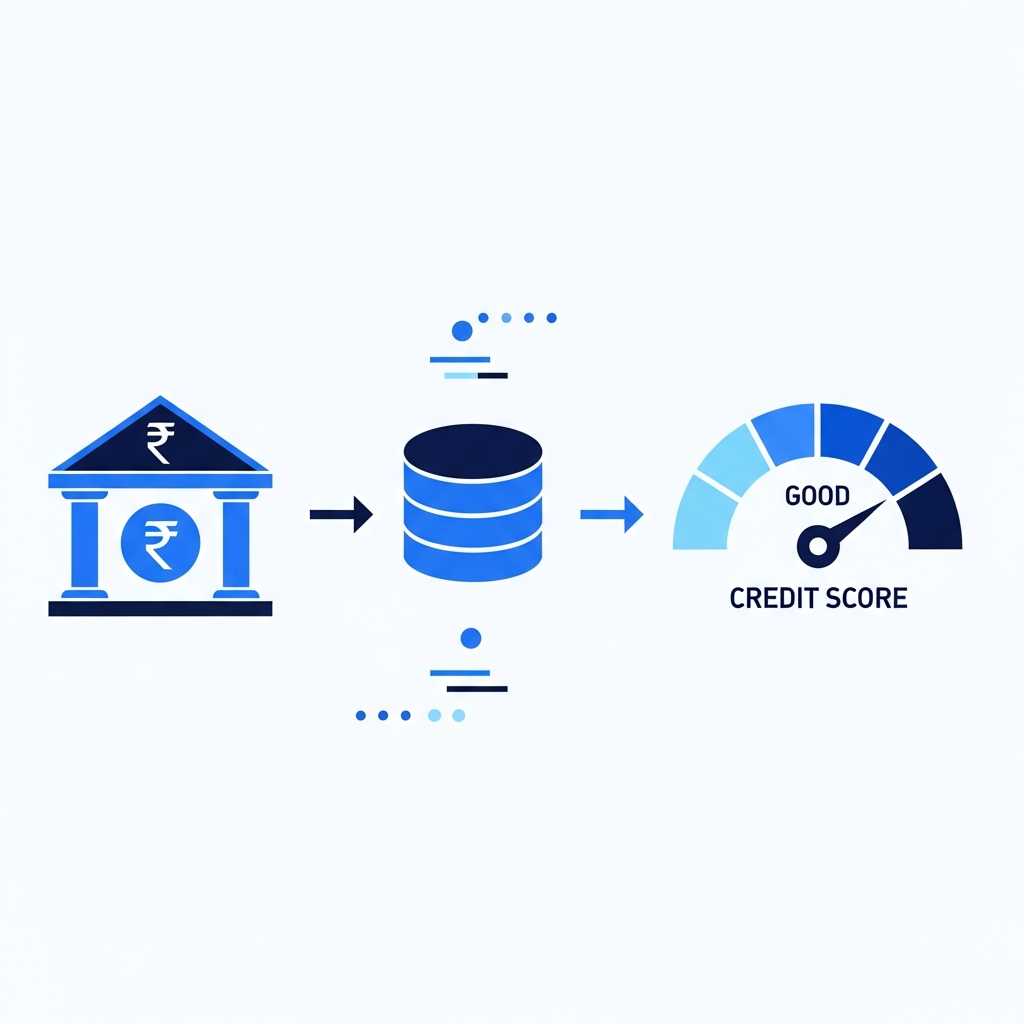
Why Doesn't Your Score Update the Same Day You Pay?
There's a chain of steps between the moment you make a payment and the moment your score actually reflects it, and each link in that chain takes its own bit of time.
First, your payment happens at your bank or lender, that's the transaction itself. Then your lender batches up all its customer data and reports it to the bureau, but only on its scheduled reporting date, not the instant a payment clears on its end. Once the bureau receives that data, it needs to process and recalculate, updating your report and your score based on what came in.
Each of these steps adds a little lag. Even under the current 15-day mandate, which is a real improvement over the old monthly system, you might still be looking at up to two weeks or so before a specific payment shows up reflected in your score. That's not a sign anything's gone wrong; it's simply how the reporting chain is structured.
What Triggers a CIBIL Score Update?
A handful of specific actions are what cause your score to actually move once they're reported.
- An EMI or credit card payment, on time or late, both get reported, and both affect the score differently.
- A loan closure, fully paying off and closing an account, updates your report to reflect that.
- Opening a new loan or credit card account, this adds to your credit profile and can shift the score, sometimes down initially due to a new hard inquiry.
- A hard enquiry, triggered whenever a lender checks your report because you've applied for new credit.
- A successful dispute resolution, once an error you've flagged gets corrected, that correction reflects as an update too.
Each of these only shows up once it's actually been reported by the relevant lender or bureau, not the moment the underlying action takes place.
How Long Does a Dispute Take to Reflect in Your Score?
Disputes run on a completely separate timeline from the regular 15-day reporting cycle, so it's worth not confusing the two.
A simple dispute, something like a clear factual error that the bank can quickly verify, typically resolves within 15 to 30 days. More complex disputes, ones requiring deeper investigation or coordination between the bureau and the lender, can take considerably longer, sometimes stretching to 45 days or beyond, depending on the specifics.
RBI's rules also include a compensation mechanism here; if a credit report error isn't resolved within 30 calendar days of your complaint, the lender is required to compensate you at ₹100 per day of delay. This gives lenders a real incentive to move disputes along rather than let them sit.

Get Expert Help With Credit Card Debt
Speak with a FREED expert to understand your debt relief options and find a personalised solution for managing your credit card dues.
Book My Free CallWhat If Your Score Has Not Updated After a Payment?
If a payment isn't showing up yet, that's usually not cause for concern; it's more likely just timing.
First, check when your specific lender's reporting cycle actually falls, since this varies slightly across different banks and NBFCs. Second, allow enough time for your lender's next reporting cycle before assuming there's a problem. If the update still doesn't appear after a reasonable period, contact your lender first or raise a dispute with the credit bureau if necessary.
Most of the time, a payment that seems to be "missing" simply hasn't hit its lender's next scheduled reporting date yet, not a genuine error.
How Can You Use the Update Cycle to Your Advantage?
A little awareness of the cycle timing can actually work in your favour if you're planning.
- Make payments early in your billing cycle rather than right up against the due date. This gives your lender more breathing room to include that payment in its next scheduled report, rather than potentially missing the window and pushing the reflection out further.
- Avoid applying for new credit right before you expect a positive update to reflect. If you know a loan closure or a string of on-time payments is about to show up and improve your score, it's often worth waiting for that update to land before submitting a new application, since you'd be applying with a more favourable number in hand.

FREED Expert Tip
Pay your EMI or credit card bill early in the billing cycle, it gives your lender more time to report the update within the next 15-day window.
Talk to a FREED Expert
How FREED Helps You Track Your Score Between Updates
Since your score only refreshes every 15 days or so, staying on top of what's actually changing between those updates can feel like guesswork. FREED's Credit Insights tool, sometimes referred to as "Check My Credit," is built for exactly this, and it's available to anyone, whether or not you're enrolled in any other FREED program.
Credit Insights pulls your report directly from Experian and provides your current score, along with personalised insights to help you understand the factors affecting your credit profile. Get flat 50% off on subscription or you avail the subscription at flat 50% off.
Rather than checking your score and wondering why a recent payment or closure hasn't shown up yet, Credit Insights helps you understand exactly where things stand between the fortnightly reporting cycles, so you're not left guessing.
Track Your Score Between Every Update.
Get your score and personalised credit insights.
Check your scoreWaiting on an Update While Managing Multiple Loans?
If you're anxiously refreshing your score every few days because you're juggling several loans or cards at once, that anxiety itself is worth paying attention to, not just the number you're waiting on.
For readers managing multiple loans and repayments, the underlying debt burden may be the bigger concern than the reporting cycle itself. Depending on your financial situation and the lending partner's assessment, debt consolidation may be an option. If eligible, a consolidation loan may help combine eligible debts into a single repayment plan. Final loan terms, including the EMI, depend on the lending partner.
Are You in a Loan Trap? Quick Check
Move the slider to your total EMIs as a % of monthly salary. See your debt stress level instantly.
EMIs as % of Monthly Salary
CIBIL Score Update Timeline, Old vs Current
Aspect | Before January 2025 | Current (Since January 2025) |
Reporting frequency | Once a month | Every 15 days |
Typical reporting dates | End of the month only | Around the 15th and the end of the month |
Time to reflect on a payment | 30 to 45 days | Depends on the lender's reporting schedule and the bureau's processing time |
Dispute resolution | Longer, less standardised | Faster, though still separate from the regular cycle |
A further move to a weekly reporting cycle has been proposed. Timelines shown are based on publicly available industry information and are subject to change as RBI rules evolve. FREED is not a Loan Provider.

Mohit Juneja
Mohit Juneja writes educational content at FREED on debt management, credit scores, loan repayment, and borrowing best practices. His content is shaped by expert insights and industry knowledge, helping readers better understand their financial options and make informed decisions.
mohit.juneja@freed.care

FREED is India's trusted loan management platform. Founded in 2020 and headquartered in Gurugram, FREED has counselled 20 lakh+ people on personal loans, credit cards, and app loans. FREED charges fees only on successful settlement, not upfront. FREED does not handle secured loans (home loans, car loans, gold loans).
Media Mentions