Understanding FOIR and Its Significance on Loan Eligibility
What is FOIR, and why is it more important for loan approval than your credit score? Find out how debt consolidation can quickly reduce your FOIR.
Mohit Juneja
Reviewed by FREED India, Debt Resolution Specialists
 4.7/5
4.7/5 ₹3,200Cr+
 20,000+
 20,00,000+4.7/5₹3,200Cr+20,000+20,00,000+
Key Takeaways

FOIR weighs your income against the lender's consideration of your ongoing financial obligations. These could include current EMIs, credit card debt, and other fixed commitments, depending on the lender and loan product.
Formula: (Monthly fixed liabilities ÷ monthly income taken into consideration by the lender) × 100 is a simplified FOIR calculation.
Although there isn't a single cutoff, many lenders employ FOIR criteria in this range as part of their own screening. The precise cutoff differs depending on the type of loan and lender.
Even with a good credit score, a high FOIR is frequently the cause of loan or credit card refusal.
The most straightforward method to lower your FOIR and enhance your overall emi score profile is to reduce current EMIs, most consistently through debt consolidation into a single loan.
What Is FOIR?
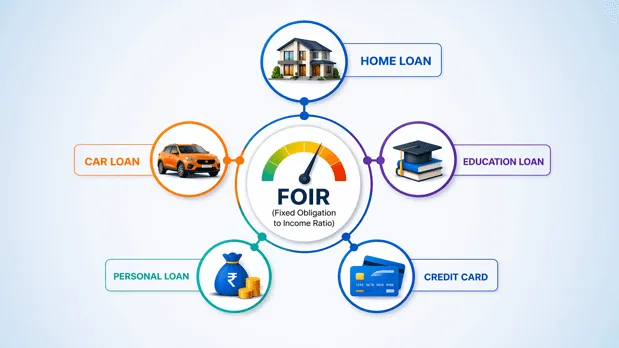
Banks utilize the Fixed Obligation to Income Ratio, or FOIR, to determine how much of your monthly income has already been spent before you come in and request additional credit.
There are two sections to it. The first is your fixed monthly commitments, which are all recurrent payments that are made regardless of your preferences. This covers the minimum amount owed on your credit cards, all current loan EMIs, and, frequently, your monthly rent. Before you spend a rupee on groceries, transportation, or anything else, these sums are already committed. Depending on the product and underwriting policy, the lender's income number may be based on gross or other qualifying income. Your gross, not your take-home pay.
The bank can learn anything from the ratio between these two that a credit score cannot. They can learn about your past debt management from your credit score. FOIR informs them of the exact amount of space you now have. Regardless of their past, a borrower with a score of 780 and a FOIR of 65% is viewed by the lender as having very little monthly headroom. Both figures are examined. Neither takes the place of the other.
This is also the reason why two individuals with the same credit score may receive quite different results when applying for a loan. On a salary of ₹60,000, one has two EMIs of ₹12,000. On the same wage, the other has five EMIs totaling ₹35,000. That discrepancy is not reflected in the score. FOIR does. The score side of this equation is covered in full in How Personal Loan Eligibility Depends on Credit Score, but FOIR is the component that most people overlook until a denial compels them to examine it.
An Indian individual using phone calculator software to calculate the FOIR formula

How Is FOIR Calculated? Formula and Example
The equation is:
FOIR is equal to (Total Fixed Monthly Obligations × Gross Monthly Income) times 100.
You get a percentage from that. A lender will notice more space in your monthly budget if it is lower. This is how it appears in real numbers.
For instance:
Monthly gross income: ₹60,000
Current fixed obligations: ₹3,000 BNPL EMI + ₹7,000 credit card minimum due + ₹15,000 personal loan EMI = ₹25,000 total
FOIR: (₹25,000 ÷ ₹60,000) × 100 = 41.6%
This borrower is on the borderline at 41.6%. A small new loan may be approved by some lenders. Some will request a co-applicant. Now observe what occurs when they add a new personal loan with a monthly EMI of ₹8,000:
₹25,000 + ₹8,000 = ₹33,000 is the new total commitments.
New FOIR: (₹33,000 ÷ ₹60,000) x 100 = 55%
Depending on the lender, loan type, and overall profile, the borrower may be subject to a more stringent eligibility examination at 55%. The income is still the same. There has been no change in the credit score. The only thing that changed was the fixed obligation number, which was sufficient to cause the application to be rejected.
Because of this, you can avoid a hard inquiry on a loan that was unlikely to be authorized in the first place by calculating your own FOIR before applying anyplace. What then qualifies as a "good" FOIR?

FREED Expert Tip
Determine your own FOIR before applying for any additional loans. Divide the total amount owed on each credit card by your gross monthly income, then multiply the result by 100. A thorough investigation into an application that is likely to be denied can be avoided with a fast check.
Examine your choices.What Is a Good FOIR for Loan Eligibility?
FOIR Range | What It Typically Means |
Below 40% | Healthy. Comfortable approval odds for most loan types. Lenders see sufficient room in the monthly budget. |
40% to 50% | Borderline. Approval is possible but the application may get more scrutiny. Lenders may reduce the loan amount, ask for a co-applicant, or request additional income proof. |
Above 50% | High risk zone. Approval becomes difficult across most lenders. The lower the remaining income headroom, the less likely a new EMI is approved. |
When lenders discuss FOIR comfort zones, they usually mean these ranges. In either case, they are not a guaranty. A 48% borrower with a strong credit score and a highly steady salary income can nonetheless be accepted. A 38% borrower with erratic income and multiple recent inquiries might not. Although FOIR is an important component of the decision, lenders consider the whole picture.
Additionally, the barrier varies depending on the type of loan. Because the commitment is greater and lasts longer, a home loan lender will typically apply a harsher cut-off than a personal loan provider. How this manifests itself in various products is discussed in the following section.
How FOIR Affects Different Types of Loans
Loan Type | Typical FOIR Threshold |
Personal Loan | Generally under 50%. Shorter tenure, unsecured, so lenders use income headroom as a primary filter. |
Home Loan | Generally under 40-45%. Longer commitment, larger amount, stricter thresholds. Even small changes in income or obligations can shift eligibility. |
Vehicle Loan | Generally under 50%, similar to personal loans. The asset backing the loan gives lenders slightly more comfort. |
Business Loan | Varies more than other categories. Self-employed income is less predictable, so lenders look at ITR, bank statements, and business vintage alongside FOIR. Generally under 50% as a starting point. |
These are not guarantyd cutoffs; they are common ranges. The lender's internal policy, employer profile, income stability, credit history, and FOIR are all factors that affect actual approval. The same borrower may receive substantially different results from two lenders on the same day.
This table makes it apparent that you need more headroom than for any other product on this list if you intend to apply for a home loan. Before contacting any lender, it is worthwhile to calculate your FOIR in order to determine which product category is appropriate for your existing responsibilities as well as to determine whether you will qualify.
Healthy, borderline, and high FOIR ranges are displayed on a straightforward tiered scale
Why Do Banks Use FOIR Instead of Just the Credit Score?
Feature | CIBIL Score | FOIR |
What it measures | Past repayment behaviour | Present repayment capacity |
What a high reading means | Strong track record of paying on time | Low existing obligation load, more room to take on new debt |
What a low or bad reading means | Missed payments, defaults, high utilisation in the past | Heavy existing obligations, limited monthly headroom |
When it matters most | At the start of eligibility screening | When deciding loan amount and tenure |
This is also the reason your rejection cannot be explained by your credit score alone. Existing liabilities and affordability metrics like FOIR may be among the things to look into if you have a good credit score but are turned down. The practicalities of lowering current obligations—the FOIR lever that most people have the most control over-are officially covered in How to Reduce Your Personal Loan EMI.
How to Improve Your FOIR
Reducing the numerator in the formula-the total amount of fixed obligations that leave your account each month-is necessary to improve FOIR. There are several methods for doing that, and they are not all equally quick or efficient.
If possible, pay off or foreclose on a lesser existing loan. An whole obligation line is eliminated from the FOIR computation when one debt is fully paid off. Once closed, even a little personal loan or consumer durable EMI reduces the monthly total. The lender's evaluation of your current obligations may no longer reflect that obligation after the loan is closed and the lender's records are updated.
Combine several loans into a single, cheaper EMI. For the majority of people who have multiple active loans, this is the most direct lever. The monthly obligation amount may decrease, which could lessen FOIR, if the new consolidated EMI is less than the total qualifying EMIs it replaces. The sequencing aspect of handling several responsibilities is covered in How to Plan Your Personal Loan EMI Payment.
Include a co-applicant who earns money on their own. Adding a co-applicant may raise the income taken into account in the affordability assessment if the lender considers the co-applicant's qualified income. The denominator increases as a result, improving the ratio. Before making a decision, it is important to fully comprehend that the co-applicant also becomes jointly liable for the loan.
If necessary, choose a new loan with a longer term. Longer terms often result in higher total interest paid, but they can also lower a new loan's monthly EMI and lessen the impact of the new EMI on the FOIR computation. There is a true trade-off: the total amount of interest paid during the loan's duration rises dramatically with tenure. This lever should only be used if the reduced monthly expenditure actually improves the existing circumstances.
Before applying, note any recent pay increases. Updated documentation can raise the gross income number, enhancing FOIR on the same obligation load, if your income has increased recently and it is not yet reflected in salary slips presented to a prior lender.
Reduce the revolving amounts on credit cards. When you merely pay the minimum amount owed on a credit card, the balance remains unpaid and the minimum amount is still considered a fixed obligation. The amount the card counts against FOIR each month decreases when a larger chunk is cleared.
What to Do If Your FOIR Is Already Too High
A wall with a high FOIR is not permanent. It is a figure that varies according to the responsibilities that underlie it. FREED's Debt Consolidation Plan (also known as the Loan Consolidation Program or "Reduce My EMI") was created especially for those who are still able to make their payments but require a more intelligent approach to handling their debt.
This is how it operates. FREED evaluates your entire financial picture, including all of your current loans, their monthly EMI, your income, and all of your fixed obligations. After that, FREED uses its network to match you with a suitable loan partner. Subject to the partner's procedure and eligibility requirements, the lending partner offers a fresh loan when it is accepted, which is used to pay back qualified unsecured obligations. BNPL balances, personal loans, and credit card debt are all replaced by a single account.
One loan, one lender, one due date, and one EMI are all that remain. Usually, that EMI is less than the total amount you were paying for each of the individual accounts it replaced. FOIR decreases together with the overall fixed obligations amount. For instance, a borrower's FOIR may drop from 58% to 38% if their qualifying debts decrease sufficiently following consolidation. The lender's computation method and the new EMI determine the final result.
Beyond FOIR, there is another advantage. Your credit accounts' reporting may be altered by debt consolidation. Over time, your credit score might be supported by regular, timely repayment of the new loan. Together, the score and the ratio advance in the right direction. Anyone who wants the specifics before making a decision can read How FREED's Debt Consolidation Program operates.
FREED's Debt Resolution Program (debt settlement) is a separate alternative if the issue has progressed beyond over-leverage and repayment has actually become impossible rather than just difficult. The two should not be confused because they are intended for distinct circumstances. For both programs, FREED charges a success-based fee; if the consolidation or settlement is unsuccessful, there is no price.
See What Consolidation Could Do to Your FOIR
The above formula and table explain how FOIR functions in theory. You enter your own numbers into the calculator below. Enter your gross monthly income, the entire amount of your present credit card debt and EMI, and an estimate of what a combined EMI may be. Your current FOIR, your anticipated FOIR following debt consolidation, and the monthly reduction are all displayed in the result. Before applying someplace new, run the numbers. It is more helpful to see the anticipated ratio than to speculate about your eligibility.
Are You in a Loan Trap? Quick Check
Move the slider to your total EMIs as a % of monthly salary. See your debt stress level instantly.
EMIs as % of Monthly Salary

Mohit Juneja
Mohit Juneja writes educational content at FREED on debt management, credit scores, loan repayment, and borrowing best practices. His content is shaped by expert insights and industry knowledge, helping readers better understand their financial options and make informed decisions.
mohit.juneja@freed.care

FREED is India's trusted loan management platform. Founded in 2020 and headquartered in Gurugram, FREED has counselled 20 lakh+ people on personal loans, credit cards, and app loans. FREED charges fees only on successful settlement, not upfront. FREED does not handle secured loans (home loans, car loans, gold loans).
Media Mentions