Soft vs Hard Credit Enquiry: Why the Difference Matters
Understand the difference between soft and hard credit enquiries in India. Learn how each affects your credit score and why regular credit monitoring matters for better financial health.
Mohit Juneja
Reviewed by FREED India, Debt Resolution Specialists
 4.7/5
4.7/5 ₹3,200Cr+
 20,000+
 20,00,000+4.7/5₹3,200Cr+20,000+20,00,000+
Key Takeaways

A credit enquiry happens whenever your credit report is accessed, either by you, or by a lender you have applied to.
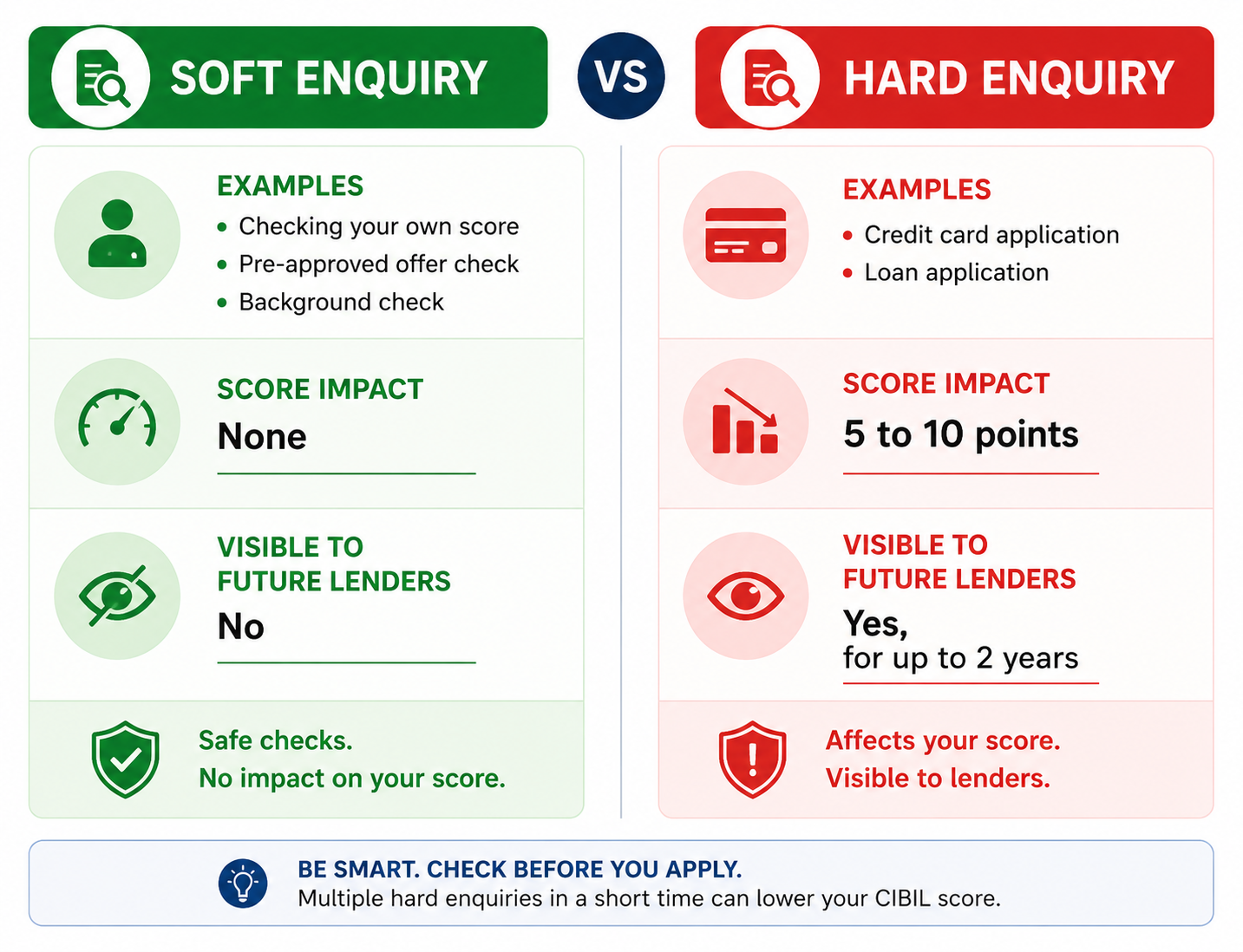
A soft enquiry has no impact on your CIBIL score. Checking your own score, or a lender doing a preliminary background check, falls into this category.
A hard enquiry can reduce your CIBIL score by 5 to 10 points, and stays visible on your credit report for up to 2 years. It happens when you formally apply for a loan or credit card.
Multiple hard enquiries within a short period signal financial distress to lenders and compound the score damage significantly beyond what a single enquiry causes.
If enquiry related score damage has combined with existing high interest debt to create a difficult financial position, FREED can help through consolidation or settlement.
What is a Credit Enquiry?
Every time your credit report is accessed by anyone, including you, it is logged as an enquiry on your credit file with CIBIL, Experian, Equifax, or CRIF High Mark, the four RBI licensed credit bureaus in India.
Not all access to your credit report is the same, however. The bureaus classify every enquiry into one of two categories, soft or hard, based on who is accessing the report and why. This classification is not a minor technical detail. It is the single factor that determines whether checking your credit has any cost at all.
Understanding which category a given action falls into is what allows you to check your own score freely, while still being deliberate about the enquiries that do carry a cost.
Soft Enquiry: What It Is and When It Happens
A soft enquiry occurs when your credit report is accessed without a formal loan or credit application being involved. It is essentially a background look at your credit report, not a request for new credit.
Common examples of soft enquiries: checking your own CIBIL score through the CIBIL website, an app, or your bank's mobile app. A lender doing a preliminary eligibility check before showing you pre-approved loan or credit card offers. An employer conducting a background check, with your consent, as part of a hiring process. An existing lender periodically reviewing your account, for example your credit card issuer checking your report before deciding whether to increase your credit limit.
Soft enquiries are recorded on your credit report, but they are visible only to you, not to future lenders reviewing your file, and critically, they have no impact on your CIBIL score whatsoever.
This is why checking your own score as often as you like, monthly or even weekly, is completely safe and often recommended as good financial practice.
Hard Enquiry: What It Is and When It Happens
A hard enquiry occurs when you formally apply for a new credit product, and the lender pulls your full credit report as part of evaluating that application.
Common examples of hard enquiries: applying for a new credit card. Applying for a personal loan, home loan, car loan, or any other formal credit product. Applying for a credit line increase on an existing card, in some cases. Co-signing or guaranteeing a loan for someone else.
Unlike a soft enquiry, a hard enquiry is visible to other lenders who review your credit report in the future, and it does affect your CIBIL score. This is because a hard enquiry represents a genuine signal that you are actively seeking new credit, which lenders factor into their assessment of your overall credit risk.
The Core Difference: Impact on Your CIBIL Score
The distinction between soft and hard enquiries comes down to one practical difference that matters enormously: does this action cost me score points, or not.
A soft enquiry costs nothing. You can check your own score as frequently as you like without any risk to it. This is a common misconception that keeps people from monitoring their credit health regularly, out of a fear that checking itself will lower the score. It will not, as long as it is a soft enquiry, which checking your own score always is.
A hard enquiry has a real, measurable cost. A single hard enquiry typically reduces your CIBIL score by 5 to 10 points. This impact is usually temporary and recovers within a few months if no further hard enquiries follow and your account behaviour remains positive. But the enquiry itself remains visible on your credit report for up to 2 years, even after the score impact has faded.
Why This Distinction Matters More Than Most People Realise
The practical consequence of not understanding this distinction shows up in two very different, and equally common, mistakes.
The first mistake: avoiding checking your own credit score out of fear that it will lower it. This is unnecessary caution. Regularly checking your own score, a soft enquiry, is one of the most useful financial habits available, since it lets you catch errors, track improvement, and understand your position before applying for anything.
The second mistake: applying for multiple credit cards or loans in a short window, without realising each application is a hard enquiry that compounds. Someone rejected for one credit card who immediately applies to three more banks, hoping one will approve them, is generating four hard enquiries in a short period, each one lowering the score further and making the next application less likely to succeed, not more.
Understanding the difference allows you to be genuinely careless about checking your own score, while being genuinely careful about submitting new credit applications.
How to Tell Which Type of Enquiry Just Happened
In most everyday situations, the type of enquiry is determined simply by what action you took.
If you opened an app or website specifically to check your own score, that is a soft enquiry, regardless of which platform you used.
If a bank showed you a pre-approved offer without you filling out a formal application, that is typically a soft enquiry, since the lender ran a preliminary check using your existing relationship data.
If you filled out and submitted a formal loan or credit card application, and the lender is now processing it, that is a hard enquiry, even if you are ultimately rejected. The enquiry happens at the point of application, not at the point of approval.
If you are unsure, the safest assumption is this: if you had to provide detailed personal and financial information as part of a formal application process, and the lender is making a lending decision based on it, it is very likely a hard enquiry
Common Situations That Confuse People
A few specific situations generate frequent confusion, and are worth addressing directly.
Pre-approved offers. Seeing a pre-approved credit card or loan offer does not, by itself, involve a hard enquiry. The lender used existing data or a soft enquiry to generate the offer. However, the moment you accept the offer and formally apply, that acceptance typically triggers a hard enquiry.
Rate shopping for a specific loan type. In some countries, multiple hard enquiries for the same loan type within a short window, for example comparing home loan rates across several banks within 2 weeks, are treated as a single enquiry for scoring purposes. In India, this deduplication is not consistently applied across all lenders and bureaus, so it is safer to assume each formal application counts separately, and to limit the number of banks you formally apply to when rate shopping.
Credit limit increase requests. Some banks perform a soft enquiry when you request a credit limit increase through their app. Others treat it as a hard enquiry. Ask your bank directly which applies before requesting an increase if you are trying to be cautious about your score.
Balance transfer applications. Applying to transfer an existing loan or credit card balance to a new lender at a better rate is a formal credit application, and counts as a hard enquiry, even though you already have the debt with your current lender.
How Many Hard Enquiries Are Too Many?
There is no single official threshold, but the general pattern that credit bureaus and lenders look for is consistency and moderation.
One hard enquiry, in isolation, has a small and temporary impact. It is a normal part of applying for credit occasionally, and does not raise concern with future lenders.
Multiple hard enquiries, three or more within a short period, typically a month or two, signal to bureaus and lenders that you are urgently seeking credit. This pattern is statistically associated with higher financial risk, so it triggers a larger cumulative score drop, and future lenders reviewing your report see the cluster of enquiries and may become more cautious about approving you.
The practical guideline: space credit applications at least 6 months apart wherever possible. If you are rejected for one card or loan, resist the urge to immediately apply elsewhere. Use the time to understand why you were rejected and improve your position before trying again.

What the Law Says
Under RBI guidelines, credit bureaus are required to maintain accurate records of all enquiries on a credit report, and lenders are required to obtain your consent before pulling a hard enquiry as part of a credit application. If you did not apply for a loan or credit card but see a hard enquiry on your report from a lender you did not authorise, this may indicate an error or, in rare cases, identity fraud. You have the right to formally dispute any enquiry you did not authorise directly with the credit bureau, and if unresolved within 30 days, escalate to the RBI Banking Ombudsman at cms.rbi.org.in, for free, without a lawyer.
Talk to FREEDHow to Protect Your Score From Unnecessary Hard Enquiries
A few deliberate habits meaningfully reduce unnecessary score damage from hard enquiries.
Check your eligibility before applying. Most banks offer an eligibility check tool that uses a soft enquiry to estimate your approval odds before you submit a formal application. Use this first, and only proceed to a full application if the eligibility check is favourable.
Apply for one credit product at a time. Submit an application, wait for the outcome, and only apply elsewhere if genuinely necessary. Avoid the instinct to apply to several lenders simultaneously as a hedge against rejection.
Space out applications by at least 6 months. This gives your score time to recover from any single hard enquiry and avoids the compounding effect of multiple enquiries clustering together.
Review your credit report periodically, using a soft enquiry, specifically to check the enquiries section. This lets you confirm that only enquiries you actually authorised appear on your file.
What to Do if You Spot an Unauthorised Enquiry
If you review your credit report and find a hard enquiry you did not authorise, from a lender you never applied to, treat this seriously and act promptly.
First, confirm the details, the lender name, the date, and the type of product applied for. Sometimes what looks unfamiliar is actually a joint application, a guarantor request, or an old application you forgot about.
If the enquiry is genuinely unrecognised, file a formal dispute directly with the credit bureau showing the enquiry, CIBIL, Experian, Equifax, or CRIF High Mark. Provide your identification and a clear description of the discrepancy.
If the bureau does not resolve the dispute satisfactorily within 30 days, escalate to the RBI Banking Ombudsman. An unauthorised hard enquiry can, in rare cases, indicate that your personal information has been used without consent, so it is also worth reviewing your full credit report for any other unfamiliar accounts at the same time.
When Credit Enquiries Have Already Damaged Your Score
If a cluster of hard enquiries, perhaps from a period of urgently seeking credit during a financial difficulty, has already lowered your score, the good news is that this specific type of damage is among the most recoverable.
Hard enquiry impact fades over time on its own, typically within a few months, faster than the impact of a missed payment or a settled account. The most effective way to support this recovery is to avoid any further hard enquiries during the recovery period, and to maintain consistent, on time payments on your existing accounts.
If the enquiries happened because you were seeking new credit to manage an existing debt burden, and that underlying debt burden is still unresolved, addressing the debt directly will do more for your score, and your finances, than any enquiry specific fix.
FREED's Debt Consolidation Program combines multiple high interest debts into one lower interest loan with a single EMI, which removes the underlying pressure that often drives repeated credit applications in the first place.
FREED's Debt Resolution Program negotiates a reduced settlement for debt that cannot realistically be repaid in full, on average 56% less than the original outstanding, addressing the root cause rather than the symptom.
[Tool, FREED Financial Health Score]
Want a clear picture of how enquiries, payment history, and utilisation are together affecting your score? Take the FREED Financial Health Score, free, 2 minutes.
Are You in a Loan Trap? Quick Check
Move the slider to your total EMIs as a % of monthly salary. See your debt stress level instantly.
EMIs as % of Monthly Salary

Mohit Juneja
Mohit Juneja writes educational content at FREED on debt management, credit scores, loan repayment, and borrowing best practices. His content is shaped by expert insights and industry knowledge, helping readers better understand their financial options and make informed decisions.
mohit.juneja@freed.care

FREED is India's trusted loan management platform. Founded in 2020 and headquartered in Gurugram, FREED has counselled 20 lakh+ people on personal loans, credit cards, and app loans. FREED charges fees only on successful settlement, not upfront. FREED does not handle secured loans (home loans, car loans, gold loans).
Media Mentions