Personal Loan Settlement Percentage: What Banks Accept
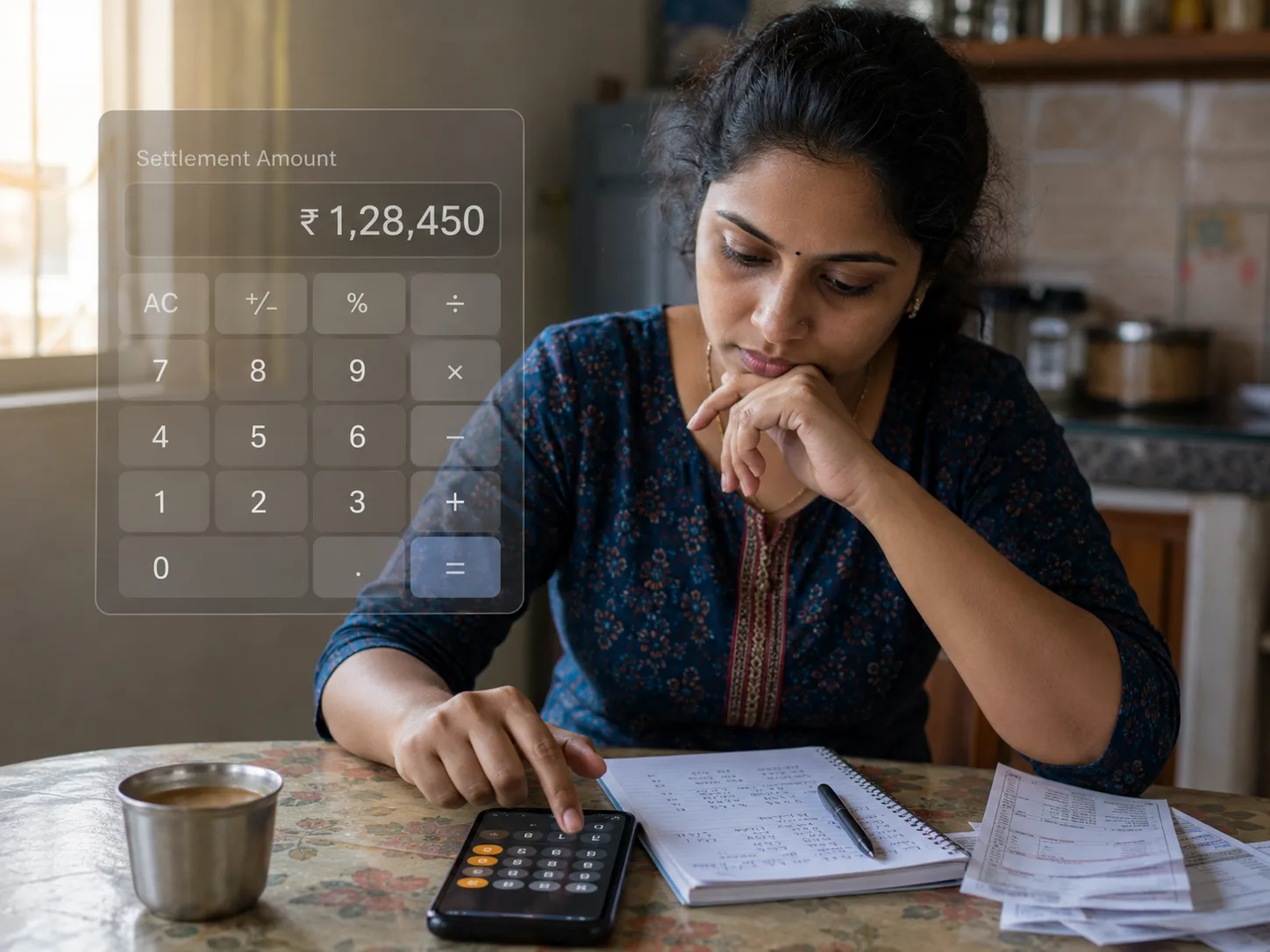
Personal loan settlement percentage is the share of your total outstanding amount that a bank accepts as full and final payment. If you owe ₹1,00,000 and the bank accepts ₹60,000, the settlement percentage is 60%. No law fixes this number, so each bank decides case by case.

Mohit Juneja
Reviewed by FREED India, Debt Resolution Specialists
 4.7/5
 ₹3,200Cr+
 20,000+
 20,00,000+4.7/5₹3,200Cr+20,000+20,00,000+
KEY TAKEAWAYS

Personal loan settlement percentage is the share of your outstanding amount a bank accepts as final payment.
No law or RBI rule fixes one percentage. Each bank decides under its own board-approved policy.
Your hardship papers, how long the loan is overdue and your lump-sum ability shape the offer.
FREED helps eligible people settle at up to 50%* less. Final terms are the bank’s decision.
A better percentage does not remove the “Settled” mark, which can stay up to 7 years.
What Is Personal Loan Settlement Percentage?
Settlement is not something a borrower chooses out of preference. Banks only consider it when you genuinely cannot repay in full. Once that is clear, the next question is always the same: how much will the bank accept?
The answer starts with one plain formula. Divide the settlement amount by your total outstanding, then multiply by 100. That gives you the personal loan settlement percentage. If you owe ₹1,00,000 and pay ₹60,000, the figure is 60%.
Here is the part most websites skip. The percentage can be read two ways. You can measure it against the total outstanding, which adds principal, interest and penal charges together. Or you can measure it against the principal alone. Principal (the amount you originally borrowed) is only one slice of what you owe.
Take a loan with ₹70,000 principal, ₹20,000 interest and ₹10,000 penal charges. Pay ₹60,000 and you have paid 60% of the outstanding. The same payment is about 86% of the principal. That is plain arithmetic, not a typical result.
Quoted percentages online rarely say which base they use. So two websites can show different numbers for the same deal. Always ask which base a number refers to.
Many people also search for the personal loan one time settlement amount. One-time settlement (OTS) generally refers to an arrangement in which the lender agrees to accept a specified amount under written settlement terms. Our guide on what the settlement amount means explains the parts of that figure. Our one-time settlement guide covers who qualifies.
One last point. A settled loan is marked “Settled” on your credit report, not “Closed”. ‘Closed’ generally indicates that the loan has been repaid in full, while ‘Settled’ generally indicates that the lender accepted less than the full amount due under the settlement arrangement. So who decides the number?

Want to know what a realistic offer looks like for your loan?
Talk to a FREED counsellor about your numbers.
Book My Free CallWhy Is There No Fixed Personal Loan Settlement Percentage?
Because no national table exists. RBI’s 2023 framework asks every regulated bank and financial company to run a board-approved policy for settlements. That policy sets the permissible sacrifice (the amount a bank may waive) for different kinds of loans. So your number comes from your bank’s own policy, applied to your file.
The framework also states the aim in plain terms. The bank should recover as much as possible from a distressed borrower, at the lowest expense. That one line explains most of what banks do. A bank accepts less only when it expects to recover less by waiting.
Approval has its own rule. Settlement approval follows the lender’s applicable policy and approval process. Verify the current RBI directions before describing a specific approval hierarchy as a universal requirement. This is why the person on the phone often cannot give you a figure. It also means the same loan can get different answers at different banks. Our guide to bank loan settlement rules explains how that policy layer works. The guide on what RBI requires banks to offer covers the rest.
Here is a warning worth keeping. Anyone who promises you a fixed percentage upfront is either guessing or selling. They have not seen your papers, and they do not sit on the bank’s approval desk. Be careful with any “guaranteed” figure.
Ask the bank to put every offer in writing. A written offer shows the amount, what is waived and the date to pay. A verbal figure on a call is not an offer yet.
So if no fixed number exists, what actually moves it?

What the Law Says
RBI requires each bank to have a board-approved settlement policy, so there is no single percentage that applies to everyone.
See what banks are required to offerWhat Decides How Much a Bank Accepts?
Banks look at your whole file, not one number. These six factors matter most:
How long the loan has been overdue, and its NPA status. NPA (a loan the bank marks as bad) usually follows 90 days of missed EMI. It is one signal the bank reads. Overdue length is only one factor among six. Our guide on an NPA account explains what happens next.
Proof of genuine hardship. A job-loss letter, medical bills and 3 to 6 months of bank statements show why you stopped paying. Without papers, a bank has little to weigh.
What your outstanding is made of. Penal charges and interest are usually where waivers begin. Principal is cut far less often. A loan with a large penal share has more room than one without.
Whether you can pay one lump sum. Banks like a clean, single payment. A real, arranged amount counts for more than a hopeful promise.
The bank’s own policy. Banks and NBFCs differ here. Each applies its own board-approved rules.
Your other debts and income. The bank asks if you can pay anything at all. A stretched budget with many loans tells a different story from a single missed loan.
Take ₹1,00,000 outstanding with ₹10,000 in penal charges. Even a small waiver of those charges changes the percentage you land on. That is why the split matters as much as the total.
Banks also differ from each other, and none publishes a percentage. FREED does not know any bank’s internal floor, and neither does anyone outside that bank. We do not rank banks by how generous they are. For process details, see the guides for HDFC, ICICI, Axis Bank, Bajaj Finance and Tata Capital.
Not sure what your papers show?
A FREED counsellor can go through your loan with you
Check your optionsHow Does the Settlement Percentage Work on a Real Loan?
Numbers make this clearer. Here is one loan, read two ways. This is an illustration only, not a typical or expected result.
Say you owe ₹1,00,000 in total. It is made of ₹70,000 principal, ₹20,000 interest and ₹10,000 penal charges.
Scenario | You pay | Waived | % of outstanding | % of principal |
A: bank waives penal charges and interest | ₹70,000 | ₹30,000 | 70% | 100% |
B: you pay a lower lump sum | ₹50,000 | ₹50,000 | 50% | about 71% |
Illustration only. It is not a typical or expected result.
Rates and ranges shown are indicative. Final terms decided by the bank. FREED is not a Loan Provider. No outcome is guaranteed. Please verify directly with your bank.
Look at Scenario A. You pay ₹70,000, which is 70% of the outstanding. But it is 100% of the principal. Now look at Scenario B. You pay ₹50,000, so the figure is 50% of the outstanding and about 71% of the principal (₹50,000 divided by ₹70,000).
The takeaway is simple. One loan gives very different percentages depending on the base you pick. So when you compare offers, compare like with like. Ask whether a figure is against the total or the principal, and ask for it in writing.
You can try your own figures too. Use the settlement calculator to enter your outstanding, principal and the lump sum you can arrange. The guide to a loan settlement calculator and waiver estimate explains what the result does and does not tell you. Treat the output as a planning figure. Only the bank’s written offer is final.
Why Do Banks Accept Less Than the Full Amount?
Here is the bank’s side, in plain words. Banks do not accept less out of generosity. They do it for practical reasons.
Once an account is long overdue, chasing it costs time and money. Staff hours, notices and follow-up calls all add up. The realistic amount the bank can recover may also be lower than the outstanding. A one-time payment ends the account and brings money in now.
RBI’s own framework describes the aim as recovery at minimum expense. That is the logic in one line. If the bank expects to recover little by waiting, a smaller payment today can look better on paper. If it expects to recover more, it will say no.
Two honest points follow. First, banks can say no, and many requests are declined. Second, a bank is more likely to engage when you show documented hardship and a real ability to pay a lump sum. Papers and a payable amount matter more than long explanations.
None of this is a reason to delay or to skip payments on purpose. That only adds penal charges and hurts your score. If you can still pay your EMIs, tell the bank so and ask about softer options first. Settlement is for the situation where you truly cannot pay.
Also remember what a settlement is not. A waived amount may still show on your report. Our guide on bad debts written off and the CIBIL impact explains how banks record such amounts. Knowing that early helps you plan the next steps with open eyes.
How Can You Make a Realistic Settlement Offer?
A realistic offer starts with your own numbers. Follow these steps in order:
Get the outstanding statement and split it. Ask for principal, interest and penal charges as separate lines. This shows what the bank may waive first.
Work out the one lump sum you can really arrange. Count savings, family help or the sale of an asset. Use the calculator to test it. A figure you cannot pay is worse than no figure.
Prepare your hardship papers. Include a job-loss or salary-cut letter, medical bills and recent bank statements. These support your request.
Send a written proposal to the collections team. State your situation and the lump sum. Our guide on how to write a loan settlement letter helps with the wording.
Expect a counter and answer it calmly. The bank may come back with a higher number. Never agree to an amount you cannot pay. Our guide on how to negotiate a personal loan settlement shows the usual back-and-forth.
Get the terms in writing before you pay a rupee. See what the final settlement letter should show.
One fact helps here. RBI’s framework treats a settlement as a restructuring (a changed loan plan) when payment stretches past 3 months. So ask for a short, clear payment window. Do not expect the bank to accept the first offer either.
Recovery calls may continue during these talks. If calls turn abusive or threatening, FREED Shield is open to anyone, enrolled or not, to document and report them. If you still pay every EMI, the Loan Consolidation Plan may suit you better than settlement.

Freed Expert Tip
Ask the bank for a written outstanding statement first. Settling at 60% of a wrong number still costs you more.
Talk to a FREED counsellorWhat Does the Settlement Percentage Mean for Your CIBIL Score?
Here is the point nobody states clearly. The percentage you settle at does not change the “Settled” status. A smaller waiver and a larger waiver both lead to “Settled”, not “Closed”. The information reported by the lender depends on the account and applicable credit-reporting practices. Check your credit report and verify any specific reference to the ‘Amount Written Off’ field against an authoritative source.
So do not expect a better percentage to buy you a cleaner record. The mark can stay on your report for up to 7 years. The drop is commonly reported at 75 to 100 points, though it varies by profile. Your starting score, your other accounts and your payment history all change the result.
Take two people with the same score. One settles a ₹1,00,000 loan for ₹70,000. The other settles for ₹50,000. Both get a “Settled” mark. The difference is in what they paid, not in how the status reads. Our guide on how settlement affects your credit score goes deeper. See also what “written off” means in CIBIL.
Rebuilding starts after the settlement, and it is mostly up to you. Keep your other accounts current. Borrow carefully. Check your Experian-based credit report with Credit Insights to see what drives your score. Before any new loan, use the EMI Score to check whether the new EMI fits your budget.
Nobody can promise you a recovery date. Take it one month at a time, and keep every settlement paper safe. Banks look at the whole report, not only one mark. Steady payments on your other accounts, month after month, are what future banks notice next.
How Does FREED Help With Personal Loan Settlement?
The FREED Loan Settlement Plan, also called the Debt Resolution Program or “Settle My Loans” in the app, covers unsecured loans only. FREED describes it this way: “Helps borrowers move from financial distress to a structured path toward resolving their debt and rebuilding their financial future.”
Here is how the Loan Settlement Plan runs in plain steps:
FREED reviews your full financial picture. That means your loans, income, expenses and what you can repay.
You get a personalised plan. It is built around your numbers, not a template.
You save a fixed monthly amount into a Special Purpose Account (SPA). An independent trusteeship company holds the SPA. It is your own savings pool.
Once the corpus is enough, FREED negotiates with the bank. FREED also prepares documents and drafts letters for you.
You accept or decline each settlement before any payout. The bank decides the final terms.
This takes time. Savings come first, and that cannot be rushed. The order in which your loans are settled is flexible. FREED charges a fee only on a successful settlement. Read about the costs involved in a personal loan settlement to see what to expect.
Banks may waive up to 50%* of what you owe. Whatever the bank agrees to, the final terms are the bank’s call. Before you sign with any agency, read how to evaluate a loan settlement agency.
*Rates and ranges shown are indicative. Final terms decided by the bank. FREED is not a Loan Provider. No outcome is guaranteed. Please verify directly with your bank.
33,000+ accounts settled | 20,00,000+ customers counselled | ₹3,500 Cr+ debt managed
Sources
Claim in the blog | Source |
Banks run a board-approved settlement policy that sets the permissible sacrifice, aimed at maximum recovery at minimum expense | |
Settlement is approved by an authority at least one level above the sanctioning authority | |
A settlement paid over more than 3 months is treated as restructuring | |
A term loan becomes NPA when overdue for more than 90 days |

Mohit Juneja
Mohit Juneja is FREED’s Content & Communication Lead with 12+ years of experience across content, media, advertising and digital communications. He holds a postgraduate diploma in Communications from Xavier Institute of Communications, Mumbai, and has worked with organisations including NDTV, The Indian Express, McCann Worldgroup and NABARD.
At FREED, he leads content and communication across loan management, debt resolution, debt consolidation and financial well-being. His work combines research, storytelling and consumer-focused communication to make complex financial topics easier to understand and act on. He has also scripted and produced 11 documentaries on rural development and agriculture for NABARD, with film's selected for the Mumbai International Film Festival.
mohit.juneja@freed.care

FREED is India's trusted loan management platform. Founded in 2020 and headquartered in Gurugram, FREED has counselled 20 lakh+ people on personal loans, credit cards, and app loans. FREED charges fees only on successful settlement, not upfront. FREED does not handle secured loans (home loans, car loans, gold loans).
Media Mentions