HDFC Loan Settlement Online: Can You Apply Digitally and How?
HDFC loan settlement online means starting or progressing a loan settlement request for a personal loan or credit card using email, the HDFC NetBanking portal, or a third-party service, instead of walking into a branch. Parts of the process can be done digitally. But a full end-to-end online settlement without any human contact is not possible with HDFC Bank today. This article explains exactly what you can do online and what still requires a call or a visit.

Mohit Juneja
Reviewed by FREED India, Debt Resolution Specialists
 4.7/5
4.7/5 ₹3,200Cr+
 20,000+
 20,00,000+4.7/5₹3,200Cr+20,000+20,00,000+
Key Takeaways

HDFC Bank does not offer a dedicated "apply for settlement" button online, but you can initiate the conversation via email, NetBanking grievance forms, or phone.
Settlement applies only to unsecured loans: personal loans, credit cards, BNPL, and consumer durable loans.
The "Settled" status stays on your CIBIL report for up to 7 years. This is the single biggest trade-off to understand before starting.
HDFC only considers settlement when you are genuinely unable to repay, not because you find EMIs inconvenient.
FREED has counselled 20,00,000+ customers across India navigate bank negotiations like this.
What Is HDFC Loan Settlement and Who Is It For?
Settlement is not something a borrower chooses out of preference. Banks and financial companies only consider it when you are in a genuine financial difficulty and are truly unable to repay the full amount. It is a last resort, not a shortcut.
HDFC loan settlement, specifically, means the bank agrees to accept a reduced lump sum as the final payment on your account. This is called an OTS (one-time settlement, meaning you pay it once and the matter ends). The final settlement amount depends on the bank's assessment of your individual circumstances. Once the agreed amount is paid and the NOC (clearance letter from the bank) is issued, the bank's claim on that loan is fully resolved.
This applies only to unsecured loans: personal loans, credit cards, BNPL (buy now pay later) products, and consumer durable loans from HDFC. It does not apply to home loans, car loans, or gold loans. Those are secured loans backed by assets that the bank can legally recover through a separate process.
Settlement discussions generally begin after prolonged non-payment, depending on the bank's internal assessment. At this stage, the bank shifts focus from EMI recovery to partial recovery. The borrower's documented financial situation is what determines whether a settlement offer is made.
Can You Actually Apply for HDFC Loan Settlement Online?
This is the real question most people come here with. The honest answer is: partly yes, mostly no.
HDFC Bank's NetBanking portal lets you view your EMI status, check outstanding dues, and see overdue amounts. You can also raise a service request through the portal. But there is no dedicated settlement application flow anywhere on the HDFC website, app, or NetBanking interface. There is no button that says "apply for OTS" or "request settlement."
What you can do digitally is initiate the conversation. Three routes work:
Email: Write to support@hdfcbank.com or nodalofficer@hdfcbank.com. State your loan account number, confirm you are unable to repay in full due to genuine financial hardship, and request information on the OTS (one-time settlement) process. Keep the email short and factual.
NetBanking service request: Log into HDFC NetBanking, go to the "Service Requests" or "Complaints" section, and raise a formal request mentioning OTS. This creates a written record with a reference number.
HDFC mobile app messaging: The app has a chat or message option that creates a logged thread. Use this to initiate the request if you cannot access NetBanking.
The actual negotiation, document review, and final settlement approval require human contact: either a phone call with HDFC's collections or recovery team, or a visit to your home branch's loans desk. Digital communication gets you into the queue and creates a paper trail. It does not replace the negotiation itself.

FREED Expert Tip
Before contacting HDFC about settlement, download your last 6 months of loan statements from NetBanking. This gives you exact figures for outstanding principal, interest, and penalties, and helps you verify the outstanding amount during discussions.
Talk to a FREED ExpertWhat Documents Do You Need to Start the Process?
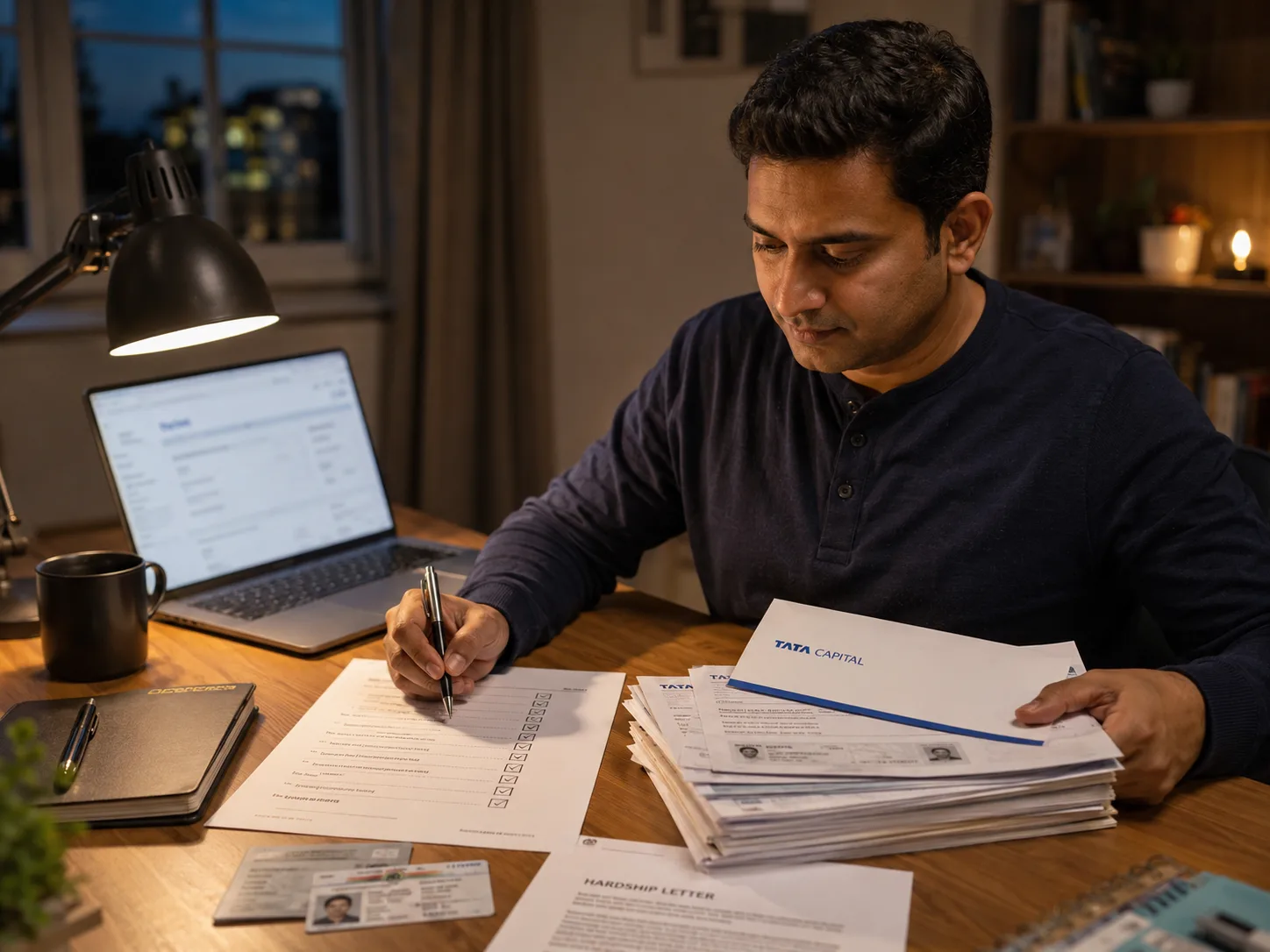
Having the right documents ready before you contact HDFC makes the process faster and protects you from being quoted figures you cannot verify.
You will need:
- PAN and Aadhaar for identity verification (KYC)
- Loan account statement showing the current outstanding amount, interest accrued, and penalties
- Last 3 to 6 months of bank statements showing your income and expenses
- Proof of financial hardship, whichever applies to your situation: a job termination letter from your employer, medical records and hospital bills if health is the reason, or business closure documents if you ran a business
- Any legal notices already received from HDFC including recovery notices or arbitration letters
Most HDFC branches accept scanned copies for the initial submission. Originals may be requested at later stages of the process. Send digital copies via email with a clear subject line that includes your loan account number.
Keep every document you send and every response you receive. This paper trail is your protection if any dispute arises later about what was agreed or when.
What Happens After You Contact HDFC: The Step-by-Step Process
Step 1: Contact HDFC's Settlement Team
Reach out via HDFC Bank customer care (1800-202-6161), the bank's grievance email, or by visiting your home branch's loans desk. Mention your loan account number and state that you want to discuss an OTS (one-time settlement) due to genuine financial difficulty. Keep the conversation factual.
Step 2: Submit Your Financial Hardship Documents
The bank needs written proof that repayment is impossible, not just inconvenient. A job termination letter, medical expense records, or business closure documents work. Send digital copies first. Keep originals ready for branch verification.
Step 3: Wait for HDFC's Internal Assessment
HDFC's collections or recovery team reviews your profile. This typically takes 2 to 4 weeks. You may receive a call requesting more information. Do not make any partial payments during this period without written confirmation of exactly how they will be applied to your account.
Step 4: Review the Settlement Offer in Writing
HDFC will send a written proposal on official bank letterhead. Read every condition carefully, especially the payment deadline, what the NOC process looks like, and whether the "full and final" clause is present. The bank may respond with a revised proposal depending on your case.
Step 5: Make the Lump Sum Payment
Pay the agreed amount via a traceable channel: NEFT, RTGS, or a demand draft. Keep the transaction receipt permanently. Never pay cash to any agent or representative.
Step 6: Collect Your NOC
Follow up specifically for the No Objection Certificate (NOC) or No Dues Certificate (NDC), which is the clearance letter confirming the matter is fully resolved. HDFC typically reports the "Settled" status to CIBIL within 30 to 45 days of receiving payment — though actual timelines may vary slightly. [(CIBIL: https://www.cibil.com/blog/impact-of-settled-status-on-cibil-score)] Check your CIBIL report at the 45-day mark to confirm the update has gone through.
What Are Your Options Before Settlement?
Settlement leaves a mark on your CIBIL report for up to 7 years. Before going there, make sure you have genuinely worked through what else is available.
EMI revision or tenure extension: Ask HDFC to reduce your monthly payment by stretching the repayment time. More months means a lower EMI. This may help you continue managing the loan without settlement. You can raise this request at your branch or through NetBanking's service request option.
Temporary payment pause (moratorium): If your hardship is short-term, a job loss or a medical situation you expect to recover from, ask HDFC for a moratorium (temporary pause on payments), typically for 3 to 6 months. Not all banks offer this for all products, but it is worth requesting in writing.
Loan plan change (restructuring): The bank may agree to rework the repayment structure entirely: different EMI amount, different schedule, different terms. This is not a waiver, but it can make repayment possible again.
Debt consolidation (merging all loans into one): If you have multiple loans and the combined EMI burden is the problem, consolidation means combining them into a single lower EMI. One payment, one date. This requires your CIBIL score to be above 670 and the accounts to still be active, not NPA.
A practical marker: if your total EMIs are already eating up more than 50% of your take-home salary, you are in the zone where these options need urgent attention. Settlement becomes relevant only when every other route has genuinely been exhausted and repayment in full is truly not possible.

Talk to Someone Who's Done This Before
Real counsellors, no pressure. Understand your settlement options in one call.
Talk to a FREED CounsellorHow Does Settlement Affect Your CIBIL Score?
This is the part most people want to understand before they decide. The answer is not comfortable, but it is important to hear clearly.
After HDFC settlement, your loan account is marked "Settled" on your CIBIL report. Not "Closed." "Settled." The difference matters: "Closed" means you repaid in full; "Settled" means the bank accepted less. Any bank that checks your report in the future will see this.
The "Settled" mark stays for up to 7 years. During this period, getting new unsecured loans or credit cards approved will be harder. Some lenders may consider this status when evaluating future applications. Others may offer loans at higher interest rates or with a co-applicant.
How does "Settled" compare to "Written Off"? A "Written Off" status means the bank has given up on recovering the full amount and removed the loan from its books as a loss. Both are negative. But "Written Off" signals complete recovery failure, while "Settled" shows partial resolution. If you are already in default for several months, your score has already taken damage; it stops them from continuing to deteriorate.

What the Law Says
Under RBI's Fair Practices Code, banks must communicate loan account status and any changes to loan terms in writing. [(RBI Fair Practices Code: https://www.rbi.org.in/scripts/NotificationUser.aspx?Id=12378&Mode=0)] For settlement specifically, always insist on a written offer before paying anything — verbal offers carry no legal weight
Get Free Debt AssessmentHow Can FREED Help With HDFC Loan Settlement?
Negotiating with HDFC's recovery team is not straightforward. The process involves multiple departments, written documentation, offer letters with clauses most borrowers have not seen before, and follow-ups that can stretch over weeks. FREED's counsellors have worked through this process with 60,000+ customers across India, managing over ₹3,200 crore in debt.
What FREED actually does: reviews your full debt picture to help you understand whether settlement is the right route or whether another option suits your situation better. Prepares your hardship documentation so the bank has what it needs. Handles the communication with HDFC's settlement team, checking every offer letter for missing clauses before you sign. Follows up for the NOC after payment. Tracks the CIBIL update at the 45-day mark.
FREED charges fees only when a settlement is successfully completed. There is no upfront charge for a consultation.
FREED covers unsecured loans only: personal loans, credit cards, BNPL, and loan apps. Secured loans such as home loans and car loans are not in scope.
FREED does not claim insider knowledge of HDFC's internal settlement figures. FREED does not guarantee any outcome. What FREED provides is structured support through a process that is genuinely difficult to navigate alone.
Disclaimer: Settlement waiver up to 50%* is indicative, not a guarantee. Final terms decided by the bank. FREED is not a Loan Provider. No outcome guaranteed. Verify directly with HDFC Bank.
Settlement vs. Other Options: What Works When
Option | When to Use | CIBIL Impact | Requires Default? |
EMI Revision or Tenure Extension | EMIs too high but still paying | None | No |
Loan Plan Change (Restructuring) | Temporarily struggling to pay | Minimal | Possible |
Debt Consolidation | Multiple loans, still repaying | None if on time | No |
Loan Settlement (OTS) | Genuinely unable to pay | "Settled" mark for up to 7 years | Yes, typically 90+ days |
Final terms decided by the bank. FREED is not a Loan Provider. No outcome guaranteed. Verify directly with HDFC Bank.

Mohit Juneja
Mohit Juneja writes educational content at FREED on debt management, credit scores, loan repayment, and borrowing best practices. His content is shaped by expert insights and industry knowledge, helping readers better understand their financial options and make informed decisions.
mohit.juneja@freed.care

FREED is India's trusted loan management platform. Founded in 2020 and headquartered in Gurugram, FREED has counselled 20 lakh+ people on personal loans, credit cards, and app loans. FREED charges fees only on successful settlement, not upfront. FREED does not handle secured loans (home loans, car loans, gold loans).
Media Mentions