How to Calculate Credit Card Interest When You Pay Only the Minimum Due
How to calculate credit card interest on a minimum payment: multiply days ÷ 365 × unpaid amount × yearly rate. Interest is charged on the unpaid amount, day by day, at your card’s yearly rate. Once you pay only the minimum, it runs from the date of each purchase.

Mohit Juneja
Reviewed by FREED India, Debt Resolution Specialists
 4.7/5
 ₹3,200Cr+
 20,000+
 20,00,000+4.7/5₹3,200Cr+20,000+20,00,000+
Key Takeaways

To calculate credit card interest on a minimum payment: days ÷ 365 × unpaid amount × yearly rate.
Pay only the minimum and the interest-free period is lost; interest runs from the purchase date (RBI).
In our example, a ₹40,000 bill grows to ₹41,177 after a ₹2,000 payment and no new spending.
Unpaid taxes and charges can’t be added to the balance that earns interest (RBI Credit Card Directions).
Check your own statement: it must show the yearly rate and how interest was worked out.
How to Calculate Credit Card Interest When You Pay Only the Minimum Payment
Here’s the formula. It looks fussy, but it’s only 4 numbers multiplied together.
Interest = days ÷ 365 × unpaid amount × yearly rate
“Days” is how long the money stayed unpaid. The 365 turns a yearly rate into a daily one. The unpaid amount is the part of your bill you haven’t cleared. The yearly rate is the rate on your statement, written as a decimal, so 42% becomes 0.42.
Try it on a small amount. Say ₹10,000 stays unpaid for 30 days at 42% a year. That’s 30 ÷ 365 × 10,000 × 0.42, which comes to ₹345.21. Put another way, every ₹10,000 you leave unpaid costs about ₹11.51 a day at that rate.
That’s the whole method for how to calculate credit card interest on a minimum payment. The hard part isn’t the sum. It’s knowing which days count. Three plain facts settle that.
- Once you pay less than the full bill, interest runs on the unpaid amount from the date of each purchase. It doesn’t wait for the due date. Most people miss this one.
- The rate on your statement is a yearly figure, and the formula needs it that way. A card that shows 3.5% a month is charging 42% a year (3.5 × 12).
- Interest, plus tax on it, is added to your next bill. So the next bill can come out bigger than the last one, even when you pay on time and buy nothing new.
One honest note before you start. This is the method banks publish for revolving credit, meaning a balance you carry from one month to the next. But the exact working sits in your card’s terms, and banks differ in small ways. A gap of ₹1 or ₹2 between your sum and your statement is normal.
A big gap is a reason to ask a question, and later sections show how. First, gather what you need. It’s all on one page of your statement.

Several Card Dues Growing Every Month?
FREED’s Loan Consolidation Plan combines multiple loans into one EMI.
Reduce My EMIWhat Do You Need Before You Calculate Credit Card Interest?
Everything you need to calculate credit card interest is already on your statement. You don’t need a special app, just the statement and about 10 minutes with it.
| What to find | Where on the statement | Why it matters |
|---|---|---|
| Yearly rate (APR) | Rate or “finance charges” box | The rate in the formula |
| Purchase dates | Transaction list | Interest runs from these dates |
| Statement date and due date | Top of the statement | Sets the days |
| Payment amount and date | Payment line | Splits paid and unpaid amounts |
| GST and fees | Charges section | Added on top of interest |
APR means annual percentage rate, the yearly cost of borrowing on the card. GST is Goods and Services Tax. Labels differ from bank to bank, so if a name here doesn’t match your statement, look for the closest one.
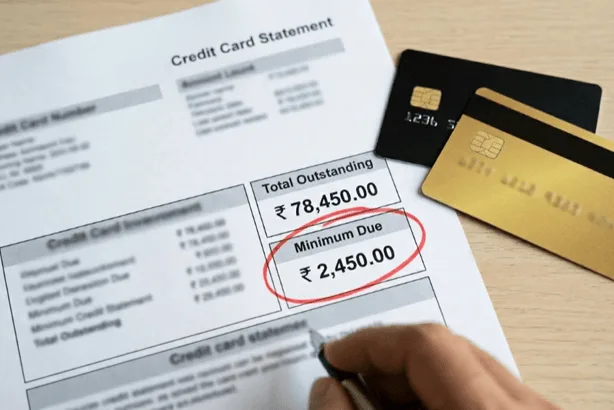
RBI’s rules say what the statement must show. Under its credit card directions (RBI/2022-23/92, updated 7 March 2024), the statement has to carry the APR for different situations, such as shopping, cash withdrawal and missed minimum payments. It must also show how the unpaid amount used for interest was worked out (para 9(b)(i)).
Look for one more thing. RBI requires a prominent warning on every statement about paying only the minimum due (para 9(b)(iii) as read). It says, in short, that paying only the minimum can stretch repayment over months or years while interest builds. Your card’s Most Important Terms and Conditions (MITC) document also explains how interest is charged.
Two small habits make the next sections easier. Keep a plain calculator next to the statement. And write each date down in day-month form, because you’ll be counting days between them.
If you’d rather see how many years the minimum takes to clear a balance, FREED’s credit card minimum due calculator and true cost guide covers that view. This guide stops at the second statement.
Not Sure What Your Cards Take Each Month?
See how much of your salary your EMIs and card dues take.
Check My EMI ScoreWhy Does the Interest-Free Period Disappear When You Pay Only the Minimum?
Before you calculate credit card interest on a minimum payment, know which days count. The interest-free period decides that. It’s the stretch from the day you buy something to your due date. No interest builds in that stretch, but only if you pay the full outstanding amount by the due date. That’s how RBI’s credit card directions define it (para 3(a)(xvi)).
RBI’s term is “interest-free period”. Many people say “grace period” (the common word), but the two aren’t always used the same way in a card’s terms. This guide sticks to RBI’s term. For the grace period itself, see FREED’s guide to what the grace period on a credit card is.
Now the part people miss. The interest-free period isn’t a gift that arrives fresh on every bill. It depends on your earlier bill being cleared. RBI says your card’s terms must state that the interest-free period is suspended if any balance from the previous bill is still unpaid (para 9(b)(iii)). RBI requires the card’s MITC to explain that the interest-free credit period is suspended if any balance from the previous month’s bill remains outstanding. This means new purchases may also attract interest from their transaction dates while the earlier balance remains unpaid. Check your issuer’s terms for the exact treatment.
Two short scenarios show the difference.
- You pay the full bill by the due date every month. You never pay interest, whatever you buy.
- You pay only the minimum once. The unpaid part starts earning interest, and what you buy next month costs interest from the day of purchase, until the old balance is gone.
That second line is why a card balance feels like it has a mind of its own. Without the interest-free period, the 40 or 50 days of interest-free time on each purchase are gone. You’re paying for money you spent weeks ago, plus money you spent yesterday.
How do you spot it on a statement? Check whether interest is charged on purchases made after your last due date. If it is, the interest-free period has been suspended. Most card terms say it returns once the full outstanding amount is cleared, but check yours, because the wording differs.
If you want the short version of why the interest-free period disappears, FREED’s guide to what a minimum due really costs covers it. The next section puts numbers on it.

How Is Credit Card Interest Worked Out Step by Step on a ₹40,000 Bill?
Let’s calculate credit card interest on a minimum payment for one case, start to finish. Treat it as an illustration with the method simplified, not a quote from any bank. (Illustrative example.)
- The card charges 42% a year (3.5% a month).
- You spend ₹40,000 on 1 September, all in one go.
- Your statement is dated 30 September. The minimum due is ₹2,000, which we assume is 5% of the bill. That 5% is for the example only, and it isn’t a law.
- The due date is 20 October. You pay ₹2,000 on that day and spend nothing new.
- Your next statement is dated 30 October.
| Step | Working | Result |
|---|---|---|
| Days from 1 Sep to 20 Oct | Count the days | 49 days |
| Days from 1 Sep to 30 Oct | Count the days | 59 days |
| Interest on the ₹2,000 you paid | 2,000 × 49 ÷ 365 × 0.42 | ₹112.77 |
| Interest on the ₹38,000 you didn’t pay | 38,000 × 59 ÷ 365 × 0.42 | ₹2,579.84 |
| Total interest | Add both, using unrounded figures | ₹2,692.60 |
| GST at 18% on the interest (bank-example rate, confirm on your statement) | 2,692.60 × 0.18 | ₹484.67 |
| Next bill | 38,000 + 2,692.60 + 484.67 | ₹41,177.27 |
The total is calculated using unrounded figures and then rounded to ₹2,692.60. Adding the individually rounded line items may produce a ₹0.01 difference.
Look at the last row. You paid ₹2,000 and spent nothing new, yet the bill rose by ₹1,177.27, from ₹40,000 to ₹41,177.27. Now flip it. If you had paid the full ₹40,000 by 20 October, the interest would be ₹0.
Why is that so surprising? Many people use the rough method: ₹38,000 × 3.5% = ₹1,330. That feels right, so the real figure of ₹2,692.60 comes as a shock. The gap exists because the first cycle carries interest from the purchase date, not from the statement date.
A cross-check helps. One bank’s published example uses the same method: ₹25,000 × 15 ÷ 365 × 45% = ₹462.33. Your own bank’s method decides your bill, and small differences are normal. For a payoff view across many months, see FREED’s guide to how to calculate credit card minimum payment payoff.
See What Your Salary Can Carry
Check how much of your pay goes to EMIs and card dues.
Check My EMI ScoreHow Is the Minimum Due Worked Out, and Why Doesn’t It Cover the Interest?
Look again at the example. Your minimum due was ₹2,000. Yet the next bill carries ₹3,177.27 of interest and GST. Why doesn’t the minimum due cover that?
Because the minimum due on statement 1 didn’t include any interest yet. Interest for the first cycle only lands on statement 2. That’s the shock in the example, and it’s why the balance rose even though you paid on time.
Statement 2 works differently. The minimum amount due is calculated according to the card issuer’s terms. Some issuers use a percentage of the outstanding principal along with interest, taxes, fees and instalments, while the exact formula can vary. Check your MITC or statement for the method used on your card. Banks set their own formula, and 5% is not an RBI number. Check your card’s terms for yours.
Apply that structure to the example. Statement 2’s minimum due would be about ₹5,077.27: 5% of ₹38,000 is ₹1,900, plus ₹2,692.60 interest and ₹484.67 GST. So the minimum due jumps from ₹2,000 to over ₹5,000. It has to, because it now carries the interest. (Illustrative example.)
There’s an RBI rule behind this. The directions say a card’s minimum due must not lead to negative amortisation, meaning a balance that keeps growing even when you pay on time (para 9(b)(ii) and the Annex example). The minimum due must be structured to prevent unpaid taxes, levies and charges from being capitalised into the balance that earns further interest.
That’s also why banks structure the minimum due the way they do. It’s not a gift to you. Without the interest inside it, the balance would never shrink.
Here’s a quick test. Take statement 2’s minimum due, then subtract the interest and the GST. What’s left is the part that actually pays down what you borrowed. In the example, that’s ₹5,077.27 − ₹2,692.60 − ₹484.67 = ₹1,900.
So here’s how to read your own statement. Find the minimum due. Then find the interest and GST lines. If the minimum due is barely above those two, almost none of your payment reduces the amount you borrowed. FREED’s guide to how minimum due is set on your statement goes deeper on the structure, and what minimum payment means covers the basics.
Combine Your Card Dues Into One EMI
FREED’s Loan Consolidation Plan can reduce your monthly EMI burden by up to 50%.* Rates and ranges shown are indicative. Final terms decided by the bank. FREED is not a Loan Provider. No outcome is guaranteed. Please verify directly with your bank.
Check My EligibilityWhat Do GST, Late Fees and Unpaid Charges Add to Credit Card Interest?
Interest is rarely the only line on a statement. Four things sit around it.
- GST on interest. The bank example used here adds 18%. Confirm the rate on your own statement.
- Late payment charges. They apply only on the amount still outstanding after the due date, not on the whole bill (RBI para 9(b)(v)).
- No interest on unpaid charges. RBI says unpaid taxes and charges can’t be capitalised, meaning they can’t be added to the balance on which interest is charged (para 9(b)(ii)).
- Your credit report. A card account can be reported as past due only after it has stayed past due for more than 3 days, counted from the due date (para 9(b)(v) as read).
Take the example again. The ₹484.67 of GST on statement 2 can’t itself earn interest. So if you carried that bill into a third cycle, the interest would be charged on the unpaid principal, not on the GST.
Be careful with one phrase, though. “No interest on interest” is a different claim. RBI’s rule covers unpaid charges and taxes. The bank may still charge interest on the unpaid principal for every day it stays unpaid, and that’s exactly what the formula in this guide does.
Why spell this out? Because people hear “RBI stopped compounding” and relax. That isn’t what the rule says. It protects you from a pile of charges earning their own interest. It doesn’t switch off interest on what you borrowed.
For a bank-by-bank look at fees, see FREED’s guide to credit card late payment charges compared. Fees change often, so use it as a map and check your own statement for the current figure. When you calculate credit card interest, keep fees on a separate line, because they aren’t part of the formula.
How Do You Check the Interest on Your Own Statement in Five Minutes?
Say the interest on your statement looks too high. Before you call anyone, spend 5 minutes on the numbers. Here’s how to calculate credit card interest on your own minimum payment and compare it with the bill.
- Note the yearly rate. Find the APR on your statement. You need it as a yearly figure, because the formula divides by 365.
- List each purchase and its date. Interest runs from these dates, so they set your days.
- Count the days. Count from each purchase date to your payment date, and then to the next statement date. A calendar or a date counter works fine.
- Apply the formula. Use days ÷ 365 × amount × rate on the paid and unpaid amounts, as in the ₹40,000 example.
- Compare with the statement. Allow for small rounding or day-count differences, since banks count days a little differently.
Don’t conclude that your bank is wrong. A gap can come from a purchase date you misread, a fee you missed, or a method your card’s terms describe differently. If the gap is large, ask the bank to explain the working in writing. You can also check how your cards appear on your report with Credit Insights before you write.
If the reply doesn’t settle it, use the bank’s grievance officer. Check your card statement and MITC for the issuer’s grievance-redressal contact details and escalation process. RBI’s applicable directions require card issuers to disclose grievance-redressal information, including the contact details of the designated grievance official.
Still stuck? You can take it to the RBI Ombudsman (the official who handles complaints against banks). You may approach the RBI Ombudsman if the bank does not respond within the applicable 30-day period, or if you are dissatisfied with its response, provided the bank and complaint are covered by the scheme. Filing is free. Check the scheme’s applicable filing deadline before submitting your complaint. If the dispute turns into pressure from recovery agents, FREED’s guide on where to file a complaint against a recovery agent shows the next step.

FREED Expert Tip
A question raised in the first week still leaves you time to pay on time. See how every card and loan shows on your report.
Check My Credit InsightsDoes Paying More Than the Minimum Reduce the Interest?
Yes, over time. But in the same cycle, less than most people expect. Let’s keep going with the same example.
Say you paid ₹10,000 on 20 October instead of ₹2,000. Everything else stays the same.
| Pay ₹2,000 | Pay ₹10,000 | |
|---|---|---|
| Interest on the part you paid (to 20 Oct, 49 days) | ₹112.77 | ₹563.84 |
| Interest on the part you didn’t pay (to 30 Oct, 59 days) | ₹2,579.84 | ₹2,036.71 |
| Total interest | ₹2,692.60 | ₹2,600.55 |
The ₹10,000 case works out as ₹10,000 × 49 ÷ 365 × 0.42 = ₹563.84, plus ₹30,000 × 59 ÷ 365 × 0.42 = ₹2,036.71. Total ₹2,600.55. That’s only ₹92.05 less than ₹2,692.60. (Illustrative example.)
Why so small? The extra ₹8,000 only saves interest for the last 10 days: ₹8,000 × 10 ÷ 365 × 0.42 = ₹92.05. Once the interest-free period is lost, interest already runs from the purchase dates. Paying more on 20 October can’t undo the 49 days before it.
So is it pointless to pay more? No. Paying more is still better, and the real benefit shows up next. You carry ₹30,000 forward instead of ₹38,000. That ₹8,000 difference saves about ₹276 in interest over each 30 days (8,000 × 30 ÷ 365 × 0.42). Every cycle after this one costs less.
One more habit helps. If you can pay extra, pay it as soon as you have it instead of waiting for the due date. Interest on the paid part stops on the day you pay, so each day sooner saves about ₹9.21 on ₹8,000 (8,000 × 1 ÷ 365 × 0.42). Over 10 days that’s the ₹92.05 you saw above.
For ordinary retail purchases, paying the total amount due by the payment due date is generally the way to retain the interest-free period and avoid purchase interest. Cash advances, balance transfers, EMI transactions and other card features may have separate interest and fee terms. This all follows the method a bank has published. Your card’s terms decide your actual bill.
If paying much more isn’t possible, there’s another route. Some banks let you turn the bill into fixed instalments. FREED’s guide to credit card EMI conversion explains how that works and what to check. Compare the rate and fees first. And what happens if you pay only the minimum lays out the longer-term effects.
Want One Lower EMI Instead of Card Bills?
One monthly EMI instead of several, with the process handled for you. Rates and ranges shown are indicative. Final terms decided by the bank. FREED is not a Loan Provider. No outcome is guaranteed. Please verify directly with your bank.
Reduce My EMIWhat Can You Do When the Card Balance Keeps Growing?
The bill has grown for several months. You’ve paid on time, and the number still isn’t dropping. That’s a common spot to be in, and you have options. Here they are, in order.
- Pay the full bill once, if you can, and then stay on full payment. This is the only way to get the interest-free period back.
- Ask the bank to turn the balance into EMIs. This gives you a fixed amount and a fixed end date. Check the rate and fees first, and read FREED’s guide to credit card EMI conversion.
- Try a balance transfer. This moves the balance to another card, often at a lower rate for a set period. Read the fees carefully, and see balance transfer credit cards in India.
- Combine several dues into one EMI. This suits you if you’re juggling more than 1 card or loan. FREED’s guide to consolidating credit card debt explains the idea.
On that last option, here’s the neutral line. “If most of your salary goes towards paying multiple EMIs, FREED’s Loan Consolidation Plan helps you combine multiple loans into a single monthly EMI. This can reduce your monthly EMI burden by up to 50%.*”
It’s for people who are still paying. If you’ve missed payments, talk to your bank or get guidance first. You can also see how your payments stack up with the EMI Score.
And if repaying has become genuinely impossible, a different path exists. It is for that situation only, and the next section explains it. For most readers, the steps above come first, and many people never need more than the first or second one.
*Rates and ranges shown are indicative. Final terms decided by the bank. FREED is not a Loan Provider. No outcome is guaranteed. Please verify directly with your bank.
Genuinely Unable to Repay Your Card Dues?
FREED negotiates with your banks to settle for less than 50%* of your outstanding dues. Rates and ranges shown are indicative. Final terms decided by the bank. FREED is not a Loan Provider. No outcome is guaranteed. Please verify directly with your bank.
Settle My LoansHow FREED Helps With Credit Card Dues Growing on the Minimum
You can work out your own interest, and the steps above fix a lot. FREED is for when the balance has already gone beyond that.
Loan Consolidation Plan, For People Still Paying
If most of your salary goes towards paying multiple EMIs, FREED’s Loan Consolidation Plan helps you combine multiple loans into a single monthly EMI. This can reduce your monthly EMI burden by up to 50%.*
Here’s how it runs. FREED assesses your profile and matches you to a lending partner. The partner disburses one new loan that pays off your existing dues. FREED handles the process end to end.
There’s no FREED fee to the customer, and the lending partner’s fees may apply. Your credit score doesn’t drop with consolidation.
Loan Settlement Plan, Only If You Can’t Repay
Settlement is not something a borrower chooses out of preference. FREED works with borrowers to approach lenders and discuss possible settlement options. The lender decides whether to accept a settlement and determines the amount and terms.
The process starts with an assessment and a personalised plan. You save an agreed amount through a settlement account arrangement administered by an independent trustee. Before enrolling, review the account documents to understand the legal account structure, access and withdrawal controls, payment authorisation process and treatment of any remaining balance if you leave the programme. FREED negotiates with each bank once enough is saved. The bank decides the terms. No bank is paid until you authorise it, and you receive a settlement letter from the bank at the end.
Based on FREED’s reported programme experience, the first settlement may take around four months, while the full programme may take approximately 1.5 years. Actual timelines vary depending on the borrower’s savings, lender response, negotiations and payment terms. These are indicative timelines, not guarantees. Fees are success-based, and the evaluation fee is non-refundable. A “Settled” mark can stay on your credit report for up to 7 years. The Loan Settlement Plan is only for people who can’t repay.
The founding team of FREED brings over 50 years of combined experience in the US loan settlement industry. So far, 33,000+ accounts have been settled, with ₹500 Cr+ in settlement amount.
*Rates and ranges shown are indicative. Final terms decided by the bank. FREED is not a Loan Provider. No outcome is guaranteed. Please verify directly with your bank.
Combine Your Loans Into One EMI With FREED
One monthly EMI instead of several, with the process handled for you.
Reduce My EMI
Mohit Juneja
Mohit Juneja is FREED’s Content & Communication Lead with 12+ years of experience across content, media, advertising and digital communications. He holds a postgraduate diploma in Communications from Xavier Institute of Communications, Mumbai, and has worked with organisations including NDTV, The Indian Express, McCann Worldgroup and NABARD.
At FREED, he leads content and communication across loan management, debt resolution, debt consolidation and financial well-being. His work combines research, storytelling and consumer-focused communication to make complex financial topics easier to understand and act on. He has also scripted and produced 11 documentaries on rural development and agriculture for NABARD, with film's selected for the Mumbai International Film Festival.
mohit.juneja@freed.care

FREED is India's trusted loan management platform. We help India settle their loans, consolidate their EMIs, improve their credit score, and manage their loans better. Over 20 lakh people trust FREED. We have managed more than ₹3,500 crore in loans and saved our users over ₹450 crore.
Media Mentions