Credit Card Minimum Payment Means: What the Bank Statement Shows
The minimum payment on your credit card statement is the smallest amount your bank will accept by the due date to keep your account in good standing. It mostly covers interest, fees, and a small part of what you owe, not your actual spending. Paying only this amount keeps a late fee away, but the rest of your balance stays on the statement and keeps earning interest.
Mohit Juneja
Reviewed by FREED India, Debt Resolution Specialists

 4.7/5
4.7/5 ₹3,200Cr+
 20,000+
 20,00,000+4.7/5₹3,200Cr+20,000+20,00,000+
KEY TAKEAWAYS

Credit card minimum payment means roughly 2 to 5% of your outstanding balance, not the full bill.
MAD sits right below TAD in your statement's payment summary box, usually on the first page.
Paying only MAD lets interest run on the full remaining balance from day one, not just the unpaid part.
From 2025-26, RBI rules require the minimum due to include a fixed slice of actual principal, not just interest and fees.
A meaningful share of Indian cardholders pay only the minimum amount every month, and the balance rarely shrinks because of it.
What Does Credit Card Minimum Payment Mean
Credit card minimum payment means the smallest amount your bank will accept by the due date so your account stays in good standing. It is not what you owe. It is the floor amount that keeps a late fee off your statement and stops your account from being reported as overdue.
Your bank shows this figure clearly as "Minimum Amount Due" or MAD. It sits next to a bigger number called "Total Amount Due" or TAD. TAD is your full outstanding bill. MAD is usually 2% to 5% of that TAD, though some banks add a flat minimum amount on top, so you never pay less than a fixed floor, say ₹100 or ₹200, even on a small bill.
Here is a simple example. If your TAD is ₹20,000 and your bank's MAD rate is 5%, your minimum due works out to ₹1,000. Pay that ₹1,000 by the due date and no late fee gets added. But the remaining ₹19,000 does not disappear. It stays on your account, and interest starts building on it right away.
If you miss even this minimum amount, the consequences are immediate. If the overdue continues in accordance with the lender's reporting practices, it may be reported to the credit bureau. That is why understanding this one line on your statement matters more than most people realise. It looks like a small, harmless number. It is actually the difference between staying compliant and slipping into a cycle that is hard to climb out of.

What Does Credit Card Minimum Payment Mean
Credit card minimum payment means the smallest amount your bank will accept by the due date so your account stays in good standing. It is not what you owe. It is the floor amount that keeps a late fee off your statement and stops your account from being reported as overdue.
Your bank shows this figure clearly as "Minimum Amount Due" or MAD. It sits next to a bigger number called "Total Amount Due" or TAD. TAD is your full outstanding bill. MAD is usually 2% to 5% of that TAD, though some banks add a flat minimum amount on top, so you never pay less than a fixed floor, say ₹100 or ₹200, even on a small bill.
Here is a simple example. If your TAD is ₹20,000 and your bank's MAD rate is 5%, your minimum due works out to ₹1,000. Pay that ₹1,000 by the due date and no late fee gets added. But the remaining ₹19,000 does not disappear. It stays on your account, and interest starts building on it right away.
If you miss even this minimum amount, the consequences are immediate. If the overdue continues in accordance with the lender's reporting practices, it may be reported to the credit bureau. That is why understanding this one line on your statement matters more than most people realise. It looks like a small, harmless number. It is actually the difference between staying compliant and slipping into a cycle that is hard to climb out of.
Why Banks Show a Minimum Due on Every Statement
Banks are not trying to encourage you to carry a balance. The minimum due exists as a safety net for genuine cash flow problems, not as a repayment plan you are meant to follow every month.
Think of Priya, a working professional in her early 30s. Her salary usually covers her card bill comfortably. But one month, an unexpected medical expense at home eats into her budget, or her salary gets delayed by a few days because of a payroll issue at her company. In that one month, paying the full ₹20,000 bill is simply not possible. The minimum due option lets her pay ₹1,000, avoid a late fee, and keep her account in good standing while she gets her finances back on track the following month.
This is exactly what MAD is designed for, a short term cushion, not a long term strategy. The problem starts when this becomes a habit rather than an exception. Credit card interest in India typically runs between 36% and 42% annually, among the highest rates of any borrowing product available to consumers. When you carry a balance for even two or three months instead of one, that interest compounds fast and turns a manageable bill into a growing one.
Banks are upfront that MAD is available every month, but they are not designed to warn you when using it repeatedly stops being a one-off adjustment and starts becoming your normal payment pattern. That distinction is something you have to track yourself, and it is exactly what the next section walks you through.
Signs Your Minimum Payment Habit Is Becoming a Problem
A single month of paying only the minimum due is not a red flag. It becomes one when the pattern repeats and your finances stop improving because of it. Watch for these signs.
- You have paid only MAD for three or more months in a row. One month can be a genuine cash crunch. Three months in a row usually means your income and expenses are no longer balancing out, and the card is quietly filling that gap.
- Your outstanding balance is not shrinking, even though you are paying every month. If your TAD stays roughly the same or keeps creeping up despite regular MAD payments, interest is outpacing whatever small amount you are putting in.
- You are still using the same card for daily spends while a balance is outstanding. New purchases on a card that already carries a balance attract interest from the transaction date itself, since the interest free period on new spends disappears once you are carrying forward dues.
- You have more than one card on MAD-only payments. When two or three cards are all running on minimum payments at the same time, the combined interest burden usually grows faster than most people realise until they add up the actual numbers.
If two or more of these describe your situation right now, it is worth stepping back and looking at your full picture, not just this month's bill.
How Minimum Payment Is Calculated on Your Statement
The exact formula varies slightly bank to bank, but the general method stays consistent across most Indian card issuers. Understanding it helps you predict your own MAD before the statement even arrives.
- Start with a percentage of your Total Amount Due. Most banks apply 2% to 5% of your outstanding TAD as the base minimum.
- Add any past dues carried forward. If you missed a minimum payment last cycle, that unpaid amount gets added on top of this cycle's calculated percentage.
- Add EMI portions, if you have converted any purchase to EMI. The EMI instalment due this month is added in full, since EMI amounts are treated separately from the revolving balance.
- Compare against the bank's fixed floor amount. Banks set a minimum floor, commonly ₹100 to ₹200, and you pay whichever is higher between the percentage calculation and this floor.
Here is a worked example. Say your TAD is ₹20,000, your bank's rate is 5%, you have no past dues, and no EMI conversions. Your MAD calculates to ₹1,000. Now assume the same ₹20,000 TAD, but you missed ₹500 of last month's minimum. This month's MAD becomes ₹1,000 plus ₹500, which is ₹1,500. The past due amount does not vanish, it stacks directly onto the current cycle.

What the Law Says
From 2025-26, RBI rules require your minimum due to include a fixed slice of actual principal, not just interest and fees.
Check Your Credit InsightWhere to Find Minimum Due on Your Credit Card Bank Statement
Every Indian credit card statement follows a broadly similar layout, even though the exact design differs slightly from bank to bank. Knowing what to look for saves you from scanning the entire document every month.
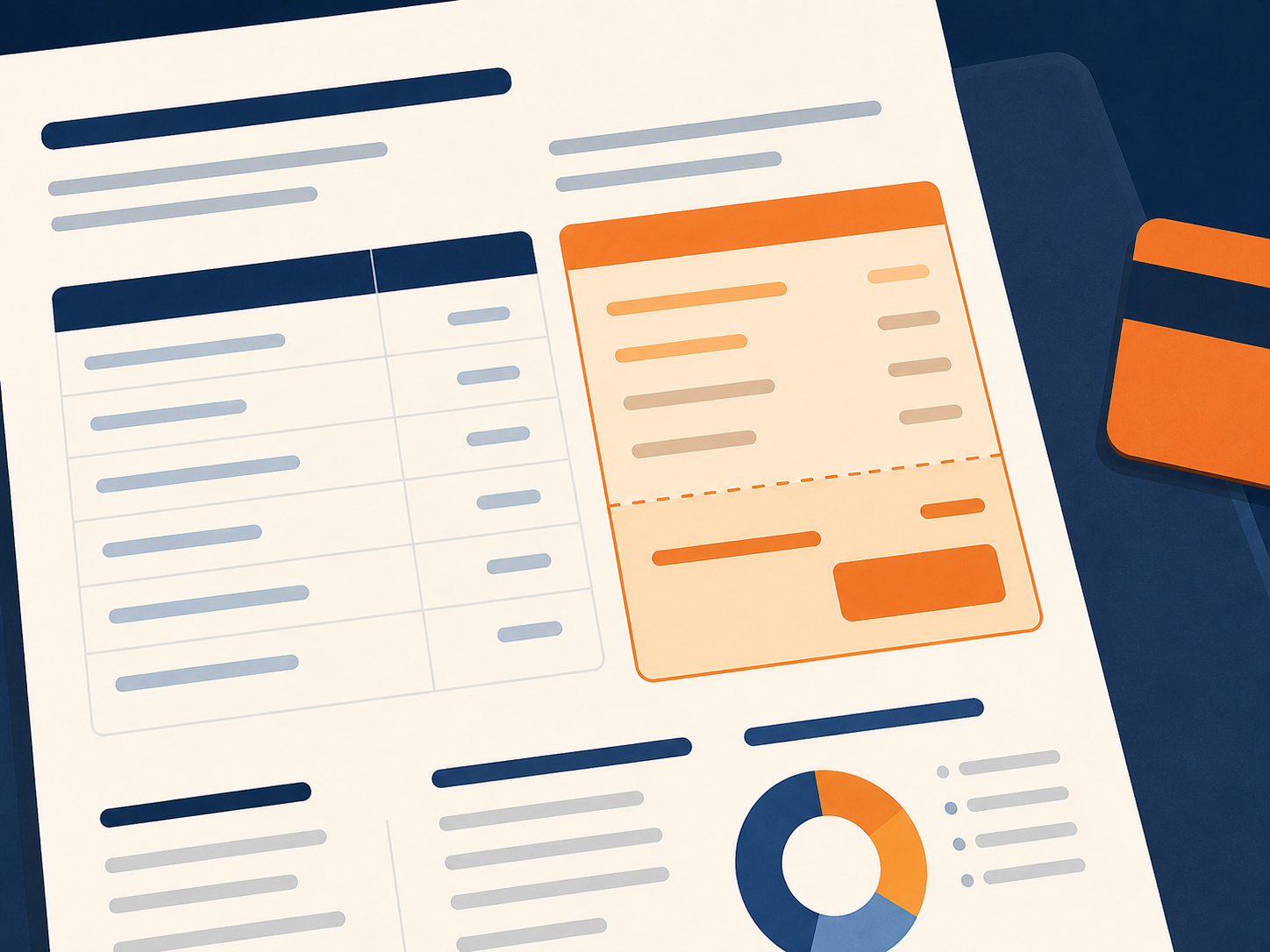
At the very top of your statement, usually on the first page, sits a box often labelled "Payment Summary" or "Account Summary." This box is where TAD and MAD sit side by side, almost always with TAD shown first in a larger or bolder font, and MAD shown just below or beside it in smaller text. Your payment due date appears directly next to or just under this box, so all three numbers, TAD, MAD, and the due date, are visible together at a glance.
Below this summary box, many statements carry a separate warning section, sometimes titled something like "Minimum Amount Due Warning" or a similar phrase. This section is a regulatory requirement across Indian banks and typically shows a projection: if you only ever pay the minimum due, how many years it would take to clear your current balance, and roughly how much total interest you would end up paying. This box exists specifically to make the long-term cost of minimum payments visible, and it is worth reading carefully every single month, not skipping past it.
Further down the statement, in the detailed transaction section, you will usually find a breakdown showing how your MAD was calculated, the percentage applied, any past dues added, and any EMI portions included. If your statement does not show this breakdown clearly, you can always call your bank's customer care number for a plain explanation of how your specific minimum due figure was reached.
Comparison: What Paying Only the Minimum Actually Costs
Outstanding Balance | Minimum Due (5%) | Approx. Years to Clear if Only Minimum Paid | Rough Total Interest Paid |
₹20,000 | ₹1,000 | 3 to 4 years | ₹10,000 to ₹14,000 |
₹50,000 | ₹2,500 | 5 to 7 years | ₹35,000 to ₹45,000 |
₹1,00,000 | ₹5,000 | 8 to 10 years | ₹80,000 to ₹1,00,000 |
Figures are indicative, based on typical Indian credit card interest rates of 36% to 42% annually, and assume no new spends are added to the card during this period. Actual figures depend on your specific bank's rate and MAD structure.
This table shows why minimum due, while useful for one difficult month, turns expensive fast when it becomes the default. A ₹20,000 balance paid off only through minimum payments can end up costing more in interest than the original amount borrowed, stretched across several years.
What Are Your Options if You Can Only Pay the Minimum
If you find yourself only able to pay MAD month after month, there are structured options worth looking at before the balance grows further.
Option 1: Balance transfer. If your credit score is still healthy, you may be able to move your outstanding balance to another card offering a lower interest rate, sometimes with an interest free window for a few months. This works best when you have one card with a manageable balance and a reasonably good repayment history.
Option 2: Debt consolidation. If you are managing more than one card, or a card plus a personal loan, and juggling multiple minimum dues every month, consolidating everything into a single new loan can simplify things. FREED's Debt Consolidation Program is built for exactly this situation, still paying but stretched across too many due dates. FREED's Debt Consolidation Program may combine eligible unsecured debts into a single repayment, depending on the approved loan amount, tenure, and lender terms. This moves your repayment behaviour onto a single, regular track, and once your accounts are consolidated and reporting reflects that consistency, it's generally viewed favourably in future lender assessments.
Both options work best while you are still current on your payments. The earlier you act, the more choices you have.

How FREED Helps If You Are Juggling Minimum Dues on Several Cards
If you have reached a point where you are tracking two, three, or more minimum due dates every month, FREED's Debt Consolidation Program is designed to bring that down to one.
Here is what the process looks like. You share your existing loan and credit card details along with your income with FREED. FREED assesses your financial profile and matches you to a suitable lending partner from its network. That lending partner then disburses one new consolidated loan, which instantly pays off all your existing eligible credit card dues and unsecured loans. From that point, you have one loan, one EMI, one due date, one lender to deal with, instead of several. FREED charges a success-based fee, only once the consolidation is actually completed.
This is not a loan settlement product and does not involve negotiating a lower payoff amount with your bank. It simply restructures how many payments you are managing every month, and may simplify repayment into a single loan, depending on the approved loan terms. If you are unsure whether your situation qualifies, FREED's team can assess it on a free call and tell you what options are available to you.

See if Consolidation Fits Your Cards
One lower EMI instead of juggling minimum dues on every card.
Get a Free EMI AssessmentTips: What Helps While You Pay Down the Balance
Are You in a Loan Trap? Quick Check
Move the slider to your total EMIs as a % of monthly salary. See your debt stress level instantly.
EMIs as % of Monthly Salary
Sources
Claim | Source |
RBI requirement that minimum due include a fixed slice of principal | [LEGAL FLAG, reviewing team to verify and cite the specific RBI circular or Master Direction before publish; no working link confirmed at draft stage] |
Note: No other claim in this blog traces to a specific, locatable RBI circular or regulator document. Interest rate ranges, MAD percentages, late fee ranges, and payoff timelines are industry-typical figures without a codified regulatory source, and are worded as indicative throughout the body rather than included in this table.

Mohit Juneja
Mohit Juneja writes educational content at FREED on debt management, credit scores, loan repayment, and borrowing best practices. His content is shaped by expert insights and industry knowledge, helping readers better understand their financial options and make informed decisions.
mohit.juneja@freed.care

FREED is India's trusted loan management platform. Founded in 2020 and headquartered in Gurugram, FREED has counselled 20 lakh+ people on personal loans, credit cards, and app loans. FREED charges fees only on successful settlement, not upfront. FREED does not handle secured loans (home loans, car loans, gold loans).
Media Mentions