Revolving Credit Meaning: How It Works and Why It Keeps You in Debt
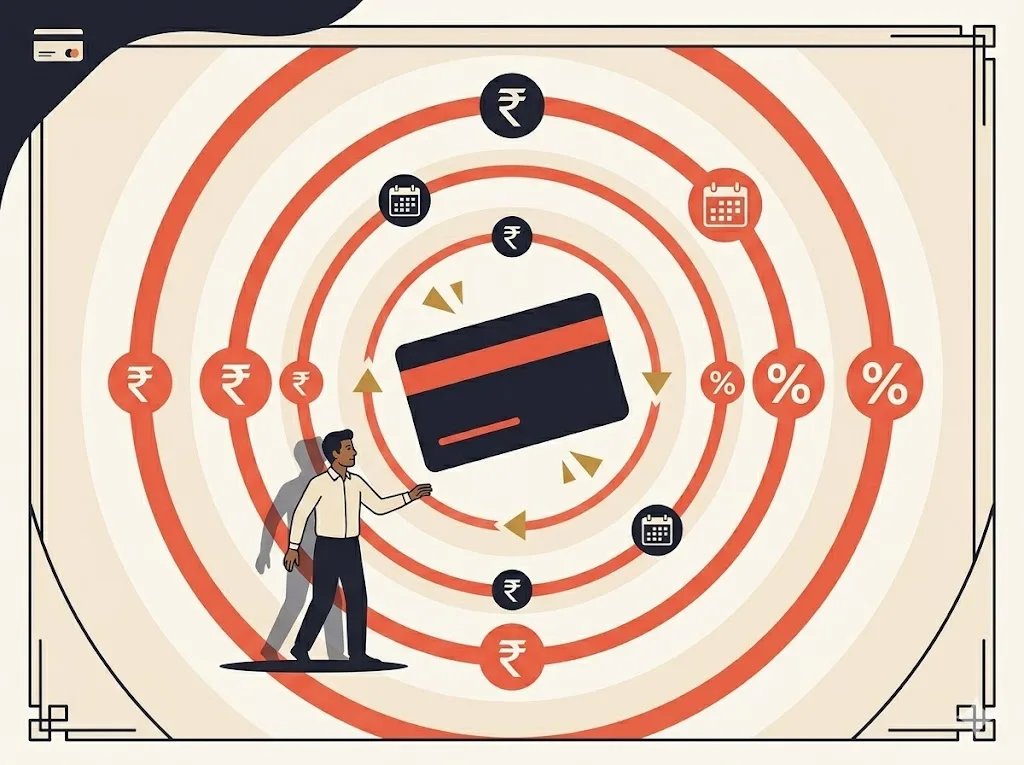
Revolving credit means a reusable credit limit, like a credit card, that refills as you repay it instead of closing like a fixed loan. There's no end date and no fixed EMI. That flexibility is exactly what makes it easy to slide into a debt cycle that quietly grows every month.
Mohit Juneja
Reviewed by FREED India, Debt Resolution Specialists
 4.7/5
4.7/5 ₹3,200Cr+
 20,000+
 20,00,000+4.7/5₹3,200Cr+20,000+20,00,000+
KEY TAKEAWAYS

Revolving credit has no fixed end date, unlike instalment loans that close on a set schedule.
Credit card interest in India commonly runs 36% to 42% annually, among the highest of any borrowing product.
Paying only the minimum due means interest is charged on the full outstanding balance, not just the leftover part.
Many Indian cardholders pay only the minimum each month without realising how slowly the balance actually shrinks.
If repayment becomes genuinely impossible, settlement is the last resort. It is not something a borrower chooses out of preference.
Why Does Revolving Credit Quietly Turn Into a Debt Trap
Nobody sets out to get stuck in revolving debt. It happens gradually, one manageable-looking month at a time, which is exactly what makes it hard to notice until the balance has grown a lot.
Here's the pattern. Say Priya has a ₹40,000 balance and pays the ₹2,000 minimum due. It feels responsible, she's paid something, the account is current, and nothing looks urgent. But credit card interest in India commonly runs between 36% and 42% annually, some of the highest rates on any consumer credit product. That works out to roughly 3% a month. On a ₹38,000 remaining balance, that's over ₹1,100 in interest alone, added before she's even made a single new purchase.
So of her ₹2,000 payment, more than half went straight to interest. The principal barely moved. Next month, if she spends even a little more, the balance doesn't shrink; it grows. This is genuinely common; a meaningful share of Indian cardholders pay only the minimum due each cycle, often without fully realising how much of that payment is interest rather than actual debt reduction.
The trap isn't reckless spending. It's the gap between what "paying something" feels like and what it actually does to the balance. Each month looks fine in isolation. It's only months later, looking at a balance that hasn't moved despite regular payments, that the pattern becomes visible.

FREED Expert Tip
Paying only the minimum due means your balance can take much longer to clear because interest continues to apply to the outstanding amount. If you're finding it difficult to keep up, it may be worth reviewing your repayment options.
Check Your OptionsThe Three Stages of a Revolving Credit Spiral
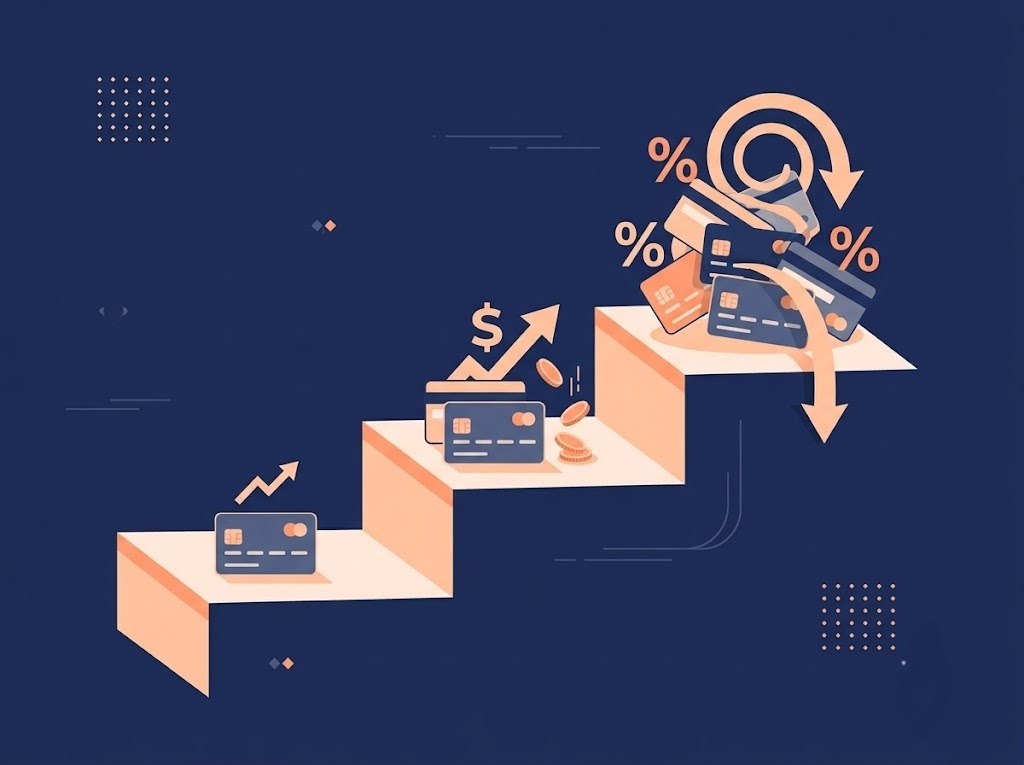
The slide from manageable to unmanageable tends to move through three recognisable stages.
Stage 1: The minimum due feels fine. The balance creeps up slowly, a little more spent than repaid each cycle, but nothing about any single month feels alarming.
Stage 2: Multiple cards enter the picture. Often, to cover a shortfall or handle an unexpected expense, another card gets opened. Now more of each month's total payment goes toward interest across two or three cards, and less toward actually reducing what's owed.
Stage 3: The balance stops shrinking no matter what's paid. Interest is outpacing repayment. This is usually when recovery calls start, and when the situation shifts from "manageable if I'm careful" to something that needs a real plan.
Recognising which stage you're in matters, because the right move at Stage 1 (pay more than minimum, stop new spending) is very different from what's needed at Stage 3.
Revolving Credit vs Instalment Credit: What's the Real Difference
Feature | Revolving Credit (Credit Card) | Instalment Credit (Personal Loan) |
End date | None, ongoing | Fixed tenure |
Repayment | Flexible, minimum due allowed | Fixed EMI every month |
Interest rate (India) | 36%–42% annually | 10%–24% annually |
Limit behaviour | Refills as you repay | One-time disbursal doesn't refill |
Best suited for | Short-term, paid in full monthly | Planned, larger one-time expenses |
Rates are indicative and vary by bank and borrower profile. This isn't a recommendation to switch products without assessing your own situation. FREED is not a Loan Provider and does not guarantee any specific outcome.

What the Law Says
Under RBI's Master Direction on Credit Card and Debit Card Issuance and Conduct, 2022, card issuers must disclose the Annual Percentage Rate (APR), the true annualised cost of credit, including interest and other charges, with equal prominence on billing statements. This is meant to make the real cost of revolving a balance clear upfront, not buried in fine print.
Check Your OptionsHow to Tell If You're Already Stuck in the Revolving Trap
A few signs suggest the balance has moved past "manageable" into something that needs attention.
- Your balance never reaches zero, even in months where you didn't spend much beyond your usual bills.
- You're using one card to pay another, a cash advance or a new card covering an old card's minimum due. This is one of the clearest signs the balance has outgrown what regular income can absorb.
- If a large share of your monthly income is going towards EMIs and minimum dues, it may be a sign that your repayments are becoming difficult to manage.
None of these signs means something has gone badly wrong. They mean it's time to shift from habit-level fixes to a more structural one, which is exactly what the next section covers.

What Are Your Options to Break the Cycle
If you're still able to pay, and the issue is the interest and structure of revolving credit rather than an inability to pay at all, there's a clear order of options worth working through.
Pay more than the minimum whenever you can. Even an extra ₹1,000 or ₹2,000 above the minimum due meaningfully speeds up how fast the principal actually shrinks, since more of that payment goes toward the balance instead of interest.
Stop new spending on the card while the balance is outstanding. Every new purchase adds to what's accruing interest, which works directly against whatever progress you're making on repayment.
Consider a balance transfer or EMI conversion. Moving the balance to a card with a lower promotional rate, or converting it into a fixed EMI, can bring structure and a lower rate to what's currently open-ended and expensive.
If you're managing multiple cards and repayments are becoming difficult to keep track of, FREED's Debt Consolidation Program may be worth exploring. It helps eligible borrowers combine multiple revolving balances into a single loan with one fixed EMI. Loan terms, including interest rates, depend on the lending partner and your individual profile.
This section is specifically for readers who are still able to pay, just stretched thin by the structure of revolving credit. If repayment has genuinely stopped being possible, that's a different conversation, covered next.
How FREED Helps When Revolving Credit Becomes Unmanageable
For someone like Priya, still working, still able to pay something each month, but genuinely stretched across two or three revolving balances, FREED's Debt Consolidation Program (also called the Loan Consolidation Plan, or "Reduce My EMI") is usually the most direct fit.
Here's how it works. FREED assesses your full financial profile, then matches you to a lending partner from its network. That partner issues one new loan that pays off your existing revolving balances in a single transaction. Instead of tracking several minimum dues across different cards each month, you're left with one loan, one EMI, one date. Because the new loan replaces multiple revolving balances with a structured repayment plan, it may make repayments easier to manage. The impact on your credit profile depends on your overall repayment behaviour and individual circumstances. FREED only charges a fee once the consolidation actually completes, nothing upfront.
This is the right fit for the reader this section describes, someone still paying, just stuck with the wrong structure. If repaying in full has genuinely stopped being possible, that's a different territory. Settlement is not something a borrower chooses out of preference. Banks generally consider it only when someone is facing genuine financial difficulty and repaying the full amount is no longer realistic. For that situation, FREED's Loan Settlement Plan exists as a separate, structured path, but it's a last resort, not the starting point for someone simply juggling revolving balances.
Explore Whether Debt Consolidation Is Right for You
Combine your revolving balances into a single reduced payment.
Check if I Qualify for ConsolidationSimple Habits to Stay Ahead of Revolving Credit
A few consistent habits keep revolving credit working in your favour instead of against you.
- Pay the full statement balance whenever you can. This is the single most effective habit; it keeps you in the interest-free window entirely, rather than starting the 36-42% clock at all.
- Track your credit utilisation and try to keep it at a reasonable level. High utilisation may affect your credit profile, even if you make your payments on time.
- Set up auto-debit for at least the minimum due, so a missed payment never happens by accident. Ideally, set it for the full statement amount if your cash flow allows.
- Avoid opening new cards while an existing balance is outstanding. Another limit doesn't reduce what's already owed; it just adds another account to track and another minimum due to remember.
None of these requires dramatic changes, just consistency, applied before a balance has a chance to compound.
Sources
Claim | Source |
Card issuers must disclose the Annual Percentage Rate (APR) with equal prominence on billing statements | RBI Master Direction – Credit Card and Debit Card – Issuance and Conduct Directions, 2022, dated April 21, 2022 (updated March 7, 2024): rbi.org.in/Scripts/BS_ViewMasDirections.aspx?id=12300 |
Interest may only be charged on the outstanding amount after adjusting payments, not the full total amount due | Same RBI Master Direction, Query 6 of the accompanying FAQ: rbi.org.in/commonman/Upload/English/FAQs/PDFs/FAQMDCreditCardandDebitCard.pdf |

Mohit Juneja
Mohit Juneja writes educational content at FREED on debt management, credit scores, loan repayment, and borrowing best practices. His content is shaped by expert insights and industry knowledge, helping readers better understand their financial options and make informed decisions.
mohit.juneja@freed.care

FREED is India's trusted loan management platform. Founded in 2020 and headquartered in Gurugram, FREED has counselled 20 lakh+ people on personal loans, credit cards, and app loans. FREED charges fees only on successful settlement, not upfront. FREED does not handle secured loans (home loans, car loans, gold loans).
Media Mentions