Credit Card Late Payment Charges: Banks Compared and How to Avoid Them
What are credit card late payment charges? Credit card late payment charges are fees applied when the Minimum Amount Due (MAD, the smallest payment a bank accepts to avoid a penalty, typically 5% of the outstanding balance or Rs. 200, whichever is higher) is not paid by the due date. Fees range from Rs. 100 to Rs. 1,300 across banks depending on the outstanding balance, plus 18% GST.
Mohit Juneja
Reviewed by FREED India, SEO Intern
 4.7/5
4.7/5 ₹3,200Cr+
 20,000+
 20,00,000+4.7/5₹3,200Cr+20,000+20,00,000+
Key summury

All major Indian banks, including HDFC, SBI, ICICI, Axis, and Kotak, charge late payment fees on a slab system. The higher the outstanding balance, the higher the fee.
The late fee is charged once per billing cycle, not daily. But interest of up to 3.75% per month starts running daily from the original transaction date, not from when the payment was missed.
Interest-free periods of up to 50 days exist on most cards but are lost entirely the moment any balance is carried forward, even a small one.
A payment delayed by 30 days or more may be reported to the credit bureau as overdue, which can affect future lending decisions.
Late payment entries stay on a CIBIL report for up to 7 years.
What Are Credit Card Late Payment Charges and What Triggers Them?
Two separate charges apply when a credit card payment is missed. Most cardholders treat them as the same thing. They are not.
The first is the late payment fee: a flat, one-time amount charged per billing cycle the moment the due date passes without a minimum payment received. Not per day of delay. Once per cycle.
The second is the finance charge: daily interest on the unpaid balance, calculated retroactively from the original transaction date, not from when the payment was missed. This is almost always the more expensive of the two.
Two terms to know before going further:
Minimum Amount Due (MAD): The smallest payment a bank accepts to avoid a late fee. The percentage and minimum amount vary by issuer and card product. Check your specific card's most current terms or your bank's official website for the figure that applies to you.
Total Amount Due (TAD): The full outstanding balance. Paying this in full every month is the only way to avoid interest entirely.
Most cards offer an interest-free period of up to 50 days from the transaction date. This window exists only if the previous month's full balance was paid in full. Carry any balance forward and the interest-free period disappears for all purchases in the next cycle too.
Here is what that looks like in practice. You spend Rs. 15,000 on the 5th of the month. Due date is the 25th of the following month, which is 50 days. If the previous balance was fully paid, no interest accrues for those 50 days. But if you pay only Rs. 5,000 on the 25th and carry Rs. 10,000 forward, interest is calculated from the 5th on the full Rs. 15,000, not just on the Rs. 10,000 unpaid portion, and not from the 25th. That retroactive calculation catches most cardholders off guard.

Credit Card Outstanding Growing Every Month?
Get a free assessment of your situation. No commitment, no pressure.
Get My Free AssessmentCredit Card Late Payment Charges: All Major Banks Compared
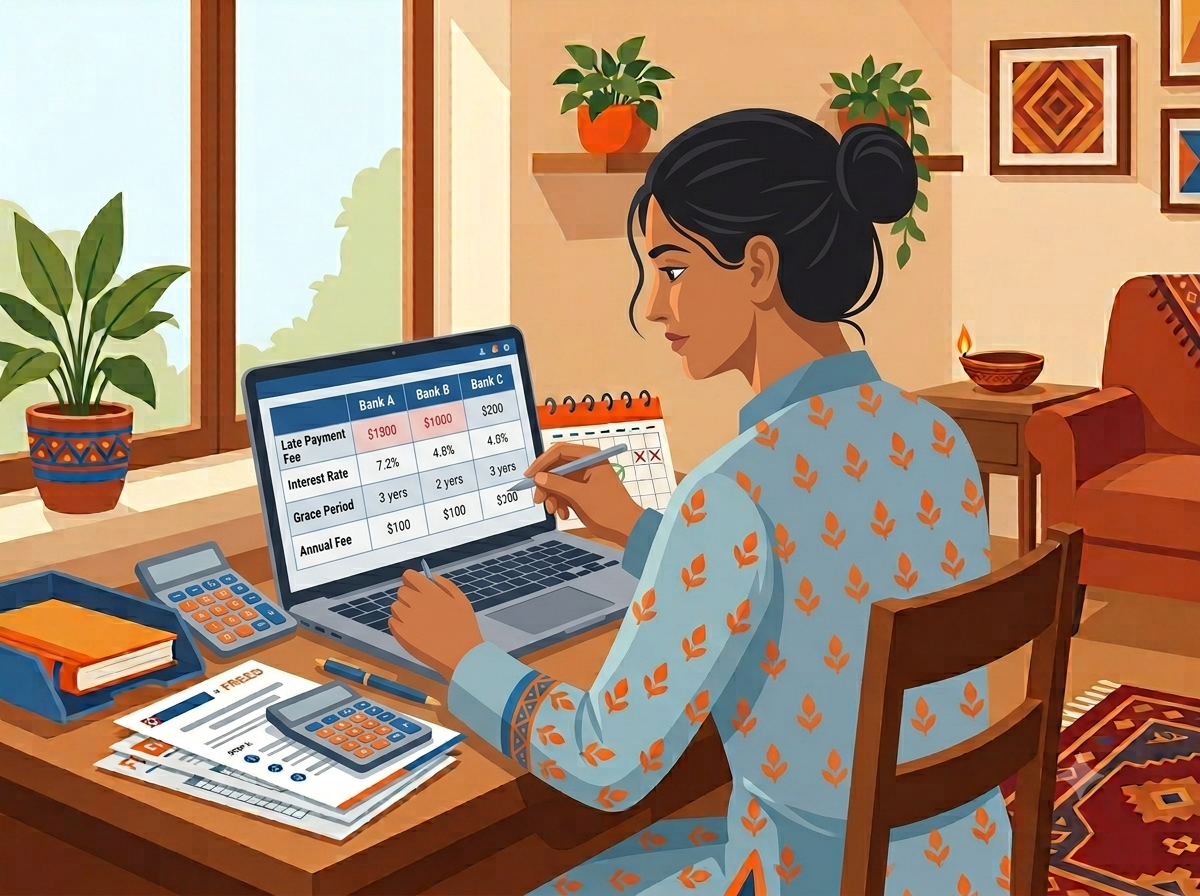
Here are the exact slab-by-slab late payment fees across HDFC, SBI Card, ICICI, Axis, and Kotak. All figures exclude 18% GST.
Late Payment Fee Slabs by Bank
Outstanding Balance | HDFC | SBI Card | ICICI | Axis | Kotak |
Less than Rs. 100 | Nil | Nil | Nil | Nil | Nil |
Rs. 100 to Rs. 500 | Rs. 100 | Nil | Rs. 100 | Rs. 100 | Rs. 100 |
Rs. 501 to Rs. 5,000 | Rs. 500 | Rs. 400 | Rs. 400 | Rs. 400 | Rs. 500 |
Rs. 5,001 to Rs. 10,000 | Rs. 500 | Rs. 400 | Rs. 500 | Rs. 400 | Rs. 500 |
Rs. 10,001 to Rs. 25,000 | Rs. 750 | Rs. 750 | Rs. 600 | Rs. 750 | Rs. 750 |
Rs. 25,001 to Rs. 50,000 | Rs. 1,000 | Rs. 1,000 | Rs. 700 | Rs. 1,000 | Rs. 1,000 |
Above Rs. 50,000 | Rs. 1,300 | Rs. 1,200 | Rs. 800 | Rs. 1,200 | Rs. 1,300 |
Three things to note: HDFC's slab structure was updated August 1, 2024. SBI Card charges an additional Rs. 100 if the minimum due is missed for 2 consecutive billing cycles. Axis Burgundy Private Credit Card cardholders are exempt from late payment fees entirely.
Interest Rates and Interest-Free Periods by Bank
Bank | Standard Interest Rate | Premium Card Rate | Interest-Free Period |
HDFC | Up to 3.75% p.m. (45% p.a.) | 1.99% p.m. (23.88% p.a.) on Infinia, Diners Black | Up to 50 days |
SBI Card | Up to 3.50% p.m. (42% p.a.) | Varies by card | Up to 50 days |
ICICI | Up to 3.75% p.m. (45% p.a.) | Varies by card | Up to 48 days |
Axis | Up to 3.40% p.m. (40.8% p.a.) | No late fee on Burgundy Private | Up to 50 days |
Kotak | Up to 3.75% p.m. (45% p.a.) | 3.50% p.m. on most standard cards | Up to 48 to 50 days |
Interest rates and interest-free periods vary by card variant. The rate on your specific card is in the MITC (Most Important Terms and Conditions, the official fee schedule issued at card approval). All slabs and rates can change. Verify current figures directly at each bank's website before relying on them.
What Does a Missed Credit Card Payment Actually Cost? Real Numbers
Most articles show the fee table and move on. Here is the full cost of a single missed payment, with the numbers that most cardholders never see.
Worked example: Rs. 20,000 outstanding on a standard card at 3.75% per month. Payment missed. Paid 10 days late. Transaction was 30 days before the due date, so 40 days from original purchase to actual payment.
Late fee (Rs. 10,001 to Rs. 25,000 slab): Rs. 750
GST at 18% on late fee: Rs. 135
Interest retroactive from transaction date: Rs. 20,000 x 3.75% divided by 30 x 40 days = Rs. 1,000
Total extra cost for a 10-day delay: Rs. 1,885
Now the minimum payment trap. The same Rs. 20,000 outstanding, but the cardholder pays only the Rs. 1,000 minimum on time each month.
Interest next month: Rs. 20,000 x 3.75% = Rs. 750
Net reduction in balance: Rs. 1,000 minus Rs. 750 = Rs. 250 per month
At Rs. 250 reduction per month, clearing Rs. 20,000 takes a long time. The actual repayment period depends on future interest accrual, payment behaviour, and changes to the outstanding balance. Total interest paid over that period can far exceed the original outstanding. The balance barely moves each month while interest accumulates at full pace.
A Rs. 15,000 bill paid 7 days late with no minimum payment made can result in significant costs including late fees, GST, and interest in a single billing cycle. These figures are illustrative. Actual costs depend on your card's specific fee slabs and interest rate. Verify with your bank.

FREED Expert Tip
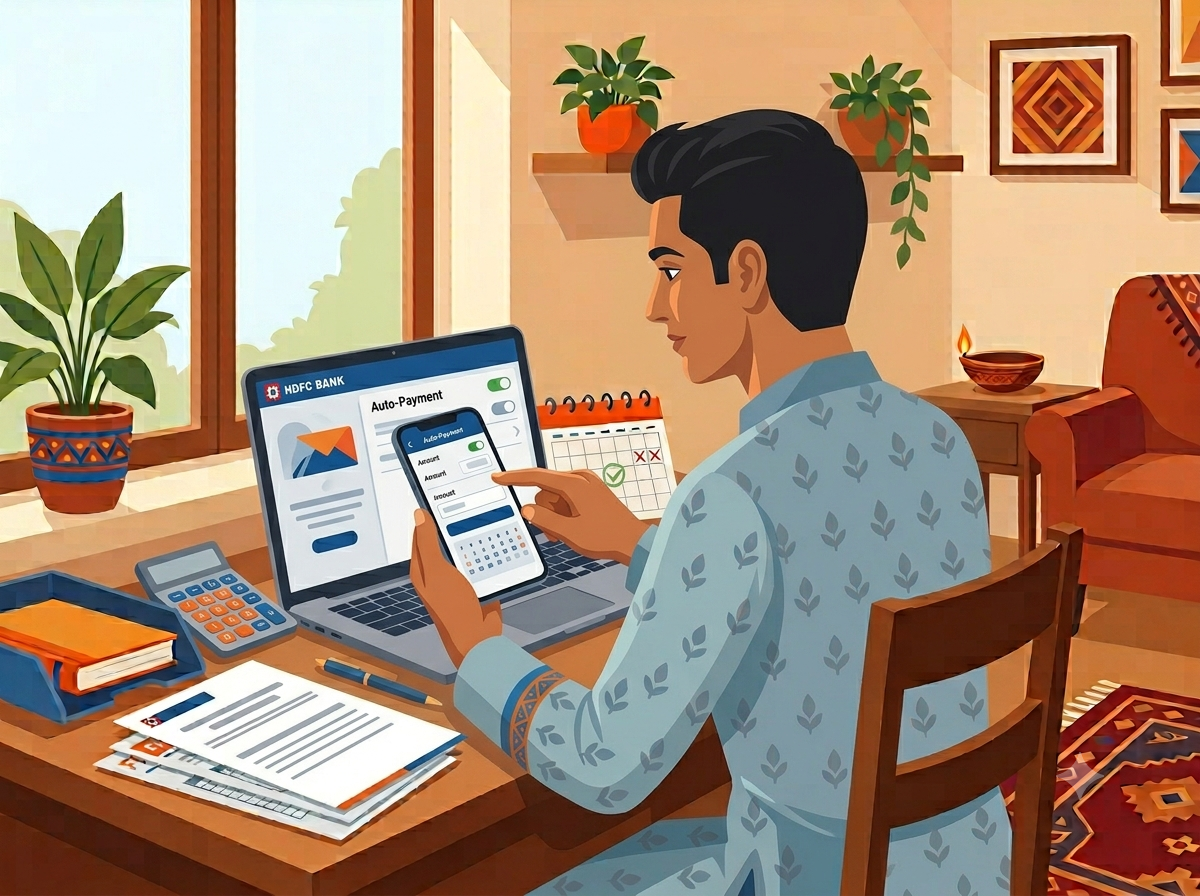
Set up auto-payment (NACH mandate, the auto-deduction permission you give your bank) for at least the minimum amount due on every card. Banks report this takes 2 to 3 billing cycles to activate. Set it today, not after the next late fee. If you cannot pay the full bill, the auto-minimum at least stops the late fee and the CIBIL report entry.
See How Late Payments Affect Your ScoreHow Credit Card Late Payments Affect the CIBIL Score: Stage by Stage
A missed credit card payment does two separate things to the CIBIL score. Most cardholders only think about one.
The DPD entry. Banks typically do not report a delay of 1 to 7 days to the credit bureau, though the late fee still applies. Once the delay crosses 30 days, the payment is reported as "30 DPD" (Days Past Due, the number of days a payment has been overdue, shown on the CIBIL report). This entry is then visible to every bank or NBFC that checks the credit history.
The progression from there is significant:
30 days late: Reported as "30 DPD." Score drop of 50 to 80 points.
60 days late: Reported as "60 DPD." Recovery calls begin. Score drop of 50 to 100 points. Bank may reduce the card limit.
90 days late: Account classified as NPA (marked as bad by the bank). Score drop of 100 to 150 points. Card may be frozen. Legal action possible.
These entries stay on the CIBIL report for up to 7 years.
The credit utilisation impact. High credit utilisation may influence how lenders assess your credit profile. This independently lowers the CIBIL score even without a late payment entry. Consistently high utilisation is one of the most common reasons a score stays low despite on-time payments.
Payment history is one of the most significant factors in your CIBIL score. Every month of on-time payment is a positive signal. Every DPD entry is a negative one. Credit bureau scoring methodologies are proprietary -- the exact weightage should be treated as indicative, not definitive.
One important fact: a confirmed 30-day DPD entry cannot be removed by asking the bank. It must age out of the report. The only way to limit damage is to pay before the 30-day mark is crossed.
Credit Card Late Payment: CIBIL Score Impact by Delay Duration
Delay | Bank Action | CIBIL Impact | Score Drop Range |
1 to 7 days | Late fee + interest charged | Generally not reported to bureau | Nil in score, but fee applies |
8 to 29 days | Interest accruing daily. Interest-free period lost. | Not yet reported | Nil in score, but fee + interest growing |
30 days | Reported as "30 DPD" | Score begins to drop | 50 to 80 points |
60 days | Reported as "60 DPD." Recovery calls begin. | Moderate lasting damage | 50 to 100 points |
90 days | NPA classification. Card may be frozen. | Major lasting damage | 100 to 150 points |
7 years | Entry ages out of report | Impact fades gradually | — |
Score drops are indicative and depend on overall credit profile, existing score level, and credit history. Higher scores tend to drop more in points. Verify directly with CIBIL for your specific situation.

What the Law Says
Under RBI Credit Card Directions 2022, all credit card issuers must give cardholders at least 3 working days' notice before implementing changes to fees or charges. They must also provide a Key Fact Statement (KFS, a document showing the full Annual Percentage Rate, all fees, and penalty slabs) at the time of card issuance. If any fee on your statement was not disclosed in the KFS, you can raise a dispute with the bank's grievance officer or escalate to the RBI Integrated Ombudsman.
Check What's on Your Credit ReportHow to Get a Credit Card Late Fee Reversed: What Works
Banks do waive late fees in some cases. It is a goodwill gesture, not a guaranteed right, and it works best when the miss was genuinely a one-time oversight.
Conditions that give the best chance of a reversal:
First-time late payment on an otherwise clean account
At least the minimum amount due is paid before calling
Request is made within 7 days of the fee appearing on the statement
The cardholder asks directly: "I always pay on time, this was a one-time oversight, can you please reverse the late fee?"
One important limit: even if the fee is reversed, the interest accrued cannot be reversed once charged. Only the flat late fee is typically subject to a goodwill reversal.
Bank-specific notes:
HDFC: Call 1800-202-6161. First-time waivers are reasonably common for long-standing accounts. The HDFC app service request also works.
SBI Card: Call 1860-180-1297. SimplyCLICK users report frequent waivers on a first miss. Air India SBI Card is less flexible.
ICICI: The iMobile app has a "Fee Reversal" option post-2024. Chat support also works.
Axis: Call customer care or use the Axis Bank app. Premium cardholders on Magnus and Atlas sometimes receive automatic waivers on auto-debit failure cases.
Kotak: Call 1860-266-2666. Auto-waivers have been reported for payments made within 3 days via the Kotak app.
Step-by-step process:
Pay the minimum amount due (or full outstanding if possible) before calling. Banks will not consider a reversal on an unpaid account.
Call from the registered mobile number. Verify identity using the card number and OTP.
State the card number, the billing cycle, and that this is a first-time late payment. Ask directly for a waiver. Keep it brief.
If the first agent declines, ask to speak to a supervisor or escalate via the bank's grievance email.
Check the next statement. If approved, the reversal typically reflects in 2 to 4 working days.
Credit Card Outstanding Growing Every Month?
Get a free assessment of your situation. No commitment, no pressure.
Get My Free AssessmentHow to Avoid Credit Card Late Payment Charges: 6 Practical Steps
Every step here is doable today.
Step 1: Set auto-pay for the minimum due, right now
Not after the next miss. A NACH mandate (auto-deduction permission given to the bank) on the savings account ensures the bank always receives at least the minimum, even if the due date is forgotten. It takes 2 to 3 billing cycles to activate, so the earlier the better.
Step 2: Pay 3 to 4 days before the due date, not on it
NEFT, net banking via other banks, and UPI payments to credit cards can take 1 to 3 working days to reflect. Paying on the due date itself sometimes results in a late flag if the payment settles on the next working day. Build in the buffer.
Step 3: Ask the bank to change the billing cycle date
If the current due date falls before salary credit date, request a shift. Most banks allow this once per year. Aligning the due date to fall 7 to 10 days after salary credit means funds are always available when the payment is due.
Step 4: Check the statement as soon as it is generated
Statements arrive 20 to 22 days before the due date. Reviewing immediately identifies unexpected charges or disputed transactions that need to be resolved before payment, not after.
Step 5: Keep credit card usage as low as possible
This protects the CIBIL score independently of payment timing. It also keeps the minimum amount due manageable each month.
Step 6: Pay the full statement balance every month where possible
Paying only the minimum avoids the late fee but not the interest. At 3.75% per month, interest on Rs. 20,000 adds Rs. 750 in the very next month. The full balance is the only way to avoid interest entirely.
When Credit Card Outstanding Keeps Growing: What to Do
One missed payment is manageable. A pattern of minimum payments is a different situation.
Signs the outstanding has crossed from manageable to needing action: the balance on the statement keeps rising despite regular minimum payments, 2 or more payments have been missed in the last few months, or total card if a significant share of your monthly income is already committed to loan repayments.
Here is the right order of steps:
Pay more than the minimum every month. Even Rs. 1,000 or Rs. 2,000 extra reduces the principal faster and cuts the interest charged in the next cycle. The minimum payment barely moves the balance at 3.75% per month.
Ask the bank to convert the outstanding to a lower-rate EMI plan. Most banks offer this for cardholders who ask. One call to customer care can open this option. The rate on a structured EMI plan is almost always lower than the standard revolving rate.
Move the outstanding to a bank with a lower balance transfer rate. This means shifting the outstanding from the current card to another card or bank offering a lower promotional rate, typically 0% to 1% per month for 3 to 6 months. This buys time to repay at a lower cost. This option is generally available to borrowers who qualify under the receiving lender's eligibility criteria.
Merge all card and loan debts into one lower monthly payment. Debt consolidation (merging all loans into one, so there is one EMI, one bank, one due date) reduces the total monthly outflow and simplifies repayment.
If all of the above have been tried and repayment is genuinely impossible, loan settlement is the remaining option for unsecured credit card debt.
How Loan Settlement Helps When Credit Card Repayment Has Become Genuinely Impossible
Settlement is not something a borrower chooses out of preference. Banks and financial companies only consider it when you are in genuine financial difficulty and are truly unable to repay the full amount. It is a last resort, not a shortcut.
When someone has converted the outstanding to an EMI plan, tried a balance transfer, and still cannot keep up, settlement is the remaining option for unsecured debt. Credit card outstanding is unsecured debt and within FREED's scope. Home loans, car loans, and gold loans are not.
In a settlement, the bank agrees to accept a one-time payment that is less than the total amount owed. FREED helps borrowers settle their unpaid/overdue loans at up to 50% less*. The exact figure ultimately depends on your bank.
The cost to know: the "Settled" mark stays on your CIBIL report for up to 7 years. This affects future credit access. Settlement is not a clean exit. It is an honest exit when nothing else works.
FREED handles the paperwork, prepares the documents, drafts the settlement letters, and manages the back-and-forth with the bank. A counsellor explains what to expect at every stage.
Rates and ranges shown are indicative. Final terms decided by the bank. FREED is not a Loan Provider. No outcome is guaranteed. Please verify directly with your bank.
Are You in a Loan Trap? Quick Check
Move the slider to your total EMIs as a % of monthly salary. See your debt stress level instantly.
EMIs as % of Monthly Salary
Things That Actually Help After a Missed Credit Card Payment
The damage from a missed payment is not fixed overnight. But the steps below limit how far it spreads.
Pay the minimum amount due immediately, even if late. A payment made 7 days late costs less than one made 30 days late. The 30-day mark is when the CIBIL report entry appears. Every day before that mark is worth something.
Check the CIBIL report 45 days after clearing the overdue. CIBIL reporting frequency has increased in recent years. Cleared payments reflect once the lender reports the update to the bureau. Confirm the bank has reported the update correctly. If the overdue still shows as unpaid after a reasonable period following payment, raise a dispute at CIBIL's Dispute Centre. Verify current reporting timelines directly at cibil.com.
Do not apply for any new credit for 3 to 6 months after a miss. Every application creates a hard enquiry that may be considered by lenders during future credit assessments. After a missed payment, the score is already under pressure. Adding enquiries makes recovery slower.
Keep credit card usage below 30% of the limit going forward. High utilisation compounds the damage from a late payment entry. Maintaining lower utilisation supports responsible credit management.
The honest picture: a single missed payment is not permanent damage. Consistent on-time payments over time can support credit profile improvement. The DPD entry stays on the report for up to 7 years but its weight on how lenders assess you can diminish with positive payment behaviour. No specific recovery timeline can be guaranteed -- outcomes depend on the overall credit profile.


Mohit Juneja
Mohit Juneja writes educational content at FREED on debt management, credit scores, loan repayment, and borrowing best practices. His content is shaped by expert insights and industry knowledge, helping readers better understand their financial options and make informed decisions.
mohit.juneja@freed.care

FREED is India's trusted loan management platform. Founded in 2020 and headquartered in Gurugram, FREED has counselled 20 lakh+ people on personal loans, credit cards, and app loans. FREED charges fees only on successful settlement, not upfront. FREED does not handle secured loans (home loans, car loans, gold loans).
Media Mentions