Outstanding Balance Meaning: What It Means in Loans and Cards
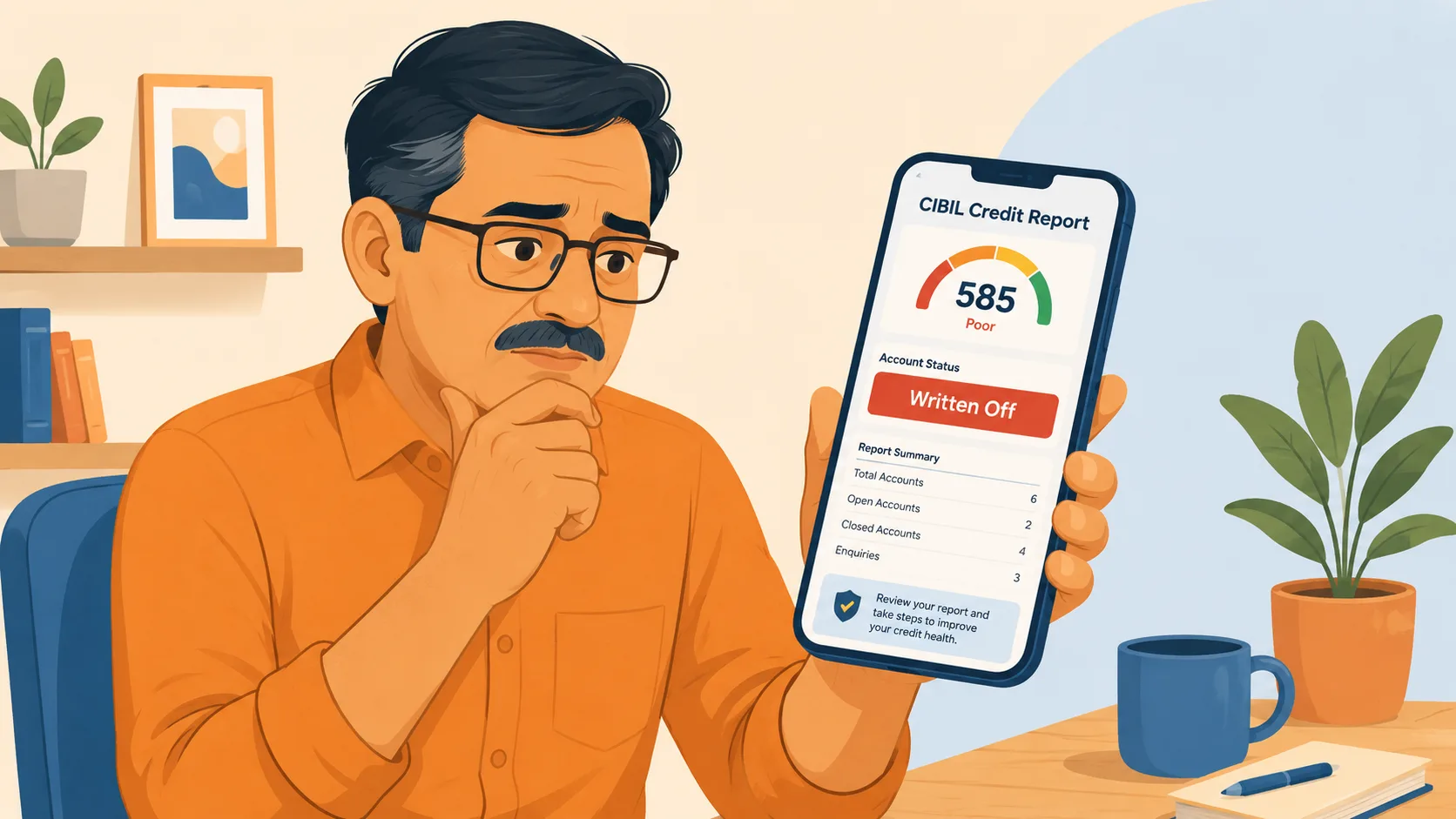
Outstanding balance is the total amount you currently owe on a loan or credit card. It includes the original amount you borrowed (called the principal), any interest that has built up, and any unpaid fees or charges. It is not the same as the amount you borrowed. It changes every day as interest builds up and payments come in.
Mohit Juneja
Reviewed by FREED India, SEO Intern
 4.7/5
4.7/5 ₹3,200Cr+
 20,000+
 20,00,000+4.7/5₹3,200Cr+20,000+20,00,000+
Key summury

Your outstanding balance on a loan = unpaid principal + interest built up so far + any overdue charges.
Your outstanding balance on a credit card = all purchases made + interest charged on unpaid amounts + any fees, minus payments made.
A high outstanding balance increases your credit utilisation, which may affect how lenders assess your credit profile. Credit utilisation accounts for approximately 30% of the CIBIL score.
An outstanding balance that stays unpaid for more than 90 consecutive days turns the loan into an NPA (loan marked as bad by the bank). This is reflected in your credit history and may significantly affect future borrowing.
Total outstanding credit card balances in India reached Rs. 3.03 lakh crore as of October 2025.
What Is Outstanding Balance Meaning in Simple Terms?
You take a loan or a credit card. You spend some money. You pay some back. What's still left to pay, at this moment today, is your outstanding balance.
It is a live number. Not a fixed one.
When a payment comes in, the outstanding balance goes down. When interest builds up, it goes up. When an EMI is missed, it goes up further. It moves every single day.
Two situations where you see this term most:
On a personal loan: Say you took a personal loan of Rs. 50,000 at 16% per year for 2 years. You've paid 6 EMIs on time. Your outstanding balance is no longer Rs. 50,000. You've paid down some of the original amount borrowed (called the principal). But it's not zero either. It's the amount still left to repay, including principal remaining plus any interest that has built up since the last payment.
On a credit card: Say you spent Rs. 20,000 on your credit card this month. You paid Rs. 8,000 on the due date. Your outstanding balance is now Rs. 12,000. But next month, the bank adds interest on that Rs. 12,000, typically 3% to 3.5% per month. Your outstanding balance becomes Rs. 12,360 before you've made a single new purchase. That's how the number grows when only part of the bill is paid.
Credit cards in India typically charge 3% to 3.75% interest per month on outstanding balances, which comes to 36% to 45% per year. (Source: Airtel Finance 2025) Outstanding credit card balances in India stood at Rs. 3.03 lakh crore as of October 2025. (Source: RBI data via Whalesbook)
The outstanding balance is not what you borrowed. It's what you still owe.
Outstanding Balance Meaning in a Loan vs. a Credit Card: What Is the Difference?
Same term. Very different behaviour.
On a personal loan, the outstanding balance goes down in a predictable way.
Every EMI you pay is split into two parts. One part covers the interest. The other reduces the principal, the original amount you borrowed. Early in the loan, more of each EMI goes toward interest. Later, more goes toward reducing the principal. So even if every EMI has been paid on time, the outstanding balance in month 1 is much higher than in month 20. This is just how loan math works.
On a credit card, the outstanding balance can move in any direction.
If the full statement amount is paid every month, the outstanding balance resets to zero and no interest is charged. But if only the minimum payment is made, interest is charged on the entire unpaid outstanding, not just the minimum. This is the part most people miss.
Here's what it looks like in numbers:
You owe Rs. 1 lakh on your credit card. The bank asks for a minimum payment of 5%, that is Rs. 5,000. You pay Rs. 5,000. The remaining Rs. 95,000 attracts interest at 3.5% per month. That is Rs. 3,325 added in the next 30 days. Your outstanding balance next month: Rs. 98,325, before any new spending.
Minimum payment on most Indian credit cards: 5% of outstanding balance. (Source: Pice app 2025) Interest on unpaid credit card balance: 3% to 3.75% per month = 36% to 45% per year. (Source: Airtel Finance 2025)
On Rs. 1 lakh outstanding at 3.5% per month, paying only the minimum due, the balance barely reduces. Total interest paid can exceed the original outstanding over 12 to 18 months.

Outstanding Balance vs. Statement Balance vs. Current Balance: What Is the Difference?
Three terms appear on your credit card app or statement. They look similar. They are not the same.
Outstanding balance (also called current balance): What you owe on the card right now, today. It includes everything: spending from this month, last month's unpaid amount, and any interest charged since the last statement. It updates in real time, every time a transaction happens.
Statement balance: What you owed at the end of the last billing cycle. This is the number printed on the monthly statement. It does not include spending made after the statement date. This is the amount that determines whether interest is charged. If paid in full by the due date, no interest is charged on purchases made before the statement date.
Minimum due: The smallest amount the bank will accept to avoid a late payment penalty. Typically 5% of the outstanding balance. Paying only the minimum does not avoid interest. It only avoids the late fee. Interest still accrues on everything that isn't paid.
Here's a concrete example:
- May 1: Statement generated. Statement balance = Rs. 18,000.
- May 5: You spend Rs. 2,000 on the card.
- May 10: You check the app. Outstanding balance = Rs. 20,000.
- May 20 (due date): You pay Rs. 18,000, the full statement balance. No interest charged on the May purchases because the full statement balance was paid.
- May 21: Outstanding balance = Rs. 2,000 (only the May 5 spending remains).
Two things worth knowing here. First: paying the full statement balance by the due date every month eliminates interest on purchases completely. Second: the outstanding balance reported to CIBIL is based on the balance at the time the bank reports to the bureau, not the statement balance. Mid-cycle balances count too.

FREED Expert Tip
Your CIBIL score uses your outstanding balance at the time the bank reports to the bureau, not your statement balance. If you paid Rs. 18,000 on the due date but spent Rs. 22,000 on the card in between, the bureau might capture the higher number. Maintaining lower credit utilisation is generally considered a healthy credit practice.
Check My Credit ScoreHow Does an Outstanding Balance Affect Your CIBIL Score?
Four ways. All of them matter.
1. Credit utilisation
Credit utilisation is the ratio of your outstanding card balance to your total card limit. It accounts for approximately 30% of your CIBIL score. Keeping utilisation low is generally viewed positively by lenders. As utilisation rises, it may signal greater credit dependence, which can influence how lenders assess your profile. At very high utilisation levels, particularly when a card is near or at its limit, lenders typically view this as a sign of financial stress.
2. Unpaid outstanding turning overdue
Once an EMI or credit card payment is 30 days late, it appears on your CIBIL report. At 60 days, it shows as "60 DPD" (days past due). At 90 days, the loan or card account is classified as an NPA (loan marked as bad by the bank). Each stage of overdue increases the negative signal on your credit profile and can significantly affect how future lenders assess your application.
3. Total debt burden
Approximately 30% of the CIBIL score also reflects total outstanding debt across all accounts. High outstanding balances across multiple loans and cards signal financial stress to any bank reviewing your profile.
4. Repeated minimum-only payments
Payment history accounts for approximately 35% of the CIBIL score, the single largest factor. Banks can see from your credit report that you have been paying only the minimum due month after month. This signals that the principal is not getting cleared. Even when no payment is technically missed, repeated minimum-only payments can influence how lenders assess your creditworthiness.
How Outstanding Balance Affects CIBIL Score: at Different Levels
Outstanding Balance vs. Card Limit | Credit Utilisation | CIBIL Score Impact |
Below 30% | Healthy | No negative impact, positive signal |
30% to 50% | Moderate | Minor drag on score, manageable |
50% to 75% | High | Visible score drop, red flag for new banks |
Above 75% | Very high | Significant score drop, new loans get harder to approve |
Full limit used (100%) | Maxed out | Severe score impact, signals credit dependency |
Note: These are general indicators. CIBIL score is calculated using multiple factors. Credit utilisation is one of them. Verify directly with CIBIL or your bank for your specific situation.

What the Law Says
Under RBI Credit Card Directions 2022, banks must inform cardholders of the total outstanding balance, the minimum amount due, and the interest rate applied on the outstanding, all clearly stated on the monthly statement. If any of these are unclear on your statement, you can ask your bank in writing for a detailed breakdown.
Check What's Affecting Your Credit ScoreHow to Calculate Your Outstanding Balance on a Loan
On a personal loan, every EMI you pay covers two things: interest for the month, and a portion of the original amount you borrowed. The bank does this split every month, automatically.
Here's what that looks like on a real loan:
Personal loan: Rs. 2 lakh at 16% per year for 2 years. Monthly EMI: approximately Rs. 9,772.
- Month 1: Interest portion = Rs. 2,667. Principal portion = Rs. 7,105. Outstanding balance after this EMI: Rs. 1,92,895.
- Month 12: Interest portion approximately Rs. 1,450. Principal portion approximately Rs. 8,322. Outstanding balance after this EMI: approximately Rs. 1,07,000.
The outstanding drops slowly in the early months. It falls faster toward the end. This is because more of each EMI goes toward interest at the start. As the principal reduces, less interest builds up, so more of each EMI attacks the principal itself.
Three things to know:
1) You can ask your bank for a complete repayment schedule at any time. It's a month-by-month table showing how much of each EMI goes toward principal and interest, and what the outstanding balance will be after each payment. This is your right under the loan agreement, not a bank favour.
2) Outstanding balance on a loan can be checked at any time via the bank's app, net banking, or a branch visit.
3) Making a partial prepayment, putting in extra money when available like a bonus or freelance income, reduces the principal directly and can cut the outstanding balance faster.

Outstanding Balance Growing and Feeling Stuck?
Get a free assessment of your situation. No commitment, no pressure.
Get My Free AssessmentHow to Calculate Your Outstanding Balance on a Credit Card
Unlike a loan, a credit card outstanding doesn't follow a fixed schedule. It goes up every time you spend. It comes down only when you pay. And if you don't pay the full amount, interest gets added on top.
Here's the exact calculation, month by month:
Month 1:
Spending = Rs. 25,000
Payment made = Rs. 5,000
Unpaid = Rs. 20,000
Interest charged at 3.5% on Rs. 20,000 = Rs. 700
Outstanding at start of Month 2 = Rs. 20,700
Month 2:
New spending = Rs. 10,000
Total outstanding = Rs. 30,700
Minimum due = Rs. 1,535 (5%)
If you pay only Rs. 1,535: outstanding stays above Rs. 29,000, and interest accrues again on that full amount next month.
Credit card interest in India: 3% to 3.75% per month = 36% to 45% per year. (Source: Airtel Finance 2025) Minimum payment on most Indian credit cards: 5% of outstanding. (Source: Pice app 2025)
At minimum payments only, a credit card outstanding may take 3 to 5 years to clear. Total interest paid over that time can exceed the original outstanding balance.
The only way to stop a credit card outstanding from growing is to pay the full statement amount every month.

When Does a Growing Outstanding Balance Become a Problem?
Not every growing outstanding is a crisis. But four signals tell you it has crossed from manageable to something that needs attention.
Signal 1: The balance isn't going down despite payments.
If you're paying something every month but the outstanding keeps staying flat or creeping up, the interest being added is more than the payment being made. The loan is winning.
Signal 2: EMIs are eating more than 50% of take-home salary.
FOIR (how much of your monthly income goes toward existing EMIs) is the number banks use to judge financial stress. Once total EMIs cross 50% of take-home salary, you're in the danger zone. Most banks and NBFCs use this as their threshold for loan eligibility assessment.
Signal 3: A payment has been missed.
The first missed EMI starts the formal recovery process. The CIBIL report begins showing "days past due" entries. A 30-day overdue is reflected in your credit history and may affect future lending decisions.
Signal 4: Outstanding balances across multiple products are all growing at the same time.
A personal loan, two credit cards, and a BNPL balance all growing together is not just a math problem. It's a signal that income is no longer covering obligations across the board.
Outstanding credit card balances in India grew at 7.7% year-on-year in October 2025, slowing from 16.9% the previous year, partly because banks tightened new credit issuance. (Source: RBI data via Whalesbook)
Most people who reach this point did not get there through one bad decision. A job change. A medical bill. A few months of irregular income. These things compound. Knowing the signals early is what keeps options open.
What Should You Do When the Outstanding Balance Is Too High to Manage?
There's a sensible order to try things. Start with the least disruptive option and work down.
1. Talk to the bank about changing the plan.
Ask about reducing the monthly EMI amount or extending the repayment period. Banks have internal programs for borrowers who are going through a rough patch. Ask directly.
2. Convert credit card outstanding to a lower-rate EMI plan.
If the credit card outstanding is the main problem, many banks let you convert it into a structured EMI at a much lower monthly interest rate. This is available without a new loan application.
3. Merge all loans and card outstanding into one lower monthly payment.
Debt consolidation, which means combining all outstanding balances into one loan with one EMI, can reduce what goes out every month and simplify tracking. FREED's Loan Consolidation Plan ("Reduce My EMI") does this for borrowers who are still paying but stretched thin.
4. Move high-interest debt to a lower-rate bank.
If your overall credit profile qualifies for a balance transfer , a balance transfer to a lower-rate bank can reduce the total interest outgo significantly.
5. If all of the above have been tried and repayment is genuinely impossible: loan settlement.
For unsecured loans only, meaning personal loans, credit cards, BNPL, and loan apps. Settlement is not for home loans or auto loans. It is a last resort, not a first step.
How Loan Settlement Helps When Repayment Has Become Genuinely Impossible
Settlement is not something a borrower chooses out of preference. Banks and financial companies only consider it when you are in a genuine financial difficulty and are truly unable to repay the full amount. It is a last resort, not a shortcut.
When repaying in full has become genuinely impossible, a bank may agree to accept a reduced lump-sum amount as full and final payment. The loan or card outstanding is then marked as "Settled" and closed.
The CIBIL consequence is real and must be understood going in. The "Settled" mark stays on your credit report for up to 7 years. Getting new unsecured credit during that period is harder, not impossible, but harder.
FREED's Loan Settlement Plan handles this process for enrolled customers: preparing documents, drafting settlement letters, handling the back-and-forth with the bank, and following up until each account is resolved. FREED helps borrowers settle their unpaid/overdue loans at up to 50% less*. . If a bank refuses to settle, FREED does not charge the service fee and also refunds the initial evaluation fee.
Covers: personal loans, credit cards, BNPL, loan apps. Does not cover home loans, car loans, or any secured debt.
*Rates and ranges shown are indicative. Final terms decided by the bank. FREED is not a loan provider. No outcome is guaranteed. Please verify directly with your bank.
Are You in a Loan Trap? Quick Check
Move the slider to your total EMIs as a % of monthly salary. See your debt stress level instantly.
EMIs as % of Monthly Salary
How to Reduce Your Outstanding Balance: Practical Steps
These steps work. They are not dramatic. But the math behind each one is real.
Pay more than the minimum on credit cards every month.
Even Rs. 500 to Rs. 1,000 extra above the minimum due makes a meaningful difference to total interest paid over time. At 3.5% per month, paying Rs. 1,000 extra every month on a Rs. 50,000 credit card outstanding saves thousands in interest and cuts months off the repayment time.
Pay the full statement balance, not just the current outstanding.
If both numbers differ, paying the full statement balance by the due date eliminates interest on purchases entirely. This is the single most effective credit card habit to have.
Make partial prepayments on personal loans when extra money comes in.
A bonus, an incentive, a freelance payment putting any of this directly toward the loan principal reduces the outstanding faster than waiting for the regular EMI schedule. Check with your bank whether a prepayment fee applies before making the payment.
Maintain responsible credit utilisation of the limit.
Keeping the outstanding balance below 30% of the total card limit at all times, not just at statement time, supports healthy credit management while the outstanding is being cleared. (Source: CIBIL / Airtel Finance)
Set auto-payment for at least the minimum due on all accounts.
One missed payment creates a late mark on the CIBIL report. Auto-payment for the minimum due prevents this while you handle the rest manually.
The plain rule behind all of this: the outstanding balance only goes down when the amount paid is more than the interest being charged. Until that line is crossed, the balance stays flat or grows.

Mohit Juneja
Mohit Juneja writes educational content at FREED on debt management, credit scores, loan repayment, and borrowing best practices. His content is shaped by expert insights and industry knowledge, helping readers better understand their financial options and make informed decisions.
mohit.juneja@freed.care

FREED is India's trusted loan management platform. Founded in 2020 and headquartered in Gurugram, FREED has counselled 20 lakh+ people on personal loans, credit cards, and app loans. FREED charges fees only on successful settlement, not upfront. FREED does not handle secured loans (home loans, car loans, gold loans).
Media Mentions