Credit Card Minimum Payment Calculator: Estimate Your Payoff Timeline
A credit card minimum payment calculator estimates how long it takes to clear your balance, and how much interest you'll pay, if you only pay the Minimum Amount Due each month. For most Indian cardholders, that timeline runs into years, not months, because interest keeps compounding on what's left.

Mohit Juneja
Reviewed by FREED India, Debt Resolution Specialists
 4.7/5
4.7/5 ₹3,200Cr+
 20,000+
 20,00,000+4.7/5₹3,200Cr+20,000+20,00,000+
KEY TAKEAWAYS

A credit card minimum payment calculator shows your real payoff time, not just this month's due amount.
The minimum due is calculated from a formula, not a flat guess, and it shrinks as your balance drops, which stretches the timeline further.
Credit card interest in India commonly runs 36 to 42% per year, among the highest of any common credit product.
Paying only the minimum can, in some cases, result in paying two to three times the original balance over the life of the debt, depending on the balance, APR, and repayment behavior.
RBI's credit card rules require the minimum due to be structured so there's no negative amortisation, meaning your balance actually has to shrink, not just cover interest and fees.
What a Credit Card Minimum Payment Calculator Shows
A credit card minimum payment calculator is a tool that takes your outstanding balance, your interest rate, and your minimum payment percentage, then works out two things: how many months it'll take to clear the balance, and how much total interest you'll pay along the way if you only ever pay the minimum.
It does three specific things worth knowing before you use one. It shows your real payoff timeline, not just what's due this month. It shows the total interest cost, the number most people never actually calculate for themselves. And it shows how increasing your monthly payment, even modestly, shortens both figures at once.
This is genuinely different from a simple EMI calculator, and that difference matters. An EMI stays fixed every month until the loan closes. A credit card minimum payment doesn't work that way. It's recalculated each cycle based on your current outstanding balance, which means it shrinks as your balance drops, unlike a fixed EMI that stays constant. That single difference is exactly why minimum-only payments take so much longer to clear a balance than most people expect, and it's worth understanding how the minimum itself actually gets calculated before anything else.
How Minimum Payment Is Actually Calculated
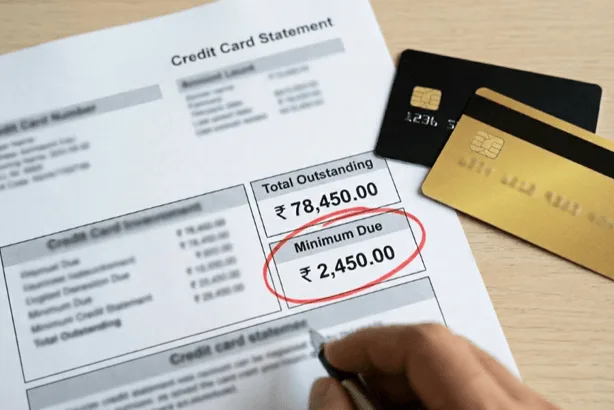
The minimum amount due isn't a flat percentage a bank simply picks. Under RBI's current credit card rules, it follows a specific formula: the higher of either 100% of the interest, fees, and taxes charged that cycle, or 5% of your total amount due, whichever is larger, plus any past-due amount, plus any EMI instalments already due on the card.
This formula exists specifically to prevent what's called negative amortisation, a situation where your balance actually grows even though you're paying the minimum every single month, because the minimum wasn't large enough to cover the interest being charged. RBI's Master Direction on Credit Card and Debit Card Issuance and Conduct explicitly requires issuers to structure minimum due calculations so this can't happen, and enforcement has been real: RBI has fined at least one major bank specifically for miscalculating minimum due in a way that produced negative amortisation on some accounts.
Older, looser minimum-due formulas historically let some balances shrink extremely slowly, since a token minimum barely touched the principal at all. The current formula closes that gap by guaranteeing the minimum covers interest and fees in full, plus a meaningful share of principal. This is a genuine improvement, but it doesn't eliminate the next problem entirely, which is what the minimum does as your balance actually starts to fall.

What the Law Says
Under RBI's Master Direction on Credit Card and Debit Card Issuance and Conduct, the minimum amount due must be structured so there's no negative amortisation, your balance has to actually reduce, not silently grow, even if you only ever pay the minimum. Unpaid charges also cannot be capitalised into the principal for further interest compounding.
See exactly what your balance is doingThe Shrinking Minimum Trap
Here's the part most explanations of minimum payments skip entirely, and it's worth walking through slowly.
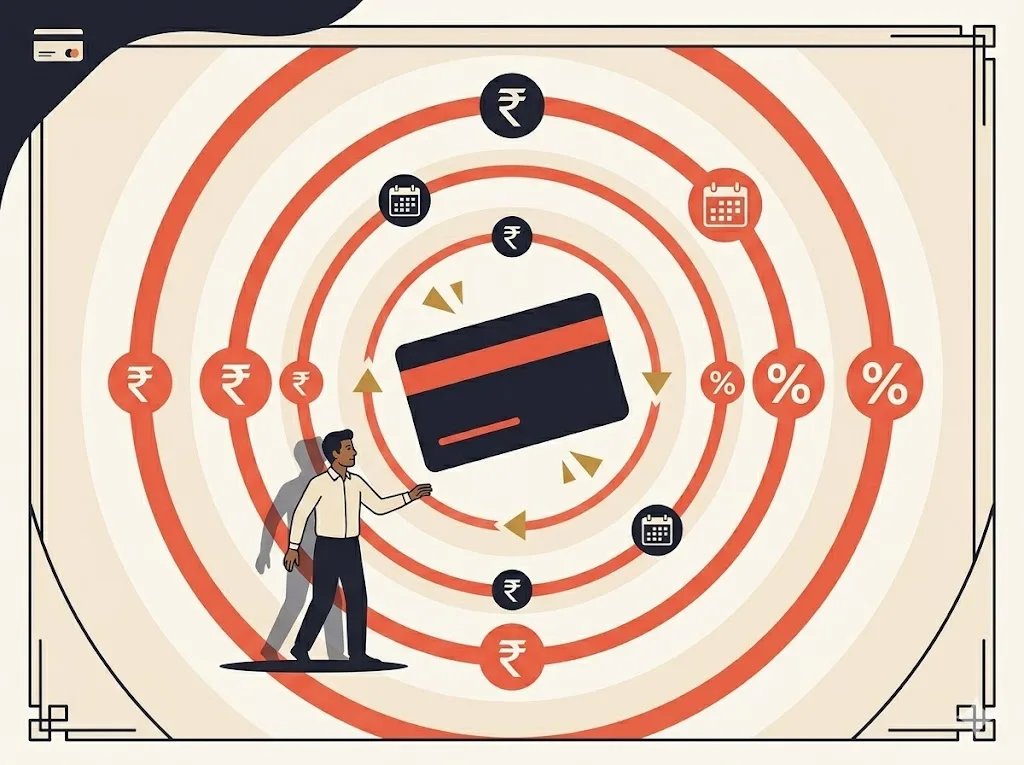
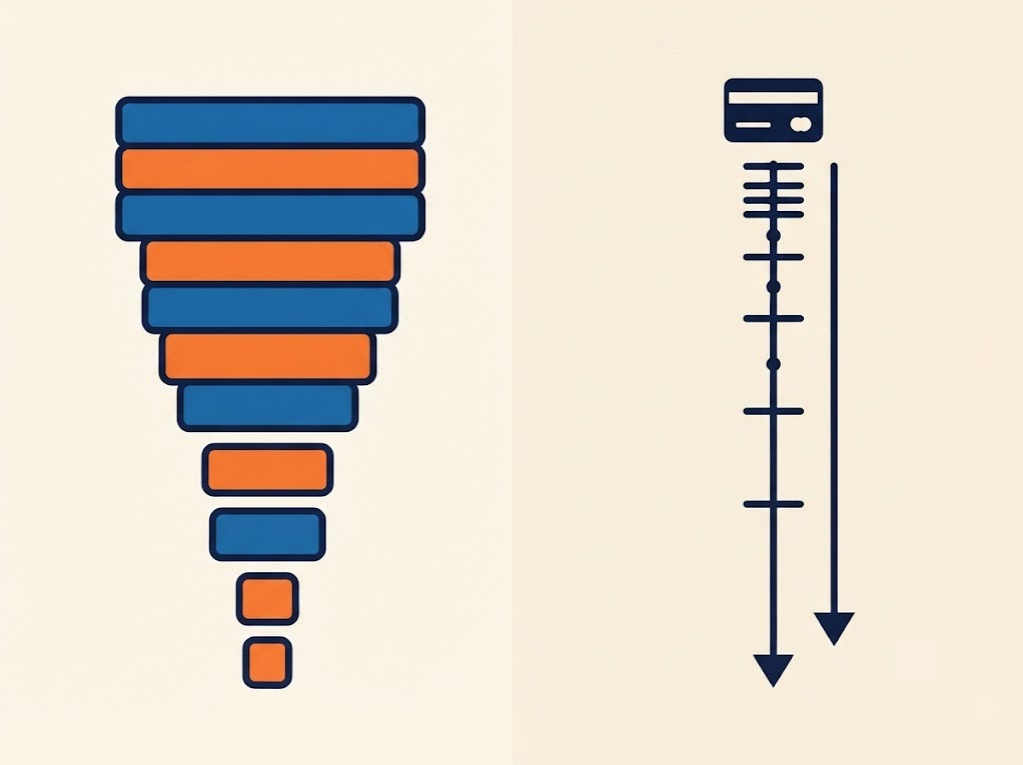
Because the minimum due is calculated as a percentage of your current outstanding balance, it shrinks every time your balance drops. That sounds like good news, a smaller bill each month, but it actually works against you.
- Starting balance, first month. Your minimum due is calculated on the full outstanding amount, a relatively larger figure.
- A few months in, balance has dropped somewhat. Your minimum due recalculates against this smaller balance, shrinking too.
- Several months further, balance has dropped more. The minimum keeps shrinking in step with it, and a growing share of each shrinking payment is still going toward interest rather than principal, since the interest rate hasn't changed even though the payment has gotten smaller.
The mental model most people carry, "the balance is shrinking, so I'm making progress," quietly breaks down here. A fixed EMI chips away at a loan on a predictable, shortening timeline. A shrinking minimum does the opposite: it stretches out the timeline the smaller it gets, because less rupee value is hitting principal every single cycle
How to Use the Calculator, Step by Step
- Gather your statement details. Find your current outstanding balance, APR, and minimum payment percentage on your latest statement.
- Enter balance and APR. Input the exact figures into the calculator. Guessing skews the result, and Indian card APRs commonly run 36 to 42% annually, though this varies by issuer and card type.
- Enter minimum payment percentage. Use the percentage shown on your statement, or the RBI-defined formula above as a working estimate if it isn't clearly stated.
- Review the payoff timeline. Note the months to payoff and total interest at minimum-only payments.
- Test a higher payment. Re-run the calculation with a larger monthly amount and compare the time and interest saved.
The accuracy of what the calculator tells you depends entirely on the accuracy of what you put in. Pulling your exact numbers from your own statement, rather than guessing, is what makes the output actually useful.
Are You in a Loan Trap? Quick Check
Move the slider to your total EMIs as a % of monthly salary. See your debt stress level instantly.
EMIs as % of Monthly Salary
Minimum Payment vs Paying More: What Changes
Paying even a modest amount above the minimum changes both numbers meaningfully, the payoff time and the total interest, because a larger share of each payment goes toward principal instead of interest.
If you're managing more than one card, two common strategies exist for deciding where extra money goes first. The avalanche approach targets the highest interest rate card first, which saves the most money overall in pure mathematical terms. The snowball approach targets the smallest balance first, clearing one card completely for a psychological win, which helps some people stay consistent even if it costs marginally more in total interest. Neither is universally correct. What matters more is which approach you'll actually stick with month after month, since a strategy abandoned after two months saves nothing at all.
When Minimum Payments Signal a Bigger Problem
A few patterns suggest the issue isn't really about payment strategy anymore.
Making only minimum payments across 2 or more cards at once is one signal. So is a situation where minimum dues, added together, eat a large share of your take-home salary, commonly discussed as a danger point once combined obligations cross around 50% of take-home pay. And so is watching your total balance stay roughly flat month over month, despite paying regularly and on time.
These are structural signs, not a discipline problem. If a calculator tells you your current path runs into many years, that's usually not something a slightly higher minimum payment fixes on its own. It's usually a sign the debt itself, its structure, its interest rate, the number of separate obligations, needs to change, not just the payment amount.


Minimum Payments Not Moving Your Balance?
FREED's Loan Consolidation Program may combine eligible unsecured debts into a single repayment, depending on the approved loan amount, tenure, and lender terms..
Start My Consolidation AssessmentHow FREED Helps
A calculator tells you the truth about your current path. It doesn't do anything to change that path, that's a separate step, and it's where FREED's Loan Consolidation Plan (LCP), also called the Debt Consolidation Program (DCP) or "Reduce My EMI," comes in.
This is built for people who can still repay but need a smarter way to manage their debt. FREED assesses your total outstanding across all your cards and matches you to a lending partner from its network. One new loan pays off your eligible unsecured dues instantly, replacing several shrinking minimum payments with a single, fixed, lower EMI that actually reduces your balance every single month, unlike a minimum due that keeps shrinking in step with what you owe. Handled this way, your CIBIL generally improves rather than takes a hit. FREED charges a success-based fee, only once consolidation actually completes.
The difference this makes isn't just about doing the math for you, a calculator already does that. It's about actually changing the structure so the math starts working in your favour instead of against it.
If you've already missed payments for months and your outstanding balance has become genuinely unmanageable, that's a different situation. FREED helps borrowers settle their unpaid/overdue loans at up to 50% less*. It's always a last resort, never the first suggestion, and worth exploring only once consolidation genuinely isn't realistic anymore.
Comparison: Minimum Payment vs Fixed Higher Payment
Payment Style | Monthly Amount Behaviour | Payoff Timeline | Total Interest Paid |
Minimum Payment Only | Shrinks as balance drops | Years, often 10+ | High, often 2 to 3x original balance |
Fixed Higher Payment | Stays constant regardless of balance | Significantly shorter | Meaningfully lower |
FREED Consolidation (DCP) | One fixed lower EMI, replaces multiple cards | Structured, defined timeline | Lower than continued card interest |
Figures shown are illustrative. Actual timeline depends on your individual balance, APR, and payment behaviour, verify using the calculator above.
Sources
Claim in blog | Source | |
|---|---|---|
1 | Minimum due formula: higher of (100% of interest+fees+taxes) or 5% of total due, plus past-due amount, plus EMI instalments designed to prevent negative amortisation; unpaid charges can't be capitalised for further compounding | Master Direction Credit Card and Debit Card Issuance and Conduct Directions, 2022 (Apr 21, 2022) |

Mohit Juneja
Mohit Juneja writes educational content at FREED on debt management, credit scores, loan repayment, and borrowing best practices. His content is shaped by expert insights and industry knowledge, helping readers better understand their financial options and make informed decisions.
mohit.juneja@freed.care

FREED is India's trusted loan management platform. Founded in 2020 and headquartered in Gurugram, FREED has counselled 20 lakh+ people on personal loans, credit cards, and app loans. FREED charges fees only on successful settlement, not upfront. FREED does not handle secured loans (home loans, car loans, gold loans).
Media Mentions