Credit Card Minimum Due: What Paying Only This Costs You
Minimum due is the smallest amount you must pay to avoid a late fee and keep your card active, usually 5–10% of your outstanding balance plus interest and any unpaid amount carried from before. It is not your full bill. Pay only the minimum, and your interest-free period ends immediately; the unpaid balance starts carrying 36–42% annual interest right away. Owe ₹50,000, pay ₹2,500, and you still owe ₹47,500 plus roughly 3% interest, close to ₹48,900, the following month. The minimum itself grows as interest piles on top of it. Repeatedly paying only the minimum can significantly extend the repayment period and increase the total interest paid. The actual cost depends on the card issuer’s terms, interest rate and subsequent transactions.
Mohit Juneja
Reviewed by FREED India, Debt Resolution Specialists
 4.7/5
4.7/5 ₹3,200Cr+
 20,000+
 20,00,000+4.7/5₹3,200Cr+20,000+20,00,000+
KEY TAKEAWAYS

Minimum due is typically 5–10% of your outstanding balance, the standard figure most Indian card issuers use.
Credit card interest in India runs 30–45% a year, making it one of the most expensive ways to borrow available to a salaried person.
Pay only the minimum, and your interest-free period disappears immediately; interest gets charged from the transaction date itself, not from the due date.
Real example: a ₹50,000 balance at 3% monthly interest, paying ₹4,000 minimum each month, still leaves ₹46,000 carrying forward and collecting fresh interest; the debt shrinks slowly and expensively.
Paying only the minimum once may help avoid a late-payment charge, but interest can still apply to the unpaid balance according to the card issuer’s terms. Turning it into a habit is where the real financial damage happens, often taking years and costing 2–3 times the original balance.
What Is Minimum Due? (Not the Same as Your Full Bill)
Every credit card statement shows two separate figures, and mixing them up is the single most common way people end up in trouble with a card. There's the total amount owed, everything you spent that cycle plus any interest and fees. And there's the minimum due, a much smaller number, framed as "pay at least this much to avoid a late payment charge." They are not the same bill; they're not even close, and the statement design doesn't always make that distinction as obvious as it should.
Most people glance at the minimum due figure, see a number that looks manageable next to their salary, and pay exactly that. The relief is real, but it's short-lived. The rest of the bill doesn't disappear; it stays outstanding and starts attracting interest from that point forward, daily, not monthly.
In India, minimum due is typically calculated as around 5% of your total outstanding balance, plus any interest already accrued and anything unpaid from the previous cycle. Some issuers use a flat minimum amount instead if your balance is small enough that 5% would come out to an unreasonably tiny figure, but the percentage-based calculation is what most cardholders with a meaningful balance actually see on their statement.

Stuck Paying Only Minimum Due?
We help borrowers break the credit card trap with a plan.
Get My Debt AssessmentHow Minimum Due Is Calculated (The Math That Traps You)
The formula itself is simple, which is exactly what makes it dangerous. Minimum due equals roughly 5–10% of your outstanding balance, plus interest already accrued, plus any late fees if you've missed something previously. Banks vary slightly in the exact percentage and method, but the core mechanic is the same everywhere: a small percentage, not the actual amount you owe.
Take a ₹1 lakh balance with a 5% minimum. That's a ₹5,000 payment. Pay it, and ₹95,000 remains, carrying forward into the next cycle at roughly 3% monthly interest. ₹95,000 × 1.03 works out to ₹97,850, more than what you started with after the payment, not less. Your payment barely touched the principal; most of it existed just to cover the interest that had already piled up.
A smaller example makes the pattern even clearer. Say you owe ₹50,000 and pay the ₹2,500 minimum. Interest at 3% monthly adds ₹1,500 back onto what remains, and you're left owing close to ₹48,900 the following month, despite having just made a payment. It looks like progress on the statement. It isn't, not in any meaningful sense, because the interest is eating almost everything the payment achieved.
Freed Expert Tip
Interest-free period means zero interest only if the full bill is paid by the due date. Pay minimum instead, and that period ends. Interest gets charged from the transaction date forward, so a purchase made on Day 1 of the cycle is already collecting 30-plus days of interest by the time you make a minimum payment on Day 30.
See exactly how your outstanding balance is calculatedThe Interest-Free Period Trap: Why It Disappears
Here's the rule almost nobody actually reads on their cardholder agreement: the interest-free period only applies if you pay the full amount by the due date. Pay anything less, including the minimum, and that period is gone entirely, not partially, gone. Interest gets charged from the transaction date itself, not from the due date the way most people assume.
That means a purchase made on the very first day of your billing cycle is already accruing interest by the time your statement even arrives, if you go on to pay only the minimum that cycle. Most cardholders think "I paid by the due date, so no interest applies." That's true only when the payment covers the entire bill. A minimum payment means interest started counting from day one of that purchase, weeks before the due date ever came around.
This is the part of credit card mechanics that catches even careful, financially responsible people off guard, because the assumption feels reasonable on the surface. It just doesn't match how the interest-free clause is actually written into RBI's guidelines and every issuer's terms. If your dues aren't cleared in full, the interest-free period is suspended for that cycle, and you only get it back by paying 100% of your bill by the next due date; one partial payment doesn't restore it gradually; it's an all-or-nothing reset.
Real Math: ₹50k Debt, Minimum Payments, Years to Clear
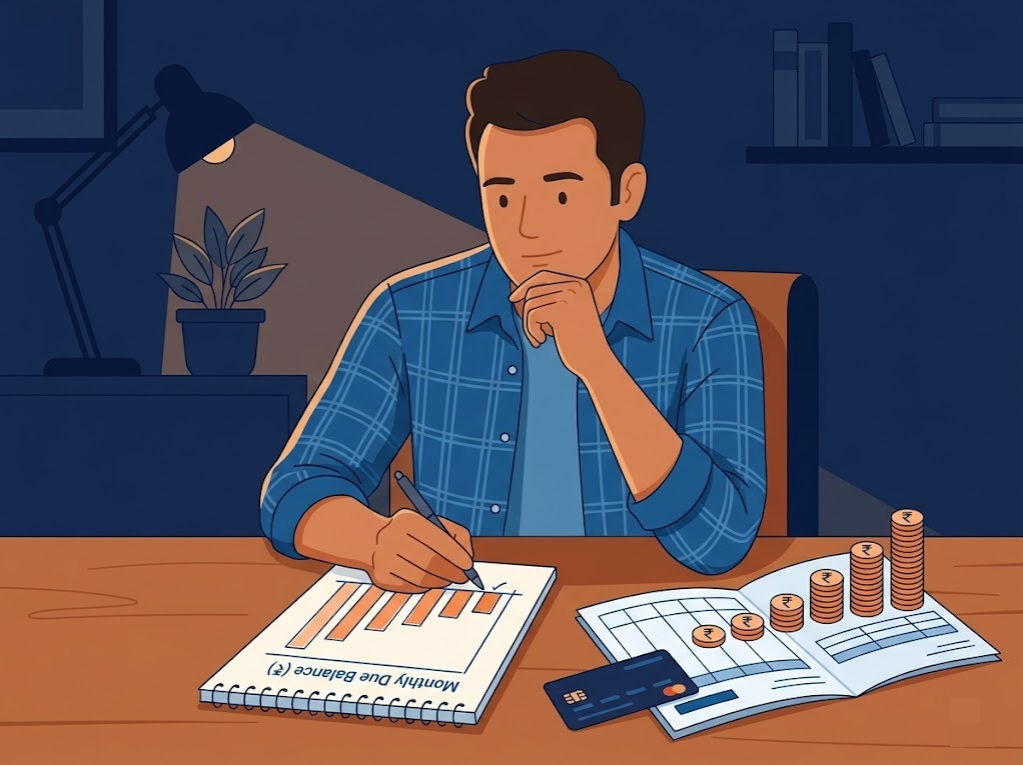
Numbers make this concrete in a way the general explanation doesn't quite manage on its own. Say you're carrying ₹50,000 outstanding, paying the ₹2,500 minimum (5%) each month, at 3% monthly interest, 36% annualised.
Month 1: You owe ₹50,000, pay ₹2,500, and interest of ₹1,500 gets added back on the remaining balance, leaving you owing roughly ₹49,000.
Month 2: The 5% minimum on ₹49,000 comes to ₹2,450, interest adds another ₹1,470, leaving you at approximately ₹47,520.
That pattern repeats, month after month, each minimum payment shrinking slightly as the balance shrinks slightly, each interest charge shrinking slightly too, but never fast enough to actually close the gap quickly. The repayment period and total amount paid will depend on the issuer’s minimum-payment formula, interest rate, fees and whether any new transactions are added. Paying only the minimum can keep the balance outstanding for a long time and substantially increase the total interest paid, just to pay off something that started at ₹50,000. And this assumes you stop spending on the card entirely during that time. Keep adding fresh purchases on top, and the balance may never actually clear at all; it just keeps circling.
The full mechanics of how minimum due is calculated and reported go into more depth on how issuers arrive at that percentage each cycle, worth a read if you want the complete picture beyond this worked example.
Why Minimum Due Feels Safe (But Isn't)
There's a reason this trap catches so many people who are otherwise financially careful: paying the minimum genuinely does avoid the immediate, visible consequences. No late fee. No default mark on your credit report. The card stays active. Your score doesn't crater the moment you do it.
But underneath that surface calm, something else is quietly building. Your utilisation creeps upward as the balance keeps growing rather than shrinking meaningfully. If your credit limit is ₹1 lakh and you're carrying ₹50,000, that's already 50% utilisation, a signal that reads as financial stress to any lender assessing your report, regardless of how consistently you've paid on time. Credit reports generally reflect information such as outstanding balances, credit utilisation, and payment status. Paying only the minimum can keep the reported balance and utilisation high, which may affect how lenders assess the borrower.

What the Law Says
RBI rules require that interest be charged from the transaction date if the full amount isn't paid, and banks must disclose their interest rates upfront, with the minimum due amount clearly shown on every statement. Where an interest-free period is offered as an incentive, it's valid only when the full bill is paid by the due date, not the minimum.
Check your CIBIL report to see how this is already showing upWhen Minimum Due Is Actually OK (Rare Emergency Only)
There is a legitimate, low-risk use for paying only the minimum, and it's worth naming clearly so this doesn't read as an absolute ban on ever doing it. A genuine one-time emergency, a car repair, an unexpected expense, something that means you can't clear the full card bill this specific month, is exactly the kind of situation minimum due exists to bridge.
It may be easier to manage when it is a one-time situation, the outstanding balance is cleared as soon as possible, and no additional spending is added. It happens once, not as a recurring pattern. The following month, you clear the full outstanding amount, interest included, rather than paying another minimum. And you don't add fresh spending on top while that balance is still outstanding. Meet all three, and minimum due did its job: a short-term bridge, nothing more.
The trap isn't the tool itself; it's the mindset shift from "I'll do this once, this month" to "I'll just do this every month," almost without a conscious decision ever being made. That's the exact moment a manageable emergency turns into the debt spiral the earlier sections walked through in detail. Understanding how minimum due payments specifically affect your CIBIL score over time is worth reading if you're unsure whether a recent one-off has already started to look like a pattern on your report.
The Escape Routes (If You're Already Trapped)
If you're already several months into paying only the minimum, there are real ways out, worth working through in order rather than jumping straight to the most drastic one.
Pay more than the minimum, even a small amount extra. An additional ₹500 or ₹1,000 every month makes a genuinely large difference to both your total interest paid and how quickly the balance actually clears, because more of each payment goes toward principal instead of just covering the interest that's already accrued.
Consider a balance transfer to a card offering a lower promotional rate. This only works, though, if you stop using the old card entirely once the balance moves; balance transfers carry their own specific terms and a limited promotional window worth understanding fully before relying on this as your fix.
Consolidate multiple card balances into a single personal loan at a lower rate, if you qualify. This addresses the underlying structure of the debt: one lower EMI instead of several revolving balances, rather than just moving the same problem to a different card.
Call your bank directly and explain the situation. You may ask your bank whether a hardship plan, lower interest rate or restructured payment schedule is available. Approval and terms depend entirely on the bank. Borrowers who approach them proactively, before things escalate to missed payments, rather than after.

Check Your Credit Health Free
See your CIBIL report and actionable improvement steps.
Check My CreditSources
Claim in Blog | Source |
|---|---|
The interest-free credit period is suspended if any part of the previous month's bill is unpaid; MITC must specify the unpaid-amount threshold beyond which it's lost; billing statement must warn that paying only the minimum stretches repayment over months/years with compounded interest | Master Direction RBI (Credit Card and Debit Card – Issuance and Conduct) Directions, 2022, RBI/2022-23/92, DoR.AUT.REC.No.27/24.01.041/2022-23, para 9(b)(iii) rbi.org.in link |
Interest is levied only on the outstanding amount, adjusted for payments/refunds/reversed transactions | Same Master Direction, para 9(b)(vi) rbi.org.in link |

Mohit Juneja
Mohit Juneja writes educational content at FREED on debt management, credit scores, loan repayment, and borrowing best practices. His content is shaped by expert insights and industry knowledge, helping readers better understand their financial options and make informed decisions.
mohit.juneja@freed.care

FREED is India's trusted loan management platform. Founded in 2020 and headquartered in Gurugram, FREED has counselled 20 lakh+ people on personal loans, credit cards, and app loans. FREED charges fees only on successful settlement, not upfront. FREED does not handle secured loans (home loans, car loans, gold loans).
Media Mentions