Does Paying Only the Minimum Due Affect Your CIBIL Score?
Paying only the minimum due means clearing just the smallest required amount on your credit card bill, usually around 5% of the total. It does not directly damage your CIBIL score, but carrying the remaining balance forward every month increases your credit utilisation, which may influence how future lenders assess your credit profile over time.

Mohit Juneja
Reviewed by FREED India, Debt Resolution Specialists
 4.7/5
4.7/5 ₹3,200Cr+
 20,000+
 20,00,000+4.7/5₹3,200Cr+20,000+20,00,000+
Key Takeaways

Does paying minimum due affect CIBIL? Not directly, on-time minimum payments keep your account current.
The real damage comes from credit utilisation, not the minimum payment itself.
Minimum due is usually around 5% of your outstanding balance, and interest keeps running on the rest.
Missing the minimum due (not just paying it) is what triggers a Days Past Due (DPD) mark on your report.
A pattern of high balances over several months is what eventually lowers the score.
Does Paying the Minimum Due Actually Affect Your CIBIL Score?
Short answer: not directly. Paying your minimum due on time, every cycle, keeps your account marked current in your payment history, and payment history is the biggest single factor in your CIBIL score. So the act of paying minimum due itself isn't what causes damage.
Here's the nuance worth understanding, though. The minimum due is usually around 5% of your total outstanding balance. Pay just that, and the remaining 95% doesn't disappear, it carries forward, and it keeps sitting on your report as an outstanding balance every month you don't clear it.
The real risk isn't the minimum payment itself, it's the side effect of relying on it repeatedly. Your account looks "fine" on paper, current, no missed payments, but the balance behind that account keeps climbing relative to your credit limit. That climbing balance is what eventually starts working against your score, not the minimum due payment that kept you technically on time.
Why Does Paying Only the Minimum Due Still Feel Risky?
The mechanism here isn't about anything you're doing wrong, it's simply how the math works once a balance starts carrying forward.
Interest keeps accruing on whatever portion of your bill goes unpaid, and credit card interest in India commonly runs 36% to 42% a year, among the highest of any borrowing type available. Pay only the minimum, and that unpaid balance doesn't shrink much month to month, it grows, because interest is being added faster than your minimum payment is chipping away at it.
This is how a balance rolls forward and quietly compounds. Your account still shows as current, no red flags there, but the total you owe relative to your credit limit keeps climbing. That ratio, what you owe against what's available to you, is credit utilisation, and it's what actually starts to matter for your score, even while your payment history stays spotless.

FREED Expert Tip
Check your credit utilisation, not just your due date. A rising balance is the real early warning sign.
Check Your Credit Insight with FREEDWhat Is Credit Utilisation and Why Does It Matter More Than the Payment Itself?
Credit utilisation is simply how much of your total available credit you're actually using at any given time. It's expressed as a percentage, and it's one of the factors CIBIL weighs most heavily, right alongside payment history.
Here's a simple way to picture it. Say you have a credit limit of ₹1,00,000 across your cards. If your combined outstanding balance sits at ₹20,000, your utilisation is 20%. If that balance grows to ₹80,000 because you've been carrying forward unpaid amounts month after month, your utilisation jumps to 80%, even if you haven't missed a single payment.
This is exactly why paying only the minimum due matters more than it first appears. Each month you don't clear the full bill, your utilisation edges higher, since the balance keeps growing relative to your limit. Many lenders generally view utilisation consistently near or above 30% as a higher-risk indicator.
This is the piece that separates payment history from utilisation, two different levers that both feed into your score, but respond to completely different behaviours.
Are You in a Loan Trap? Quick Check
Move the slider to your total EMIs as a % of monthly salary. See your debt stress level instantly.
EMIs as % of Monthly Salary

What the Law Says
RBI requires credit card statements to clearly show minimum due separately from total due, so borrowers can see the real balance they still owe.
Check your options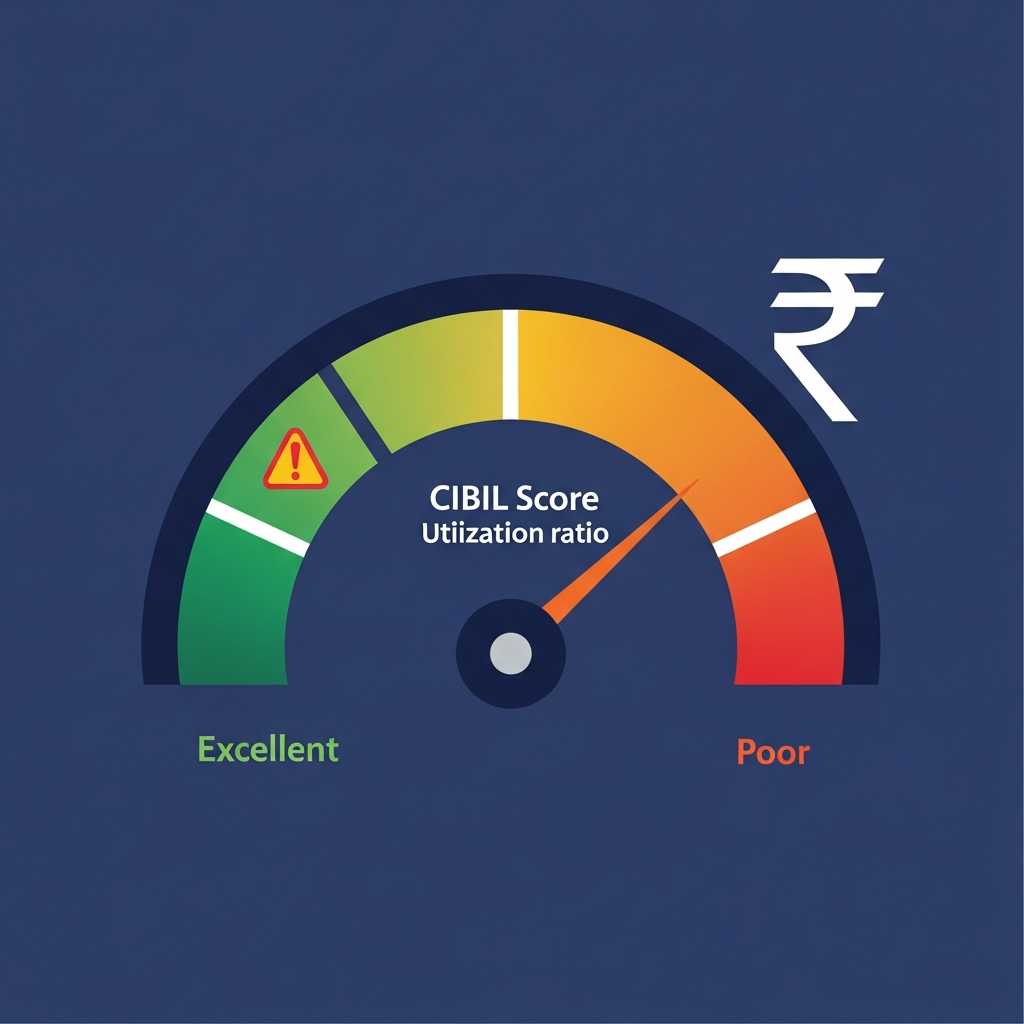
What Happens If You Pay Only the Minimum Due for Several Months in a Row?
This pattern tends to compound quietly. Your minimum due itself isn't fixed, it's usually recalculated each cycle based on your current outstanding, so as your balance grows from accumulating interest, your minimum due grows right along with it.
This is different from a single missed payment in an important way. A missed payment is a discrete event, it happens once, gets flagged, and the consequence is clear. Paying only the minimum every month for six months isn't one event, it's a slow accumulation, where each cycle adds a bit more interest, your total debt compounds, and your utilisation keeps inching upward without any single moment that feels alarming.
This is a genuinely common pattern, not a sign of doing something wrong, just how the structure of minimum-due payments naturally works if it becomes the default rather than an occasional necessity.
Does Missing the Minimum Due Hurt More Than Just Paying It?
Yes, and the difference between the two is significant enough that it's worth being completely clear about it.
Paying your minimum due on time, even if it's just that small 5% slice, keeps your account marked "current" with the bureau. Your payment history stays clean. No red flag appears on your report from this alone.
Missing the minimum due entirely is a different category of event. Once a payment crosses roughly 30 days overdue, it typically gets reported to the bureau as a DPD, Days Past Due, entry. That's a direct, documented mark against your payment history, the single biggest factor in your score, and it has a more significant impact on your repayment history and may be considered by future lenders.
So the distinction that matters most here: paying minimum due, even repeatedly, is a slow utilisation problem. Missing it, even once, is an immediate payment history problem. They're not the same risk, and treating them as interchangeable is where a lot of the confusion around this topic comes from.

Check Where Your CIBIL Score Really Stands
Free credit check, no impact on your score.
Check My Credit InsightWhat Should You Do Instead of Relying on the Minimum Due?
A few practical habits keep this from becoming a long-running pattern.
Pay more than the minimum whenever you can, even if it's not the full amount. Any extra you put in beyond the minimum chips directly into the principal rather than just holding interest at bay.
Set up auto-debit for the full statement amount, not just the minimum due. This removes the temptation to default to the smaller number out of convenience each cycle.
Track your utilisation monthly, not just your due date. A due date met on time can still hide a climbing balance if you're not checking the bigger number behind it.
If this pattern is happening because you're juggling more than one card or loan at once, rather than a single card getting away from you, FREED's Loan Consolidation Plan may help combine eligible unsecured loans into a structured repayment, subject to eligibility and lender approval.
Juggling More Than One Card or Loan?
See whether the Loan Consolidation Plan is right for you.
Book My Free Call

Mohit Juneja
Mohit Juneja writes educational content at FREED on debt management, credit scores, loan repayment, and borrowing best practices. His content is shaped by expert insights and industry knowledge, helping readers better understand their financial options and make informed decisions.
mohit.juneja@freed.care

FREED is India's trusted loan management platform. Founded in 2020 and headquartered in Gurugram, FREED has counselled 20 lakh+ people on personal loans, credit cards, and app loans. FREED charges fees only on successful settlement, not upfront. FREED does not handle secured loans (home loans, car loans, gold loans).
Media Mentions