What is debt management
Debt management is not a single product or a one-time fix, it's the ongoing discipline of organising, prioritising, and systematically repaying what you owe. Here is what that discipline actually involves in practice, and how it differs from the more specific, one-time solutions it's often confused with.

Mohit Juneja
Reviewed by FREED India, Debt Resolution Specialists
 4.7/5
4.7/5 ₹3,200Cr+
 20,000+
 20,00,000+4.7/5₹3,200Cr+20,000+20,00,000+
Key Takeaways

Debt management is the ongoing practice of organising, prioritising, and systematically repaying existing debt, distinct from consolidation, which restructures debt into one loan, and settlement, which negotiates a reduced payoff amount.
A genuine debt management approach rests on five core components: a complete inventory of every debt, a deliberate repayment priority, automated minimum payments, a budget that treats debt repayment as a fixed obligation, and regular review.
A formal Debt Management Plan, sometimes arranged through a counsellor, negotiates modified terms, reduced interest or waived fees, directly with existing lenders while repaying the full amount owed, distinct from both consolidation and settlement.
The most common failure point in self-directed debt management is inconsistency, missing the regular review step, or reverting to paying whatever feels manageable each month rather than following a deliberate, pre-set priority.
If disciplined debt management alone cannot realistically clear your existing debt within a reasonable timeframe, FREED can help through consolidation or settlement, approaches suited to situations debt management alone cannot resolve.
Debt Management, Defined Simply
Debt management is the ongoing, structured practice of organising every debt you owe, deciding a deliberate order in which to prioritise repayment, and consistently following a specific plan month over month, rather than reacting to whichever payment feels most urgent at any given moment.
Unlike a single transaction or a one-time restructuring, debt management is a discipline, a repeatable, adjustable system applied continuously until the underlying debt is genuinely cleared. It can be practiced independently, through your own tracking and prioritisation, or formalised through a structured Debt Management Plan, arranged with the help of a counsellor or agency.
How Debt Management Differs From Consolidation and Settlement
These three terms are frequently used interchangeably, but they describe genuinely different approaches. Debt consolidation restructures multiple existing debts into a single new loan, typically at a lower interest rate, replacing several payments with one. Debt settlement negotiates a reduced lump-sum payoff amount directly with a lender, resolving the debt for less than the full outstanding balance.
Debt management, distinct from both, does not necessarily change the loans themselves at all, it is the ongoing organisational and repayment discipline applied to your existing debts as they stand, or, in its formal version, involves negotiating modified terms, reduced interest, waived fees, while still repaying the full amount owed across the existing accounts.
The Core Components of a Genuine Debt Management Approach
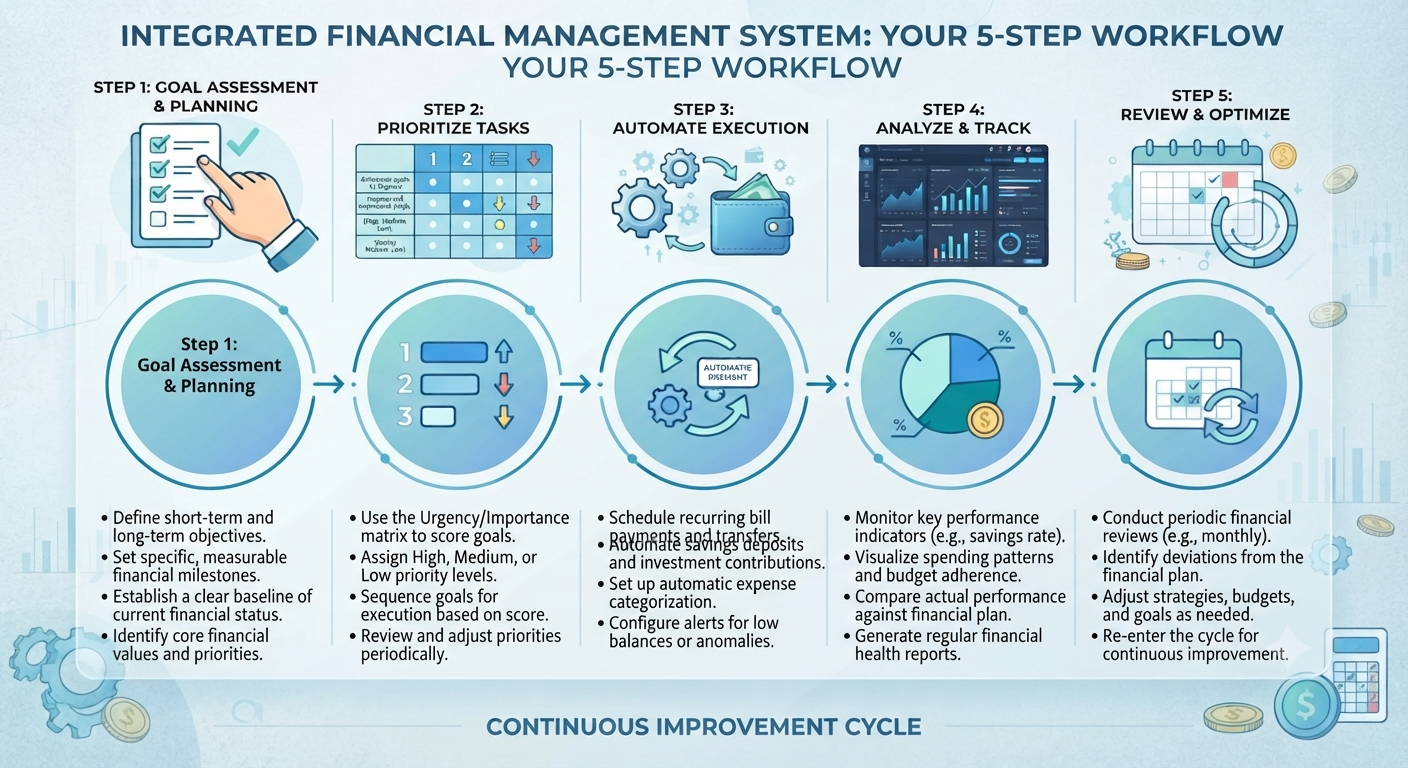
A structured debt management approach, whether self-directed or formalised, rests on five specific, practical components, each addressing a distinct part of what makes debt repayment genuinely effective rather than reactive and inconsistent.
Component 1: A Complete, Honest Inventory
Every genuine debt management approach begins with a complete, accurate list of every single debt owed, credit cards, personal loans, BNPL commitments, each with its actual current outstanding balance and interest rate, gathered from real statements rather than rough estimates.
This inventory is the foundation every subsequent component depends on. Without an accurate, complete picture, prioritisation decisions and budget calculations are all built on incomplete information, which undermines the entire approach regardless of how disciplined the remaining steps are followed.
Component 2: A Deliberate Repayment Priority
Once the inventory is complete, a specific, deliberate order needs to be chosen for directing any available extra payment, typically the highest interest debt first, known as the Avalanche method, which minimises total interest paid, or the smallest balance first, the Snowball method, which builds early momentum through visible progress.
Either approach is valid, what matters is choosing one deliberately and sticking with it, rather than splitting available extra payment thinly and inconsistently across every account each month, which produces slower progress on all fronts than a concentrated, prioritised approach.
Component 3: Automated, Non-Negotiable Minimum Payments
Regardless of which specific debt is receiving extra attention in a given month, every other account's minimum payment needs to happen reliably, without exception, since a single missed minimum payment anywhere undermines the entire approach through late fees, penalty interest, and credit score damage.
Setting up auto-debit for at least the minimum due on every single account removes the dependency on manually remembering multiple due dates, a genuinely difficult task to manage reliably across several accounts, particularly during a busy or stressful month.

Not sure which of your debts should be your priority right now?
Talk to a FREED Expert for free.
Talk to a FREED ExpertComponent 4: A Realistic Monthly Budget That Accounts for Debt First
A genuine debt management approach treats debt repayment, both the minimums and any extra prioritised payment, as a fixed, non-negotiable line item in the monthly budget, allocated before discretionary spending, rather than paid from whatever happens to be left over at month's end.
This sequencing, debt repayment first, discretionary spending second, is what actually protects the plan from being quietly eroded month over month by ordinary spending decisions that feel individually reasonable but collectively undermine consistent progress.
Component 5: Regular Review and Adjustment
A monthly review, checking total outstanding across all debts, confirming progress against the current prioritised target, and verifying all other minimum payments were made, catches drift early and allows the plan to be adjusted as income or circumstances genuinely change, rather than continuing to follow an outdated plan or abandoning the effort entirely at the first sign of difficulty.
This review does not need to be lengthy, fifteen to twenty minutes is generally sufficient, but its value depends entirely on it happening consistently, on a fixed schedule, rather than only when a specific account sends a concerning notification.
Debt Management Plans: The Formal Version
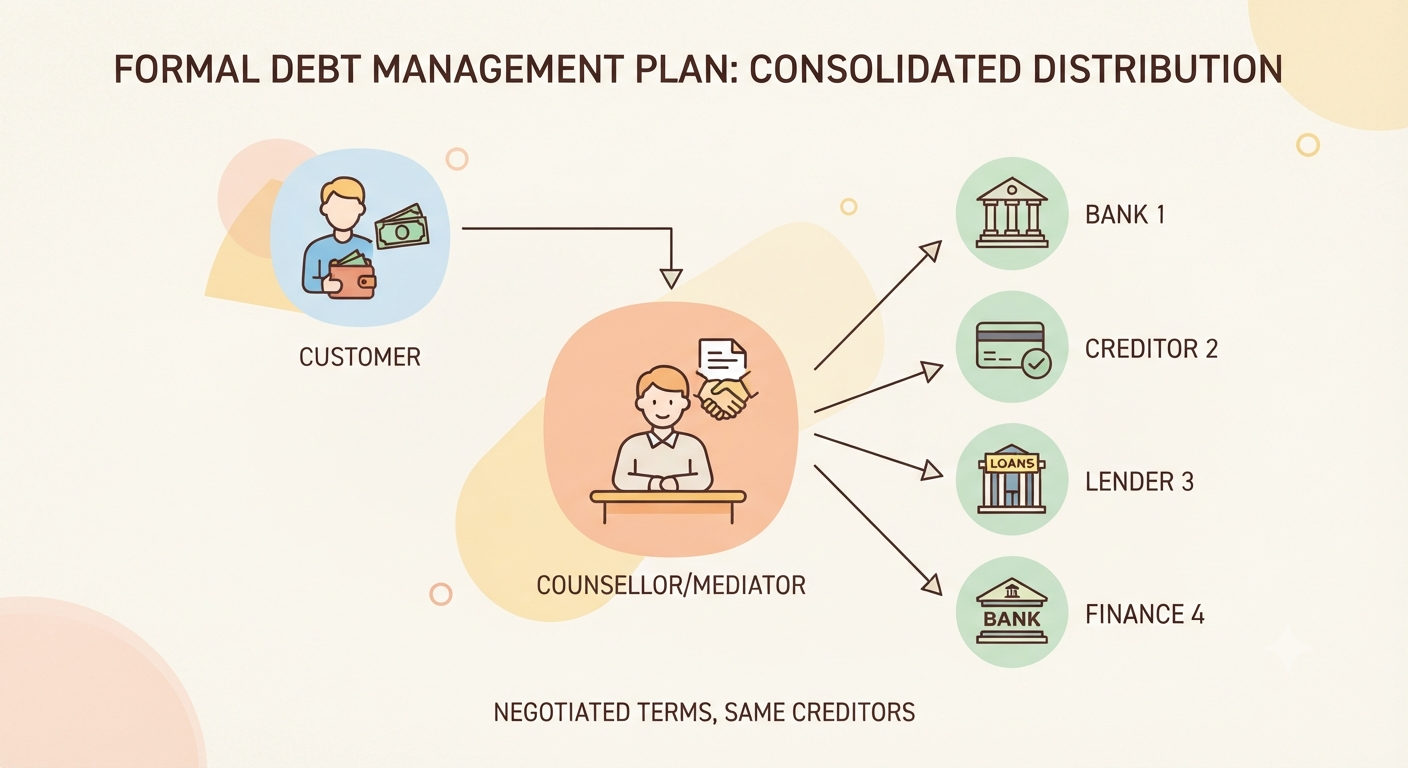
A formal Debt Management Plan, sometimes arranged through a credit counselling service, involves a counsellor negotiating directly with your existing lenders on your behalf, for reduced interest rates, waived late fees, or a restructured payment schedule, while you continue repaying the full amount owed, typically through a single, consolidated monthly payment the counsellor then distributes to each individual creditor.
This differs meaningfully from consolidation, since the underlying loans and creditors do not change, only their terms are modified, and it differs from settlement, since the full amount is still repaid, simply on improved terms rather than for a reduced total.
Who Benefits Most From a Structured Debt Management Approach
Debt management, whether self-directed or formalised, suits people who can genuinely afford to repay their full debt amount given time and structure, but who are currently managing that repayment inefficiently, without a clear priority, without automation, or without a consistent review habit, resulting in slower, more stressful progress than a structured approach would produce.
It is a distinct fit from consolidation, which suits people wanting a lower interest rate and simplified single payment through a new loan, and from settlement, which suits people who genuinely cannot repay the full amount owed under any realistic circumstances.
Common Mistakes That Undermine Debt Management
A few specific, recurring mistakes undermine an otherwise reasonable debt management approach. Splitting extra payments evenly across every debt instead of following a deliberate priority, which produces slower overall progress than a concentrated approach. Skipping the regular review, allowing drift to accumulate unnoticed until a specific account sends an alarming notification. Reverting to paying "whatever feels manageable" in a difficult month rather than maintaining the automated minimums and simply pausing extra payments temporarily. And taking on new debt during the process, which adds directly to what the plan is trying to reduce.

What the Law Says
Under RBI's Fair Practices Code, borrowers have the right to proactively request modified terms, interest reduction, fee waivers, restructured schedules, directly from a lender when facing genuine hardship, and lenders are required to respond through a formal grievance process. This right underpins the formal Debt Management Plan approach described above, since a counsellor's negotiation on your behalf relies on this same, legally supported avenue for requesting modified terms.
Get 1 EMIBuilding Your Own Debt Management System, Step by Step
Building a self-directed system does not require sophisticated tools. Start by listing every debt with its actual balance and interest rate. Choose a priority order, Avalanche or Snowball, and commit to it. Set up auto-debit for every minimum payment across every account. Build a monthly budget that allocates debt repayment, minimums plus any extra prioritised payment, before discretionary spending. And schedule a recurring quarter-hour review, on the same date each month, to check progress and adjust as needed.
Want help building a debt management system tailored to your specific accounts?
Talk to a FREED Expert for free.
Talk to a FREED ExpertWhen Debt Management Alone Is No Longer Enough
Debt management, applied consistently, works well when the underlying debt genuinely can be repaid in full within a reasonable period given your actual income. There is a specific point at which this assumption breaks down, when combined minimum payments already consume 50% or more of monthly income before essentials are even accounted for, or when several accounts have already progressed into significant overdue status.
At this point, no amount of improved organisation or discipline changes the fundamental math, the debt itself needs to be restructured, either through consolidation, to genuinely lower the interest cost and monthly payment, or through settlement, to reduce the total amount owed where full repayment is not realistic.
FREED's Debt Consolidation Program combines multiple debts into one lower interest loan with a single, more manageable EMI, when disciplined management alone cannot make sufficient progress against the interest cost involved.
FREED's Debt Resolution Program negotiates a reduced settlement for debt that cannot realistically be repaid in full even with a well-structured management approach, on average 56% less than the original outstanding.
A free consultation can assess your specific situation honestly and identify whether a structured debt management approach is likely to be sufficient on its own, or whether restructuring is the more realistic path.
Are You in a Loan Trap? Quick Check
Move the slider to your total EMIs as a % of monthly salary. See your debt stress level instantly.
EMIs as % of Monthly Salary

Mohit Juneja
Mohit Juneja writes educational content at FREED on debt management, credit scores, loan repayment, and borrowing best practices. His content is shaped by expert insights and industry knowledge, helping readers better understand their financial options and make informed decisions.
mohit.juneja@freed.care

FREED is India's trusted loan management platform. Founded in 2020 and headquartered in Gurugram, FREED has counselled 20 lakh+ people on personal loans, credit cards, and app loans. FREED charges fees only on successful settlement, not upfront. FREED does not handle secured loans (home loans, car loans, gold loans).
Media Mentions