Who is a recovery agent?
A recovery agent is an individual employed by a collection agency, hired by a bank to recover outstanding debts.

Mohit Juneja
Reviewed by FREED India, Debt Resolution Specialists
 4.7/5
4.7/5 ₹3,200Cr+
 20,000+
 20,00,000+4.7/5₹3,200Cr+20,000+20,00,000+
Key Takeaways

A recovery agent is a person appointed by a bank or NBFC to collect overdue loan repayments from borrowers.
Recovery agents must follow strict RBI guidelines. They have defined limits on what they can and cannot do.
Harassment, threats, abusive language, and calls to your family or employer are all illegal.
You have clear legal rights as a borrower and you can take formal action if those rights are violated.
Knowing who a recovery agent is and what they are allowed to do puts the power back in your hands.
Who Is a Recovery Agent?
A recovery agent is a person or a team of people hired by a bank, NBFC, or other lending institution to collect overdue loan payments from borrowers.
When a borrower misses EMI payments and stops responding to the lender's own collection efforts, the lender may hand over the account to a recovery agent.
The recovery agent's job is to contact the borrower, remind them of their dues, and try to collect the outstanding amount on behalf of the lender.
Recovery agents are sometimes also called collection agents, debt collectors, or recovery executives.
They may work directly for the bank or they may work for a third-party collection agency that the bank has contracted.
In India, recovery agents are a normal part of the lending ecosystem. Their existence is recognised and regulated by the Reserve Bank of India.
But that recognition comes with strict rules. Recovery agents are not free to do whatever they want. They operate within a defined legal framework. When they step outside that framework, they are breaking the law.
Understanding this distinction is the first and most important thing any borrower needs to know.
How Are Recovery Agents Appointed?
Banks and NBFCs do not just hire anyone off the street to recover loans.
The RBI has laid out specific guidelines for how recovery agents must be appointed, trained, and supervised.
The lender is responsible.
When a bank appoints a recovery agent or contracts with a collection agency, the bank remains fully responsible for the conduct of that agent. If the agent misbehaves, the bank is liable. This is an important point. The bank cannot simply blame the agent and wash its hands of the situation.
Agents must be trained.
RBI guidelines require that recovery agents undergo formal training before they are allowed to interact with borrowers. This training covers communication standards, legal boundaries, and the dos and don'ts of recovery activity.
Agents must be formally authorised.
A genuine recovery agent will carry an authorisation letter from the lender they represent. This letter will include the agent's name, the lender's name, and confirmation that the agent is authorised to collect on behalf of that lender.
If someone contacts you claiming to be a recovery agent but cannot produce authorisation, that is a serious red flag.
The lender must inform the borrower.
Before a recovery agent contacts you, the lender is supposed to inform you in writing that your account has been handed to a recovery agent. This is part of the Fair Practices Code that RBI requires all lenders to follow.

FREED Expert Tip
The next time a recovery agent calls you, ask them three things immediately. What is your full name? Which bank or lender do you represent? Can you send me your authorisation letter? A genuine agent will answer all three without hesitation. If they cannot or will not, end the call.
Book My Call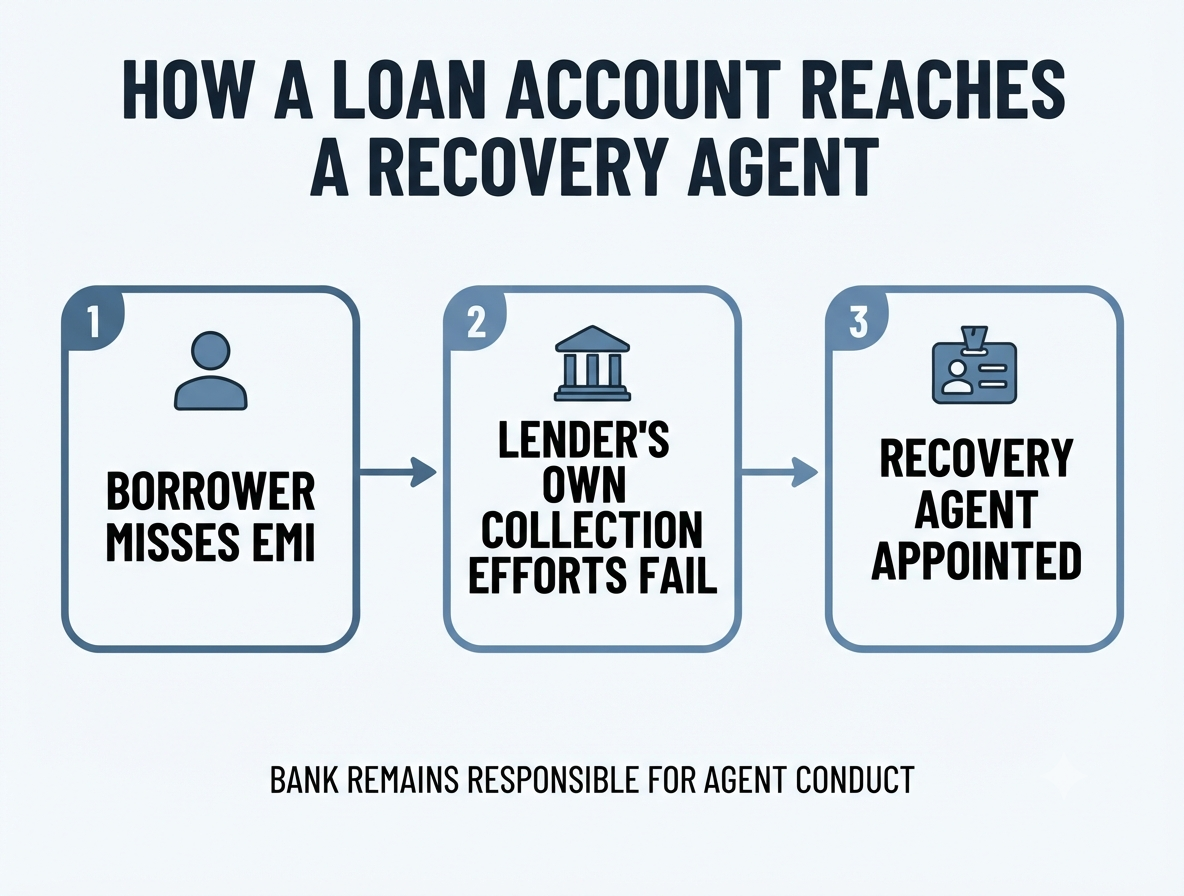
What a Recovery Agent Is Legally Allowed to Do
Recovery agents do have legitimate functions. It is important to understand what those are so you can distinguish between lawful collection activity and illegal harassment.
They can contact you to remind you of your dues.
A recovery agent can call or visit you to remind you that your loan is overdue and to request payment.
They can inform you of the consequences of non-payment.
Agents can tell you what will happen if the loan continues to remain unpaid, such as credit score damage, legal proceedings, or asset repossession for secured loans. This is factual communication, not a threat.
They can negotiate a payment arrangement.
Recovery agents can discuss repayment options with you, propose a payment schedule, or discuss settlement terms on behalf of the lender.
They can visit your home or office.
A recovery agent is allowed to make personal visits to your home or workplace during permitted hours. However, these visits must be respectful and professional at all times.
They can send written communication.
Letters, emails, and formal notices regarding outstanding dues are all legitimate forms of communication.
They can refer the matter to legal proceedings.
If recovery efforts are unsuccessful, agents can inform you that the lender may pursue legal action. This is a factual statement about a real possibility, not an illegal threat.
All of the above, when done professionally and within the guidelines, is lawful collection activity.
The problem arises when agents go beyond these boundaries. And many do.
What a Recovery Agent Is NOT Allowed to Do
This section is the one most people in debt need to read carefully and remember.
Recovery agents have very clear legal limits on their behaviour. Crossing these limits is not just unprofessional. It is illegal.
They cannot contact you outside permitted hours.
RBI guidelines are clear. Recovery agents may only contact you between 8 AM and 7 PM. Any call or visit before 8 AM or after 7 PM is a violation.
They cannot use abusive or threatening language.
Shouting, swearing, making personal insults, or using threatening language of any kind is strictly prohibited. This applies to phone calls, text messages, and in-person visits.
They cannot threaten you with violence or illegal action.
Threats of physical harm, or threats to take actions that are not legally permitted, are criminal offences. Any agent who makes such threats is breaking the law, full stop.
They cannot contact your family members, neighbours, or colleagues.
A recovery agent's mandate is to collect from the borrower. They have no legal right to call your parents, spouse, siblings, neighbours, or coworkers to pressure or shame you into paying.
They cannot contact your employer to pressure you.
Calling your employer to inform them of your debt situation, to pressurise them, or to threaten consequences for you at work is a clear violation of your privacy and your rights.
They cannot publicly shame or humiliate you.
Displaying your name, photograph, or details as a defaulter in any public forum, whether physical or digital, is illegal.
They cannot misrepresent themselves or the situation.
Recovery agents cannot pretend to be court officials, police officers, or government representatives. They cannot fabricate legal documents or misrepresent the status of your account.
They cannot take possession of your assets without a legal order.
For unsecured loans like personal loans and credit cards, recovery agents have absolutely no authority to take any of your belongings under any circumstances. Even for secured loans, formal legal processes under the SARFAESI Act must be followed before any asset can be touched. An agent who tries to take your phone, vehicle, or any other possession on the spot is acting illegally.
They cannot force you to sign any documents.
Any signature you provide must be voluntary and fully informed. Coercing someone into signing documents is not legal.
The violations listed above are not rare edge cases. They happen regularly in India. That is why knowing them is so important.

What the Law Says
The Reserve Bank of India's guidelines on engagement of recovery agents, issued under the Fair Practices Code for lenders, place full responsibility for agent conduct on the bank or NBFC that appointed them. If a recovery agent violates any of these guidelines, the lender is directly liable. You can file a complaint with the RBI Banking Ombudsman at bankingombudsman.rbi.org.in, free of charge. Complaints must be resolved within 30 days. Additionally, if a recovery agent threatens or assaults you, you have the right to file a police complaint under the Indian Penal Code. Your legal protections are real and enforceable. Read about how to file a complaint with the RBI Banking Ombudsman.
Talk to a FREED CounsellorCan a Recovery Agent Call or Visit on Sunday?
RBI rules don't name Sunday separately. What they do set is a time window: agents can call or visit only between 8 am and 7 pm, on any day. A call or visit outside those hours breaks the rules, Sunday or not. Agents also can't harass you, use abusive language, or contact you in a way meant to embarrass you. If an agent calls at 9 pm on a Sunday, note the time, the number and the name, and complain to the bank in writing.
What Changes From 1 January 2027?
RBI has issued new conduct rules for banks that take effect on 1 January 2027. They add to the current protections:
Advance notice of visits. Your bank must share the recovery agency's details with you at least one day before the first visit.
ID at the door. The agent must show an ID card, the bank's authorisation letter and a copy of the notice sent to you.
Only you or your guarantor. Agents can discuss your dues only with you or your guarantor, not your family, neighbours or employer.
Sensitive times off limits. Agents must avoid contacting you during a bereavement, a medical emergency, a calamity, or a wedding or similar function in the family.
Calls recorded. Recovery calls must be recorded, you must be told, and recordings kept for six months.
Your choice of place. Meetings should happen at a place you choose.
What Can a Recovery Agent Do and Not Do?
Recovery agents may | Recovery agents may not | Source |
|---|---|---|
Call or visit between 8 am and 7 pm | Call or visit before 8 am or after 7 pm | RBI 2022 circular; 2026 Directions |
Remind you of dues and ask for payment | Threaten, abuse or use force | RBI 2022 circular |
Speak to you or your guarantor | Discuss your dues with family, friends or colleagues | RBI 2022 circular; 2026 Directions (from 1 Jan 2027) |
Visit with ID and the bank's authorisation letter | Visit without showing ID and authorisation | 2026 Directions (from 1 Jan 2027) |
Meet you at a place you choose | Contact you during bereavement or a medical emergency | 2026 Directions (from 1 Jan 2027) |

Is a recovery agent crossing the line?
If calls or visits are harassing you, FREED Shield can help you act on it.
Get Help With HarassmentWhat Should You Check When an Agent Comes to Your Door?
Ask for the agent's ID card and the bank's authorisation letter. Take a photo of both.
Note the date, time, the agent's name and the agency name.
Don't sign any blank paper or any document you haven't read.
Don't hand over cash without an official receipt from the bank.
If the agent threatens you, ask them to leave and write to the bank the same day.
If agents are abusive or turn up without following the rules, FREED Shield helps you document what happened and report it to the right place. It's open to everyone, not only FREED members.
For next steps, see our guides on complaints against recovery agents and where to file a complaint against a recovery agent. Questions about agent certificates are covered in debt recovery agent certificate and how to verify a recovery agent's IIBF certificate.
Your Rights as a Borrower When Dealing With Recovery Agents
Let us bring all of your rights together in one place.
Every borrower in India, regardless of how much they owe or how long they have been in default, has the following rights when dealing with recovery agents.
The right to be treated with respect and dignity.
At all times, in all interactions, you are entitled to respectful, professional treatment. This is non-negotiable.
The right to know who you are dealing with.
Every recovery agent must identify themselves fully. Name, lender they represent, and contact details. This is not optional for them.
The right to contact only during permitted hours.
8 AM to 7 PM. Not before. Not after.
The right to privacy.
Your debt situation is between you and your lender. It is not something that can be shared with your employer, family members, neighbours, or anyone else without your consent.
The right to be free from harassment, threats, and abusive treatment.
Zero exceptions. Any harassment or threatening behaviour is a legal violation and gives you grounds for a formal complaint.
The right to receive formal written communication.
Before any serious step is taken, such as legal proceedings or asset repossession, you must receive written notice. You have the right to know what is happening and why.
The right to dispute the outstanding amount.
If you believe the amount being claimed is incorrect, you have the right to formally dispute it with the lender and request a detailed account statement.
The right to file a complaint.
If any of these rights are violated, you can file a complaint with the lender's internal grievance redressal team, the RBI Banking Ombudsman, and if necessary, the local police.
These rights are not favours granted by lenders. They are legally mandated protections. Assert them without hesitation.
What to Do If a Recovery Agent Harasses You
If you are facing harassment from a recovery agent, here is a step-by-step guide on what to do.
Step 1: Stay calm and do not engage with aggression.
Responding with anger or aggression rarely helps and can make the situation worse. Stay composed. The calmer you are, the harder it is for an aggressive agent to escalate.
Step 2: Document everything immediately.
Note the date, time, and duration of every call or visit. Write down exactly what was said. If possible, record the conversation. Screenshots of abusive text messages are also valuable. This documentation is your evidence.
Step 3: Ask for the agent's identity and authorisation.
Ask for their full name, the name of the lender they represent, and their authorisation letter. Genuine agents will have all of this. If they refuse, note that refusal as part of your documentation.
Step 4: Send a formal written complaint to your lender.
Write a formal complaint to the bank or NBFC's grievance redressal team. Describe the incident in detail, include dates and times, and state clearly which guidelines were violated. Send this by email so you have a record.
All banks and NBFCs are required to have a formal grievance redressal mechanism. They must acknowledge your complaint and respond within a specified time.
Step 5: Escalate to the RBI Banking Ombudsman if needed.
If the lender does not resolve your complaint satisfactorily within 30 days, escalate to the RBI Banking Ombudsman. This is a free service. You can file online at bankingombudsman.rbi.org.in.
Step 6: File a police complaint if there are threats of violence.
If a recovery agent has threatened you physically, visited your home aggressively, or made any kind of criminal threat, file a complaint at your local police station immediately. This is a criminal matter and should be treated as one.
Step 7: Get professional support.
If the harassment is ongoing and you are struggling to handle it alone, FREED can step in. We communicate directly with lenders on your behalf and make clear that any further violations of RBI guidelines will be formally escalated. This alone often stops the harassment.
Use This Tool: FREED StressOmeter Is the pressure from recovery agents and overdue loans affecting your mental and emotional wellbeing? The FREED StressOmeter is a free, 2-minute check that measures your financial stress level and tells you what kind of support might help. No numbers needed. Just honest answers.
Are You in a Loan Trap? Quick Check
Move the slider to your total EMIs as a % of monthly salary. See your debt stress level instantly.
EMIs as % of Monthly Salary
How to Tell the Difference Between a Genuine Agent and a Fraud
This is something many people do not think about until it is too late.
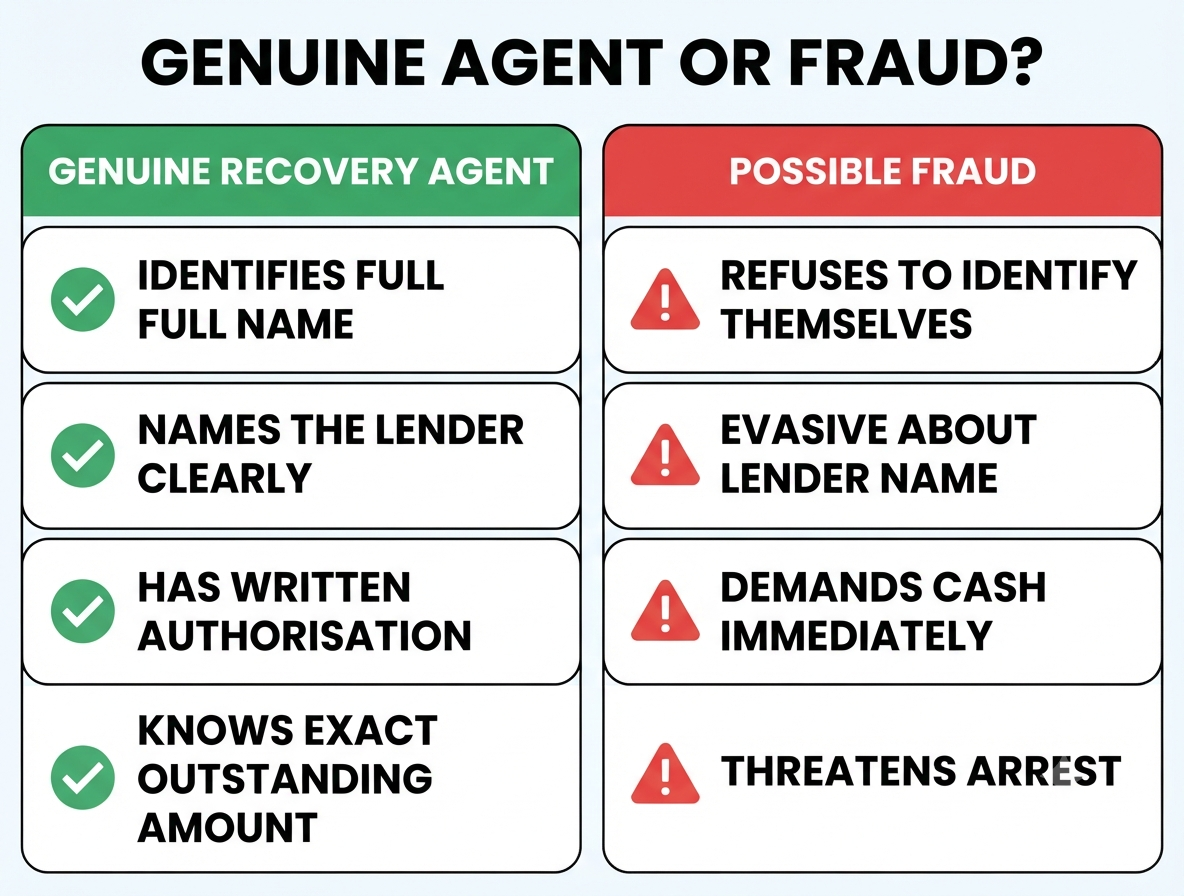
Not everyone who claims to be a recovery agent is actually one. There are people who impersonate recovery agents to extract money from borrowers, particularly those who are already stressed and scared.
Here is how to tell the difference.
A genuine recovery agent will:
Always identify themselves by full name. Always name the lender they represent and provide a contact number for that lender. Carry or be able to send a formal authorisation letter from the lender. Know the exact outstanding amount on your account. Communicate through official channels, not random personal mobile numbers. Accept that you want to verify their identity before discussing payment.
A fraudulent impersonator will often:
Refuse to identify themselves clearly. Be evasive about which lender they represent. Pressure you to pay immediately in cash or to a personal account. Claim that immediate payment is the only way to avoid arrest or legal action. Use threatening or aggressive language to prevent you from thinking clearly. Be unable to provide any written communication on official lender letterhead.
The single most important rule:
Never pay any money to anyone who contacts you until you have independently verified who they are.
Call the lender's official customer service number yourself and confirm whether the person who contacted you is genuinely authorised to collect on their behalf.
Do not use any contact number provided by the agent to verify this. Always find the lender's official number independently through their website or your loan documents.
Talk to a FREED expert
Share your loan details and get clear next steps before you reply to any agent.
Book My Call
Mohit Juneja
Mohit Juneja writes educational content at FREED on debt management, credit scores, loan repayment, and borrowing best practices. His content is shaped by expert insights and industry knowledge, helping readers better understand their financial options and make informed decisions.
mohit.juneja@freed.care

FREED is India's trusted loan management platform. Founded in 2020 and headquartered in Gurugram, FREED has counselled 20 lakh+ people on personal loans, credit cards, and app loans. FREED charges fees only on successful settlement, not upfront. FREED does not handle secured loans (home loans, car loans, gold loans).
Media Mentions