Why your Credit Score Varies Between Credit Bureaus
Checked your credit score on CIBIL and got 720. Then I checked on Experian and got 680. Now you're confused. Which one is right? Both are - and this guide explains exactly why.
Mohit Juneja
Reviewed by FREED India, Debt Resolution Specialists
 4.7/5
4.7/5 ₹3,200Cr+
 20,000+
 20,00,000+4.7/5₹3,200Cr+20,000+20,00,000+
Key Takeaways

India has 4 RBI-licensed credit bureaus CIBIL, Experian, Equifax, and CRIF High Mark. Each calculates your score differently using its own algorithm.
Your score varies because not all banks report your loan and payment data to all 4 bureaus so each bureau has slightly different information about you.
A small variation of 20–50 points between bureaus is completely normal. A large variation (100+ points) may signal an error worth investigating.
Most banks in India check your CIBIL score first so that's the one to monitor most closely.
You are entitled to one free credit report per year from each bureau checking all four gives you the most complete picture of your financial health.
First - What is a Credit Bureau?
A credit bureau is a company that collects and stores information about how you borrow and repay money.
Every time you take a loan, use a credit card, or miss a payment the bank reports that information to credit bureaus. The bureau stores all of this data and uses it to calculate your credit score.
Your credit score is a 3-digit number between 300 and 900. It tells banks and lenders how likely you are to repay a loan on time.
The higher your score the more trustworthy you look to lenders. The lower your score the harder it is to get loans at good interest rates.
Simple enough. But here's where it gets confusing for most people, India doesn't have just one credit bureau. It has four. And they don't always agree on your score.
The 4 Credit Bureaus in India
All four are licensed and regulated by the Reserve Bank of India (RBI). All four are legally recognised and banks use any or all of them.
Bureau | When Licensed | Score Range | Most Used By |
CIBIL (TransUnion) | 2000 | 300–900 | Most banks in India - the most widely checked |
Experian | 2010 | 300–900 | Several private and foreign banks |
Equifax | 2010 | 300–900 | Some banks and NBFCs |
CRIF High Mark | 2010 | 300–900 | Many NBFCs and microfinance institutions |
CIBIL is the oldest and most widely used. When a bank in India says "we checked your credit score" they almost always mean your CIBIL score.
But that doesn't mean the other three don't matter. Some lenders specifically check Experian or CRIF. And errors on any one bureau can affect your loan applications.
So Why is Your Score Different on Each Bureau?
This is the real question. If all four bureaus are looking at the same loans and the same payments why do the numbers not match?
The answer is four reasons. Let's go through each one clearly.
Reason 1: Each Bureau Uses a Different Scoring Algorithm
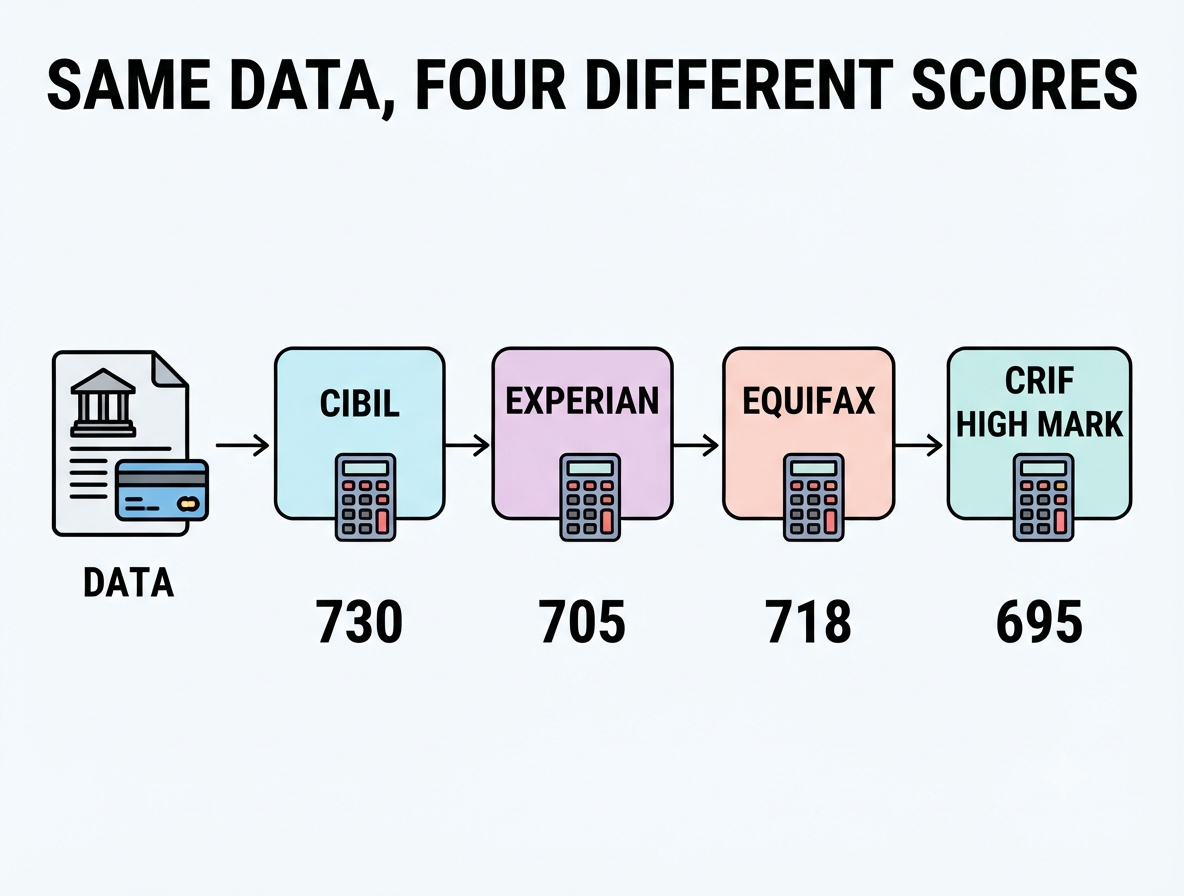
All four bureaus look at similar data - payment history, credit utilisation, length of credit history, credit mix, and new inquiries. But each bureau has its own formula for how much weight it gives to each factor.
Think of it like four different teachers grading the same exam. The answers are the same - but each teacher has a slightly different marking scheme. So the final marks are different.
For example:
- CIBIL may give more weight to payment history
- Experian may weigh credit utilisation slightly differently
- CRIF High Mark has its own unique formula for calculating risk
Even with identical information - the same person will get slightly different scores from each bureau because of how they calculate it. This is completely normal and expected.
Reason 2: Not All Banks Report to All 4 Bureaus
This is the biggest reason for significant score differences.
Banks and lenders are required to report your credit information to credit bureaus. But they are not required to report to all four. Many banks choose to report to only 2 or 3 bureaus. Some smaller lenders report to only one.
This means:
- Your home loan EMI payments might only be reported to CIBIL and Experian not Equifax or CRIF
- Your credit card data might only go to CIBIL so other bureaus don't see it
- A loan you took from a small NBFC might only be reported to CRIF High Mark
If Bureau A has your home loan data and Bureau B doesn't Bureau A has a more complete picture of your repayment history. That means they can give you a higher score - because they can see more evidence of good behaviour.
Conversely - if Bureau C only has your credit card outstanding and not your home loan - they might see you as more of a risk than Bureau A does.
Same person. Different information. Different scores. Completely normal.

FREED Expert Tip
Since most banks in India primarily check your CIBIL score - focus most of your credit-building efforts on keeping your CIBIL report clean. Pay all EMIs on time, keep credit card usage below 30% of your limit, and check your CIBIL report for errors every 3 months. A healthy CIBIL score opens most doors
Check your CIBIL score for free on FREEDReason 3: Different Timing of Data Updates
Banks don't report your data to all bureaus at the same time. They send updates at different times, some monthly, some bi-monthly.
As per updated RBI guidelines effective 2025 credit bureaus in India are required to update data every 15 days. But in practice, banks still often report monthly.
This means:
- You paid off a credit card balance this week
- Your bank reports to CIBIL first - CIBIL updates your score
- The same bank reports to Experian 2 weeks later
- During those 2 weeks, CIBIL shows your new lower balance but Experian still shows the old higher one
- Your CIBIL score is higher than your Experian score temporarily
This kind of timing difference creates short-term variations in scores across bureaus. Once all bureaus receive the updated data the scores converge closer together.
This is why your score can look very different on two bureaus right after you've made a large payment or closed an account. Give it 30–45 days and the scores will align more closely.
Reason 4: Errors Unique to One Bureau
This is the most important reason to check all four bureaus, not just CIBIL.
Because each bureau collects data independently an error on one bureau does not automatically appear on the others. Each bureau has its own unique data set.
Common errors that appear on one bureau but not others:
- A loan that was closed years ago still showing as "active"
- A payment marked as "missed" when you actually paid on time
- A loan you never took possible fraud or data entry error
- Wrong personal details name, PAN, date of birth
- A credit card with the wrong outstanding amount
These errors silently drag your score down on one bureau while your score on the others remains unaffected.
This is exactly why checking all four bureaus once a year is important. You might find your CIBIL score is 720 and your Experian score is 620 and the 100-point difference is entirely because of an error on the Experian report that needs to be disputed and corrected.

What the Law Says
Under the Credit Information Companies (Regulation) Act, 2005, every Indian citizen has the legal right to dispute incorrect information on any credit bureau's report. The bureau is legally required to investigate your dispute and respond within 30 days. If the error is confirmed - it must be corrected. Disputing errors is completely free and can significantly improve your score.
How to raise a credit bureau dispute online - step by stepHow Much Variation is Normal - and When Should You Worry?
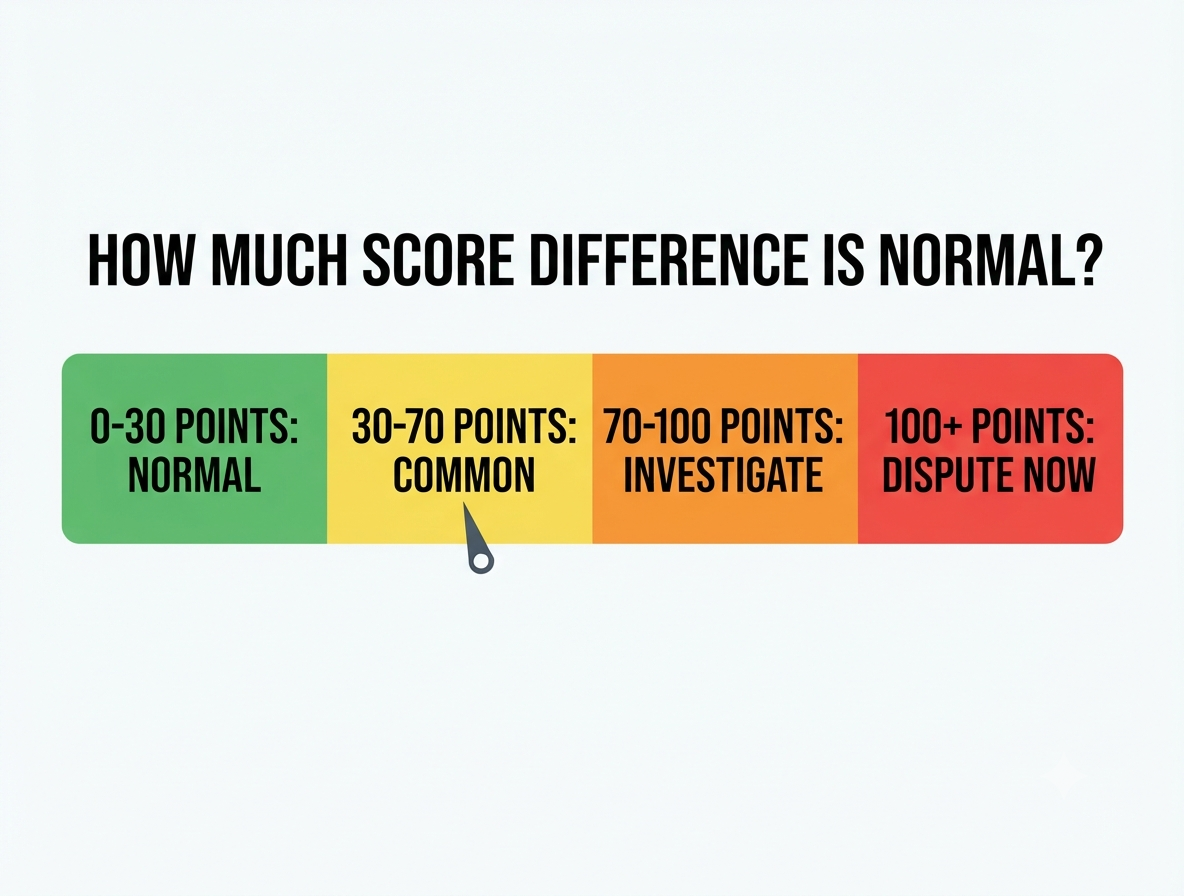
Here's a practical guide:
Score Variation Between Bureaus | What It Likely Means |
0–30 points | Normal — minor algorithm differences |
30–70 points | Common — different data sets or timing differences |
70–100 points | Investigate — check both reports for missing or extra data |
100+ points | Action needed — likely an error on one report. Dispute immediately |
If your scores are roughly in the same range across bureaus — you're fine. Small variations are expected and normal.
If one bureau shows a dramatically lower score — get that bureau's report and check it line by line for errors.
Which Score Should You Care About Most?
For most people in India - CIBIL is the score that matters most day-to-day.
Almost every major bank - SBI, HDFC, ICICI, Axis, Kotak, and others - checks your CIBIL score first when you apply for a loan or credit card.
But Experian and CRIF are used by many NBFCs and digital lenders - which are increasingly common, especially for personal loans and credit cards from newer platforms.
Practical recommendation:
- Monitor CIBIL most closely - check it every 3 months
- Check all 4 bureaus at least once a year
- Dispute errors on any bureau the moment you find them - not just CIBIL
How to Check Your Credit Score for Free in India
You are entitled to one free credit report per year from each bureau.
Bureau | How to Get Free Report |
CIBIL | cibil.com - one free report annually |
Experian | experian.in - one free report annually |
Equifax | equifax.co.in - one free report annually |
CRIF High Mark | crifhighmark.com - one free report annually |
Checking your own credit score is a "soft inquiry" - it does NOT affect your score in any way. Check as often as you like.
You can also check your credit score through FREED at freed.care/credit-check - free, instant, zero impact on your score.
Are You in a Loan Trap? Quick Check
Move the slider to your total EMIs as a % of monthly salary. See your debt stress level instantly.
EMIs as % of Monthly Salary
What to Do After Checking Your Reports
Once you have your reports from all four bureaus - go through each one carefully.
Check for these things on every report:
- Are all your loan and credit card accounts listed correctly?
- Are all accounts that you've closed showing as "Closed" - not "Active"?
- Are all payment statuses correct? No payments marked as missed when you paid on time?
- Is there any loan or credit card you don't recognise?
- Are your personal details correct - name, PAN, date of birth, address?
If you find an error:
Go to that bureau's website and raise an online dispute. It is free. The bureau must respond within 30 days. If the error is confirmed - it gets corrected and your score updates.
Even fixing one error on one bureau can give your score a meaningful boost on that bureau - without changing anything else about your financial behaviour.
How FREED Helps You Understand Your Credit Score
FREED can help you understand how your current loans and credit card bills are affecting your financial health - across bureaus.
Many people come to FREED after discovering a big score difference between bureaus and not knowing what to do about it. Our counsellors can:
- Help you understand what might be causing the difference
- Guide you on which errors to dispute and how
- Help you identify which of your current debts are most impacting your score across bureaus
- If your score is low due to debt overload - help you resolve the underlying debt through consolidation or settlement
We cannot directly improve your score - but we can help you understand the cause and guide you on what to address first.

Mohit Juneja
Mohit Juneja writes educational content at FREED on debt management, credit scores, loan repayment, and borrowing best practices. His content is shaped by expert insights and industry knowledge, helping readers better understand their financial options and make informed decisions.
mohit.juneja@freed.care

FREED is India's trusted loan management platform. Founded in 2020 and headquartered in Gurugram, FREED has counselled 20 lakh+ people on personal loans, credit cards, and app loans. FREED charges fees only on successful settlement, not upfront. FREED does not handle secured loans (home loans, car loans, gold loans).
Media Mentions