Reduce Your EMIs by Consolidating Your Debt
3 loans. 2 credit cards. 5 different due dates. Sound familiar? Debt consolidation brings it all into one single, smaller EMI, and it could save you thousands every month. Here's exactly how it works.
Mohit Juneja
Reviewed by FREED India, Debt Resolution Specialists
 4.7/5
4.7/5 ₹3,200Cr+
 20,000+
 20,00,000+4.7/5₹3,200Cr+20,000+20,00,000+
Key Takeaways

Debt consolidation means combining all your loans and credit card dues into one single loan with one EMI and usually a lower interest rate.
It can reduce your monthly EMI significantly, sometimes by 30–50%.
It does not erase your debt, but it makes it far more manageable.
It protects your credit score unlike settlement.
FREED helps you find the best consolidation option for your exact situation, for free.
What Is Debt Consolidation?
Let's say you have five different water pots that are all leaking.
You're rushing around attempting to plug each one. It wears you out. You are unable to keep up.
Through debt consolidation, all five pots are combined into a single, bigger pot with a single hole and a manageable stopper.
In terms of money, you replace all of your outstanding credit card debt and loans with a single loan.
This new loan has:
One monthly fixed EMI
Generally speaking, a smaller interest rate than the total of your current debts
One lender to handle
One deadline to keep in mind
The overall amount you owe is still the same. However, repaying it becomes much easier and frequently less expensive.
How Does Debt Consolidation Actually Reduce Your EMI?
Debt consolidation lowers your EMI for two reasons.
How Does Debt Consolidation Actually Reduce Your EMI?
There are two reasons consolidation reduces your EMI.
Reason
- 1
Lower Interest Rate
Credit cards in India charge 36-42% interest per year. Drag Drag Personal loans charge 12-24%. Drag Drag A debt consolidation loan typically comes in at 10-16%, significantly lower. Drag Drag When the interest rate drops, a larger portion of your payment goes toward the actual principal, instead of just feeding the interest.
- 2
Longer Repayment Tenure
A consolidation loan can spread your repayment over a longer period, say 4 or 5 years instead of 1 or 2. Drag Drag This brings down the monthly EMI amount, even if the total outstanding stays the same. Drag Drag Together, these two factors can make a very significant difference to your monthly cash flow.

FREED Expert Tip
"If your combined EMIs are eating up more than 40% of your take-home salary, debt consolidation is not just an option. It is something you should seriously explore right now. That ratio is a warning sign."
Check Your Options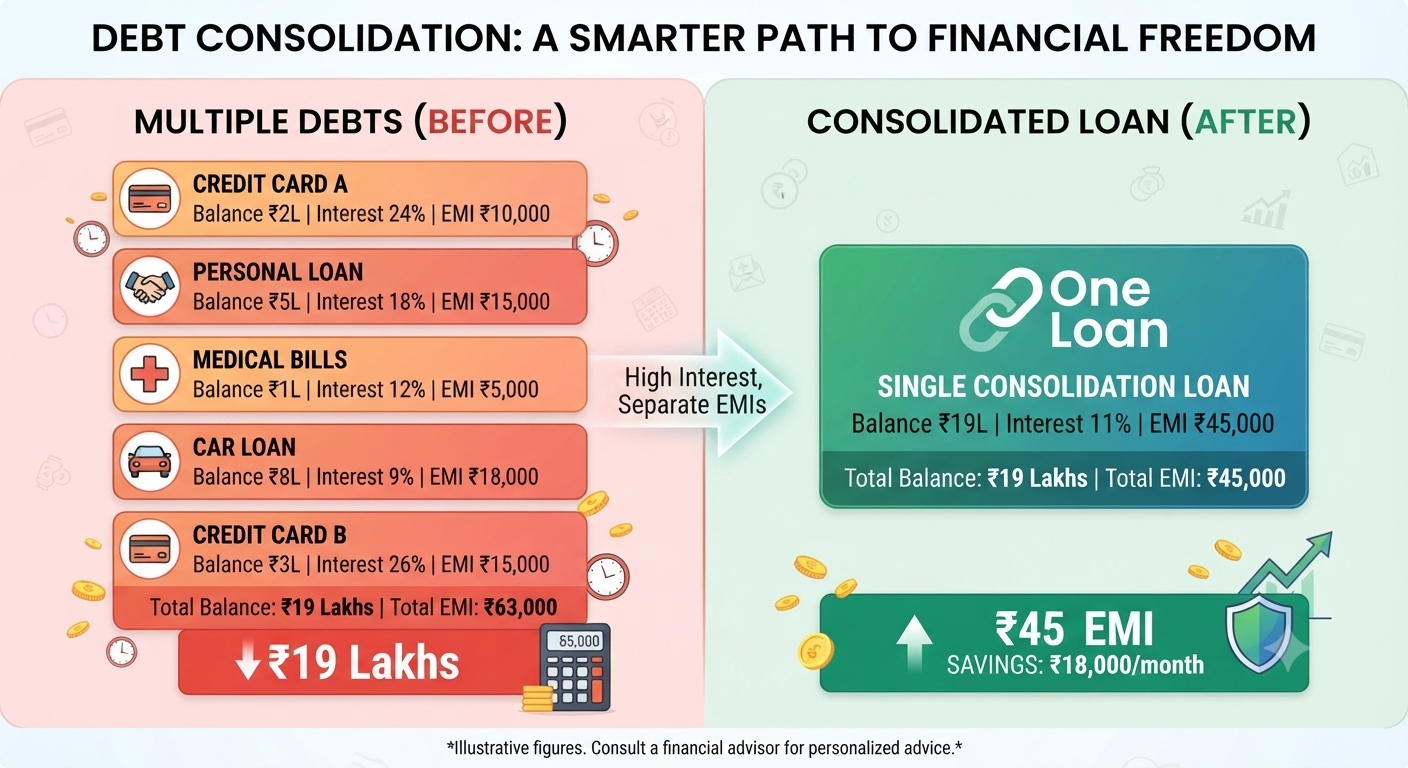
A Real Example on Before and After Consolidation
Let us take a real-life scenario.
Meet Ramesh. 34 years old. Salaried. Monthly take-home: ₹45,000.
Before Consolidation
Debt | Outstanding Amount | Interest Rate | Monthly EMI |
Personal Loan 1 | ₹1,50,000 | 18% | ₹4,200 |
Personal Loan 2 | ₹80,000 | 22% | ₹2,800 |
Credit Card 1 | ₹60,000 | 40% | ₹6,000 |
Credit Card 2 | ₹40,000 | 38% | ₹5,400 |
Consumer Loan | ₹70,000 | 20% | ₹2,500 |
Total | ₹4,00,000 | Avg ~28% | ₹20,900/month |
Ramesh is paying ₹14,500 every month; that is ~46% of his salary, just in EMIs.
He has 5 different due dates. 5 different lenders. One stressful month after another.
After Consolidation
Debt | Outstanding Amount | Interest Rate | Monthly EMI |
Single Consolidation Loan | ₹4,00,000 | 13% | ₹11,100 |
Ramesh now pays ₹11,100 per month- saving ₹9,800 every single month.
One EMI. One due date. One lender. And significantly less stress.
Calculate Your Savings: FREED Debt Calculator Enter your existing loans and EMIs. See exactly how much you could save every month with debt consolidation. Free. Takes 2 minutes. No personal details needed.
Who Should Consider Debt Consolidation?
Debt consolidation is not for everyone. But it is right for a lot more people than those who currently use it.
You are a good candidate if:
- You have 2 or more active loans or credit card dues
- Your combined EMIs are more than 35–40% of your monthly income
- You have at least one high-interest debt like a credit card or personal loan above 20%
- You are missing due dates because there are too many to track
- You are stressed about money every month even though you are earning
- Your credit score is 650 or above, making you eligible for a consolidation loan
- You want to protect your credit score, unlike settlement, consolidation does not hurt it
Consolidation may NOT be the right fit if:
- Your total debt is very small and manageable on its own
- Your credit score is below 600, making loan approval difficult
- You are likely to take on new debt after consolidating, which defeats the purpose
- You are already in severe default, in which case, a debt relief programme may be more appropriate
Not sure which category you fall into? That is exactly what a FREED Expert can tell you in one free call.
What to Watch Out For
Debt consolidation is genuinely helpful, but only when done carefully.
Here are the things to keep in mind before you go ahead.
- 1
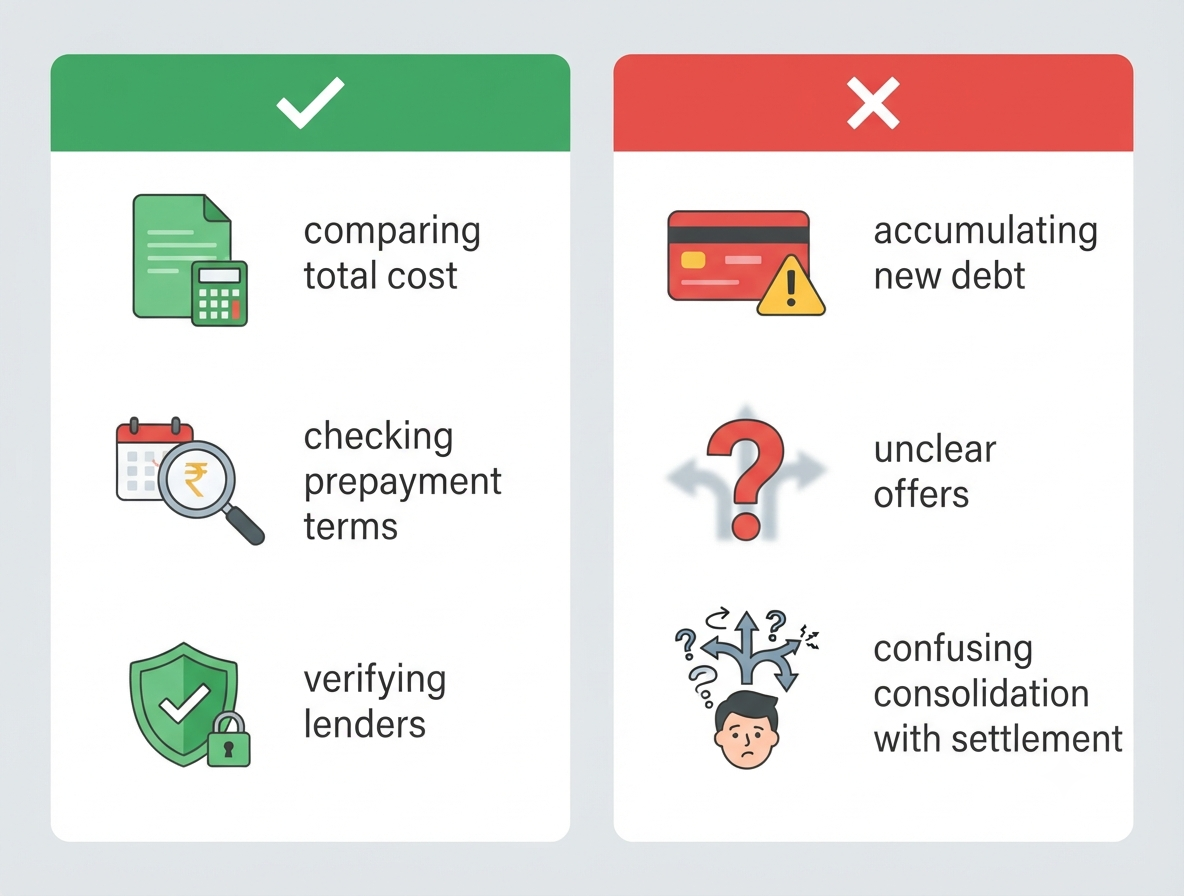
Do Not Accumulate New Debt Drag
This is the most common mistake. Drag Drag People consolidate their debts- feel immediate relief, and then start using their credit cards again. Drag Drag Within 12–18 months, they are back to the same situation, but now they also have the consolidation loan on top. Drag Drag Consolidation works only if you commit to not taking on new unnecessary debt
- 2
Check Prepayment Penalties on Existing Loans
Some personal loans and EMI-based products have prepayment or foreclosure charges typically 2–5% of the outstanding amount. Drag Drag If you are paying off an existing loan early to consolidate, check this fee first. Drag Drag In some cases, it may reduce the overall savings from consolidation.
- 3
Compare the Total Cost- Not Just the EMI Drag
A lower EMI sometimes means a much longer tenure. Drag Drag And a longer tenure can mean more total interest paid even at a lower rate. Drag Drag Always calculate the total interest outflow over the full loan period, not just the monthly EMI.
- 4
Avoid Predatory Lenders
If someone is offering you a consolidation loan at very low interest without checking your income or credit- be careful. Drag Drag Legitimate lenders always verify your ability to repay. Drag Drag Offers that sound too good to be true usually are.
- 5
Do Not Confuse Consolidation With Resolution
Consolidation combines your debts into one manageable payment. Drag Drag It works best when you have the income to service the consolidated loan. Drag Drag If your debt is so large that even a consolidated EMI would be unmanageable, you may need a debt resolution or relief programme instead. Drag Drag A FREED Expert can tell you which approach is
How to Get Started With Debt Consolidation
If you have read this far and are thinking- "This sounds like exactly what I need" here are your next steps.
- 1
List all your current debts.
Write down every loan and credit card outstanding. Include the outstanding amount, interest rate, and monthly EMI for each.
- 2
Check your credit score.
Most consolidation loan options need a credit score of 650 or above. Check yours for free on CIBIL or Experian. Drag
- 3
Calculate your potential savings.
Use the FREED Debt Calculator to see what your new consolidated EMI could look like and how much you would save every month. Drag
- 4
Talk to a FREED Expert
Before approaching any lender directly, speak to a FREED Expert. We will tell you which consolidation option suits your income, credit score, and debt profile, and help you avoid costly mistakes. Drag
- 5
Apply for the right consolidation loan
Once you know the best option- apply. FREED can guide you through the application process and help you get the best terms possible. Drag
- 6
Close your existing loans and cards
Once you receive the consolidation loan- use it immediately to close all existing debts. Do not keep them open. Drag
- 7
Stick to the plan
One EMI. One due date. Set up auto-pay. And commit to not adding new debt while you pay this off.
Are You in a Loan Trap? Quick Check
Move the slider to your total EMIs as a % of monthly salary. See your debt stress level instantly.
EMIs as % of Monthly Salary
Reason 1: Lower Interest Rate
In India, credit card interest rates range from 36 to 42 percent annually. Personal loan fees range from 12% to 24%. The average cost of a debt consolidation loan is 10–16%, which is much less. A greater percentage of your payment goes toward the principal rather than just the interest when the interest rate declines.
Reason 2: Longer Repayment Tenure
Examine Your Choices
A Real Example on Before and After Consolidation
Let's consider an actual situation.
Meet 34-year-old Ramesh. paid a salary. Take-home pay every month: ₹45,000.
Before Consolidation
Debt | Outstanding Amount | Interest Rate | Monthly EMI |
Personal Loan 1 | ₹1,50,000 | 18% | ₹4,200 |
Personal Loan 2 | ₹80,000 | 22% | ₹2,800 |
Credit Card 1 | ₹60,000 | 40% | ₹6,000 |
Credit Card 2 | ₹40,000 | 38% | ₹5,400 |
Consumer Loan | ₹70,000 | 20% | ₹2,500 |
Total | ₹4,00,000 | Avg ~28% | ₹20,900/month |
Ramesh's monthly EMI payment of ₹14,500 is around 46% of his wages.
He has five distinct deadlines. five distinct lenders. One tense month after another.
After Consolidation
Debt | Outstanding Amount | Interest Rate | Monthly EMI |
Single Consolidation Loan | ₹4,00,000 | 13% | ₹11,100 |
Ramesh now pays ₹11,100 a month, saving ₹9,800 each month.
Just one EMI. One deadline. Just one lender. and a great deal less worry.
Use the FREED Debt Calculator to Determine Your Savings Enter the loans and EMIs you currently have. Check out how much debt consolidation could save you each month. Free. It takes two minutes. No private information is required.
FREED Expert Tip
Debt consolidation is not just a possibility if your total EMIs are consuming more than 40% of your take-home pay. You ought to give it some serious thought right now. That ratio is a red flag.
Examine Your ChoicesWho Should Consider Debt Consolidation?
Not everyone is a good candidate for debt reduction. However, many more individuals than those who utilize it now can benefit from it.
You're a strong contender if
You have two or more outstanding credit card debts or loans.
The total amount of your EMIs exceeds 35–40% of your monthly salary.
You owe more than 20% on at least one high-interest obligation, such as a credit card or personal loan.
Due dates are eluding you because there are too many to keep track of.
Even though you are making money, you worry about money every month.
You qualify for a consolidation loan if your credit score is 650 or above.
Consolidation does not negatively impact your credit score, unlike settlement, therefore you wish to safeguard it.
Consolidation might not be the best option if
Your entire debt is negligible and doable on its own.
Your credit score is below 600, which makes getting a loan challenging.
After consolidating, you'll probably take on more debt, which negates the goal.
A debt resolution program can be more suitable if you are already in serious default.
Are you unsure about which category you fit into? In a single free call, a FREED Expert can tell you precisely that.
What to Watch Out For
Consolidating debt can be beneficial, but only if done correctly.
Before you proceed, bear the following points in mind.
1. Avoid Taking on New Debt
The most frequent error is this one. After consolidating their bills and seeing instant relief, people resume using their credit cards. They return to the same predicament in 12 to 18 months, but this time they now have the consolidation loan on top. Consolidation is only effective if you make a commitment to pay off your existing debt before taking on any new, needless debt.
2. Examine Current Loan Prepayment Penalties
Prepayment or foreclosure fees for certain personal loans and EMI-based products are usually between two and five percent of the total amount owed. Check this cost first if you are paying off an existing loan early in order to consolidate. In certain situations, it can lessen the total savings from consolidation.
3. Examine the Entire Cost, Not Just the EMI
Sometimes a substantially longer tenure is associated with a lower EMI. Additionally, even at a lower rate, a longer tenure may result in a larger total interest payment. Always figure out the entire interest outflow for the duration of the loan, not simply the monthly EMI.
4. Steer clear of predatory lenders
Be cautious if someone offers you an extremely low-interest consolidation loan without verifying your credit or income. Reputable lenders always check your repayment capacity. Generally speaking, offers that seem too good to be true are.
5. Keep Consolidation and Resolution Separate
Your debts are combined into a single, reasonable payment through debt consolidation. When you have the income to pay back the aggregated loan, it works best. You could require a debt resolution or relief program if your debt is so great that even a combined EMI would be too much to handle. Which strategy is best for your numbers can be determined by a FREED Expert.
How to Get Started With Debt Consolidation
This sounds like exactly what I need" is what you should do if you've read this far.
1. Make a list of all your outstanding bills.
List all outstanding credit cards and loans. Add each person's monthly EMI, interest rate, and outstanding balance.
2. Examine your credit rating.
A credit score of 650 or above is required for the majority of consolidation loan alternatives. Use CIBIL or Experian to check yours for free.
3. Determine how much you could save.
To determine how much you might save each month and what your new consolidated EMI would look like, use the FREED Debt Calculator.
4. Consult a FREED Specialist
Consult a FREED Expert before contacting any lender directly. In addition to helping you avoid costly mistakes, we will advise you on which consolidation option best fits your income, credit score, and debt profile, as well as whether debt resolution would be a better fit.
5. Make the appropriate loan application for consolidation
Apply once you've determined which choice is best. FREED can assist you in obtaining the best terms and help you throughout the application procedure.
6. Terminate your current credit cards and loans
Use the consolidation loan right away to pay off all of your outstanding obligations and credit card balances. Don't leave them open.
7. Follow the plan
Just one EMI. One deadline. Configure automatic payment. And promise not to take on any more debt while you settle this.

Mohit Juneja
Mohit Juneja writes educational content at FREED on debt management, credit scores, loan repayment, and borrowing best practices. His content is shaped by expert insights and industry knowledge, helping readers better understand their financial options and make informed decisions.
mohit.juneja@freed.care

FREED is India's trusted loan management platform. Founded in 2020 and headquartered in Gurugram, FREED has counselled 20 lakh+ people on personal loans, credit cards, and app loans. FREED charges fees only on successful settlement, not upfront. FREED does not handle secured loans (home loans, car loans, gold loans).
Media Mentions