How to Come Out of a Credit Card Debt Trap
Stuck in the minimum payment cycle with a balance that barely moves? Here is the complete, step-by-step path out, from stopping the damage to clearing the debt for good.
Mohit Juneja
Reviewed by FREED India, Debt Resolution Specialists
 4.7/5
4.7/5 ₹3,200Cr+
 20,000+
 20,00,000+4.7/5₹3,200Cr+20,000+20,00,000+
Key Takeaways

A credit card debt trap is the minimum payment cycle: paying only the minimum each month, watching interest consume most of it, and seeing the balance barely reduce despite months of payments.
At 36% to 42% annual interest, a credit card balance managed through minimum payments can persist for years and cost more in total interest than the original amount borrowed.
The right exit from the trap depends on the size of the outstanding, whether the account is current or in default, and what monthly income is available for repayment.
For balances that can be cleared within 12 to 24 months through disciplined repayment, self-directed strategies work. For balances that have grown beyond what income can realistically address, consolidation or settlement through FREED is the appropriate path.
The most important first step is stopping new charges on the card immediately, before any other action is taken.
What a Credit Card Debt Trap Actually Is
A credit card debt trap has a specific mechanism. It is not simply having a large credit card balance. It is the dynamic where the minimum payment is so small relative to the interest accruing that the balance barely reduces month after month, regardless of how consistently the minimum is paid.
At 3.5% monthly interest (equivalent to 42% annually), a Rs. 60,000 credit card balance accrues Rs. 2,100 in interest every month. If the minimum due is Rs. 3,000, only Rs. 900 of that payment actually reduces the principal. The remaining balance of Rs. 59,100 accrues another Rs. 2,069 in interest the following month. And so on.
After 12 months of consistent minimum payments, the balance has reduced by approximately Rs. 10,000 to Rs. 12,000. The borrower has paid Rs. 36,000 in minimum dues and still owes Rs. 48,000 to Rs. 50,000. In total interest paid over those 12 months: approximately Rs. 24,000 to Rs. 25,000. That is almost two thirds of the total paid going to interest, not principal reduction.
This is the trap. Not one payment. Twelve consecutive, consistent payments, and the balance is still close to where it started. The debt persists. The interest compounds. The borrower is running without moving.

Credit card debt trap already formed and cannot get out alone?
Talk to a FREED Expert, It's Free.
Connect with FREED ExpertHow People Get Into One
Credit card debt traps form through recognisable patterns.
The most common is gradual balance accumulation: a balance that starts small from one emergency or one month of overspending, grows slightly each month because only the minimum is paid, and compounds over 6 to 18 months into a number that feels impossible to address.
The second is balance transfer dependency: moving the balance to a new card offering a 0% promotional rate, using the promotional period to make some progress, then finding the balance has not been cleared when the rate resets to 40% and starting the minimum payment cycle again.
The third is the festive season spike: significant credit card spending during Diwali or other festive periods, carried forward because the bill is too large to clear in one go, then minimum-paid month after month while interest compounds.
In all three cases, the trap mechanism is the same: minimum payments keeping the account technically current while interest ensures the balance barely moves.

FREED Expert Tip:
The minimum due amount shown on a credit card statement is calculated to keep you in debt as long as possible, not to help you exit it quickly. It is set low enough to feel manageable and low enough that most of the payment goes to interest. Doubling the minimum payment every month reduces the repayment timeline dramatically. Paying five times the minimum clears most balances within 12 to 18 months. The minimum is not a target. It is a floor.
See the Real Cost of Minimum DueStep 1: Stop the Card from Being Used
No exit strategy works while the balance is actively growing from new purchases.
This means removing the credit card from all spending contexts: unlink it from food delivery apps, e-commerce platforms, and subscription services. Switch daily spending to a debit card or UPI. If the card is on auto-pay for utilities or subscriptions, redirect those to a bank account debit.
Do not close the card account. Closing a card reduces total available credit limit and raises credit utilisation ratio, both of which suppress the CIBIL score. Keep the account open but remove it from all active spending.
From this point, the balance only moves in one direction: down.
Step 2: Know the Full Outstanding
Before choosing an exit, know the exact number: the full outstanding balance, not the minimum due. This includes the principal, all accrued interest since the last statement, any late fees, and any other charges shown on the current statement.
This number is almost always higher than the rough mental estimate, because interest has been accruing daily between statements and the mind rounds down when the reality is uncomfortable.
Write the exact number down. Calculate what 40% annually means in monthly interest on that amount. Then calculate how much above the minimum you would need to pay each month to clear this balance within 12 months, 18 months, and 24 months. This calculation tells you which exit is realistic.
Are You in a Loan Trap? Quick Check
Move the slider to your total EMIs as a % of monthly salary. See your debt stress level instantly.
EMIs as % of Monthly Salary
Step 3: Assess Which Exit Applies to Your Situation
The right exit depends on three things: the total outstanding, what monthly payment above the minimum is feasible, and whether the account is still current or has entered default.
If total outstanding is below Rs. 1 to 1.5 lakh and monthly income allows paying 3 to 5 times the minimum: self-directed repayment works. A consistent, automated above-minimum payment every month clears the balance within 12 to 18 months.
If total outstanding is Rs. 1.5 to 5 lakh and the account is current: balance transfer, EMI conversion, or a personal loan at a lower rate may restructure the debt more effectively.
If total outstanding is above Rs. 3 to 5 lakh across multiple cards, or the balance has grown to a level where even aggressive payments produce negligible progress: professional debt consolidation or resolution through FREED is the appropriate path.
If the account is in default and the balance includes months of accumulated interest and penalties: settlement through negotiation with the bank is typically the most direct path to actually being debt-free.
Exit 1: Self-Directed Repayment
For balances that are genuinely clearable within 12 to 24 months of aggressive above-minimum payments, self-directed repayment is the cleanest exit. No new products. No professional fees. Just consistent, automated payment well above the minimum.
The mechanics: calculate the payment that clears the balance within the target timeline using an EMI calculator. Set up a standing instruction for this amount to leave the account on the 3rd of each month (before any discretionary spending). Stop all new card purchases. Review progress quarterly.
At 3.5% monthly interest on Rs. 60,000: paying Rs. 5,000 per month clears the balance in approximately 14 months. Paying Rs. 8,000 clears it in approximately 9 months. Each increase in the monthly payment dramatically shortens the timeline and reduces total interest paid.
Exit 2: Balance Transfer
A balance transfer moves the outstanding from a high-interest card to a new card offering a 0% promotional rate for 3 to 6 months, or a significantly lower standard rate.
This works when: the promotional period is long enough to make meaningful principal reduction, the new card's post-promotional rate is lower than the current card, and the borrower is disciplined enough to pay aggressively during the promotional window rather than simply making the minimum again.
The risk: balance transfers require a new credit card application (hard enquiry, CIBIL impact) and a processing fee (typically 1% to 2% of the transferred amount). If the balance is not significantly reduced during the promotional period, the problem restarts at the new card's rate.
Balance transfer is a useful tool for people who have the discipline to use the interest-free window aggressively. It is not useful for people who will revert to minimum payment once the pressure of the high rate is temporarily removed.
Exit 3: EMI Conversion
Many Indian credit card issuers offer the option to convert the outstanding balance into a fixed EMI at a defined interest rate, typically between 12% and 24%, significantly lower than the standard 40% revolving rate.
This converts a revolving balance with no fixed end date into a structured instalment loan with a defined repayment timeline. Every EMI payment reduces the principal by a meaningful amount. The balance has an end date.
To access this: call the credit card customer care or use the issuer's app to check if EMI conversion is available on the account. Request the conversion and compare the offered rate, EMI amount, and tenure against alternatives before accepting.
The limitation: the credit card limit may remain blocked for the EMI amount during the conversion tenure, reducing available credit. And if new purchases are made on the card during the EMI period, the balance rebuilds alongside the EMI. Discipline around new spending remains critical.

Legal Note:
Under RBI guidelines on credit cards, issuers are required to disclose the effective annual interest rate, the total interest cost, and any prepayment charges before converting a balance to EMI. Request these details in writing before accepting any conversion offer. You have the right to full cost disclosure before agreeing to any restructuring of your credit card balance.
Know your rights as a credit card holderExit 4: Personal Loan for Consolidation
A personal loan at 12% to 20% interest used to clear a credit card balance at 40% saves 20 to 28 percentage points in annual interest rate. On a Rs. 2 lakh outstanding, this saving in the first year alone is Rs. 40,000 to Rs. 56,000.
The mechanics: apply for a personal loan of sufficient amount to clear the full credit card outstanding. When approved, use the loan disbursement to pay the card in full. Then repay the personal loan through fixed monthly EMIs at the lower rate.
This only works if: the credit card is not used again after being cleared. The cleared credit limit is now available, and the temptation to spend on it is real. A borrower who clears the card with a personal loan and then rebuilds the card balance ends up with both the personal loan EMI and a new card balance.
If the CIBIL score has already been affected by the high utilisation, the personal loan application may be declined or offered at a higher rate. Check the score first before applying.
Tool: FREED Credit Insights
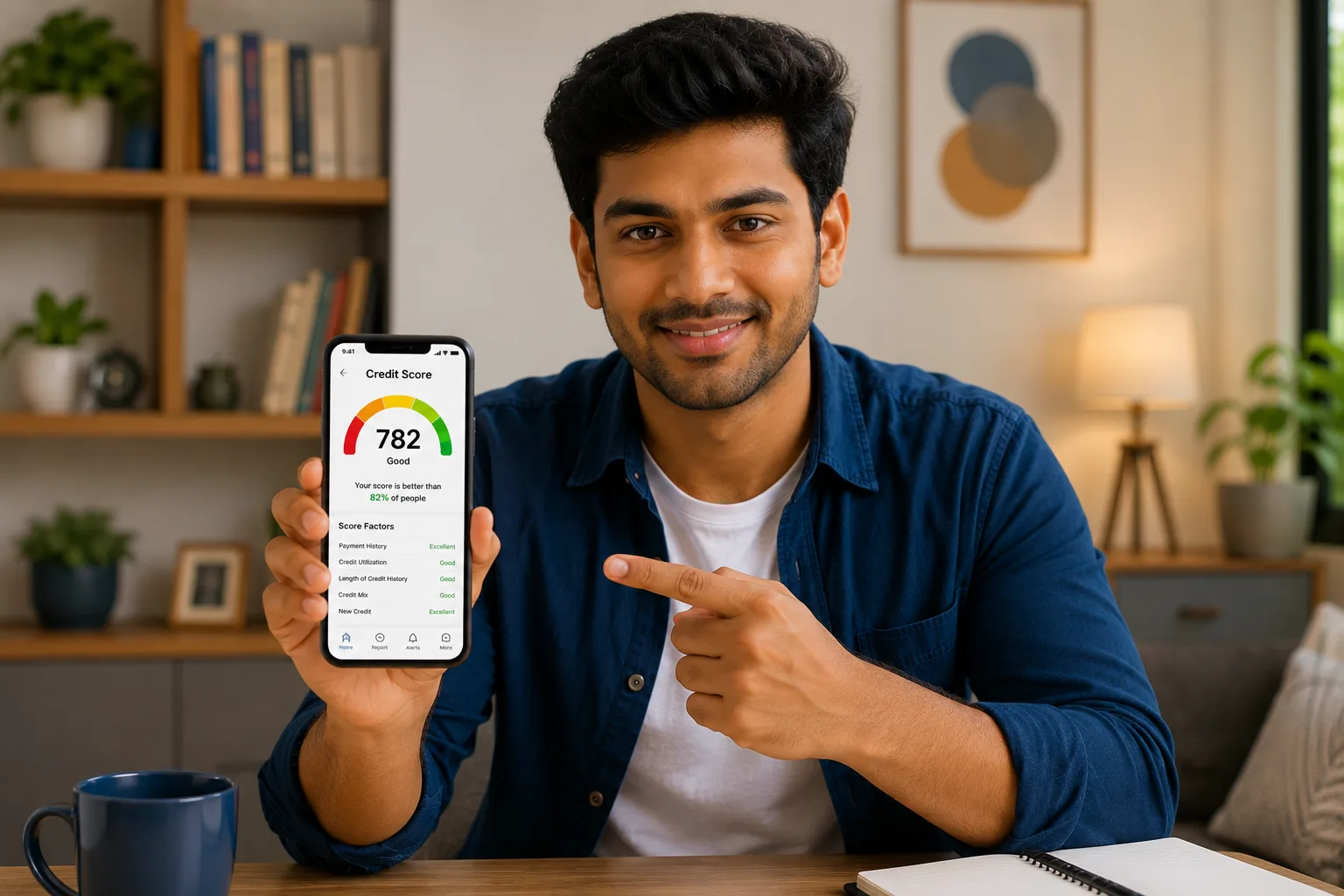
Check your credit score before applying for a personal loan or balance transfer. Know where you stand first.
Check Your Credit Score Free →Exit 5: Professional Debt Consolidation
When multiple credit cards are running simultaneously, each with different balances, different due dates, and different interest rates, managing them individually becomes both administratively complex and financially inefficient.
FREED's Debt Consolidation Programme combines all credit card balances into one lower monthly payment at a reduced effective interest rate. The programme negotiates with existing creditors on the borrower's behalf, without requiring a new loan application. It suits borrowers who can repay in full with a better structure and a single, manageable monthly payment.
The benefit beyond cost: one payment, one due date, one relationship manager handling all creditor communications. The administrative burden and the monthly anxiety of juggling multiple cards is removed.
Exit 6: Debt Settlement
When the credit card outstanding has grown to a level where even a restructured full repayment is not realistic on current income, settlement through negotiation with the bank is the direct path to actually being debt-free.
In a settlement, the bank agrees to accept less than the full outstanding amount as complete and final payment. Most settlements in India fall between 40% and 70% of the total outstanding including accumulated interest and charges. On an account that has been in NPA status for 6 months or more, the bank has already provisioned against it internally and has a business incentive to accept a negotiated exit rather than continue carrying the account.
The consequences are real: the account is permanently closed and marked "Settled" on the CIBIL report, remaining for up to 7 years from the date of first default. Future credit applications are affected in the near term. But for people whose balance has grown beyond what any repayment structure can address, settlement closes the account, stops the compounding, and begins the recovery.
FREED's Debt Resolution Programme negotiates settlements professionally on behalf of enrolled clients, with full documentation at every step and no payment released before the written settlement letter is in hand.
Protecting Your CIBIL Score Through the Process
Different exits have different CIBIL implications.
Self-directed repayment, EMI conversion, and balance transfer (if managed without new missed payments) have neutral to positive CIBIL impact over time. Consistently paying above the minimum reduces utilisation and builds positive payment history.
Personal loan consolidation has minimal CIBIL impact if payments are maintained. The hard enquiry from the application causes a small temporary reduction.
Professional debt consolidation through FREED keeps accounts in good standing and has neutral to positive CIBIL impact.
Settlement produces a "Settled" remark that reduces the score and remains for up to 7 years. For accounts already in default, this impact is typically less than the ongoing damage from continued non-payment.
After any exit, rebuilding begins with consistent on-time payments on all active obligations and keeping credit utilisation below 30% on any remaining active credit products.
Credit card debt trap already beyond what self-directed strategies can fix?
FREED has helped over 60,000 Indians find the right exit. Talk to a FREED Expert, Free, no pressure.
Connect Now
Mohit Juneja
Mohit Juneja writes educational content at FREED on debt management, credit scores, loan repayment, and borrowing best practices. His content is shaped by expert insights and industry knowledge, helping readers better understand their financial options and make informed decisions.
mohit.juneja@freed.care

FREED is India's trusted loan management platform. Founded in 2020 and headquartered in Gurugram, FREED has counselled 20 lakh+ people on personal loans, credit cards, and app loans. FREED charges fees only on successful settlement, not upfront. FREED does not handle secured loans (home loans, car loans, gold loans).
Media Mentions