HDFC EMI Bounce Message: What It Means and How to Fix It
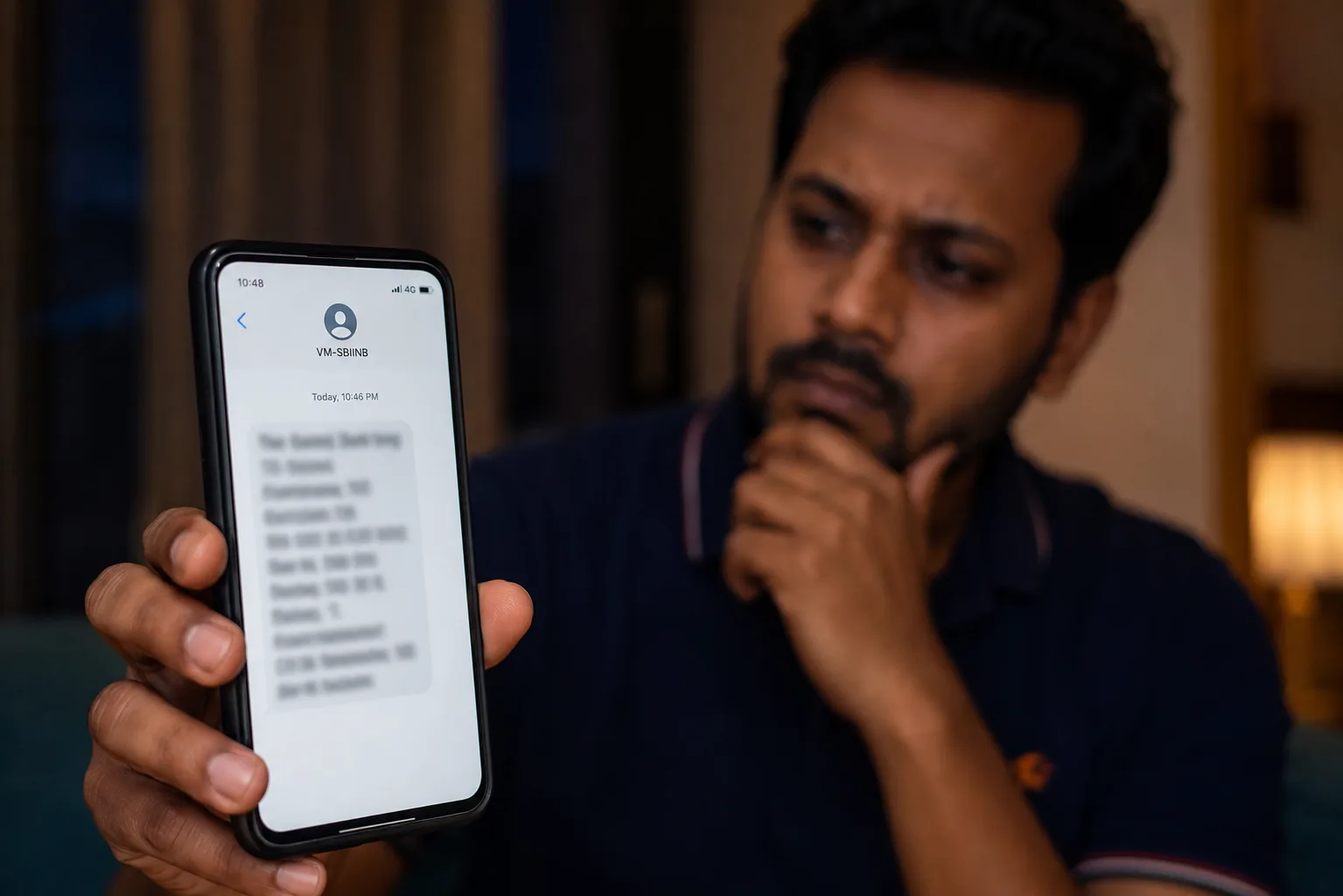
An HDFC EMI bounce message is the SMS or alert you get when your HDFC loan EMI auto-debit fails. It usually names the loan, the EMI amount, the date and the reason. Check the reason first, then pay through HDFC’s official app or website. A single bounce is a failed debit, not a default.
Mohit Juneja
Reviewed by FREED India, Debt Resolution Specialists
 4.7/5
 ₹3,200Cr+
 20,000+
 20,00,000+4.7/5₹3,200Cr+20,000+20,00,000+
Key Summary

An HDFC EMI bounce message means one debit failed. It does not mean you have defaulted.
Wording can differ by loan type and channel, so read the reason and amount lines first.
RBI says reminders must state the applicable penal charge, with a reason for each levy.
Credit card dues follow separate rules from loan EMIs.
HDFC’s complaint route goes from customer care to its Grievance Redressal Cell, the Principal Nodal Officer, then the RBI Integrated Ombudsman.
What Does an HDFC EMI Bounce Message Mean?
An HDFC EMI bounce message means HDFC tried to take your EMI from the linked account and the debit did not go through. The instalment is still unpaid, and nothing more serious than that has happened yet.
There is one point many readers miss. The text may come from HDFC about the loan, or from the bank that holds the account being debited. If your salary account is with another bank, you can get both. The two read differently, and the second can mention a return fee of its own.
HDFC also offers several kinds of loans, including personal, home, car, and two-wheeler loans. Credit card EMIs are a separate case. So the first job is to match the masked loan number in the message to the right loan on your list.
An EMI bounce means an attempted automatic payment has failed. If the instalment remains unpaid after the due date, the account may become overdue, attracting applicable bounce charges, penal charges and potential negative credit reporting. Paying promptly can help limit these consequences, but it may not automatically reverse charges or remove an overdue entry. And you are likely reading this with the message still open on your phone. Take it one line at a time. The reason the line matters most is that it decides whether you need to add money, renew a permission, or just wait for a fix.
For what a bounce can cost in general, read what actually happens when your EMI bounces. For the layout banks usually follow, see the guide on EMI bounce message format. Next, here is what the message usually contains.
What Does an HDFC EMI Bounce Message Usually Contain?
No single fixed HDFC template was found, so the order and wording can change from one loan or channel to another. Most alerts of this kind are built from the same parts.
What the message can include
Sender name: the bank or loan provider the SMS comes from
Masked loan number: usually the last few digits of the loan account
EMI amount: what was due
Due date or debit date: when the debit was tried
Reason for failure: why it did not go through
Any charge: a penalty charge or return fee, if one applies
How to pay or get help: an app, a link or a helpline
How to read it: reason first, then amount, then charge.
Here is one short sample, shown only to make the layout clear. Illustrative, not HDFC’s actual message:
“Your EMI of Rs [Amount] due on [Date] for loan ending [XXXX] was not debited. Reason: [Reason]. Please pay through the official app.”
For the full anatomy and three template variants, see our guide to EMI bounce message format.

FREED Expert Tip
Open the HDFC app and match the amount in the SMS to your loan before you pay.
Check My EMI StatusWhy Did Your HDFC EMI Bounce?
The cause is usually simple, and the reason line in the message points to it. These are the common ones.
The account balance was short when the debit ran
The mandate (your permission for the auto-debit) expired or was cancelled
The account was closed, inoperative, or frozen
The account number or bank details did not match
The EMI was higher than the mandate’s limit
A technical failure on either bank’s side
Reason Shown | What It Usually Means | What to Do |
|---|---|---|
Insufficient balance | The money was not there when the debit ran | Add the amount and pay through the official app |
Mandate expired or cancelled | The auto-debit permission has ended | Renew the mandate and pay this EMI manually |
Account closed, inoperative or frozen | The account cannot take debits | Ask your bank to reactivate it, or give HDFC a new account |
Account or bank details mismatch | The mandate details do not match your account | Check the details with HDFC and your bank |
EMI above the mandate limit | The EMI is higher than the limit you approved | Raise the limit or register a new mandate |
Technical failure | A system problem, not necessarily your balance | Check your statement and pay manually if the EMI still shows due |
Wording varies by bank, so treat the middle column as a guide. Rates and ranges shown are indicative. Final terms decided by the bank. FREED is not a Loan Provider. No outcome is guaranteed. Please verify directly with your bank.
A worked example. Your salary credits at 11 AM, but the debit ran earlier that morning when the balance was short. The money arrived a few hours too late. Debit timing can vary, so check your own statement for the exact time.
Mandates are usually renewed online. HDFC Bank has an e-Mandate registration page on its website. Check on HDFC’s site or app whether it covers your loan before you use it.
To see what is still due, follow the steps on how to check your EMI status. If you took a pause on repayments in the past, the HDFC EMI moratorium explains how that worked.

Check Your EMI Load Before the Next Due Date
See how much of your pay your EMIs already take.
Check My EMI ScoreHow to Fix an HDFC EMI Bounce Step by Step
Acting the same day tends to keep the cost down. These steps work for most loans, and you can follow them on your own.
Read the reason line and the loan number. It tells you which loan failed and what to fix.
Check your account balance and the debit entry. Confirm whether money left the account.
Pay the due EMI through HDFC’s official app, NetBanking, or loan repayment page. Do not pay through a link you are unsure of. If you prefer, WhatsApp banking or a branch visit also works.
Ask HDFC for the charge breakdown in writing. The amount and the reason must be disclosed, and you can match them to your agreement.
Fix the cause. Refill the account, renew the mandate, or update the bank details. The EMI Score tool shows how much of your pay your EMIs take.
Keep proof. Save the SMS, the payment receipt, and any email.
Complain if the charge looks wrong. Use the route in the complaint section below.
If a bounce is not cleared and the loan slips further, read what to do when your loan becomes overdue. To understand how lateness is counted by credit bureaus, see days past due (DPD). RBI expects the reminder to state the charge, with a reason for each levy (para 3(vii)).
What Charges Apply When an HDFC EMI Bounces?
HDFC’s own charge for your loan type is not quoted here. Charges differ by product and can change, so the right numbers are in your documents. What we can explain is what the RBI requires banks to do.
RBI circular RBI/2023-24/53 (18 August 2023) lays down these rules for penal charges:
A charge, not extra interest. A penal charge (a fee for breaking a loan term) cannot be added to your interest rate, and no interest can be charged on it (para 3(i)).
Reasonable and fair. The amount must be reasonable and applied without discrimination (para 3(iv)).
Disclosed upfront. The amount and the reason must appear in your loan agreement, in the Key Fact Statement (KFS, the one-page summary of loan costs) and on the bank’s website (para 3(vi)).
Stated in reminders. A reminder must state the penalty charge, and the reason must be given each time one is levied (para 3(vii)).
These rules have applied since 1 January 2024. Credit cards are outside this circular and follow their own rules (para 5).
If your debit account is with another bank, that bank may also levy its own return charge under its tariff. So one bounce can lead to two charges from two places. Ask each bank which charge is theirs, and keep both statements.
Where to look:
Your loan agreement
Your KFS, explained in the APR in a loan
The fee schedule on HDFC’s website for your loan type
Cardholders should read HDFC credit card late payment charges, since cards follow different rules.

What the Law Says
Banks must state the applicable penal charge in reminders and give the reason each time one is levied.
Know the Charges on Your LoanHow to Tell a Real HDFC EMI Bounce Message From a Fake One
Scam messages copy the look of bank alerts, because they know a failed EMI makes people react fast. A real alert asks you to pay your own loan through the channel you already use. A fake one wants something else: your OTP, your PIN, or a payment into an account you have never seen.
Warning signs
It asks for an OTP, UPI PIN, card details, or asks you to install a remote-access app
It threatens arrest or legal action within hours
The loan number, amount, or date does not match your HDFC loan
It pushes you to pay into a personal account
It comes from an odd number instead of a normal sender name
It adds pressure to act within minutes, such as “pay now, or the case goes to court today”
One balanced point. A pay link does not prove a message is fake, since real providers send links too. So open the official HDFC app instead of tapping it.
The safe route is to check dues in the HDFC app or NetBanking, or call the number printed on your loan documents. If you are dealing with a loan you never took, read the fake loan app complaint guide.
How to Complain If HDFC Charged You Wrongly
If a charge looks wrong, escalate in order. HDFC’s complaint page lists levels, and the contact forms are on that page, so use it instead of searching for numbers. Check the page before you file, since levels can change.
Raise it through HDFC’s customer channels. Note the complaint number you are given.
If you are not satisfied, go to the Grievance Redressal Cell.
If it is still not resolved, go to the Principal Nodal Officer.
If the issue remains, use the RBI Integrated Ombudsman. The scheme is set out in the RBI notification.
What to attach
A screenshot of the SMS
The bank statement entry
The payment receipt
The loan agreement page showing charges
Keep copies of everything you send, and write down the date and the complaint number at each level. If one level replies with a fix, ask for it in writing. If it does not, move to the next level and mention the earlier complaint number so the history travels with you.
If your worry is about calls from recovery agents rather than a charge, see your rights with HDFC recovery agents.
What If Your HDFC EMI Keeps Bouncing?
Start with the trigger: more than one bounce in a few months. That is usually a maths problem, not a discipline problem.
Take a take-home pay of ₹45,000 and EMIs of ₹25,000 across three loans. That is about 56% of income (25,000 / 45,000 = 55.6%). Illustration only. The comfort line is 50% of take-home pay. Above it, one late salary can bounce a payment.
The lighter options come first, in this order.
Ask HDFC to move the due date to just after salary day.
Ask about repayment help. HDFC may offer ways to rework your repayment. HDFC loan restructuring explains what to know first.
If you also have loans elsewhere, a balance transfer for one loan may help. See HDFC personal loan balance transfer.
If you are still paying but spread across several loans, debt consolidation means one new loan pays off the others. Read what debt consolidation is. Consolidation by itself does not drop your CIBIL score.
Whichever option you try, start the conversation before the next due date, not after the next bounce. Banks tend to be more flexible with someone who calls early and explains the cash-flow gap than with someone who goes quiet.
Consolidation is for people who are still repaying. If you have already missed many EMIs, talk to a counsellor first.
Too Many EMIs on Different Dates?
See whether one consolidated EMI could fit your situation.
Start My Debt AssessmentHow FREED Helps If HDFC EMI Bounces Become a Pattern
When bounces keep arriving, reminders are not the answer. Fewer payments are.
The FREED Loan Consolidation Plan, also called the Debt Consolidation Program or “Reduce My EMI”, is for people who can still repay but need a smarter way to manage their debt. Here is how it works. FREED's debt resolution program works only with unsecured loans and credit cards, and the fee is tied to a savings plan.
Profile review. FREED looks at your income, your loans, and your EMIs.
Lending partner match. Your profile is matched to a lending partner from FREED’s network.
Subject to eligibility and lending partner approval, debt consolidation may allow borrowers to combine multiple eligible unsecured loans into a single loan with one monthly EMI. However, a lower EMI is not guaranteed and depends on the interest rate, repayment tenure, and applicable charges. Borrowers should compare the total repayment cost before accepting a consolidation offer. You keep money ready for a single date.
FREED gets the consolidation done for you, so you are not chasing several banks for closure letters and statements. Final terms depend on the lending partner, and nothing is guaranteed. The new loan has its own rate and charges, so read them before you accept anything. The aim is simple: one date in your calendar, and one amount to keep in the account.
If you are unsure whether you qualify, FREED’s team can talk through your situation on a call and tell you what options are open.
Rates and ranges shown are indicative. Final terms decided by the bank. FREED is not a Loan Provider. No outcome is guaranteed. Please verify directly with your bank.
If HDFC recovery calls become abusive or threatening, you can report recovery harassment through FREED Shield. If repaying in full is genuinely no longer possible, the loan settlement program is the last-resort option.
How to Avoid Another HDFC EMI Bounce Message
Most repeat bounces come from timing, not from lack of money. Five habits cover nearly all of them.
Keep the EMI amount in the account the day before the due date. The debit may run earlier than you expect.
Ask HDFC to align the due date with your salary date. A date a few days after payday is the safest.
Check the mandate’s end date and limit once a year. Renew it before it lapses, and raise the limit if your EMI has gone up.
Update HDFC if you change bank accounts. An old account on a mandate is a common cause of a failed debit.
Turn on SMS and app alerts for the debit account. You see a problem the same day, not a week later.
For a simple monthly routine, see how to plan your personal loan EMI payment better. To understand when a late payment reaches your report, read when your CIBIL score updates.
Print or screenshot this list if it helps, and check it again whenever your salary date or bank account changes.
A single bounce is a bad morning, not a verdict. Fix the reason, keep the receipt, and set the next date so it works for you.
Sourcing and Verification
Claim | Source |
|---|---|
Penal charges are a charge, not added to the interest rate; no interest on them (para 3(i)) | RBI circular RBI/2023-24/53 |
Amount reasonable and non-discriminatory (3(iv)); disclosed in agreement, KFS and website (3(vi)) | Same circular |
Reminders must state penal charges; each levy needs a reason (3(vii)) | Same circular |
In effect from 1 Jan 2024; credit cards excluded (3(viii), 5) | Same circular |
RBI Integrated Ombudsman Scheme 2021 | RBI notification |
HDFC complaint levels (customer channels, Grievance Redressal Cell, Principal Nodal Officer, Ombudsman) | HDFC grievance page |

Mohit Juneja
Mohit Juneja is FREED’s Content & Communication Lead with 12+ years of experience across content, media, advertising and digital communications. He holds a postgraduate diploma in Communications from Xavier Institute of Communications, Mumbai, and has worked with organisations including NDTV, The Indian Express, McCann Worldgroup and NABARD.
At FREED, he leads content and communication across loan management, debt resolution, debt consolidation and financial well-being. His work combines research, storytelling and consumer-focused communication to make complex financial topics easier to understand and act on. He has also scripted and produced 11 documentaries on rural development and agriculture for NABARD, with film's selected for the Mumbai International Film Festival.
mohit.juneja@freed.care

FREED is India's trusted loan management platform. Founded in 2020 and headquartered in Gurugram, FREED has counselled 20 lakh+ people on personal loans, credit cards, and app loans. FREED charges fees only on successful settlement, not upfront. FREED does not handle secured loans (home loans, car loans, gold loans).
Media Mentions