HDFC Credit Card Late Payment Charges: What They Are and What They Actually Cost
What are HDFC credit card late payment charges? HDFC credit card late payment charges are fees applied when the minimum amount due (MAD, the smallest payment HDFC accepts to avoid a penalty, typically 5% of the outstanding balance) is not paid by the due date. The fee is charged once per billing cycle, ranges from Nil to Rs. 1,300 depending on the outstanding balance, and attracts 18% GST on top.
Mohit Juneja
Reviewed by FREED India, SEO Intern
 4.7/5
4.7/5 ₹3,200Cr+
 20,000+
 20,00,000+4.7/5₹3,200Cr+20,000+20,00,000+
Key summury

HDFC's late payment fee is charged once per billing cycle, not daily. But it is applied the moment the due date passes with no minimum payment received.
The fee ranges from Nil (outstanding below Rs. 100) to Rs. 1,300 (outstanding above Rs. 50,000), as per HDFC's updated slab structure effective August 1, 2024.
The late fee is often the smaller cost. The bigger hit is retroactive interest, charged from the original transaction date, not from when the payment was missed, at up to 3.75% per month (45% per year).
Payments delayed by 30 days or more may be reported to the credit bureau as overdue, which can affect future lending decisions.
A first-time late fee can sometimes be reversed by HDFC. Clean payment history and a direct call to customer care improve the chance of a waiver.
What Are HDFC Credit Card Late Payment Charges?
Two separate charges kick in when you miss your HDFC credit card due date. Most people think the late fee is the main penalty. It usually is not.
The first charge is the late payment fee. This is a flat amount applied once per billing cycle the moment the due date passes without a minimum payment received. It is not charged per day of delay. One fee per cycle.
The second charge is the finance charge, which is interest on the unpaid balance. This is almost always the more expensive one. And here is what most cardholders do not realise: HDFC calculates this interest from the original transaction date, not from when the payment was missed. A purchase made on the 5th of the month, missed on the 25th due date, begins accruing interest from the 5th. That is 20 extra days of interest the cardholder typically does not account for.
To understand how these charges apply, two terms matter:
Minimum amount due (MAD): The smallest payment HDFC accepts to avoid a late fee. The percentage and minimum amount vary by card product. Check your card's most current terms and conditions or HDFC's official website for the figure that applies to your specific card.
Total amount due (TAD): The full outstanding balance. Paying this in full every month is the only way to avoid interest entirely.
There is also an interest-free period of up to 50 days from the transaction date. This window exists only if the previous month's full balance was paid. Carry any balance forward and the interest-free period disappears for all transactions in the next cycle too.

HDFC Card Outstanding Growing and Hard to Manage?
Get a free assessment of your situation. No commitment, no pressure.
Get My Free AssessmentHDFC Credit Card Late Payment Fee Slabs: The Exact Amounts
HDFC's late payment fee depends on the total outstanding balance on the card at the statement date. These slabs are effective from August 1, 2024.
Total Outstanding Balance | Late Payment Charge (excl. GST) |
Less than Rs. 100 | Nil |
Rs. 100 to Rs. 500 | Rs. 100 |
Rs. 501 to Rs. 5,000 | Rs. 500 |
Rs. 5,001 to Rs. 20,000 | Rs. 750 |
Rs. 20,001 to Rs. 50,000 | Rs. 1,000 |
Above Rs. 50,000 | Rs. 1,300 |
GST at 18% applies on top of each slab amount. On the highest slab of Rs. 1,300, GST adds Rs. 234. Total late fee at that level: Rs. 1,534 for the fee alone, before any interest.
Two exceptions:
Pixel Credit Cards: Late payment charges do not apply.
Commercial credit cards: Only the Rental Transaction Charge applies under a different structure.
These charges are verified as of June 2026. HDFC can update fee structures. Always confirm the current amounts at hdfcbank.com or in the Most Important Terms and Conditions (MITC) document for your specific card.

What the Law Says
Under RBI Credit Card Directions 2022, all credit card issuers must provide a Key Fact Statement (KFS) showing the full Annual Percentage Rate, all fees, and penalty charges before the card is issued. HDFC must also give cardholders at least 3 working days' notice of any change in fees or charges. If the fee schedule on your statement differs from what was shown when you applied, you can raise a dispute with HDFC's grievance officer or escalate to the RBI Integrated Ombudsman.
Check What's on Your Credit ReportThe Real Cost of Missing an HDFC Payment: Beyond the Late Fee
The late fee gets the attention. The interest does the real damage. Here is the full cost breakdown of a single missed payment.
Component 1: The late payment fee
The flat slab amount per the table above. Charged once per billing cycle. With GST, the maximum is Rs. 1,534 for outstanding above Rs. 50,000.
Component 2: Retroactive interest
On most HDFC credit cards, the interest rate is up to 3.75% per month (45% per year). On premium cards such as Infinia, Diners Black, and Diners Black Metal, the rate is 1.99% per month (23.88% per year). Interest is calculated from the original transaction date, not from the missed due date.
Component 3: Loss of interest-free period on new purchases
Once any balance is carried forward, the interest-free period disappears for the next cycle too. Every new purchase made on the card immediately starts accruing interest from the transaction date, even if you pay those new transactions on time.
Component 4: CIBIL score impact
Payments delayed by 30 days or more are reported to CIBIL as DPD entries (Days Past Due, the number of days a payment has been overdue, visible on the CIBIL credit report). A payment delayed by 30 days or more may be reported to the credit bureau as a Days Past Due (DPD) entry. A single 30-day late payment can drop the CIBIL score by 50 to 100 points. At 90 days of non-payment, the account is classified as NPA (marked as bad by the bank), causing major, lasting damage.
Worked example:
You make a Rs. 30,000 purchase on your HDFC card on the 10th of the month. Your due date is the 25th. You miss the due date by one day and pay on the 26th.
- Late fee: Rs. 750 (Rs. 5,001 to Rs. 20,000 slab) + Rs. 135 GST = Rs. 885
- Interest: 3.75% per month from 10th to 26th = 16 days. Daily rate = 3.75% divided by 30 = 0.125% per day. Interest on Rs. 30,000 for 16 days = Rs. 600
- Total extra cost for a one-day delay: Rs. 885 + Rs. 600 = Rs. 1,485
One day late. Rs. 1,485 in extra charges.
HDFC Credit Card Late Payment: Impact on CIBIL Score
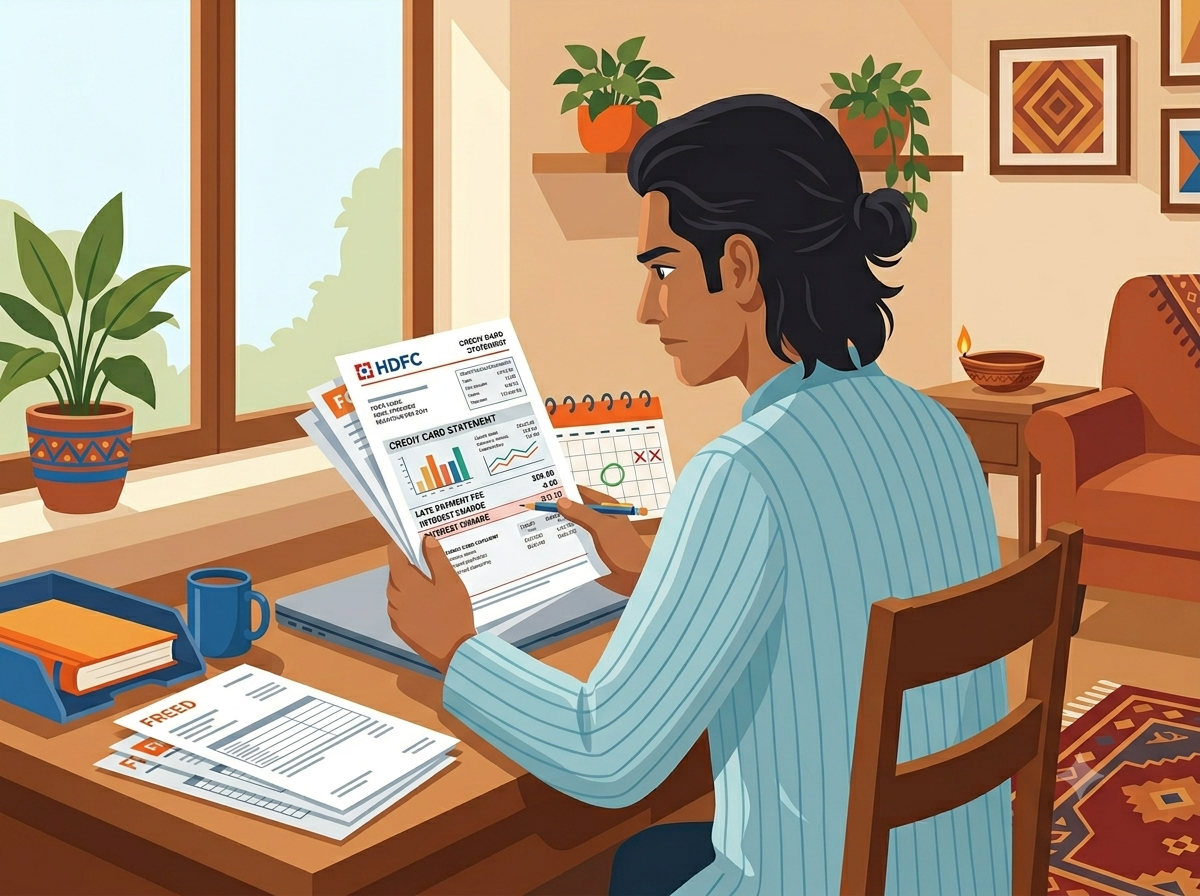
A missed HDFC credit card payment does two separate things to your CIBIL score. Most people only know about one.
The first is the DPD entry. HDFC typically does not report a delay of 1 to 2 days to the credit bureau if payment is made quickly. But once the delay crosses 30 days, it is reported as "30 DPD" (Days Past Due, the number of days a payment has been overdue, visible on your CIBIL credit report). This stays on your report and is visible to any bank or NBFC that checks your credit history in the future.
The progression from there:
- 30 DPD: 50 to 100 point score drop possible. Entry visible on report.
- 60 DPD: Further drop. Recovery calls begin. HDFC may reduce your credit limit.
- 90 DPD: Account classified as NPA (marked as bad by the bank). Major, lasting damage. Card may be frozen. Reward points suspended. Legal action possible.
The second impact is credit utilisation. A large unpaid balance on your HDFC card raises your credit utilisation ratio (how much of your card limit is currently being used). High credit utilisation may influence how lenders assess your credit profile. Even without a late payment, utilisation consistently above 30% of the card limit independently pulls down the CIBIL score.
CIBIL reporting frequency has increased in recent years. A payment made will reflect on your report once the lender reports it to the bureau. If a payment has just been missed, the priority is to pay as much as possible right now. Paying quickly reduces how the overdue appears in your credit history, though the exact impact varies by case. Verify current CIBIL reporting timelines directly at cibil.com.
HDFC Credit Card Late Payment: What Happens at Each Stage
Delay Duration | HDFC Action | CIBIL Impact | Key Risk |
1 to 2 days | Late fee charged. Interest retroactive from transaction date. | Usually not reported if paid quickly. | Fee + interest. No lasting damage if paid fast. |
3 to 29 days | Late fee + full month interest on outstanding. Interest-free period lost on new purchases. | Not yet reported to bureau. | Growing outstanding. Act immediately. |
30 days | Reported to CIBIL as "30 DPD." | 50 to 100 point drop possible. | Visible on credit report. Hard to remove. |
60 days | Reported as "60 DPD." Recovery calls begin. | Further score drop. | Bank may reduce credit limit. |
90 days | Account classified as NPA. | Major, lasting damage. | Card may be frozen. Reward points suspended. Legal action possible. |
Timelines are indicative based on HDFC's standard policies. Exact reporting depends on billing cycle date and HDFC's internal processes. Always verify directly with HDFC.

FREED Expert Tip
If a payment has just been missed, do not wait for the next statement. Pay as much as possible right now, at least the minimum amount due, to stop the interest from building and to reduce the chance of a CIBIL report entry. If it is a first-time miss, call HDFC customer care at 1800-202-6161 and ask for a fee reversal. Banks often waive the first late fee for cardholders with a clean prior history.
Understand the Full CIBIL ImpactHow to Get an HDFC Credit Card Late Fee Reversed
HDFC does waive late fees in some cases. It is not automatic and it is not guaranteed. But it happens often enough for first-time misses that it is always worth asking.
Conditions that improve the chance of a reversal:
- First-time late payment on the account
- Account has been in good standing for at least 6 to 12 months
- Payment of at least the minimum amount due is made before calling
- The request is made within 7 days of the fee appearing on the statement
- The cardholder asks directly: "I would like to request a waiver on the late payment charge for this billing cycle"
One important point: a bank will not consider a waiver on an account with an unpaid overdue balance. Pay first, then request.
Three ways to reach HDFC:
HDFC customer care: Call 1800-202-6161 from the registered mobile number. This is toll-free for HDFC customers.
HDFC Bank app: Go to "Complaints and Requests" and raise an online service request.
NetBanking: Log in and go to "Service Requests" then "Credit Card" to submit a query.
Fee reversal, if approved, is typically processed in 2 to 4 working days. If the first request is declined, a follow-up call with a supervisor sometimes changes the outcome.
How to Avoid HDFC Credit Card Late Payment Charges
These steps take one afternoon to set up and protect you from late fees indefinitely.
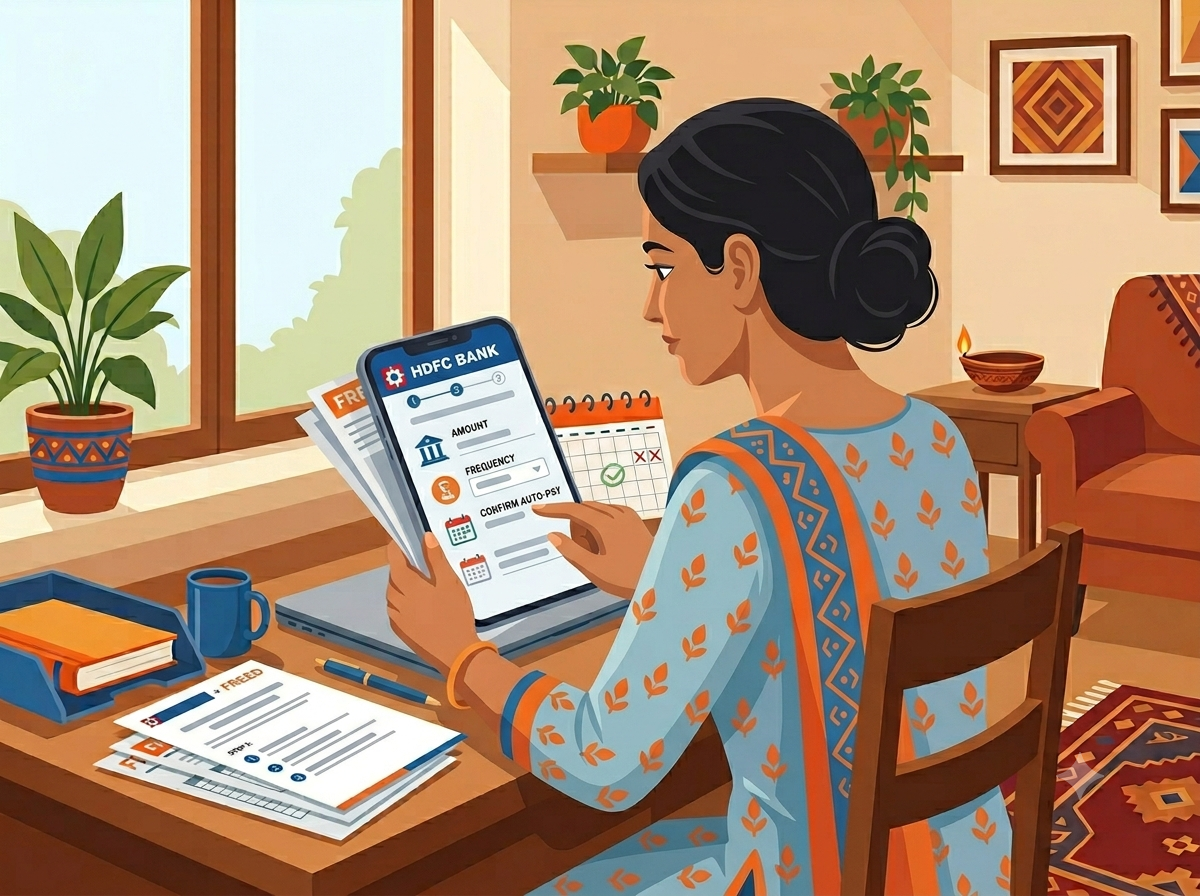
Set up auto-payment for at least the minimum amount due. Log in to HDFC NetBanking or the HDFC Bank app and enable a NACH mandate (auto-deduction permission given to the bank). This ensures the minimum payment is deducted automatically even if you forget the due date. It does not pay the full balance, but it prevents the late fee entirely.
Set a personal calendar reminder 5 days before the due date, not on it. Non-HDFC payment modes such as NEFT or other bank net banking can take 1 to 3 days to reflect. Pay 3 to 4 days early to be safe. Local cheques take 3 working days to credit. Never post-date a cheque for the due date.
Ask HDFC to change the billing cycle if the due date falls before your salary credit date. HDFC allows billing cycle changes under certain conditions. A due date that lands after your salary hits your account removes the monthly cash flow mismatch.
Check the statement every month, not just when paying. Errors, duplicate charges, and unauthorised transactions are caught earlier this way. A disputed charge is easier to resolve before it becomes an overdue.
Maintain responsible credit utilisation. This protects the CIBIL score independently of payment timing.
Pay the full statement balance each month. This is the only way to completely avoid interest. Paying anything less means interest applies on the unpaid portion from the original transaction date.
When the HDFC Card Outstanding Keeps Growing: What to Do
One missed payment is a mistake. A pattern of minimum payments is a different problem.
Signs the outstanding is growing beyond manageable: you have been paying only the minimum due for 2 or more months in a row, the balance on the statement keeps rising despite regular payments, or the total of your HDFC card bill plus all other EMIs exceeds 50% of your take-home monthly salary (how much of your income goes toward existing EMI payments).
Here is the right order of steps:
Pay more than the minimum every month. Even Rs. 1,000 or Rs. 2,000 extra reduces the principal faster and cuts the interest charged in the next cycle.
Ask HDFC to convert the outstanding to a lower-rate EMI plan. HDFC offers this for cardholders in genuine difficulty. One call to customer care can open this option. The rate on a structured EMI plan is almost always lower than 3.75% per month.
Move the outstanding to a bank with a lower balance transfer rate. This means shifting the outstanding from the HDFC card to another card or bank that offers a lower promotional rate, typically for 3 to 6 months. This buys time to repay at a lower cost.
Merge all debts into one lower monthly payment. If there are multiple credit cards and personal loans running together, a debt consolidation plan (merging all loans into one, so there is one EMI, one bank, one due date) can reduce the total monthly outflow.
If all of the above have been tried and repayment is genuinely impossible, loan settlement may be the remaining option for the credit card outstanding. Credit cards are unsecured debt and within FREED's scope.
How Loan Settlement Helps When HDFC Card Repayment Has Become Genuinely Impossible
Settlement is not something a borrower chooses out of preference. Banks and financial companies only consider it when you are in genuine financial difficulty and are truly unable to repay the full amount. It is a last resort, not a shortcut.
When someone has converted the outstanding to an EMI plan, tried a balance transfer, and still cannot keep up, settlement is the remaining option for unsecured debt. HDFC credit card outstanding is unsecured and within FREED's scope. Home loans, car loans, and gold loans are not.
In a settlement, HDFC agrees to accept a one-time payment that is less than the total amount owed. FREED helps borrowers settle their unpaid/overdue loans at up to 50% less*. The exact figure ultimately depends on your bank.
The cost to know: the "Settled" mark stays on your CIBIL report for up to 7 years. This affects future credit access. Settlement is not a clean exit. It is an honest exit when nothing else works.
FREED handles the paperwork, prepares the documents, drafts the settlement letters, and manages the back-and-forth with HDFC. A counsellor explains what to expect at every stage.
Rates and ranges shown are indicative. Final terms decided by the bank. FREED is not a Loan Provider. No outcome is guaranteed. Please verify directly with your bank.
Are You in a Loan Trap? Quick Check
Move the slider to your total EMIs as a % of monthly salary. See your debt stress level instantly.
EMIs as % of Monthly Salary

Mohit Juneja
Mohit Juneja writes educational content at FREED on debt management, credit scores, loan repayment, and borrowing best practices. His content is shaped by expert insights and industry knowledge, helping readers better understand their financial options and make informed decisions.
mohit.juneja@freed.care

FREED is India's trusted loan management platform. Founded in 2020 and headquartered in Gurugram, FREED has counselled 20 lakh+ people on personal loans, credit cards, and app loans. FREED charges fees only on successful settlement, not upfront. FREED does not handle secured loans (home loans, car loans, gold loans).
Media Mentions