How to Check Your EMI Status Online
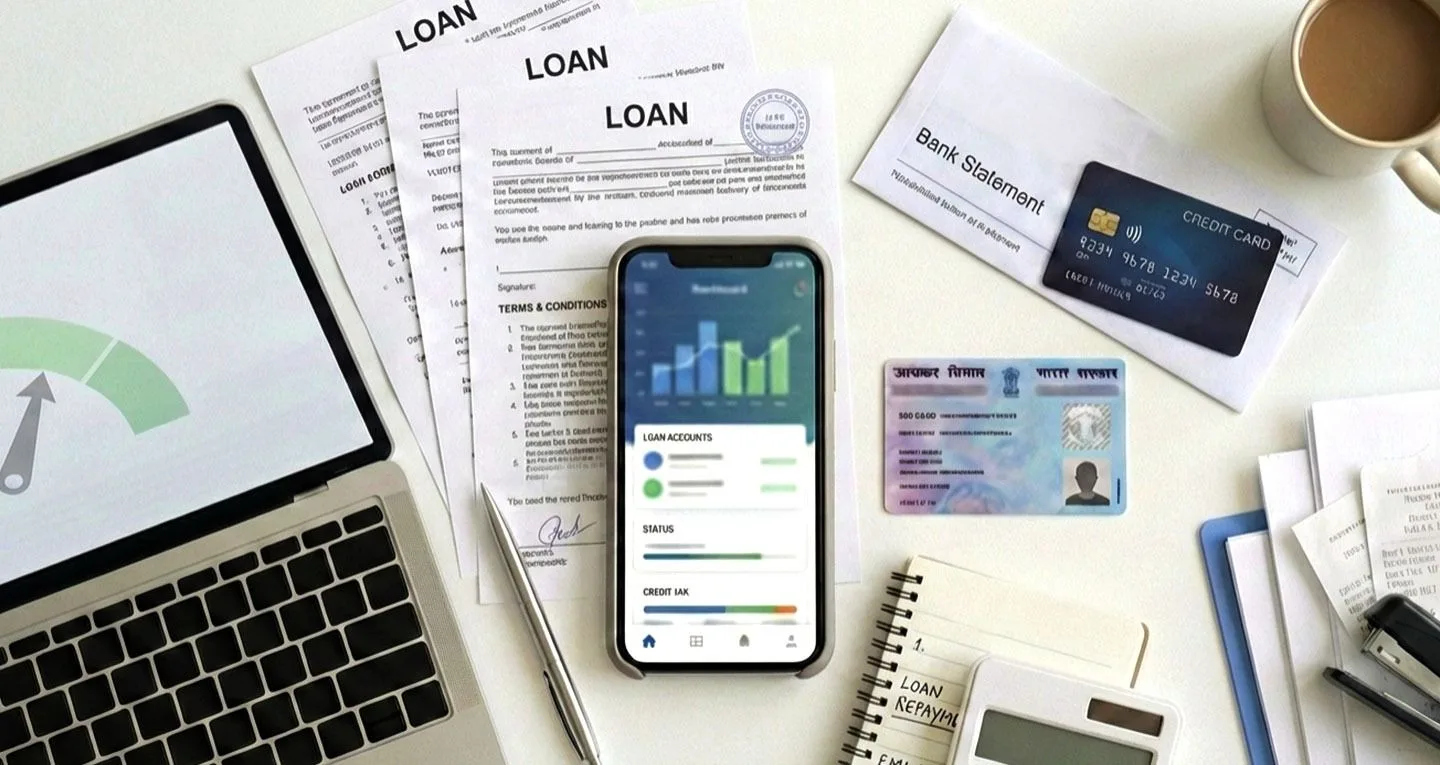
Checking your EMI status means confirming whether your latest instalment was paid, is still pending, or has failed, and whether your auto-debit mandate is active. You can check this in a few minutes through net banking, SMS, your NACH mandate section, your credit report, or customer care.

Mohit Juneja
Reviewed by FREED India, Debt Resolution Specialists
 4.7/5
4.7/5 ₹3,200Cr+
 20,000+
 20,00,000+4.7/5₹3,200Cr+20,000+20,00,000+
KEY TAKEAWAYS

You can check your EMI status five ways, net banking or app, SMS/missed-call banking, your NACH mandate section, your credit report, or lender customer care.
A failed auto-debit can be caused by an expired or inactive NACH mandate, insufficient balance, or other processing issues.
RBI now requires lenders to send a pre-debit notification at least 24 hours before any auto-debit, giving you a heads-up window.
Your credit report shows EMI payment history across every lender in one place, useful for catching a reporting error your bank statement won't show.
Different methods answer different questions; this guide tells you which one to use for which situation, not just how to use each.
What Does "Checking Your EMI Status" Actually Mean?
"EMI status" isn't one single thing. It usually refers to three separate checks bundled together: whether your last EMI shows as paid, pending, or overdue, whether your auto-debit (NACH) mandate is active or has quietly expired, and whether your lender's own records actually match what you believe you've paid.
These three can go wrong independently of each other, and that's the part most people miss. An active mandate doesn't guarantee a successful debit; a payment can still fail on the day even with the mandate in place. A paid EMI showing correctly on your bank statement doesn't guarantee it was reported correctly to your credit bureau either. Each one needs its own check.
That's exactly why checking regularly, not just when something feels off, matters more than it sounds like it should.
Why It's Worth Checking Regularly
A NACH mandate can expire quietly. A bank account change, a reissued debit card, or a closed account linked to the old mandate — any of these can break the auto-debit link with no obvious signal until a payment actually fails.
By the time you notice, you're usually looking at a bounce charge, a late fee, and a mark that can affect your credit report. A two-minute check every few months is enough to catch a broken mandate before any of that happens. Think of it the same way you'd think of checking your bank balance now and then, a small habit that saves you a much bigger cleanup later.
Here are five ways to actually do that check.
Five Ways to Check Your EMI Status
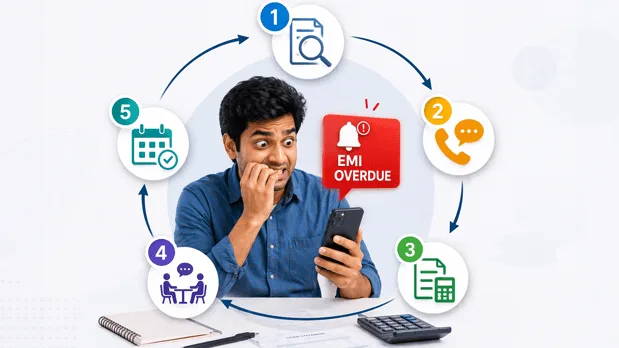
There are five reliable ways to check where your EMI stands: net banking or your lender's mobile app, SMS or missed-call banking, your NACH mandate section specifically, your credit report, and calling lender customer care.
These aren't interchangeable. Each one answers a slightly different question; one might show your full repayment schedule, while another only confirms your last transaction. That comparison is covered in detail further down this guide, so you can jump straight to the method that fits your situation. For now, here's how each one actually works, starting with the one most people reach for first.
Method 1: Net Banking or Mobile App
This is usually the most complete method and the right starting point for most people.
- Log in to your lender's net banking portal or mobile app.
- Go to the Loans or Accounts section and select the specific loan account you want to check.
- Find the repayment schedule or payment history. Each EMI should show a clear status: Paid, Due, or Overdue.
- Download the loan statement for a fuller record you can keep or share if needed.
Before any of this, it's worth confirming the loan is even registered correctly in your name in the first place, especially if something about the account looks unfamiliar. Checking whether a loan is actually registered under your PAN is a five-minute step that rules out a bigger problem before you go further.
A quick reference for major banks, illustrative only, since exact menu wording changes over time and you should look for the equivalent section if your bank differs:
- SBI: Account → Loan Account → Repayment Schedule
- HDFC: Accounts → Loans → View Details
- ICICI (iMobile app): Loans → Track Application/Repayment
Confirm the current menu path in your own app before relying on it. Bank interfaces get redesigned more often than most people expect.
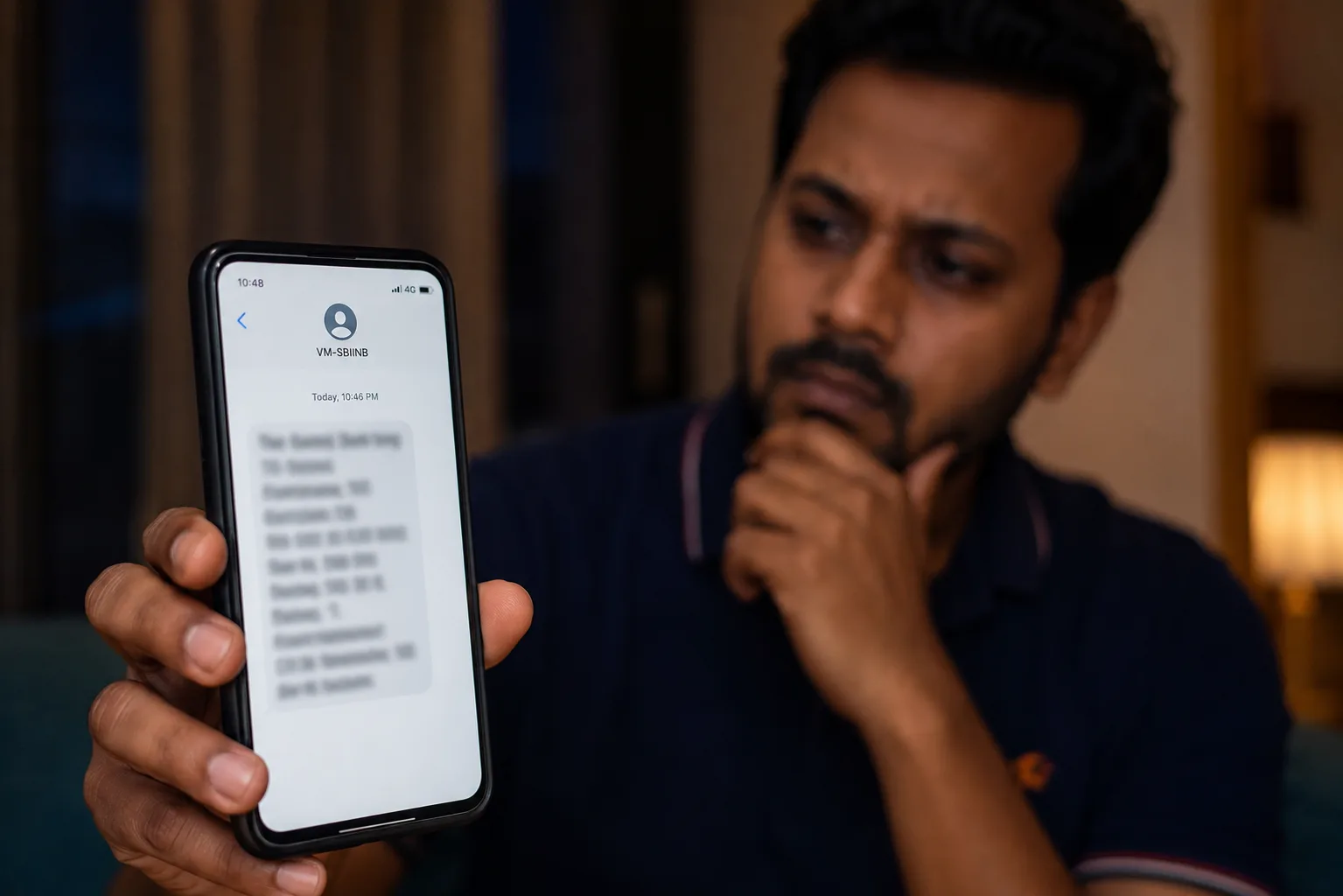
Method 2: SMS or Missed-Call Banking
If you don't have app access or just want a faster check, this method works from any basic phone.
Most major banks let your registered mobile number pull account and loan updates through SMS commands or a missed call to a designated number, without logging into anything at all. This gets set up once, usually through net banking or a branch visit, and after that it works independently of whether you have internet access at the time.
What it typically shows is your last transaction or EMI debit confirmation, not the full repayment schedule you'd see through net banking. It's a quick pulse-check, useful for confirming a single payment went through, but not a replacement for Method 1 when you need the complete picture. The exact SMS keyword or number is specific to each bank and changes periodically, so check your own bank's official SMS banking page rather than relying on a number you've seen elsewhere.
Method 3: Your NACH Mandate Status
A NACH mandate is the standing authorisation that lets your lender auto-debit your EMI on the due date. Without it, or if it's expired, the payment simply doesn't go through, even if you have more than enough balance sitting in the account.
Checking it takes a few steps:
- Log in to net banking or your lender's app.
- Find the section called Mandates, NACH Management, or Standing Instructions. The exact name varies by bank.
- Locate the mandate tied to this specific loan.
- Confirm it reads Active. Anything else, expired, inactive, or missing, is the reason your payment failed.
The most common way a mandate quietly breaks is a bank account change or a reissued debit card that was never linked back to the mandate. NACH itself is operated by NPCI on behalf of RBI, and RBI has recently tightened what lenders must tell you before any of this reaches your account.

What the Law Says
For recurring transactions covered by RBI's e-mandate framework, a pre-transaction notification must be sent at least 24 hours before the debit.
Check your optionsMethod 4: Your Credit Report
Your credit report, from CIBIL, Experian, or Equifax, shows payment history for every loan and card reported to it, all in one place. That cross-lender view is something no single bank's app can give you.
- Download your free annual report from the bureau's own site, or use a lender app that offers free checks.
- Find the account-wise payment history for the loan you're checking.
- Look for a "0" against each month, meaning on time, versus a number, meaning days past due.
The specific value here over net banking is that it can catch a case your bank's own portal won't show you, where your lender's system says "paid" internally but reported it late or incorrectly to the bureau. Downloading your full CIBIL report walks you through the complete process if you haven't pulled one before.

Freed Expert Tip
Check your credit report once a quarter, not just when applying for a new loan. Catching a wrongly reported EMI early is far easier to fix than after months have passed.
Check My Credit ScoreMethod 5: Calling Customer Care
Every lender's toll-free number or IVR menu offers an EMI or loan-status option, usually requiring your loan account number and a registered mobile OTP to get through.
This method actually beats the others in two situations: when you have no internet access at that moment, or when there's a discrepancy between what the app shows and what you expect, worth confirming verbally and getting a reference or complaint number for your own records. One caution, though: IVR wait times can run long. Treat this as a backup, not your first move.

Which Method Should You Actually Use?
Method | Best For |
Net Banking / App | Full repayment schedule and statement download |
SMS / Missed Call | A fast pulse-check with no login |
NACH Mandate Check | Specifically when a payment failed despite sufficient balance |
Credit Report | A cross-lender view or a suspected reporting error |
Customer Care | A backup, or a verbal confirmation with a reference number |
As a practical default, check net banking or your app first. If something looks off from there, your two follow-ups are the NACH mandate check and your credit report, in that order, since between them they cover almost every reason a status might look wrong.
What to Do If Something Looks Wrong
There isn't one generic fix here. What you do depends on exactly what you're seeing.
Status shows Overdue, but you're sure you paid. First, rule out a routine display lag; banks can take a day or two to update after a payment clears. If it's still showing as overdue after 3 to 4 days, raise it with the lender directly, quoting your payment reference number.
Mandate shows as Inactive or Expired. Register a fresh e-mandate through the same net banking or app flow right away. Don't wait for the next due date to come around and hope it resolves itself.

You never received the RBI-mandated pre-debit notification and then saw an unexpected debit. This is a genuine compliance gap, not a minor inconvenience. Raise it with the lender in writing and reference the RBI e-mandate framework by name.
The credit report shows a payment as late when your bank statement shows it on time. This is a reporting discrepancy between your lender and the bureau. Raise a dispute directly with the credit bureau, and keep both records, your statement and the report, as proof.
Freed Expert Tip
Whichever scenario applies, screenshot or save the exact status page with a date and time stamp before you contact the lender. It's the single most useful thing to have on hand when raising a dispute.
Book My Free CallWhat Are Your Options If You're Falling Behind?
If overdue status is starting to show up more than once, it's worth stepping back before it becomes a pattern.
Start by talking to your lender directly about restructuring; it costs nothing to ask, and some lenders will work with you on a revised schedule. If the real issue is repeated overdue flags across multiple lenders rather than just one loan, consolidating into a single lower EMI is usually the next thing worth looking at. Settlement sits at the far end of this, and it's only for genuine, sustained inability to repay, not a first option. It's worth being direct about the trade-off there too: settlement affects your CIBIL score, and the "Settled" status can stay on your report for up to 7 years.
Left unaddressed, an overdue loan doesn't stay quiet on its own. What actually happens once a loan goes overdue walks through that timeline in full.
How FREED Helps If Your EMIs Are Getting Hard to Manage
If you're still current on your payments but noticing repeated overdue flags, or simply juggling several EMIs across different lenders, FREED's Debt Consolidation Program, "Reduce My EMI," is built for exactly this stage.
FREED can help consolidate eligible unsecured debts into one new loan through a matched lending partner, potentially resulting in a lower monthly payment. The impact on your CIBIL score depends on your overall credit profile and repayment behaviour.”It's worth noting this only covers unsecured debt, personal loans, credit cards, and similar. For genuine, sustained inability to repay any of it, FREED's Debt Resolution Program is the separate, later-stage path, distinct from consolidation and only relevant once repaying in full has become genuinely impossible.
Freed Expert Tip
Consolidation works best while you're still current on every payment. Waiting until after a missed EMI narrows which lenders will work with you.
Ready to See Your Options?
Mohit Juneja
Mohit Juneja writes educational content at FREED on debt management, credit scores, loan repayment, and borrowing best practices. His content is shaped by expert insights and industry knowledge, helping readers better understand their financial options and make informed decisions.
mohit.juneja@freed.care

FREED is India's trusted loan management platform. Founded in 2020 and headquartered in Gurugram, FREED has counselled 20 lakh+ people on personal loans, credit cards, and app loans. FREED charges fees only on successful settlement, not upfront. FREED does not handle secured loans (home loans, car loans, gold loans).
Media Mentions