HDFC Personal Loan Balance Transfer: Should You Switch and How to Apply
An HDFC personal loan balance transfer lets you move your existing personal loan from another bank or NBFC to HDFC Bank, usually to get a lower interest rate or a longer tenure. HDFC pays off your old loan, and you start repaying HDFC instead. Whether it's worth it depends on your CIBIL score, the rate gap, and how much loan tenure is left.
Mohit Juneja
Reviewed by FREED India, Debt Resolution Specialists

 4.7/5
4.7/5 ₹3,200Cr+
 20,000+
 20,00,000+4.7/5₹3,200Cr+20,000+20,00,000+
KEY TAKEAWAYS

HDFC personal loan balance transfer rates typically start around 10.40% to 10.85% p.a. for strong profiles, confirm the live rate with HDFC before applying.
HDFC may apply minimum eligibility criteria for balance transfer applications, including credit profile and income requirements. These may change over time, so applicants should confirm the latest criteria directly with the bank.
The processing fee is a flat amount, roughly ₹3,999 to ₹6,500 plus GST, not a percentage of the loan, so the maths works differently than with banks that charge a percentage-based fee.
HDFC allows clubbing more than one existing personal loan into a single balance transfer account.
This route is for salaried applicants only, self-employed borrowers would need a different HDFC loan product.
Should You Switch Your Personal Loan to HDFC
This is a decision question before it's a paperwork question, so it's worth starting there rather than jumping straight to the application steps.
Switching genuinely makes sense in a few specific situations. If there's a meaningful gap between your current rate and what HDFC is offering, commonly the case if your existing loan is with an NBFC running at 16-20% while HDFC's rate for your profile sits closer to 11-13%, the savings can be real. It also makes more sense when your repayment record on the current loan is clean, since that's exactly the profile HDFC's underwriting favours, and when enough tenure remains, at least a year or two, for the interest savings to actually outweigh the switching costs.
It makes less sense in the opposite situations. A relatively small difference in interest rates may not offset the costs of switching. Being near the end of your current tenure is another sign to pause, there simply isn't enough runway left for the savings to build up. And if you're managing more than one loan rather than a single balance, a straight bank-to-bank transfer often isn't the right tool at all, that's covered further down this page.
None of this is about being cautious for its own sake. It's simply that a balance transfer is a genuine financial decision with real costs attached, and it deserves the same five minutes of maths as any other loan decision, not just a glance at the headline rate.

Freed Expert Tip
Before applying to HDFC, ask your current bank for a written rate match offer. It costs nothing and can save you the entire transfer process.
Compare My Current RateHDFC Personal Loan Balance Transfer Interest Rate
HDFC's published starting rate for personal loan balance transfer generally sits in the 10.40% to 10.85% p.a. range, though this is the floor for the strongest profiles, not a number every applicant should expect.
The rate you're actually offered depends on several things working together. Borrowers with stronger credit profiles generally receive more competitive pricing, although HDFC evaluates each application individually. Income matters too, both the absolute amount and how stable it looks on paper, a longer tenure with your current employer generally reads better than a recent job change. Your employer's category, whether it's a well-known company, a government body, or a smaller private firm, also factors into HDFC's internal risk assessment, sometimes more than borrowers expect.
Published rates online vary meaningfully from source to source, some cite 10.40%, others 10.85%, and HDFC's own general personal loan page lists a much wider range depending on profile. This isn't inconsistency so much as different sources capturing different moments or different customer segments. The only reliable number is the one HDFC actually quotes you after reviewing your specific application, so treat any rate you see in an article, including this one, as a starting point for comparison, not a guarantee.

What the Law Says
RBI mandates that HDFC give you a Key Fact Statement disclosing the full annual rate and every fee before you sign a balance transfer loan.
See a Sample Key Fact StatementHDFC Personal Loan Balance Transfer Eligibility
A few clear criteria determine whether this specific route is available to you.
- Age between 21 and 60 years, in line with HDFC's standard personal loan age band.
- CIBIL score generally above 720. A lower score doesn't rule out a personal loan entirely, but it typically rules out this specific balance transfer product's better rates.
- Salaried applicants only. This particular route is not available to self-employed borrowers, who would need to look at a different HDFC loan product entirely.
- Net monthly take-home above roughly ₹50,000, specifically for the balance transfer route, though this figure is worth confirming directly with HDFC since minimums can shift.
- A clean repayment track on your existing loan. HDFC reviews your history on the loan being transferred, not just your overall credit report.
Meeting every item on this list doesn't guarantee approval, HDFC's internal underwriting still has the final say, but falling short on any of these generally means the application won't move forward.
What Does an HDFC Balance Transfer Actually Cost
This is the section most competitor content skips, stopping at "rates start from 10.40%" without ever showing what a switch actually costs once every fee is accounted for.
HDFC's processing fee for balance transfer is typically a flat amount rather than a percentage, commonly cited between ₹3,999 and ₹6,500 plus GST depending on the source and offer period, confirm the exact current figure with HDFC before applying. This flat structure changes the maths compared to banks charging a percentage of the loan amount, on a larger loan, a flat fee is proportionally cheaper; on a smaller one, it can eat into savings more than expected.
The bigger variable is usually the foreclosure charge from your existing lender, not from HDFC. This can run close to 2% to 3% of the outstanding principal for bank loans, and NBFCs often charge more, sometimes 4% to 5%, plus GST on top of either. This is entirely dependent on your current lender's specific terms, so it's worth pulling your loan agreement or asking directly before assuming a number.
To know whether a switch genuinely saves money, add HDFC's processing fee to your existing lender's foreclosure charge, then compare that total against the actual rupee amount you'd save in interest over your remaining tenure at HDFC's new rate. If the interest savings clearly exceed the combined fees within a reasonable window, the switch pays for itself. If it's close, the maths deserves a second look before committing.
Documents Required for HDFC Personal Loan Balance Transfer
- KYC documents, Aadhaar, PAN, and a recent photograph.
- Income proof, latest salary slips and Form 16, or a salary certificate.
- Bank statements, typically the last 3 to 6 months, showing salary credits and existing EMI debits.
- Foreclosure letter or closure statement from your current lender, confirming the outstanding balance and closure terms.
Having these documents ready may help avoid delays during processing.
How to Apply for an HDFC Personal Loan Balance Transfer
The process runs from an eligibility check through to your old loan actually closing, and it's worth knowing the full sequence before you start, since a couple of steps depend on your current lender responding promptly.
- 1
Check Your Eligibility First
Confirm your CIBIL score, income, and employment type match HDFC's balance transfer criteria before applying.
- 2
Request a Foreclosure Statement
Get the outstanding balance and closure terms in writing from your current lender.
- 3
Apply With HDFC
Submit the application online or at a branch with KYC, income proof, and bank statements.
- 4
Complete Verification
HDFC runs a CIBIL check, income verification, and underwriting review on your file.
- 5
Review the Sanction Letter
Check the final interest rate, tenure, and processing fee before accepting.
- 6
Collect Closure Confirmation
Once HDFC pays off your old loan, get written closure confirmation from your previous lender.
If You Have More Than One Loan
HDFC does allow clubbing more than one existing personal loan into a single balance transfer account, but this only works if every loan being combined individually meets HDFC's eligibility criteria, the same CIBIL, income, and repayment-track requirements covered above apply to each one.
Where this gets complicated is with three or more loans, especially across a mix of banks and NBFCs with different rates and remaining tenures. A direct HDFC balance transfer starts to strain at that point, since HDFC's underwriting is built around a relatively clean, well-documented case, not a complex, mixed profile with several moving pieces.
If that describes your situation, FREED's existing guide on HDFC debt consolidation walks through a different route specifically built for multiple loans, worth reading instead of trying to force several accounts through a single balance transfer application.

Have More Than One Loan
See if FREED can combine them into one lower EMI.
Check If I Qualify for ConsolidationHow FREED Helps If a Direct Bank Switch Isn't the Right Fit
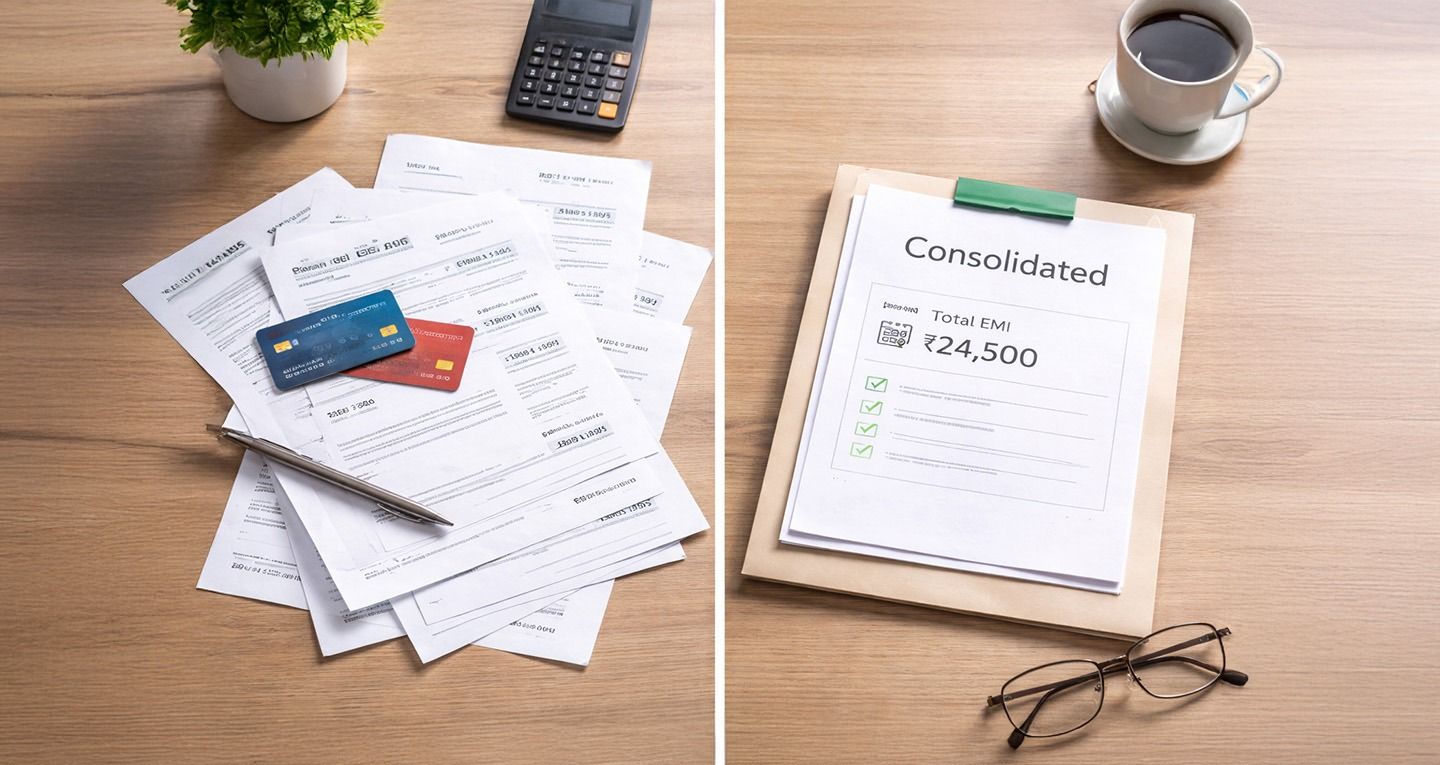
If the HDFC route didn't work out, whether your application didn't qualify, or you're managing loans across more than one lender, that's exactly the situation FREED's Loan Consolidation Plan is built for.
Also called the Debt Consolidation Program, or "Reduce My EMI," this works differently from a single bank-to-bank balance transfer. FREED assesses your complete financial profile, not just one loan in isolation, and matches you to a suitable lending partner from its network. That partner issues one new loan that pays off your existing eligible loans across whichever banks or NBFCs currently hold them, leaving you with one lender, one EMI, and one due date instead of several.
Because your existing loans close out properly rather than sitting unresolved, your CIBIL score tends to improve through this process rather than drop. The Loan Consolidation Plan comes at zero fee to you, any processing or foreclosure fee on the new loan is charged by the lending partner, not FREED. The plan requires a minimum CIBIL score of 700, since lending partners need to see a healthy credit profile to approve a new consolidated loan. Beyond that baseline, the exact EMI saving depends entirely on your individual loan profile, not a fixed formula.
This isn't a replacement for a straightforward HDFC balance transfer when that route genuinely fits, it's the option for when it doesn't, whether that's a declined application or simply too many accounts for one bank-to-bank switch to solve cleanly.
Things to Check Before You Switch
A few habits protect you from surprises after the paperwork is already signed.
Read the Key Fact Statement in full before accepting any offer, it's designed specifically so you can see the true annual rate and every fee in one place, not scattered across a sanction letter's fine print. Don't accept a top-up loan just because it's offered alongside the transfer, a larger loan than you actually need adds cost without adding value to the switch itself. Get written closure confirmation from your old lender once HDFC pays them off, this is your proof the old account is genuinely closed, not just marked for closure. If only a small portion of your loan tenure remains, the savings from a balance transfer may be limited.
Switching to HDFC vs Staying With Your Current Lender
Factor | Switch to HDFC | Stay and Negotiate |
Best for | Clean repayment track, meaningful rate gap | Existing relationship, minor rate gap |
Cost | Processing fee plus foreclosure charge on old loan | Usually no new fees |
Time | Full new loan application process | Faster, one phone call or branch visit |
CIBIL impact | Minor short-term dip from a hard inquiry | No new inquiry |
Keep neutral, no "best" or "worst" implied. Results depend on your individual profile and lender policies. FREED is not a Loan Provider and does not guarantee any specific outcome.
Sources
Claim | Source |
RBI mandates a Key Facts Statement (KFS), disclosing the full APR and all charges, for retail term loans sanctioned on or after October 1, 2024 | RBI Circular RBI/2024-25/18, DOR.STR.REC.13/13.03.00/2024-25, dated April 15, 2024: rbi.org.in/Scripts/NotificationUser.aspx?Id=12663&Mode=0 |
The rest of the blog's figures, HDFC's rate range, processing fee, CIBIL threshold, minimum income, are bank-specific commercial terms, not RBI regulations, so per the standing rule they stay in the blog body itself (softened with "confirm with HDFC" language where I've already flagged them) rather than appearing in this table with a fabricated link.

Mohit Juneja
Mohit Juneja writes educational content at FREED on debt management, credit scores, loan repayment, and borrowing best practices. His content is shaped by expert insights and industry knowledge, helping readers better understand their financial options and make informed decisions.
mohit.juneja@freed.care

FREED is India's trusted loan management platform. Founded in 2020 and headquartered in Gurugram, FREED has counselled 20 lakh+ people on personal loans, credit cards, and app loans. FREED charges fees only on successful settlement, not upfront. FREED does not handle secured loans (home loans, car loans, gold loans).
Media Mentions