HDFC EMI Moratorium: Rules, Benefits, and Eligibility
HDFC EMI moratorium was a temporary pause on loan and credit card EMI payments, offered under RBI's COVID-19 relief package. It ended on 31 August 2020, and HDFC isn't accepting new requests. If you're searching this today because your EMIs are getting hard to manage, the real options now are restructuring, consolidation, or settlement, not a moratorium.
Mohit Juneja
Reviewed by FREED India, Debt Resolution Specialists
 4.7/5
4.7/5 ₹3,200Cr+
 20,000+
 20,00,000+4.7/5₹3,200Cr+20,000+20,00,000+
Key Takeaways

HDFC's EMI moratorium ended on 31 August 2020. It was a one-time COVID-19 measure, not something you can apply for now.
Interest kept adding up during the paused months, so the total loan cost actually went up, not down.
If you need EMI relief today, HDFC's current option is case-by-case restructuring, and it isn't guaranteed.
If restructuring doesn't get approved, or doesn't lower your EMI enough, FREED can help you look at consolidation or settlement instead.
What Was the HDFC EMI Moratorium?
The moratorium let borrowers skip their EMIs for a few months without the bank marking it as a missed payment. HDFC didn't come up with this on its own. RBI directed every bank in the country to offer it, because the 2020 lockdown had left a huge number of salaried people and small businesses with no income at all for months at a stretch.
It ran in two phases: 1 March 2020 to 31 May 2020, then extended through 31 August 2020. It covered term loans, personal loans, home loans, car loans, and the minimum due on credit cards.
Here's the part that matters most if you're reading this in 2026: it was a one-time, emergency measure tied to a national crisis. It was never meant to be something you could opt into whenever cash got tight. That gap between what it was and what people remember it as is basically why this search term is still alive years after the scheme ended.
If you're dealing with tight EMIs right now, for whatever reason, it's worth knowing early that FREED works with people in exactly this spot. Whether it's one loan feeling heavy or several loans piling up at once, there's usually a next step worth looking at.

Not Sure What EMI Relief You Actually Qualify For?
The moratorium ended years ago. That doesn't mean you're out of options.
Check My OptionsIs HDFC EMI Moratorium Still Available in 2026?
No. It closed on 31 August 2020, and HDFC has confirmed it isn't accepting new moratorium requests.
If you came across this term recently, maybe from an old article, a forwarded message, or a friend bringing it up, it's worth being direct: there's no active scheme sitting there waiting for you to apply. Nothing is pending. Nothing is reopening. RBI hasn't issued anything similar since the pandemic period.
This is a genuinely confusing moment for a lot of people, because you're searching this term precisely because your EMIs are hard to manage right now, and the thing you're searching for turns out not to exist anymore. That's frustrating, but it's not a dead end. HDFC still has an ongoing option for genuinely stressed borrowers, restructuring, and if that doesn't work out, FREED's consolidation or settlement plans exist for people in exactly this situation. The rest of this piece walks through what's actually on the table.
Who Was Eligible for the Original HDFC Moratorium?
This part is history, not something you can act on. It explains who could apply back in 2020, so the rest of the article makes sense.
The scheme covered a wide base of people. Retail borrowers with loans taken before 1 March 2020 qualified, personal loans, home loans, car loans, two-wheeler loans. Credit cardholders could defer their minimum due. Agriculture and SME borrowers were included too, since small businesses got hit especially hard by the lockdown.
You had to opt in yourself, through net banking, the app, or a branch visit. Nobody was auto-enrolled. There was no minimum loan size and no credit score cutoff, the relief was tied to the pandemic disrupting everyone's income, not to how risky a borrower someone was on paper.
This is part of why "HDFC EMI moratorium" still gets searched so often. For close to six months, it was one of the most widely used relief tools in the country. That kind of scale leaves a mark, even years after the scheme itself is gone.
If old missed payments or a moratorium period from that time are still muddying your credit report today, that's something worth checking rather than guessing about.
Still Dealing With Old Loan Confusion?
See exactly what's showing on your credit report today.
check your scoreWhat Were the Rules and Costs of the Moratorium?
The moratorium bought people time, but it was never free, and this is the part that gets left out when people remember it fondly. EMIs paused, but interest on the outstanding amount kept accruing every single day. That interest didn't vanish once the pause ended. It got added back into the loan.
To account for it, the loan tenure was generally extended, depending on the loan terms and the bank's implementation. Skip 6 months of EMIs, and your tenure moved out by about 6 months, with the total interest paid over the life of the loan going up as a result.
This trade-off shows up again in every option you'll read about below, restructuring, consolidation, settlement. Deferring a payment isn't the bank forgiving it. The amount still needs to be repaid, just on a different schedule. Keep that in mind as we go through what's actually available now, because none of these options make debt disappear. They change how and when it gets paid off, and FREED's role is mostly in helping you land on the version of that trade-off that actually fits your situation.
What Are Your Options for EMI Relief Today?
Since the moratorium is gone, here's what genuinely exists if your EMIs are getting hard to manage. There's a rough order worth following, rather than jumping straight to whatever sounds easiest.
- 1
Start with your bank
If you're temporarily stressed but can still manage payments with some adjustment, restructuring with HDFC is the first thing to try. It changes your loan's tenure or terms so the EMI comes down.
- 2
Look at consolidation if you're juggling more than one loan
Restructuring one loan doesn't help much if the real issue is that you're paying several EMIs across different banks and cards every month. This is where FREED's Loan Consolidation Plan comes in, it merges everything into a single loan with one lower EMI, through a lending partner in FREED's network.
- 3
Settlement, only if repayment in full genuinely isn't possible
This isn't a step to take early or lightly. FREED's Loan Settlement Plan exists for situations where, even after trying the above, paying back the full amount you owe just isn't realistic anymore given your circumstances.
Know What Relief Options Exist for You
From restructuring to consolidation, understand which path actually fits your situation.
Explore My Options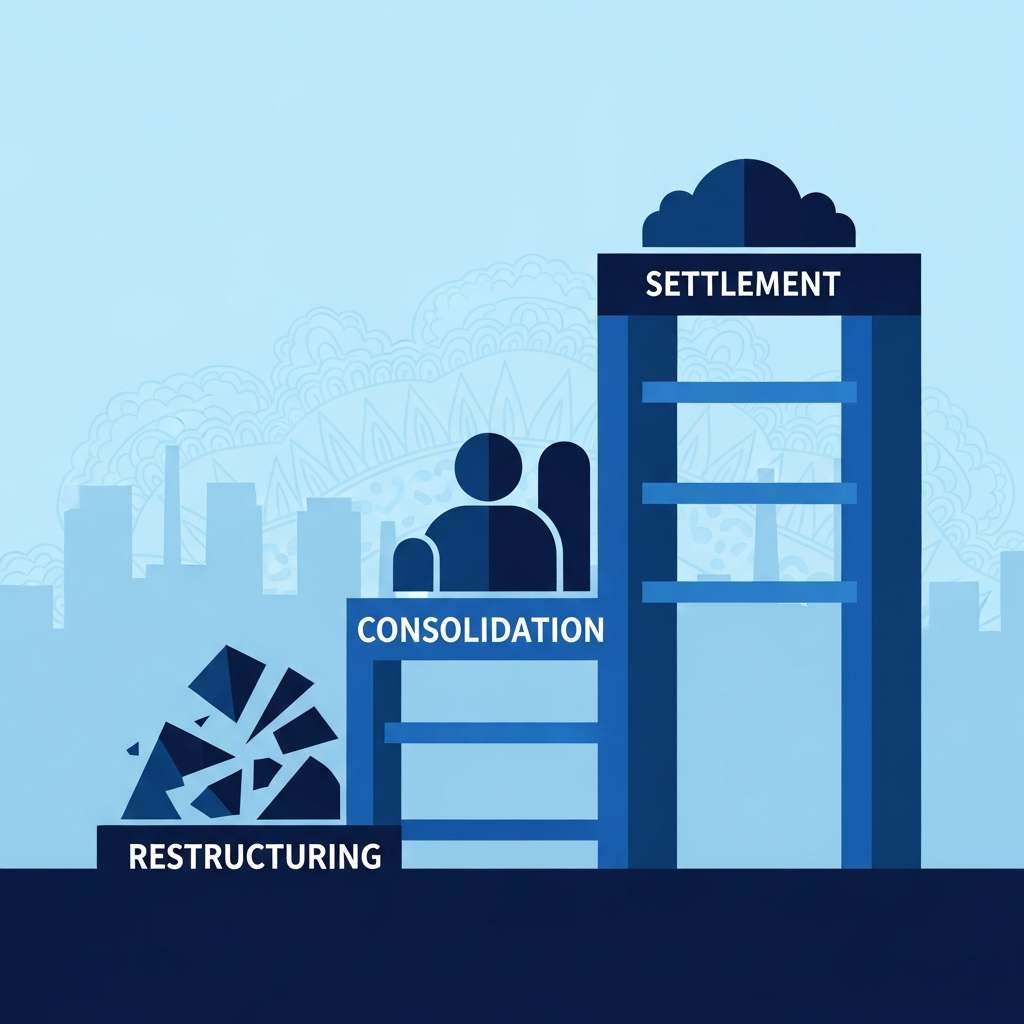
How Does HDFC Loan Restructuring Work Today?
Restructuring is different from a moratorium in one big way. A moratorium was a blanket pause offered to everyone during a crisis. Restructuring is a case-by-case call the bank makes. About your individual situation, under RBI's standing framework for stressed loan accounts.
To request it, you'd typically reach out through net banking, the app, or your relationship manager or nearest branch. [LEGAL FLAG — reviewing team to verify current process before publish] You'll usually need to explain what's going on and share recent income proof. HDFC reviews it and decides whether to approve, and on what terms.
Approval sits entirely with the bank. Asking doesn't mean you'll get it. If it's approved, the most common change is a longer tenure, which brings the EMI down but adds to the total interest over the loan's life, the same trade-off as the moratorium, just decided case by case instead of offered to everyone at once. Some approvals include a short payment break too, but that depends entirely on how the bank reads your case.
If HDFC turns down the request, or the new EMI still doesn't feel workable, that's usually the point where it's worth talking to FREED. Consolidation and settlement don't depend on your existing bank's approval the same way restructuring does.

What the Law Says
Under RBI's stressed asset framework, banks are required to have a board-approved policy for reviewing restructuring requests from borrowers in genuine financial distress
Understand My Rights as a BorrowerWhat If Restructuring Is Not Approved or Not Enough?
A lot of restructuring requests don't get approved, and even when they do, the new EMI doesn't always feel manageable. If that's where you've landed, there are two clear next paths, and which one fits depends on where you actually stand.
Still able to pay, just spread too thin across multiple loans and cards? Consolidation is the next thing to look at. FREED assesses your full financial picture and matches you to a lending partner, and that partner's loan pays off your existing debts at once, leaving you with one EMI instead of several. This means simplified repayment and repayment discipline, which can factor into future lender assessment over time.
Genuinely unable to repay in full because of your financial circumstances? That's not a decision anyone takes lightly, and it's exactly what FREED's settlement plan is built for. It means your bank agrees to accept less than the full amount as final payment, worked out through a structured savings process rather than a single negotiation.
How FREED Helps When Moratorium and Restructuring Are Not Options
Two different situations call for two different FREED plans here.
If you're still paying your EMIs but stretched thin across multiple loans, the FREED Loan Consolidation Plan, also called "Reduce My EMI," is built for this. FREED looks at your full financial picture and matches you to a lending partner from its network. That partner pays off your existing unsecured loans and credit card dues in one go, leaving you with one loan, one bank/NBFC, one lower EMI. FREED itself doesn't charge you a fee for this. If your lending partner charges an evaluation fee as part of the process, that fee is non-refundable even if the loan doesn't get approved, and any processing or foreclosure charges belong to the lending partner, not FREED. The minimum credit score needed is 700. Consolidation combines your eligible unsecured loans into one repayment schedule, simplifying debt management instead of juggling several accounts with different due dates.
If repaying in full has genuinely become difficult, the FREED Loan Settlement Plan, "Settle My Loans," is the more relevant path. This isn't something a borrower chooses out of preference. Banks only consider it when you're in genuine financial difficulty and truly can't repay the full amount. FREED helps you build a structured monthly savings plan, and once enough funds accumulate,negotiates with your bank toward a settlement, up to 50%* less than what you owe in many cases. It does show up on your credit report though. The loan gets marked "Settled," and that stays on your record for up to 7 years.
If you're not sure which of these actually fits your situation, FREED's counsellors can assess it directly rather than you having to guess.

Find the Right EMI Relief Option for You
Get a clear picture before you decide.
Start My Debt AssessmentWhat to Check Before Choosing Any EMI Relief Option
A few checks upfront can save a lot of trouble later, whichever option you're leaning toward. Get every term in writing. A verbal assurance from a call centre or a branch visit won't help you if there's a dispute six months down the line.
Look at the total interest cost, not just the new EMI figure. A lower monthly payment usually means a longer tenure, and a longer tenure usually means more interest paid overall, even though each individual payment feels lighter. Ask specifically how the arrangement gets reported to the credit bureau. Restructuring, consolidation, and settlement each show up differently, and knowing this ahead of time matters if you'll need another loan later.
And take a moment to actually compare more than one option. It's tempting to grab whatever's offered first when you're stressed about EMIs, but the right fit depends on what you can genuinely repay, not on what sounds easiest right now. If you want a second opinion before deciding, FREED's team can walk through your numbers with you at no cost.

FREED Expert Tip
Before choosing any EMI relief option, ask for the total interest cost over the new tenure in writing, not just the new EMI number.
Compare My OptionsEMI Relief Options Compared
Aspect | Restructuring | Consolidation | Settlement |
Who it is for | Temporarily stressed, still able to pay | Paying but over-leveraged across multiple loans | Genuinely unable to repay |
What changes | Tenure or terms on the same loan | Multiple loans merged into one lower EMI | Bank accepts a reduced lump sum |
CIBIL impact | Varies, generally milder if pre-default | Score improves | Score drops, "Settled" tag up to 7 years |
Who arranges it | Your own bank (HDFC in this case) | FREED matches you to a lending partner | FREED negotiates via the SPA process |
None of these is universally "better." Restructuring keeps you with the same bank on new terms. Consolidation replaces several loans with one and tends to help your credit profile over time. Settlement exists specifically for when full repayment isn't realistic anymore, and it leaves a real, lasting mark on your credit report. Which one makes sense depends on where you actually stand, not on which sounds least disruptive on paper.

Mohit Juneja
Mohit Juneja writes educational content at FREED on debt management, credit scores, loan repayment, and borrowing best practices. His content is shaped by expert insights and industry knowledge, helping readers better understand their financial options and make informed decisions.
mohit.juneja@freed.care

FREED is India's trusted loan management platform. Founded in 2020 and headquartered in Gurugram, FREED has counselled 20 lakh+ people on personal loans, credit cards, and app loans. FREED charges fees only on successful settlement, not upfront. FREED does not handle secured loans (home loans, car loans, gold loans).
Media Mentions