HDFC Loan Restructuring: What Every Borrower Should Know First
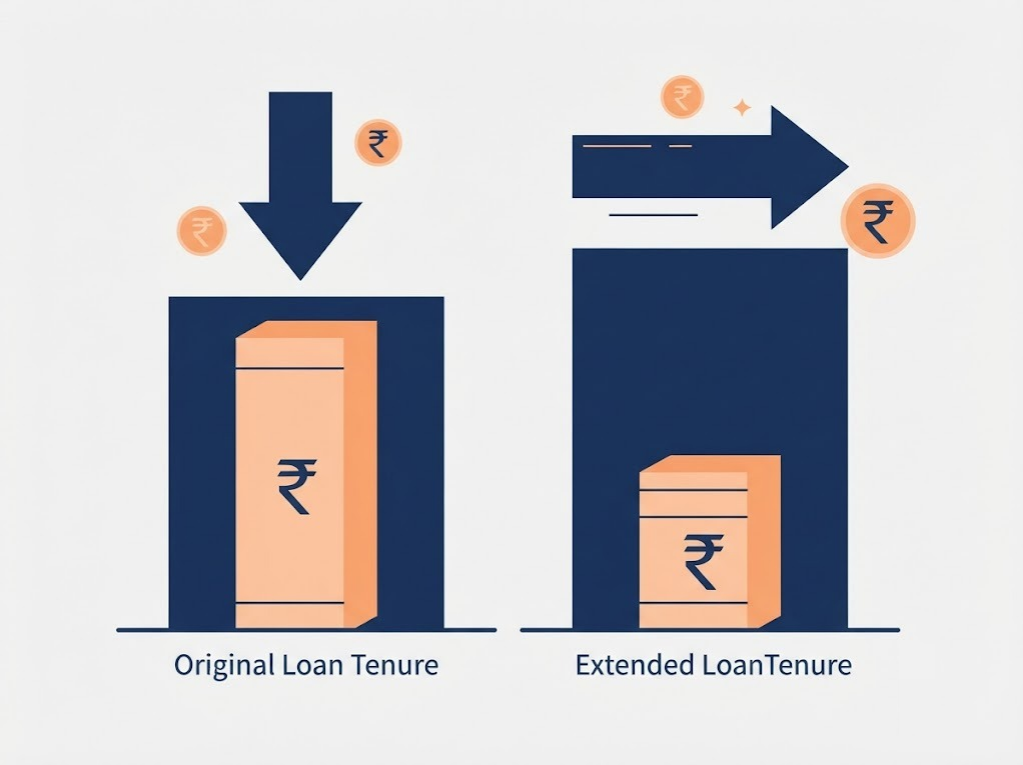
HDFC loan restructuring is when the bank changes your loan plan, usually by stretching the repayment time, so your monthly EMI becomes smaller. You still owe the full amount. It gives breathing room during genuine hardship, but the loan shows a "Restructured" mark on your credit report, and you end up paying more interest overall.

Mohit Juneja
Reviewed by FREED India, Debt Resolution Specialists
 4.7/5
4.7/5 ₹3,200Cr+
 20,000+
 20,00,000+4.7/5₹3,200Cr+20,000+20,00,000+
KEY TAKEAWAYS

HDFC loan restructuring lowers your EMI by extending repayment time, but you still owe every rupee.
HDFC loan restructuring lowers your EMI by extending repayment time, but you still owe every rupee.
A longer repayment time means a lower EMI now but more total interest paid over the full loan.
Under RBI's COVID framework, extending the repayment time including any payment pause was capped at two years. That window has closed. Today the limit is at the bank's discretion.
Restructuring is for temporary hardship with a real path back to full repayment, not a way to pay less than you owe.
What Is HDFC Loan Restructuring?
HDFC loan restructuring, meaning the bank changes your loan plan so the monthly EMI becomes smaller, is a relief tool for when money gets tight. Usually the bank stretches the repayment time. Sometimes it offers a short payment pause. Sometimes it lowers the interest rate a little. But one thing stays the same in every version: you still owe the full amount. The loan does not shrink. Only the monthly pressure does.
Here's a simple picture. Say you have a loan of about ₹3 lakh with an EMI of ₹9,000 spread over 4 years. After the bank changes the plan, that might become an EMI of ₹6,500 over 6 years. Your monthly outgo drops by ₹2,500. That feels like breathing room, and it is. But notice what happened: the loan now runs two extra years. (This is an illustrative example, not an HDFC quote.)
Now the one line that matters most, and the one people get wrong constantly.
Restructuring is not settlement. When you change the loan plan, you pay the whole amount, just slower. In a settlement, the bank accepts less than the full amount. Two completely different things. Readers mix them up all the time, so keep them separate in your head from the start.
Restructuring can apply to many loan types. This blog focuses on what it means for personal loans and credit card dues. The relief here is real. But it comes with two costs most people don't see until later. The next sections walk through both.

Confused about restructuring, consolidation, or settlement?
Talk it through with a FREED counsellor. No pressure, just a clear read on where you stand.
Talk to FREED, FreeWhy Do Borrowers Ask HDFC to Restructure a Loan?
Before the mechanics, sit with the real situation for a second. Because nobody reaches this point on a good day.
People ask the bank for a new schedule for reasons that are nobody's fault. A job loss or a salary cut that arrived without warning. A medical bill that swallowed a month's income. A business that dipped for a quarter. Or the plain, common one: too many EMIs landing in the same week, and the maths just stopped working. None of this is a sign of bad planning. It's a normal response to a genuine cash-flow problem, the kind that happens to careful, hard-working people.
So why does HDFC agree at all? Because a borrower who keeps paying a smaller EMI is far better for the bank than one who stops paying entirely. A changed plan that keeps money flowing beats a loan that goes bad. That's why this works as a shared solution, not a favour the bank is doing you. Both sides get something.
If you're at this point, the honest next step is to understand what that "Restructured" mark actually does to your credit report before you say yes. That's next.
Not sure if restructuring or another option fits you?
Get a clear read on your debt in one free call.
Book My Free CallDoes HDFC Loan Restructuring Affect Your CIBIL Score?
Yes, it affects your credit report, and here is exactly how, in plain terms.
Three things happen, in order:
- Your loan gets a "Restructured" mark. This mark sits on your credit report and stays there until the new repayment period is fully complete, even if you clear the dues early. It does not vanish the moment you feel back on track. It stays flagged for the length of the new plan.
- The account reads as a sign of financial stress. Any future bank reading your report sees that your repayment took a turn. For a while, that can make a fresh loan or a new credit card harder to get, because lenders read the mark as recent strain.
- The account is reported as restructured, based on your repayment history, which future lenders will factor into their assessment.
Now the honest comparison that matters most. A "Restructured" mark is a real cost, no sugar-coating it. But it is far less damaging than missing EMIs month after month, which drags the score down continuously and keeps dragging. And it is much lighter than a "Settled" mark, which is worse and stays on your report for up to 7 years. If the choice is between a "Restructured" mark and repeated missed payments, the mark is the smaller wound.
Note that no reliable single number exists for how many points a restructuring knocks off. Anyone quoting you an exact figure is guessing. What's clear is the direction: a temporary dip that recovers with steady payments.
Even with the credit hit understood, most people miss the second cost. A longer repayment time quietly increases what you pay in total. That's the part almost every article skips.

What the Law Says
Under RBI's rules, a restructured loan must be reported to the credit bureaus as "restructured," and the mark stays flagged until the new repayment period is complete. This reporting requirement came from RBI's COVID-era Resolution Framework 2.0. That specific relief window has since closed, but the general reporting treatment for restructured accounts remains
Know your credit-report rightsThe Hidden Cost of Loan Restructuring: You Pay More Interest
This is the part most competitor blogs never tell you, so here it is straight.
Interest is charged on the amount you still owe, for as long as the loan runs. That's the whole rule. So when you stretch the loan over more months, two things happen at once. The EMI falls, which feels good. But the loan runs longer, which means interest keeps getting charged for extra months. Add those extra months up, and the total interest you pay goes up, even though each monthly payment got smaller.
Walk through it with rounded numbers so it's clear. Say you have a loan of around ₹3 lakh on a 4-year plan. Move it to a 6-year plan and the EMI might drop by a few thousand rupees a month, real monthly relief. But over the full life of the loan, you could end up paying tens of thousands of rupees more in total interest, simply because the loan ran two extra years. (This is an illustrative example to show the trade, not an HDFC quote or rate.)
Here's the fair takeaway, and it's not a scare. This extra cost is often worth it, if the other option is missing EMIs and damaging your credit for years. Protecting your record while you recover has real value. You're just making a trade: a lower monthly amount now, in exchange for a higher total later. That's a fine trade to make. It's only a bad one if you make it without knowing you made it.
So before you agree, put your own numbers in and see the trade for yourself.
Are You in a Loan Trap? Quick Check
Move the slider to your total EMIs as a % of monthly salary. See your debt stress level instantly.
EMIs as % of Monthly Salary
When HDFC Loan Restructuring Is Worth It, and When It Isn't
You don't need a finance degree to make this call. You need a clean checklist you can hold against your own situation. Here it is, both sides.
Restructuring makes sense when:
- The hardship is temporary and you can already see income recovering. A three-month gap after a job change is the classic case. You just need the monthly load lighter until things steady.
- Your income is stable but the current EMI is simply too high for it. A longer plan brings the EMI down to a number your salary can actually carry.
- You have one or two loans, not many scattered across different lenders. A single loan with a changed plan is easy to manage. A pile of them is a different problem.
- You want to protect your record from missed-payment damage while you get back on your feet. A "Restructured" mark hurts less than months of slipped EMIs.
Restructuring may not be the best fit when:
- You have several loans across different lenders, all straining at once. Changing one plan barely touches the load. A different tool fits this situation better.
- Repaying the full amount in any form is genuinely no longer possible. If the money simply isn't there and won't be, stretching the schedule only stretches the strain. A different path fits.
Think of a changed loan plan as the middle option. It's gentler than a settlement, because your record stays cleaner and you still repay in full. But it's a longer, costlier route than a straight payoff, because of that extra interest. Middle options are for middle situations.
If restructuring isn't the right fit for yours, other options exist. The next section lays them out in order.
What Are Your Options If HDFC Restructuring Isn't Enough?
There isn't one answer here. There's a ladder, and where you stand on it depends on your actual situation. Three rungs, in order, and they are not the same for the same person.
Restructuring. Change the loan plan with HDFC, keep paying, full amount still owed. This is the rung you're already reading about. It fits temporary hardship where you can still repay in full, just slower. For the full process and eligibility, see HDFC Bank Loan Restructuring: Process and Eligibility.
Debt Consolidation. This is for borrowers who are still paying but juggling several loans and EMIs across different banks. A new single loan replaces all your existing unsecured loans, so instead of four EMIs to four lenders on four dates, you pay one lower EMI to one lender on one date. And here's the part that surprises people: your credit score does not drop with this. It typically improves, because you're clearing multiple accounts and moving to steady payments on one. This is FREED's Debt Consolidation Program (DCP), "Reduce My EMI".
Loan Settlement. Settlement is not something a borrower chooses out of preference. Banks only consider it when you're in genuine financial difficulty and truly cannot repay the full amount. Here the bank accepts a reduced lump sum, up to 50%* of the debt can be waived, and the account is marked "Settled" for up to 7 years. It's the last rung, for a specific, difficult situation, not a smart hack.
One important thing: these are not three choices for one person. They're three answers for three different situations. Don't skip the consolidation rung and jump from restructuring straight to settlement, that's a common and costly mistake. The comparison table right below lays out which is which.
Where FREED fits, when a changed loan plan alone doesn't solve it, is next.

Restructuring vs Consolidation vs Settlement
Restructuring | Consolidation | Settlement | |
Who it's for | Temporary hardship, can still repay in full | Still paying, but juggling many loans | Genuine inability to repay in full |
What happens | Loan plan changed, longer time, smaller EMI | One new loan pays off all existing loans | Bank accepts a reduced lump sum |
Amount owed | Full amount, over longer time | Full amount, at one lower EMI | Less than full (up to 50%* waived) |
CIBIL impact | "Restructured" mark until period ends | Score typically improves | "Settled" mark for up to 7 years |
FREED's role | Not handled by FREED (deal with HDFC directly) | FREED's Debt Consolidation Program | FREED's Loan Settlement Plan |
Read the table as three different doors for three different rooms, not a menu you pick your favourite from. A person who can still pay in full but wants a smaller monthly load belongs in the first or second column. A person who genuinely cannot repay at all belongs in the third. Matching yourself to the right column is the whole job here.
Rates and ranges shown are indicative. Final terms decided by the bank. FREED is not a Loan Provider. No outcome is guaranteed. Please verify directly with your bank.
How FREED Helps If HDFC Restructuring Isn't the Right Fit
Straight fact first, because this is where trust is won or lost. FREED does not restructure your HDFC loan. That arrangement is strictly between you and HDFC directly, and you handle it with the bank (here's the full process). What FREED does is step in when changing the loan plan alone won't fix the problem. Two situations, kept clearly separate.
Situation one: you're still paying, but stretched thin across many loans. This is where FREED's Debt Consolidation Program comes in. FREED looks at your full financial picture, matches you to a lending partner from its network, and that partner gives you one new loan that instantly pays off all your existing unsecured loans and credit card dues. You walk away with one lower EMI, one due date, one repayment schedule, and simplified debt management instead of several accounts pulling at once. FREED gets the consolidation done for you, start to finish. It doesn't hand you advice and leave.
Situation two: repaying in full is genuinely no longer possible. Here FREED's Loan Settlement Plan applies. FREED assesses your situation, helps you build a structured monthly savings pool that's held independently in your own name, and negotiates with the bank once enough has built up. The fee is charged only when a settlement is actually completed, never upfront. Be clear-eyed about this route, though: it takes time, and it carries the "Settled" mark on your report for up to 7 years. It exists for the situation where the money simply isn't there.
FREED works only on unsecured debt, personal loans, credit cards, and the like. It does not touch secured loans such as a home loan or car loan, and it does not speed up or handle your HDFC restructuring.
The record behind this: over 20,000+ accounts settled, more than 20,00,000+ people counselled, and over ₹3,200 Cr+ in debt managed. If you're unsure which path fits, a free call with a FREED counsellor can help you figure it out, with no pressure either way.
How to Apply for HDFC Loan Restructuring
Kept short here on purpose. For full eligibility and document detail, see HDFC Bank Loan Restructuring: Process and Eligibility. This is the quick version you can follow yourself.
Step 1 — Check if you qualify. Confirm your account is in standard status, not long-overdue, and that you can show a genuine hardship. Banks look at whether you've been broadly regular, since a changed plan is meant for a temporary rough patch, not a long default.
Step 2 — Gather your income proof. Keep your recent salary slips or business income records ready, along with a short written note on why repayment has become strained. The clearer your hardship story on paper, the smoother the bank's review.
Step 3 — Apply online or at a branch. Submit the request through HDFC's official channel or your nearest branch. Using the official route keeps a proper record of your request, which protects you later.
Step 4 — Review the revised terms. Check the new EMI, the new repayment time, the new total, and any charges before you agree to anything. This is the moment to catch a plan that lowers the EMI but quietly balloons the total.
Step 5 — Sign the revised agreement. Once you're satisfied, sign the new agreement and keep a copy of the revised schedule for yourself. That copy is your proof of the exact terms you agreed to.
If restructuring isn't approved or isn't enough, FREED can help you look at consolidation or settlement.
Restructuring not approved, or not enough?
Talk to a FREED counsellor free and find the path that actually fits.
Talk to FREED, FreeWhat to Check Before You Sign the Restructuring Agreement
A changed loan plan done with clear eyes is a legitimate, useful tool. The goal is simply to walk in informed. Five quick checks before you sign.
- Get the revised schedule in writing before you agree. Confirm three numbers on paper: the new EMI, the new repayment time, and the new total you'll pay. A verbal "your EMI will be lower" is not enough to sign on.
- Ask exactly how long the "Restructured" mark will stay on your report. You already know it stays until the new repayment period ends, but confirm the timeline for your specific plan so there are no surprises later.
- Check whether the interest rate stays the same or changes. Some plans keep the rate, some shift it. This single number decides a lot of your total cost, so ask it plainly.
- Confirm whether there's any processing charge for the change. Sometimes there's a small fee to redo the plan. Better to know the exact figure now than to find it on a statement afterwards.
- Make sure the new EMI is one you can actually sustain. A plan you'll miss again helps no one and only deepens the strain. Pick a monthly number you're confident you can pay through the full new term, not just next month.
Do these five, and a changed loan plan stops being a leap of faith and becomes a decision you made on purpose.

Freed Expert Tip
Before you sign, ask HDFC for the new total you'll repay, not just the new EMI. A lower monthly amount can hide a much higher total.
Check your full debt pictureSources
Claim | Source |
|---|---|
A restructured loan is reported to bureaus as "restructured"; extension of repayment time including any payment pause was capped at 2 years under the RBI COVID framework (window now closed) |

Mohit Juneja
Mohit Juneja writes educational content at FREED on debt management, credit scores, loan repayment, and borrowing best practices. His content is shaped by expert insights and industry knowledge, helping readers better understand their financial options and make informed decisions.
mohit.juneja@freed.care

FREED is India's trusted loan management platform. Founded in 2020 and headquartered in Gurugram, FREED has counselled 20 lakh+ people on personal loans, credit cards, and app loans. FREED charges fees only on successful settlement, not upfront. FREED does not handle secured loans (home loans, car loans, gold loans).
Media Mentions