Debt Consolidation Example: A Real Rupee Calculation
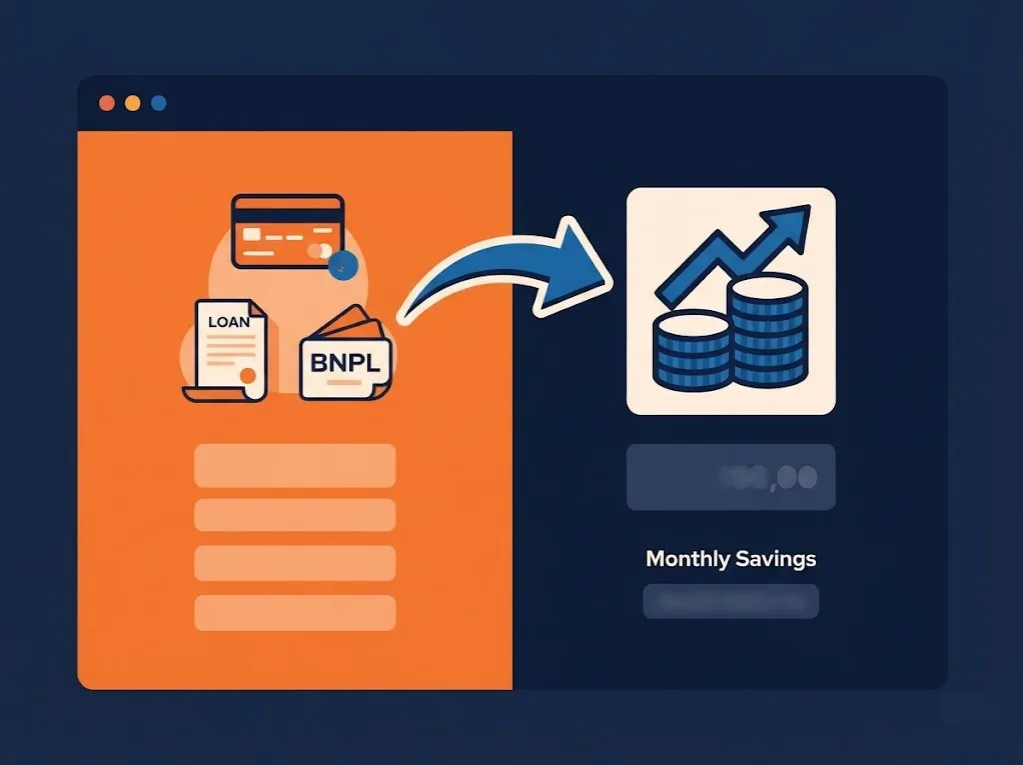
A debt consolidation example shows how several loans and card dues are paid off with one new loan, leaving you with one EMI. In this blog, four payments totalling ₹26,592 a month become one EMI of about ₹15,722.

Mohit Juneja
Reviewed by FREED India, Debt Resolution Specialists
 4.7/5
 ₹3,200Cr+
 20,000+
 20,00,000+4.7/5₹3,200Cr+20,000+20,00,000+
Key Summary

This debt consolidation example merges ₹4.6 lakh across 4 debts into one loan.
Monthly outgoings fall from ₹26,592 to about ₹15,722 on a 36-month plan at 14%.
Total interest drops from about ₹1.84 lakh to about ₹1.06 lakh in this scenario.
A longer 48-month plan lowers the EMI further but cuts your interest savings by about half.
Every new retail loan must come with a Key Facts Statement showing the full cost (APR) before you sign.
What Is a Debt Consolidation Example, and Why Look at One?
You have read the definitions of consolidation. You still cannot tell if it would help you. A worked debt consolidation example, with real rupees, answers that faster than any definition.
Here is the idea in two short sentences. Consolidation means one new loan pays off your old loans and card dues. You then pay one EMI on one date.
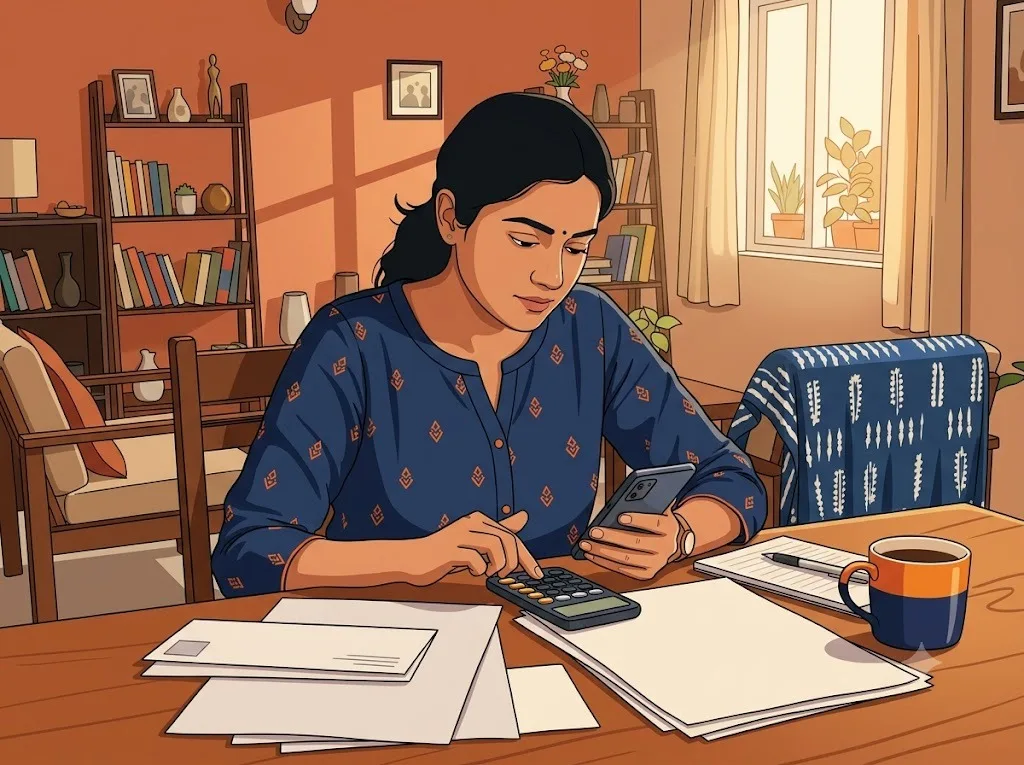
Now meet Priya. She is 32, lives in Indore, and takes home ₹50,000 a month. She has four debts: two credit cards, a bank personal loan, and an instant app loan. Together, she owes ₹4,60,000. She has never missed a payment. Still, every month feels squeezed.
By the end of this blog, you will see four things. You will see her EMI before and after. You will see the total interest in both cases. You will see what a longer plan does to her savings. And you will see how to run the same sums on your own loans.
The numbers are illustrative, but the method is real. Every figure in this debt consolidation example is worked out in the open. With a new loan that pays off the old ones, the whole picture shifts from four dates to one.

Still Paying on Time but Feeling Squeezed?
Check how one EMI could fit your salary.
Check My EMI ScoreWhy Do Four Small EMIs Feel Heavier Than One Big One?
Salary lands on the 1st. Then four debits go out on the 3rd, the 7th, the 12th, and the 18th. By the 20th, there is nothing left. Nothing went wrong. It is just how four dates work.
Two real reasons sit behind this feeling.
First, cards and app loans carry far higher interest than bank loans. Cards often charge around 3 to 3.75% a month. So a big share of each card payment is interest, not the money you borrowed. Your balance falls slowly even when you pay on time.
Second, separate due dates make a single slip more likely. Even careful people miss one date out of four. One missed date can mean a late fee and a mark on your report. If you pay only the minimum on cards, the problem grows. Our guide on what happens if you only pay the minimum due shows how.
There is also the 50% rule. When your EMIs cross half your take-home pay, one surprise expense can tip the month over. Banks look at the same number when they check your FOIR, which simply means how much of your salary goes to EMIs.
Priya is at 53%. Her ₹26,592 of EMIs sits against a ₹50,000 salary. That is above the line. She did nothing wrong. The debt built up through ordinary life: a laptop, a family function, a medical bill.
Let’s put her numbers on the table.
How Do You Know If Consolidation Could Help You?
Check each point below. If most of them sound like you, consolidation may fit.
You have 2 or more loans or cards with different dates. Each date is a chance to slip. One date is easier to remember and to fund.
Your EMIs cross 50% of your take-home pay. At that level, there is little room left for rent, food, and surprises.
You pay only the card minimum, or a small fixed amount. Interest eats most of that payment, so the balance barely moves.
You are still paying on time. This matters most. Consolidation is for people who have not defaulted.
Your credit score is still in decent shape. A healthier score gives you a wider choice of offers.
You have app loans with high monthly interest. Short, costly app loans are often the first debts worth replacing.
If a payment or two has slipped, you are not out of options. Talk to FREED’s team to check what fits. For the basics of who qualifies, read Can I consolidate my debt and debt consolidation eligibility.

FREED Expert Tip
Before comparing any offer, check your credit report for errors. A wrong late-payment entry can push your loan rate up. Action: Check your report this week.
Check My Credit InsightsDebt Consolidation Example: What Does the Rupee Math Look Like?
Here are Priya’s four debts exactly as they stand today.
| Debt | Outstanding | Interest (p.a.) | Monthly payment | Time to clear | Interest still to pay |
|---|---|---|---|---|---|
| Credit card A | ₹1,20,000 | 42% (3.5% a month) | ₹6,000 (fixed) | 35 months | ₹89,987 |
| Credit card B | ₹60,000 | 42% | ₹3,000 (fixed) | 35 months | ₹44,993 |
| Bank personal loan | ₹2,00,000 | 16% | ₹9,793 | 24 months | ₹35,023 |
| Instant app loan | ₹80,000 | 30% | ₹7,799 | 12 months | ₹13,588 |
| Total | ₹4,60,000 | ₹26,592 | ₹1,83,591 |
Rates and ranges shown are indicative. Final terms decided by the bank. FREED is not a Loan Provider. No outcome is guaranteed. Please verify directly with your bank.
Read the table plainly. ₹26,592 leaves Priya’s salary every month. That is 53% of her pay. Over the coming years, about ₹1.84 lakh of what she pays is pure interest. The two cards alone account for about ₹1.35 lakh of it, because of their monthly rate.
Now the “after”. One loan of ₹4,60,000 pays off all four debts. Here are three plans. The rates are illustrative.
| Plan | EMI | Total interest | Interest saved vs. before |
|---|---|---|---|
| 14%, 36 months | ₹15,722 | ₹1,05,982 | about ₹77,600 |
| 14%, 48 months | ₹12,570 | ₹1,43,369 | about ₹40,200 |
| 16%, 36 months | ₹16,172 | ₹1,22,200 | about ₹61,400 |
Rates and ranges shown are indicative. Final terms decided by the bank. FREED is not a Loan Provider. No outcome is guaranteed. Please verify directly with your bank.
Under the illustrative 36-month consolidation plan, Priya's initial monthly repayment falls from ₹26,592 to approximately ₹15,722. This frees up around ₹10,870 in her monthly budget at the start.
However, her existing app loan would end after 12 months and her bank personal loan after 24 months. Without consolidation, her monthly repayments would therefore decrease over time.
The ₹10,870 difference represents initial monthly cash-flow relief, not a fixed saving throughout the loan tenure. To understand the actual financial benefit, compare the total remaining cost of her existing debts with the complete cost of the consolidation loan, including applicable fees.
A note on timing. Her app loan ends after 12 months and her bank loan after 24, so her old outgoings would shrink on their own. The totals above count all the interest on all four debts, so the comparison stays fair.
The new loan may also involve additional costs. For example, an illustrative processing fee of 2% on ₹4,60,000 would be ₹9,200. If 18% GST applies to that fee, the combined amount would be ₹10,856.
Based on the estimated interest savings of approximately ₹77,600, this would leave around ₹66,700 before considering any other charges.
The final saving could be lower if Priya must pay foreclosure or prepayment charges on existing loans, insurance costs, or other applicable fees.
Before accepting a consolidation offer, she should review the lender's Key Facts Statement (KFS), compare the Annual Percentage Rate (APR), and calculate the total cost of borrowing.
These figures are illustrative, not guaranteed savings.
One honest point. This debt consolidation example works because the new rate (14%) is far below the card rate (42%). If the new loan rate were close to your old rates, the savings would shrink. For more math like this, see personal loan debt consolidation math.
To understand the idea behind this example, read loan consolidation meaning and how it works step by step.
How Is a Debt Consolidation EMI Calculated, Step by Step?
You can follow this method alone, with a phone calculator. Six steps.
List every debt. Write the outstanding amount, rate, and months left for each. You cannot compare what you have not written down.
Add up your total monthly outgoings. Priya’s comes to ₹26,592. This is the number your new EMI has to beat.
Note the interest still left on each debt. Your statement or a calculator will show it. Priya’s total is about ₹1,83,591.
Get the new loan’s rate, tenure, and fees. Find them in the Key Facts Statement. Fees change the real cost, so do not skip them.
Run the new EMI. Use the total debt as the loan amount. Priya’s ₹4,60,000 at 14% for 36 months gives ₹15,722. The EMI depends on three things: the loan amount, the monthly interest rate, and the number of months.
Compare total cost, not just the EMI. Multiply the new EMI by the months, then add fees. A low EMI can still be a costlier loan. For more on the method, read how banks calculate EMI and APR in a loan, explained. Our debt consolidation calculator guide shows another way.
See What Consolidation Could Save You (Debt Calculator)
Inputs: each existing debt (amount, rate, months left), new loan rate, new tenure, processing fee %
Output: current total monthly outgo, new EMI, total interest before vs after, net saving after fee
Rates and ranges shown are indicative. Final terms decided by the bank. FREED is not a Loan Provider. No outcome is guaranteed. Please verify directly with your bank.
Does a Longer Repayment Time Always Save You More?
No. The lowest EMI is not always the cheapest loan. Many comparisons stop at “the EMI drops”. This one shows the trade-off.
Look at Priya’s 48-month plan. Her EMI falls further, to ₹12,570. That feels great. But her total interest rises to ₹1,43,369. Her savings shrink from about ₹77,600 to about ₹40,200.
| Plan | EMI | Total interest | Interest saved vs. before |
|---|---|---|---|
| 14%, 36 months | ₹15,722 | ₹1,05,982 | about ₹77,600 |
| 14%, 48 months | ₹12,570 | ₹1,43,369 | about ₹40,200 |
| 16%, 36 months | ₹16,172 | ₹1,22,200 | about ₹61,400 |
Rates and ranges shown are indicative. Final terms decided by the bank. FREED is not a Loan Provider. No outcome is guaranteed. Please verify directly with your bank.
Here is a rule of thumb. Pick the shortest repayment time whose EMI still leaves room for rent, groceries, and a small buffer. A tight budget breaks more easily than a slightly higher EMI.
Also, read the Key Facts Statement before you sign. RBI requires it for retail term loans sanctioned on or after 1 October 2024. It must show the APR, which is the total yearly cost including fees. It must also show the full repayment schedule. The rule is in RBI’s KFS circular. Credit cards are not covered by it.
A different rate changes the answer too. See what drives it in our guide to debt consolidation interest rates.
What Are Your Options to Consolidate Multiple Debts?
Here are the main options, in order.
1. Credit card balance transfer. You move one card’s balance to another card at a lower rate for a short period. It works for a single card. It does not fit four mixed debts. Read the balance transfer steps to see how it runs.
2. A personal loan you arrange yourself. You get a loan and pay off each account. It is possible. But you do the rate shopping, the paperwork, and every payoff. Our guide on personal loan vs credit card debt consolidation compares them.
3. FREED’s Loan Consolidation Plan. A lending partner pays off all your eligible loans and card dues together. You then pay one EMI.
| Option | Best for | Covers mixed debts? | Who does the work | Credit score effect |
|---|---|---|---|---|
| Balance transfer | One card, short-term relief | No | You | Depends on the new card and your payments |
| Personal loan you arrange | People happy to shop for rates | Yes, if the amount is enough | You | One new enquiry, then regular payments help |
| Loan Consolidation Plan | Several loans and cards, still paying | Yes | FREED handles the process | Regular payments and closed accounts can help over time |
Rates and ranges shown are indicative. Final terms decided by the bank. FREED is not a Loan Provider. No outcome is guaranteed. Please verify directly with your bank.
One more cost to count. When old loans are paid off early, some may carry a prepayment charge. RBI bars this on floating-rate loans to individuals for non-business purposes, sanctioned or renewed on or after 1 January 2026. Fixed-rate personal loans may still have one. Check the agreement for each old loan and add any charge to your sums.

What the Law Says
Floating-rate personal loans sanctioned from January 1, 2026 can’t carry a prepayment charge. Fixed-rate loans may.
Know Your RightsHow FREED Helps If You’re Still Paying but Juggling Several EMIs
FREED’s Loan Consolidation Plan, called “Reduce My EMI”, is for people who can still repay but need a smarter way to manage their debt.
Here is how it works, in order. FREED looks at your loans, your income, and your EMIs. It then matches you to a suitable lending partner. The partner gives you one new loan. That loan pays off all your eligible unsecured loans and card dues at once.
If the consolidation loan is approved and successfully disbursed, Priya's eligible debts can be paid off through the new loan, leaving her with one EMI and one repayment date.
However, debt consolidation does not guarantee an improvement in her credit score. The lender's credit enquiry, the new loan account and changes to existing accounts may affect her credit profile.
Consistent, timely repayments may support her credit health over time, but the actual impact depends on her overall credit history and the credit bureau's assessment.
On cost, FREED charges a success-based fee. It applies only when your consolidation is completed. There is no upfront fee. Separately, any foreclosure charge on an old loan or processing fee on the new one belongs to those banks. It is not FREED’s charge.
The plan covers unsecured loans and card dues, such as personal loans, credit card dues, and app loans. It does not cover home, car, gold, or education loans. FREED does the work for you, from the matching to the process itself.
Tie it back to Priya. Her four debts would become one payment.
Want to look at your report first? FREED’s Credit Insights shows your score and what is shaping it. You can also see how heavy your EMIs are with the EMI Score.
What Helps After You Consolidate Your Loans?
You have one EMI now. A few habits keep it that way.
Set auto-pay one day after salary credit. Not on salary day itself. A day later avoids a failed debit.
Keep paid-off cards, but leave them in a drawer. Or keep one for small spends that you clear in full each month. Old accounts help your history, but only if you do not refill them.
Collect a closure letter (called an NOC) for every old loan. It is your proof that the account is closed. Do it now, not when you need it.
Check your credit report 30 to 60 days later. Old accounts should show as closed. If one does not, raise it with the bank.
Put part of the savings into an emergency fund. Priya saves about ₹10,870 a month. Even half of that, ₹5,000 or so, builds a cushion in a year.
For more on what to expect, read about the credit score impact of debt consolidation. And a fair view of the other side is in the disadvantages of debt consolidation.
Debt that once felt like four problems is now one. Make that one easy to carry.

Mohit Juneja
Mohit Juneja is FREED’s Content & Communication Lead with 12+ years of experience across content, media, advertising and digital communications. He holds a postgraduate diploma in Communications from Xavier Institute of Communications, Mumbai, and has worked with organisations including NDTV, The Indian Express, McCann Worldgroup and NABARD.
At FREED, he leads content and communication across loan management, debt resolution, debt consolidation and financial well-being. His work combines research, storytelling and consumer-focused communication to make complex financial topics easier to understand and act on. He has also scripted and produced 11 documentaries on rural development and agriculture for NABARD, with film's selected for the Mumbai International Film Festival.
mohit.juneja@freed.care

FREED is India's trusted loan management platform. Founded in 2020 and headquartered in Gurugram, FREED has counselled 20 lakh+ people on personal loans, credit cards, and app loans. FREED charges fees only on successful settlement, not upfront. FREED does not handle secured loans (home loans, car loans, gold loans).
Media Mentions