Debt Consolidation Calculator: See Your New EMI First
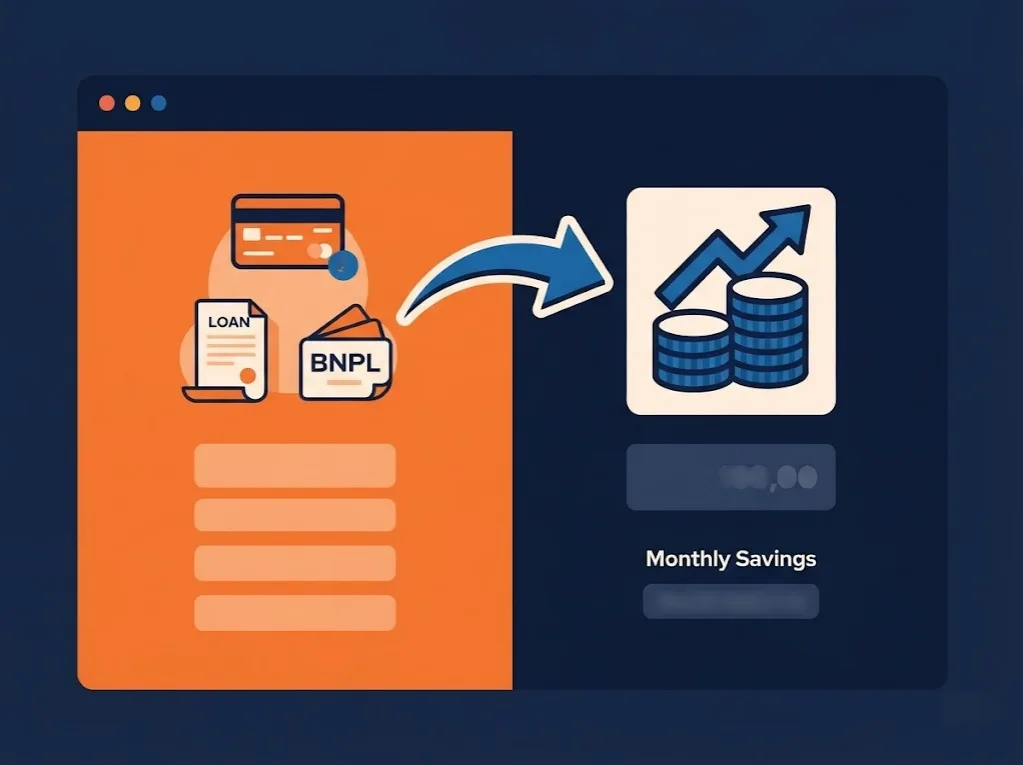
A debt consolidation calculator is a free tool that does one job. You put in what you owe now across every loan and card, and it shows what a single consolidated EMI would look like instead. Enter your debts and rates. See your new number next to your old one. No sign-up, nothing saved anywhere, just the math laid out in front of you.
Mohit Juneja
Reviewed by FREED India, Debt Resolution Specialists
 4.7/5
4.7/5 ₹3,200Cr+
 20,000+
 20,00,000+4.7/5₹3,200Cr+20,000+20,00,000+
KEY TAKEAWAYS

Inputs: your current debts, their interest rates, and how many months you want to repay them over.
Outputs: new EMI, monthly savings, total interest under both paths, and a rough payoff date.
Illustrative estimate: ₹5 lakh at 14% over 36 months would have an EMI of approximately ₹17,089 and total interest of approximately ₹1.15 lakh, excluding fees.
Eligibility and interest rates depend on the lender’s criteria and the borrower’s overall credit profile; no particular score guarantees approval or a specific rate.
The calculator only tells you something useful if the new rate actually beats your blended current rate, and if you stop adding fresh spending on top.
What Is a Debt Consolidation Calculator? (And Why Use One)
Most people carrying more than one loan or card don't actually know their total monthly burden. Not because they're careless, just because nobody sits down and adds it up in one place. A credit card EMI here, a personal loan EMI there, maybe a BNPL due date buried inside a shopping app that only pings you three days before it's due. Each one looks manageable on its own, sitting quietly in its own corner. Added together, they're often the real reason the salary account runs dry by the 20th, and nobody can point to exactly why.
A consolidation calculator exists to close that gap between "I think I'm stretched" and "here's the actual number." You type in what you owe, at what rate, for how long. It runs the math and hands back the one figure that matters most: what a single consolidated EMI would cost you every month, sitting right next to what you're already paying. The calculator takes every debt you enter, current balances, current rates, current terms, and works out your combined existing payment and your combined interest cost as one number, so you're comparing like with like instead of eyeballing three different statements and guessing.
That's the actual value here. Not the tool, but what it removes: the guesswork that keeps people stuck between "maybe I should look into this" and actually doing anything about it. Once you see the real gap between your current EMIs and a consolidated one, planning your EMI payments with a clearer monthly structure gets a lot less abstract, because you're now working from an actual number instead of a feeling of being stretched thin.
How to Use the Consolidation Calculator: Step-by-Step
Five steps, and none of them need anything you don't already have sitting in a banking app or a statement PDF somewhere.
- 1
List every debt you're currently paying, without leaving anything out.
Credit cards, personal loans, BNPL dues, any unsecured borrowing you're carrying. This step is where most people undercount without meaning to. A ₹15,000 BNPL balance feels too small to matter, so it gets left off, and the whole calculation ends up wrong by exactly that much.
- 2
Enter each debt into the calculator separately.
Balance, current interest rate, and however many months you have left on it. Don't average them together at this stage; the calculator needs the individual pieces to build an accurate combined picture.
- 3
Set your target consolidation tenure.
Most people land somewhere between 24 and 60 months. A shorter tenure costs less in total interest over the life of the loan. A longer one feels lighter month to month, but the trade-off is real and shows up clearly once you run both.
- 4
Enter your expected consolidation rate.
If you haven't actually spoken to a bank or NBFC yet, 12–14% is a reasonable placeholder for most salaried borrowers to plan around, though your real rate will depend on your income and credit profile.
- 5
Hit calculate.
The old combined total and the new consolidated EMI show up side by side, with the interest gap laid out between them. Worth knowing before you start entering numbers: Indian lenders calculate EMI on a reducing-balance basis, which means interest gets charged only on whatever's still outstanding, not on the original amount you borrowed. That holds true across personal loans

FREED Expert Tip
Run the calculator at 24, 36, and 48 months before deciding anything. Longer tenure lowers your EMI but raises total interest. Find the shortest tenure where the new EMI still stays under half your take-home pay.
See what your EMI looks like at different tenuresWhat Inputs Does the Calculator Need? (Get Your Numbers Ready)
Five things, and you likely have all of them within reach right now, no digging required.
1. Every debt, listed on its own line. Say a credit card balance of ₹50,000 running at roughly 3.5% a month, alongside a personal loan of ₹1 lakh at around 1.2% a month. Keep each one separate rather than folding them into a single average, since the calculator needs the actual spread across your debts to give you an honest number.
2. The total. Add up every balance from step one into a single figure.
3. Your expected consolidation rate. Ask a lender for an actual estimate if you're at that stage. If not, 12–14% remains a workable planning assumption for most salaried borrowers.
4. Your tenure in months. Anywhere from 24 to 60 is typical across most consolidation products.
5. Any processing fee your lender mentions upfront. Not every lender charges one, but where it applies, it eats into your real monthly savings, and it belongs in the calculation from the start rather than getting discovered after you've already signed.
Whether a bank will actually approve you on those numbers comes down to a ratio most people have never heard named out loud: how much of your monthly income is already committed to EMIs across everything you owe. Lenders call this FOIR, or Fixed Obligation to Income Ratio, and it's usually the real gatekeeper behind whether your application clears, more so than the headline interest rate you're quoted. If you do move ahead with an actual application after running these numbers, most lenders will also ask for PAN, Aadhaar, three months of salary slips, and six months of bank statements, with a CIBIL score of 650 or above typically the baseline for approval. The calculator itself doesn't check any of that. It just does honest math on whatever you feed it.
What Do Calculator Outputs Mean? (Decoding the Results)
Six numbers come back, and each one is answering a different question you'd otherwise have to work out by hand.
New EMI is your monthly payment after consolidation, the number you'd actually start paying from the following month.
Old total EMI is what you're paying right now, added up across every separate loan and card currently running.
Monthly savings is the gap between those two figures, and it's usually the number people fixate on first, understandably, since it's the one that changes what's left in the account every month.
Total interest, current path is what you'd pay in interest overall if you left everything exactly as it is and just kept paying it down separately.
Total interest, new path is what you'd pay in interest instead, under the consolidated loan, over its own tenure.
The payoff date is roughly when the new loan would be fully closed out, based on whatever tenure you selected.
For example, ₹5 lakh at 14% over 36 months produces an estimated EMI of approximately ₹17,089 and total interest of approximately ₹1.15 lakh, excluding fees. Actual savings can only be calculated after comparing these figures with the EMIs, remaining tenures, interest, and closure charges on the existing debts. That's a monthly saving in the ballpark of ₹16,000, the kind of gap that changes what a month actually feels like, not just a number sitting in a spreadsheet nobody reopens. If your score is sitting on the lower end of what lenders want to see, it's worth checking what's actually dragging a CIBIL score down and what tends to fix it before you apply anywhere, since a stronger score at application time is often the difference between the 12% end of the rate range and the 15% end.

Real Example: What the Numbers Actually Look Like
A hypothetical scenario, but a realistic one, the kind that shows up in actual applications every week. Say you're carrying a credit card balance of ₹30,000 running at about 3.5% a month, a personal loan of ₹1 lakh at 1.5% a month, and a BNPL due of ₹20,000 at 2.5% a month. Your current EMIs come to roughly ₹2,000 on the card, ₹3,500 on the personal loan, and ₹1,000 on the BNPL balance, about ₹6,500 total, leaving your account every month across three different due dates.
Consolidating ₹1.5 lakh at 12% over 48 months would produce an estimated EMI of approximately ₹3,950 and total interest of approximately ₹39,600, excluding fees. Compared with current EMIs of about ₹6,500, the estimated monthly difference is approximately ₹2,550. The old and new total interest cannot be compared accurately without the remaining tenure and charges for each existing debt. The EMI relief is genuinely real. The total cost isn't automatically lower just because the loan feels lighter. Both of those things are true at the same time, and the calculator is what lets you actually see that trade-off laid out, rather than assuming a smaller monthly number always means a cheaper deal overall.
That reducing-balance mechanic mentioned earlier shows up clearly in a worked example like this too: your first EMIs on the new loan carry more interest in them, and the later ones shift steadily toward paying down principal, even though the EMI figure itself never moves month to month across the whole 48-month stretch.

What the Law Says
RBI requires lenders to disclose all fees upfront before you sign anything, including processing charges, pre-closure penalties, and any bundled insurance costs included in the loan. If a lender's offer doesn't spell these out clearly in writing, that's a transparency gap you're entitled to push back on before agreeing to anything at all.
Check what a lender must disclose before you signCommon Calculator Mistakes (Don't Make These)
A handful of ways people quietly undercut their own numbers without ever realizing they've done it.
Stretching the tenure too far just to see a smaller EMI. A 60-month loan drops the monthly figure, sure, but the total interest paid over that stretch climbs enough to eat most of the relief you thought you were getting when you first ran the numbers.
Leaving a debt out of the calculation entirely. Forget one credit card or one small personal loan, and every single output the calculator gives you afterward is wrong by that much, sometimes enough to flip the whole decision from worth-it to not.
Assuming an unrealistically low interest rate. Plugging in 8% because it sounds better doesn't make it the rate you'll actually be offered. 12–14% sits much closer to what most salaried borrowers see in practice once an actual application goes in.
Skipping the processing fee entirely. A 1–2% fee sounds negligible right up until it's subtracted from your monthly savings figure, and by then you've usually already committed to the loan based on the number that didn't account for it.
The one that actually costs people the most money, and it has nothing to do with the calculator itself: consolidating, then spending on the same credit cards all over again. You clear the cards, the credit limit opens right back up, and old spending habits fill it back in within a few months. Now you're carrying the new consolidated loan and fresh card debt simultaneously, a genuinely worse spot than the one you started in. If keeping spending in check after clearing a balance has been the harder part historically, practical ways to manage credit card debt and the stress that comes with it are worth a read before, not after, you consolidate.

After the Calculator: Next Steps (Not Just Numbers)
The calculator tells you whether consolidation is worth exploring further. It doesn't get you the actual loan. A few things worth doing before you go anywhere near an application.
Check your CIBIL score first, before applying anywhere. Most lenders want 650 or above, and knowing exactly where you stand before you apply saves you a wasted application and a fresh inquiry on your report for nothing.
Get two or three lender offers, not just the first one you're shown. Rates on these loans commonly range from 11% to 15% depending on the bank and your profile, and that spread is wide enough to genuinely change your savings picture. If a straightforward new loan doesn't end up being the best fit once you compare offers, it's also worth knowing how a personal loan balance transfer works as a separate route for shifting one specific high-interest loan rather than consolidating everything at once.
Read the fine print before signing anything at all. Processing fee, pre-closure charge, anything bundled into the loan that wasn't obvious from the headline rate. If it's not written down clearly, ask directly rather than assuming.
Recalculate your savings after fees, not before. The calculator's first pass is a starting point, useful for deciding whether to explore further. Fees change the real number, sometimes meaningfully.
Confirm the new EMI genuinely fits your budget, not just your optimism. A reasonable rule most lenders and financial planners lean on: keep it under half your take-home pay, with room left for the rest of your life to still function normally.
Don't apply just because the calculator's first pass looked promising. Verify that the actual offer on the table matches what you modeled before you commit to anything you can't easily undo.
Ready to See Your Consolidation Savings?
Use our free calculator; no sign-up needed.
Calculate My New EMISources
Claim in Blog | Source |
|---|---|
Lenders must disclose all fees upfront before the borrower signs processing charges, pre-closure penalties, bundled insurance costs | RBI/2024-25/18, DOR.STR.REC.13/13.03.00/2024-25, "Key Facts Statement (KFS) for Loans & Advances," April 15, 2024 rbi.org.in link |

Mohit Juneja
Mohit Juneja writes educational content at FREED on debt management, credit scores, loan repayment, and borrowing best practices. His content is shaped by expert insights and industry knowledge, helping readers better understand their financial options and make informed decisions.
mohit.juneja@freed.care

FREED is India's trusted loan management platform. Founded in 2020 and headquartered in Gurugram, FREED has counselled 20 lakh+ people on personal loans, credit cards, and app loans. FREED charges fees only on successful settlement, not upfront. FREED does not handle secured loans (home loans, car loans, gold loans).
Media Mentions