Personal Loan Balance Transfer Lowest Interest Rate: Finding the Best Deal
Personal loan balance transfer lowest interest rate refers to the most competitive rate a bank or NBFC offers when taking over your existing personal loan. The lowest advertised rate is not the same as the lowest rate you will actually get. Your CIBIL score, income, and employer category decide where you actually land on the rate card.

Mohit Juneja
Reviewed by FREED India, Debt Resolution Specialists
 4.7/5
4.7/5 ₹3,200Cr+
 20,000+
 20,00,000+4.7/5₹3,200Cr+20,000+20,00,000+
KEY TAKEAWAYS

As of mid-2026, the lowest advertised personal loan balance transfer rates from top private banks sit around 9.99% to 10% p.a. for the strongest profiles. This applies only to a narrow slice of borrowers, and confirming the live rate at the time of applying matters because these numbers shift monthly.
NBFCs offer faster approval and accept lower CIBIL scores, but they charge noticeably more, roughly 11% to 24% p.a. depending on the lender and your specific profile.
The lowest advertised rates are generally offered to borrowers with stronger credit profiles, subject to the lender's internal assessment.
Comparing offers from multiple lenders, while considering both interest rates and overall borrowing costs, can help borrowers make a more informed decision. On a ₹5 lakh loan with 3 years remaining, the gap between a 9.99% offer and a 13% offer works out to roughly ₹25,000 to ₹30,000 in extra interest, real money that a few hours of comparison can save.
What "Lowest Interest Rate" Actually Means in a Balance Transfer
Every bank puts a number on its website: "Personal loans starting at 9.99% p.a." That number is real, but it is also the ceiling of what most borrowers can hope for, not a starting point everyone gets. Banks reserve it for the strongest applicants they see, someone with a high CIBIL score, a stable salaried job at a well-recognised company, and no red flags in their repayment history.
For everyone else, the actual quote sits somewhere above that floor. A borrower with a CIBIL score of 720 and a decent but unremarkable job profile might be quoted 11.5% or 12%, even though the same bank advertises 9.99% on its homepage. Neither number is wrong. They are simply priced for different risk levels.
As of mid-2026, a handful of top private banks are advertising rates around 9.99% p.a. for their best-qualified borrowers, while public sector banks tend to sit closer to 10% to 10.5%. These figures move month to month based on the RBI's policy rate, each bank's own funding cost, and how much competition they are facing for good customers. Confirm the current live rate directly with the bank before you apply. A number you read three months ago may already be stale.
Where you personally land on this scale comes down to four factors: your CIBIL score, your income, your employer category, and your existing repayment track. This piece walks through those factors and the bank-by-bank picture below. For the full walkthrough on comparing multiple offers properly and negotiating a better rate with your own bank, FREED has covered that process in detail here. This piece stays focused on the numbers themselves, bank by bank, and on what actually decides whether you get the lowest one.

Have Multiple Loans, Not Just One?
A single low rate won't fix multiple EMIs, see if consolidation will.
Check If I Qualify for ConsolidationBank-by-Bank Personal Loan Balance Transfer Rates
Rate shopping gets a lot easier once you have a reference point for what different banks are quoting right now. The table below is a snapshot, not a guarantee. Every figure here is a starting rate reserved for top-tier profiles, and your actual offer will depend on where your own CIBIL score, income, and employer category place you on each bank's internal grid.
A useful way to read this table: treat the numbers as a rough map of where banks sit relative to each other, not as promises. HDFC and SBI currently anchor the lower end of the range for salaried, high-CIBIL applicants. ICICI, Kotak, Axis, and IndusInd sit a notch higher, often within half a percentage point to one percentage point of the lowest quoted rate. NBFCs sit meaningfully higher across the board, trading a costlier rate for faster approval and a wider CIBIL band they are willing to accept.
Bank-by-Bank Personal Loan Balance Transfer Rates
Bank | Starting Rate (p.a.) | Notes |
HDFC Bank | Around 9.99% | Top profiles only, verify current rate card |
SBI | Around 10% | Public sector pricing, verify current rate card |
ICICI Bank | Around 10.4% to 10.5% | Verify current rate card |
Kotak Mahindra Bank | Around 10.5% | Verify current rate card |
Axis Bank | Around 11% | Verify current rate card |
IndusInd Bank | Around 11% | Verify current rate card |
NBFCs (general) | Roughly 11% to 24% | Faster approval, wider CIBIL acceptance, wider spread by lender |
Rates shown are starting rates for the strongest profiles as of mid-2026. Individual offers will vary based on your CIBIL score, income, and employer category. Refresh this table against live bank rate cards periodically, since rates move monthly and this snapshot will age.
Looking for HDFC specifically, including its own eligibility criteria and process? FREED has a dedicated HDFC guide here with more detail on that bank alone, rather than repeating it in this comparison.

Freed Expert Tip
Rate cards update monthly. Check your salary account bank first. Existing customers often get a rate below the public rate card without even asking, simply because the bank already has your salary and repayment history on file.
Check If I Qualify for ConsolidationNBFC vs Bank, Where the Lowest Rate Actually Comes From
Banks generally beat NBFCs on rate, and the reason comes down to how each raises money. Banks fund their loans largely through deposits, which cost them less. NBFCs borrow from banks and the market at a higher cost, and that gets passed on to you as a borrower. This is a structural difference, not something that changes month to month.
This is why banks can afford to offer 9.99% to a strong applicant while an NBFC quoting the exact same borrower might land at 13% or higher. It is not that the NBFC is being unfair. It is pricing risk and cost of funds differently.
What NBFCs offer in exchange is real, and worth naming honestly. Approval can take a few days instead of the two to three weeks a bank sometimes needs. Some NBFCs may consider applicants with weaker credit profiles than many banks, although eligibility varies by lender. If a bank has already rejected your application, or if your score sits below what banks typically accept, an NBFC becomes the realistic path forward even at a higher rate, simply because it is the option actually available to you.
So this is not really a question of which category is "better." It is a question of fit. If your profile clears a bank's bar, a bank will almost always work out cheaper over the life of the loan. If it does not, an NBFC at a higher rate can still beat staying stuck on your current, more expensive loan.

What the Law Says
RBI requires every lender, bank or NBFC, to disclose the full annual rate and all fees in a Key Fact Statement before you sign a balance transfer loan. The advertised number you see online is never the final word. What is written in your Key Fact Statement is.
Book My Free CallWhat Decides Whether You Get the Lowest Rate
Four factors decide exactly where you land on any bank's rate card, and understanding each one helps explain why the table above shows a range rather than one fixed number.
CIBIL score carries the most weight of the four. Borrowers with stronger credit profiles generally have access to more competitive pricing, while eligibility and rates vary across lenders. As an indicative pattern, higher scores tend to attract rates closer to a bank's advertised floor, mid-range scores usually get approved but at a rate somewhere above it, and weaker scores often push borrowers toward NBFCs, since many banks decline outright at that level. Where exactly those lines fall differs from lender to lender, because each applies its own underwriting criteria.
Income signals your repayment capacity to the lender. A higher, stable monthly income supports a better rate, but it will not override a weak CIBIL score by itself. A high earner with a poor repayment history can still get quoted a worse rate than a moderate earner with a spotless record.
Employer category is the one factor most borrowers do not know exists. Banks quietly rank employers into internal tiers, often labelled something like A, B, C, and D. A stable job at a large, well-known company or a government role can shave a fraction of a percent off your rate compared to an identical income and score at a smaller, less-recognised employer. It is worth checking, before you apply, whether your organisation sits on your target bank's preferred list.
Existing repayment track on the loan you are looking to transfer gets checked closely by the new lender. A clean history with every EMI paid on time works strongly in your favour. Even one or two missed payments in recent months can push your quoted rate up meaningfully, or lead to an outright decline.
Are You in a Loan Trap? Quick Check
Move the slider to your total EMIs as a % of monthly salary. See your debt stress level instantly.
EMIs as % of Monthly Salary
Lowest Rate Is Not Always the Best Deal
It is tempting to simply pick whichever number on the table above looks smallest and apply there. That instinct misses something important. The interest rate is only one part of what a loan actually costs you. Processing fees, foreclosure charges on your existing loan, and documentation costs all add to your real, out-of-pocket total, and a lower rate can lose to a slightly higher one once these are added in.
Processing fees typically run 1% to 3% of the loan amount, charged upfront and deducted from your disbursed amount. On a ₹5 lakh loan, a 3% fee works out to ₹15,000 taken off the top before you see a rupee of it. Foreclosure charges on your current loan, if your existing lender levies any, add a further cost on top of that.
Here is how this plays out in practice. Say Lender A quotes 9.99% with a 3% processing fee, and Lender B quotes 10.5% with a 1% fee, both on a ₹5 lakh loan with 3 years remaining. Lender A's upfront fee costs ₹15,000. Lender B's costs ₹5,000. Once you factor that ₹10,000 difference in fees against the roughly 0.5% rate gap over 3 years, the two offers can end up within a few thousand rupees of each other, sometimes with Lender B coming out ahead despite the "higher" advertised rate.
This is exactly why the rate alone should never be the only number you compare. For the complete effective-rate calculation method, with the full worked math, FREED has walked through that step by step here. The short version for this piece: always ask each lender for the total cost in writing, not just the headline interest rate, before you decide.
If You Have Multiple Loans, a Single Low Rate Won't Fix It
Finding the cheapest rate on one loan feels like real progress, and it can be, if that one loan is your only debt. But if you are managing 3 or more loans or credit cards spread across different banks, chasing the single lowest rate solves only a fraction of what is actually weighing on you.
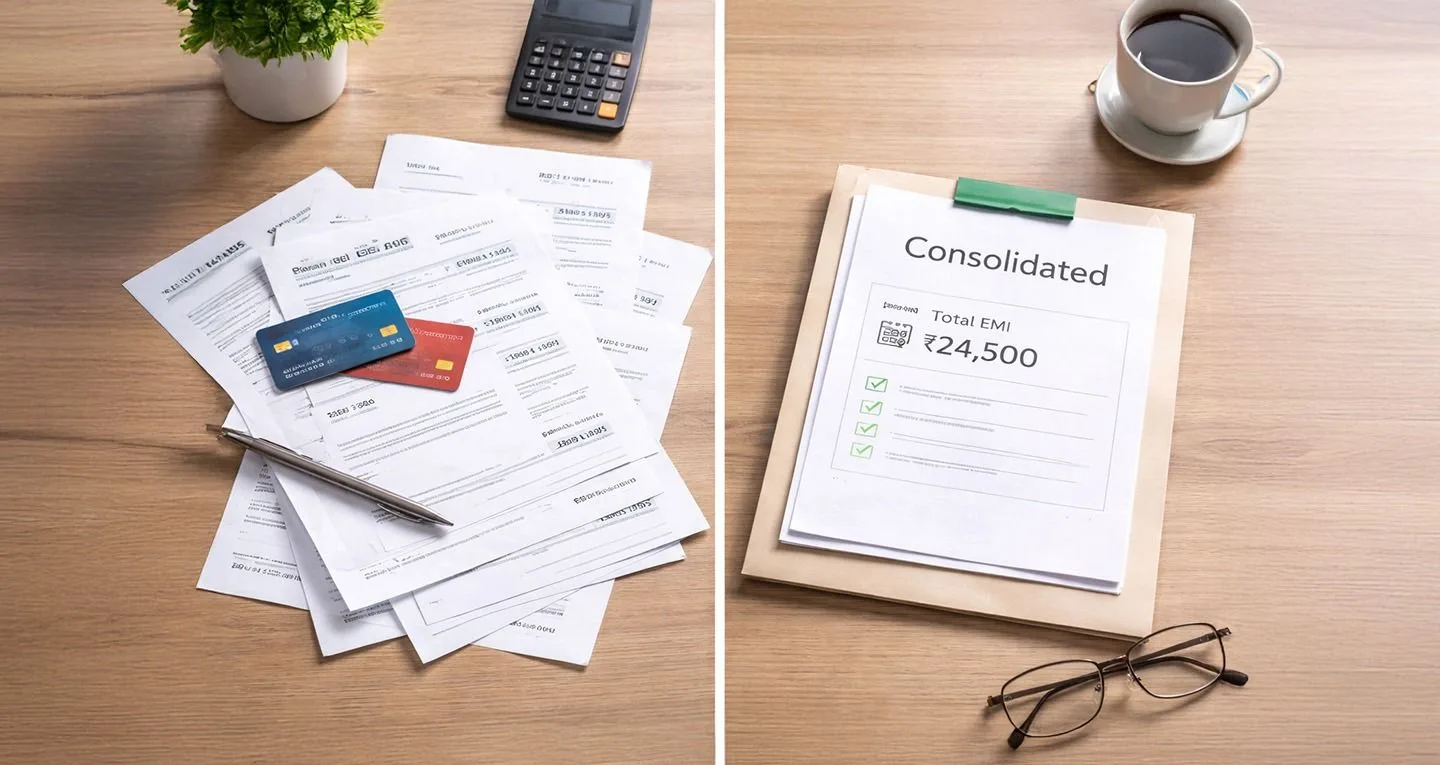
Think about what is really creating the stress in that situation. It is rarely just the interest rate on any one loan. It is the sheer number of separate EMIs, due dates, and lenders you have to track and pay every single month, each with its own account, its own auto-debit, its own risk of a bounced payment if your timing slips even once. A balance transfer moves one loan to a better rate. It does nothing to reduce that number of moving parts, and it does not lower your total monthly outgo across everything you owe.
If you recognise this in your own situation, several loans, multiple EMI dates, a sense that you are juggling rather than managing, rate shopping on a single loan is not the fix that actually addresses it. What helps here is combining everything into one, which is a different kind of solution entirely, and it is exactly what FREED's Debt Consolidation Program is built for. It exists for borrowers who can still repay, who are not behind on anything, but who are stretched thin managing several loans at once and want one clean payment instead of several.
Have More Than One Loan
A single low rate won't fix multiple EMIs, see if consolidation will.
Check If I Qualify for ConsolidationHow FREED Helps Beyond Rate Shopping
FREED's Loan Consolidation Plan, also known as the Debt Consolidation Program or "Reduce My EMI," is built for two overlapping groups of borrowers. The first is someone juggling multiple loans across different banks, where a single transfer cannot meaningfully simplify things. The second is someone who tried to chase a lower rate on their own but did not qualify for the best bank offers, and is still looking for a genuinely better path forward.
Here is how it actually works. FREED first assesses your complete loan profile, every loan and credit card balance sitting across your different lenders right now, along with your income and repayment history. Based on that full picture, FREED matches you to a suitable lending partner from its network, one equipped to take on a consolidated loan of that size and profile. That partner then disburses a single new loan, and this new loan pays off all your existing eligible balances at once, instantly. What you are left with afterward is one lender, one EMI, one due date, replacing what may have been three, four, or more separate payments every month.
Debt Consolidation may simplify repayment for eligible borrowers, depending on repayment behaviour and lender reporting. If anything, it typically starts to improve over the following months, because your credit utilisation across multiple accounts drops sharply, and your payment history consolidates into a single, steady, on-time account instead of being spread thin across several. FREED charges a success-based fee for this, meaning it is only charged once the consolidation is actually completed. If it does not go through for any reason, nothing is charged.
Sources
Claim | Source |
RBI mandates a Key Fact Statement disclosing the full APR and all fees before signing, effective October 1, 2024 | RBI Circular RBI/2024-25/18, dated April 15, 2024, rbi.org.in (reviewing team to confirm exact circular link before publish) |
(Bank-by-bank rate figures and the ₹5 lakh worked examples are market data pulled from lender rate cards and rate aggregators as of mid-2026, not RBI-codified numbers, so they stay out of this table and are marked "verify current rate card" throughout the piece.)

Mohit Juneja
Mohit Juneja writes educational content at FREED on debt management, credit scores, loan repayment, and borrowing best practices. His content is shaped by expert insights and industry knowledge, helping readers better understand their financial options and make informed decisions.
mohit.juneja@freed.care

FREED is India's trusted loan management platform. Founded in 2020 and headquartered in Gurugram, FREED has counselled 20 lakh+ people on personal loans, credit cards, and app loans. FREED charges fees only on successful settlement, not upfront. FREED does not handle secured loans (home loans, car loans, gold loans).
Media Mentions