How Does Debt Consolidation Affect Your Credit? What You Should Know
Debt consolidation can affect your credit profile in several ways. Applying for a new loan may result in a lender enquiry, while the subsequent effect can depend on factors such as payment history, credit utilisation, account information and how the new and existing accounts are reported. After that, how your score moves depends mainly on your credit utilisation and whether payments on the new loan stay on time. Unlike settlement, consolidation doesn't damage your credit the way a default or reduced payoff does.

Mohit Juneja
Reviewed by FREED India, Debt Resolution Specialists
 4.7/5
4.7/5 ₹3,200Cr+
 20,000+
 20,00,000+4.7/5₹3,200Cr+20,000+20,00,000+
KEY TAKEAWAYS

Debt consolidation typically causes a small, temporary dip from the hard inquiry. What happens after that depends mainly on your credit utilisation and how consistently you pay the new loan, not on the act of consolidating itself.
The factor most likely to move in your favour is credit utilisation: paying off multiple card balances with one loan usually lowers the percentage of available credit you're using.
This is different from debt settlement, which does negatively impact the score. Consolidation itself does not.
Several factors can influence what happens next, including payment history, credit utilisation, credit enquiries, the age of your credit accounts and the way new and existing accounts are reported.
There's no fixed number of points or fixed timeline anyone can expect. General research on consolidation outcomes exists, but it isn't India-specific and isn't a promise for your score.
How Does Debt Consolidation Affect Your Credit? The Short Answer
There are two separate things happening, and they pull in different directions.
The first is immediate: applying for a consolidation loan triggers a hard inquiry, a credit check by the new lender. This usually causes a small, temporary dip of a few points. It's the same effect any new loan or credit card application has, nothing specific to consolidation.
The second is gradual, and it's less predictable. Once the new loan pays off your existing credit accounts, your credit utilisation usually drops, since several card balances get replaced by one loan. From there, what happens to your score depends on how consistently you pay the new EMI and how your lender reports it. It isn't automatic, and it isn't the same for everyone.
This is a common worry before people consolidate, and it's worth naming clearly why.

See If Consolidation Fits Your Credit Picture
Free assessment, no impact on your CIBIL score to check.
Check your optionsWhy This Worries People Before They Consolidate
If you're hesitant to consolidate because you've heard debt-related moves can hurt your credit, that worry isn't unfounded. It's just often pointed at the wrong product.
Settlement and consolidation get confused often, and settlement genuinely does hurt your score, with a "Settled" mark that stays on your report for up to 7 years. If that's the mental image you're carrying into a decision about consolidation, the caution makes sense, even though consolidation works very differently.
The second source of worry is simpler. Any new loan application involves a credit check, and that understandably feels risky if you're already anxious about where your score stands. Understanding how your score is actually built tends to make that single inquiry feel a lot less high-stakes than it sounds.
Here's how to tell in advance whether consolidation is likely to work in your favour.
Signs Consolidation Fits Your Situation
You're currently carrying high balances relative to your credit limits. The utilisation benefit of consolidation is strongest here, since that's the biggest single input you're about to change.
You have several separate accounts to track. One clean account reporting on-time payments is usually easier to manage well than several accounts with mixed histories.
You plan to keep the consolidated loan in good standing. On-time payments are what actually build a track record, not the consolidation event itself.
You're not planning to immediately reopen the credit you just freed up. Running card balances back up defeats the utilisation benefit before it has a chance to matter.
These aren't a strict pass or fail list. They're signs of which direction things are more likely to move, not approval odds. If you want to see where you actually stand before assuming anything, check your EMI score rather than guessing.
Understanding exactly what happens, in order, makes the whole process a lot less abstract.

What the Law Says
Under RBI's Key Facts Statement framework, applicable regulated entities must provide a standardised KFS for covered retail and MSME term-loan products before execution of the loan contract. The KFS provides key information about the loan, including applicable costs and terms.
Talk to FREED's TeamWhat Actually Happens to Your Score, Step by Step
This plays out over several months, not instantly. Patience matters more than reacting to any single data point along the way.
The hard inquiry hits. Applying for the consolidation loan triggers a credit check, usually a small, temporary dip of a few points.
Existing balances get paid off. The new loan closes out your existing debts, immediately changing what you owe across those accounts.
Your utilisation ratio recalculates. With card balances cleared, the percentage of available credit you're using typically drops. This is usually the biggest positive input in the whole process.
Payment history starts building on the new loan. Each on-time EMI payment reports to the bureau, gradually strengthening your track record.
Account age and mix settle over time. If you closed older accounts, average account age may dip slightly at first. This effect fades as the new loan's own history lengthens.
One thing matters more than any step above: missing a payment on the new consolidated loan undoes the benefit faster than almost anything else in this process. The mechanics only work in your favour if the discipline holds.
The Four Factors That Decide the Outcome
Most advice on this lists vague pros and cons. Here's what's actually driving the number.
Hard inquiry. A small, temporary dip when the lender checks your credit. Avoid submitting unnecessary credit applications to multiple lenders. If you are comparing consolidation offers, ask each provider whether an eligibility check or full application will result in a bureau enquiry before proceeding.
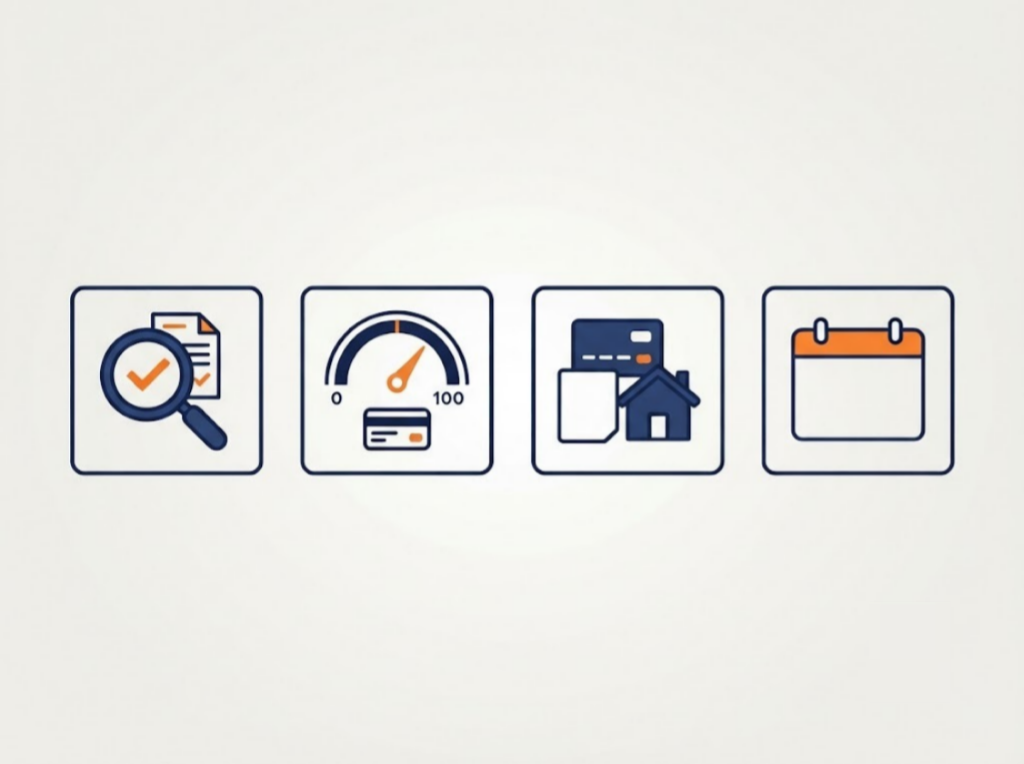
Credit utilisation. Usually the single biggest factor. Paying off high-balance cards with one loan can meaningfully lower the percentage of available credit you're using, which most scoring models weigh heavily.
Credit mix. Adding an installment loan (fixed EMI) alongside revolving credit (cards) diversifies what your credit profile shows lenders. This is real, but it's a smaller factor than utilisation, worth knowing about without overweighting it.
Account age and payment history. Closing old accounts can shorten your average account age slightly. A clean, consistent payment history on the new consolidated loan tends to matter more over time than the account-age dip typically costs.
None of these factors works in isolation, and none of them guarantees a specific outcome. Some external research on consolidation outcomes exists, but it isn't India-specific, and it isn't a promise for any individual score. What you actually control is how you manage the new loan from here, whether that's something you handle yourself or something you get structured help with.

Freed Expert Tip
Compare lenders within a short window, a couple of weeks, rather than spreading applications out over months. Clustered inquiries for the same purpose are usually treated more leniently.
Check My CreditWhat Are Your Options
You can manage this process yourself: being deliberate about which accounts you close, keeping every payment on time, and comparing lenders within a tight window to limit the inquiry impact. That's a completely valid path if you're comfortable tracking it.
Or you can use a matched approach, where your full financial picture, including how a new loan fits your existing obligations, gets assessed as part of the process rather than something you have to work through alone. Neither path is wrong. It depends on how much of this you want to figure out yourself versus have structured for you.
How FREED Helps
FREED's Loan Consolidation Plan, also known as the Debt Consolidation Program or "Reduce My EMI," starts by reviewing your full debt picture before matching you to a lender, which naturally means fewer hard inquiries than applying to several banks separately on your own.
From there, FREED matches you to a lending partner from its network based on your EMI-to-income math. If approved, the matched loan can be used to repay eligible existing debts, subject to the lender and programme terms. The result: one loan, one EMI, and a single clean payment history to build going forward.
The fee is success-based, charged only once consolidation is completed. Consolidation itself doesn't hurt your CIBIL score the way a default or settlement would. What happens to your score afterward depends on how consistently you repay the new EMI, not on a promise FREED or anyone else can make about where it lands.
Across the program, FREED has counselled over 20,00,000 customers and managed more than ₹3,200 crore in debt.
See Your Consolidation Impact
Get matched to a lender and simplify your credit picture.
Check My Consolidation OptionsCheck Your CIBIL Impact Before Deciding
The averages above are general. This is the clearest way to see a projection specific to your own starting score, rather than relying on broad ranges.
Enter: your current CIBIL score, and the action you're considering (consolidation)
See: the likely change in your score, roughly how long recovery takes, and when you might return to a healthy range
Rates and ranges shown are indicative. Final terms decided by the bank. FREED is not a Loan Provider. No outcome is guaranteed. Please verify directly with your bank
Tips to Protect Your Score During Consolidation
Compare lenders within a short window, a couple of weeks, rather than spreading applications out over months. Most scoring models treat clustered inquiries for the same purpose more leniently than scattered ones.
Think carefully before closing very old accounts. Sometimes keeping a long-standing account open, even at zero balance, helps your average account age more than closing it helps simplicity.
Set up autopay on the new consolidated EMI immediately. A missed payment undoes the benefit of consolidating faster than anything else in this process.
Resist reopening the credit card limits you just freed up. The utilisation benefit only holds if those balances stay down, not just briefly after consolidating.
Keeping an eye on your credit report through the transition means nothing here surprises you, and checking your own score this way doesn't count against you the way a new loan application does.

Mohit Juneja
Mohit Juneja writes educational content at FREED on debt management, credit scores, loan repayment, and borrowing best practices. His content is shaped by expert insights and industry knowledge, helping readers better understand their financial options and make informed decisions.
mohit.juneja@freed.care

FREED is India's trusted loan management platform. Founded in 2020 and headquartered in Gurugram, FREED has counselled 20 lakh+ people on personal loans, credit cards, and app loans. FREED charges fees only on successful settlement, not upfront. FREED does not handle secured loans (home loans, car loans, gold loans).
Media Mentions