How to Do a Personal Loan Balance Transfer Online: Step-by-Step
Moving your personal loan to a new bank can lower your EMI or interest rate, but the process has real steps you cannot skip. This guide walks you through checking your eligibility, comparing offers, and completing the transfer online, so you know exactly what to expect before you apply.

Mohit Juneja
Reviewed by FREED India, Debt Resolution Specialists
 4.7/5
4.7/5 ₹3,200Cr+
 20,000+
 20,00,000+4.7/5₹3,200Cr+20,000+20,00,000+
Key Takeaways

A personal loan balance transfer online lowers your EMI (monthly loan payment) by moving your loan to a bank with a better rate.
Works best when the rate gap between your current bank and the new one is 2 percentage points or more.
You need a foreclosure letter (permission to close your loan early) and an NOC (clearance letter) from your current bank.
The entire process, from application to new loan disbursal, can usually be done online.
It's only worth it if your total savings beat the processing and foreclosure fees combined.
What is a personal loan balance transfer online?
Moving your existing personal loan from your current bank to a new one offering a lower interest rate that's the core of it. You do it through an app or website, and for most steps, you never need to walk into a branch anymore. A few years ago, this meant physical visits, printed statements, and a foreclosure process that could stretch on for weeks. Most of that friction is gone now.
Here's what actually happens behind the scenes, in order. Your old loan gets closed. The new bank pays it off directly, in one transaction, straight to your existing lender. A fresh loan starts at your new bank, with the final EMI depending on the interest rate, tenure, and loan terms offered by the new lender.
It's worth understanding why banks are even willing to do this. A balance transfer customer is, from the new bank's perspective, a known quantity. You already have a repayment history on record somewhere, which makes you lower risk than a brand-new borrower with no track record at all. That's part of why banks often price balance transfer offers aggressively; they're competing for borrowers who've already proven they pay on time.
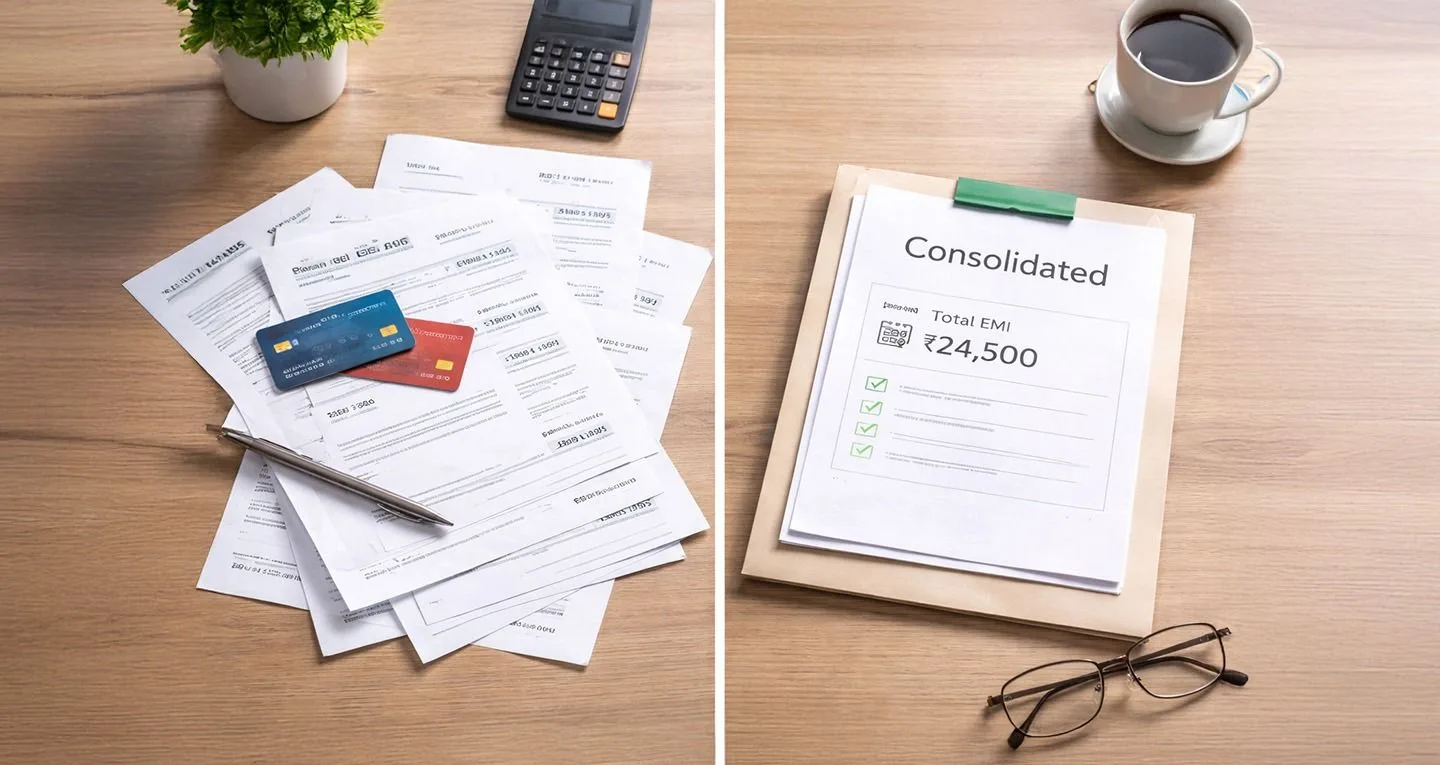
One thing worth clearing up early, because it trips people up constantly and the two get mixed up in casual conversation all the time: this isn't the same as debt consolidation. A balance transfer moves one loan, full stop, from one lender to another. Consolidation merges two or more loans into a single new one, closing multiple accounts at once rather than just relocating a single account. If you've got several loans running at once, a plain balance transfer only ever touches one of them; it won't solve the underlying problem of juggling multiple due dates. We'll come back to this distinction in detail further down, with a full side-by-side comparison, because it's genuinely the difference that decides which path fits your situation.
Why borrowers look at a balance transfer
No single reason drives this decision. A few situations come up again and again, and it's worth walking through each one, because the "why" often determines whether a transfer will actually be worth the effort of applying.
- The market has moved since you borrowed. Interest rates aren't fixed forever across the industry; they shift with the broader lending environment, RBI policy rate changes, and how aggressively banks are competing for new customers in a given quarter. A loan taken during a higher-rate period can look expensive next to what the same bank, or a competitor, is offering today for a similar risk profile.
- Your credit profile has become stronger through consistent repayment behaviour. This is one of the most common triggers. Someone who took a personal loan two years ago with a CIBIL score of 660 might now be sitting at 740 or higher, purely from a consistent, unbroken payment history on that very loan. The frustrating part is that your current bank often won't automatically reprice your existing loan just because your score improved; you usually have to either negotiate directly or look elsewhere. A new lender, seeing that a fresh, improved score, is far more likely to offer a meaningfully better rate.
- The EMI just feels heavier than it should, relative to where your income sits now. Sometimes this isn't about the bank or the rate at all, it's about your own financial picture shifting. A promotion, a second income source, or simply better budgeting can change how a given EMI feels month to month, and that can be the trigger to go looking for better terms rather than just living with what you signed up for originally.
- A competing offer showed up unprompted. It's increasingly common for banks and NBFCs to proactively reach out to borrowers with pre-approved balance transfer offers, sometimes based purely on your existing repayment history with another lender that reports to the bureau. These offers are worth a serious look, but never worth accepting on rate alone without running the full cost comparison first, which we'll get into shortly.
None of these reasons reflects a mistake on your part when you originally took the loan. A loan priced two or three years ago was priced for the borrower you were then, not the one you are today, and there's nothing unusual or embarrassing about wanting terms that reflect your current standing.
Signs a balance transfer is worth doing
Not every loan is worth the effort and paperwork of transferring. A transfer that looks appealing on the surface, purely because the advertised rate is lower, can still end up being a wash or even a loss once fees and timing are factored in. Here's what tends to make it genuinely worthwhile, and each of these deserves a closer look rather than a quick glance.
The rate gap between your current loan and the new offer is 2 percentage points or more. This isn't an arbitrary number; it's roughly the point at which the interest savings on a typical personal loan tenure start to comfortably outweigh the processing fee, foreclosure charge, and the general hassle of switching lenders. A 0.5 percentage point gap, by contrast, often isn't worth the paperwork.
Your CIBIL score has improved meaningfully since you took the original loan. A jump of 50 points or more is generally what unlocks a materially better rate tier at most lenders. Smaller improvements might get you a marginally better offer, but often not enough to clear the fees involved.
You are not already deep into your loan tenure, specifically not in the last 30% of it. This matters more than most borrowers realise going in. Personal loan EMIs are typically structured so that a larger share of interest gets paid off in the earlier months, and principal repayment accelerates toward the end. Transfer late in the tenure, and you're mostly just restarting that interest-heavy curve on a smaller remaining balance, which can actually cost you more overall despite the lower headline rate.
The processing fee and foreclosure charge together are smaller than what you'd actually save. This is the single most important check, and it's the one people skip most often because they get anchored on the interest rate alone. Add up the new bank's processing fee, plus whatever foreclosure charge your current bank levies for closing the loan early, and compare that total against your projected interest savings over the remaining tenure. If the fees eat more than a third of your projected savings, the transfer probably isn't worth it.
You haven't missed an EMI in the last 3 months. Most banks reject a transfer application outright if you have, since a recent missed payment signals exactly the kind of risk they're trying to screen out through the transfer process. If this applies to you, the more useful move is often a conversation with your existing bank about restructuring, not a fresh application elsewhere.

What the Law Says
Under the RBI's Key Fact Statement (KFS) requirement, every bank must give you a simple summary of your loan's real cost before sanctioning any loan, including a balance transfer.
See how KFS rules protect youHow to do a personal loan balance transfer online, step-by-step
The exact screens and sequence differ slightly from bank to bank; some ask for documents before eligibility confirmation, others reverse that order, but the broad method holds steady across the board. No bank gets named here as the best option; that comparison depends entirely on your own numbers, your city, and what each lender is currently offering.
- 1
Check your eligibility.
A quick online check, usually right there on the new bank's app or website, tells you whether your CIBIL score and income clear their minimum bar for a balance transfer product specifically, which can differ from their minimum bar for a fresh personal loan. This takes a few minutes and commits you to nothing at this stage; most banks run
- 2
Compare rates and fees together, never the rate in isolation.
Pull up the interest rate, the processing fee, and the foreclosure charge from your current bank side by side. A slightly lower headline rate paired with a heavy processing fee can genuinely cost you more over the transfer than simply staying where you are. Some banks also charge a nominal documentation or legal verification fee on top, so ask specifically
- 3
Request your foreclosure letter and NOC from your current bank, in writing, before applying anywhere else.
This step is easy to underestimate. Some banks take a few days to issue these documents, others take over a week, particularly if the request goes through a call centre rather than a branch or app. Having both documents ready and in hand before you even begin the new application is what keeps the entire process from stalling later, since
- 4
Apply online with the new bank.
Fill out the balance transfer application through their website or app, specifying that it's a balance transfer rather than a fresh loan, since the two application flows are usually handled differently on the backend. Most banks now handle this entirely online, with at most one in-person step remaining, typically for signature verification or a video KYC call.
- 5
Submit your documents digitally.
KYC, income proof, and latest loan statement from your current lender, all uploaded through the new bank's portal, generally as PDF or clear image scans. Keep clean, legible copies ready before you start this step, rather than scrambling to scan things mid-application. A rejected or blurry upload is one of the more common reasons applications stall for days.
- 6
Get your sanction, then track the disbursal.
Once approved, the new bank pays off your old loan directly, bank to bank, through a process typically called a "direct settlement" or "takeover disbursement." No cash lands in your account at this point, and that's completely normal; it's not a sign anything's gone wrong. The money simply moves between the two institutions without passing through you.
- 7
Confirm your old loan is actually closed.
Get a formal closure confirmation from your old bank once the transfer wraps up; don't assume it's done just because the new EMI has started. Check that your credit report reflects the closure. If it doesn't update after a reasonable period, follow up with your lender.
Documents needed for an online balance transfer
Most banks ask for a broadly similar set, though self-employed applicants usually need a couple of extras thrown in on top of the standard list.
- Foreclosure letter and NOC from your current bank
- Latest loan statement, showing your outstanding balance and payment history
- KYC documents (PAN, Aadhaar)
- Income proof, salary slips for the last 3 months if salaried, or ITR copies and bank statements for the last 2 years if self-employed
- Bank statements for the last 3 months, showing your salary credits or business income flow
Get digital copies of every one of these into a single, clearly labelled folder before you start the application, not after the new bank asks for them. This single habit saves you from the repeated back-and-forth that eats up most of the delay in these transfers, since incomplete document sets are the most common reason a straightforward application ends up taking two weeks instead of a few days.
Are You in a Loan Trap? Quick Check
Move the slider to your total EMIs as a % of monthly salary. See your debt stress level instantly.
EMIs as % of Monthly Salary

What are your options if you have more than one loan?
A balance transfer does its job well when you've got exactly one loan and a healthy CIBIL score behind you. It moves that one loan to a better rate. That is the entire scope of what it's built to do, and it's worth being honest about that limit rather than stretching the tool to cover a problem it wasn't designed for.
But if you're actually sitting on two or more loans, several EMIs, different lenders, and different due dates scattered across the month, a transfer on just one of them won't fix the real problem sitting underneath. You'd end up with a slightly cheaper version of one loan while everything else stays exactly as complicated as before. What actually helps in this situation is pulling everything, all your loans and cards, under a single EMI instead of optimising just one piece of a larger puzzle. FREED's Debt Consolidation Program, also called the FREED Loan Consolidation Plan, is built specifically for this scenario, still paying every bill on time, just stretched thin across too many due dates and too many lenders to track comfortably.
Balance transfer vs debt consolidation
Situation | Balance Transfer | Debt Consolidation |
Number of loans | One loan | Two or more loans |
What moves | Single loan to a new bank | All loans merged into one new loan |
Who does the work | You apply directly | FREED matches you to a lending partner |
Best for | Strong CIBIL, single expensive loan | Multiple EMIs, feeling stretched |
Typical outcome | Lower rate, same single EMI structure | Typical outcome: One EMI replacing several, subject to the lending partner's loan terms. |
The impact on your credit profile depends on your repayment behaviour and individual circumstances. FREED does not decide your eligibility; your bank or lending partner does.

See If Consolidation Fits You Better
Got more than one loan? One EMI beats juggling many.
Get a Free EMI AssessmentHow FREED helps
If you're carrying just one loan with a solid CIBIL score, a balance transfer is genuinely something you can handle yourself, start to finish, using the steps above. No need for FREED here, and we'll say that plainly rather than pretend otherwise just to make a case for reaching out. Plenty of borrowers in this exact situation manage the entire process on their own in under two weeks.
Where FREED actually helps is the moment you realise it isn't one loan sitting slightly overpriced, it's several, spread across different lenders, with a combined EMI load that's genuinely difficult to manage month to month. In that situation, FREED looks at your full financial profile, every existing loan, every card, your income, your monthly obligations as a whole, and matches you to a suitable lending partner from its network. That partner disburses one new loan, which pays off all your existing eligible loans in a single transaction. What's left afterwards is one EMI. The final repayment amount depends on the lending partner's assessment and loan terms. The fee is success-based throughout, meaning nothing is charged unless the consolidation actually goes through and disburses.
Tips for a smooth balance transfer

FREED Expert Tip
Always ask for a Key Fact Statement (KFS) before signing your new loan. It's a regulatory requirement now, and it tells you the real cost of the loan on one page.
Check your loan's real cost
Mohit Juneja
Mohit Juneja writes educational content at FREED on debt management, credit scores, loan repayment, and borrowing best practices. His content is shaped by expert insights and industry knowledge, helping readers better understand their financial options and make informed decisions.
mohit.juneja@freed.care

FREED is India's trusted loan management platform. Founded in 2020 and headquartered in Gurugram, FREED has counselled 20 lakh+ people on personal loans, credit cards, and app loans. FREED charges fees only on successful settlement, not upfront. FREED does not handle secured loans (home loans, car loans, gold loans).
Media Mentions