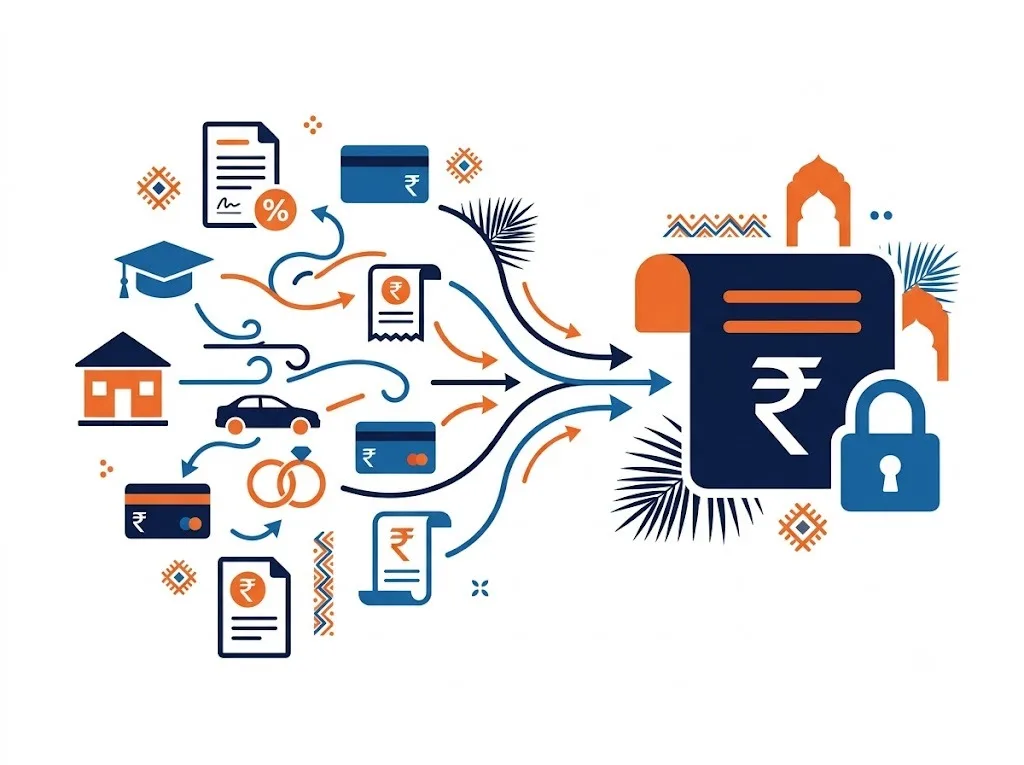
Government Approved Debt Consolidation Programs in India
Government-approved debt consolidation programs are schemes where the government itself would combine your loans. We found none for individuals in India. What exists are consolidation loans from banks and NBFCs that RBI regulates. “Regulated” means rules apply to the lender. It doesn’t mean any offer is approved.
Mohit Juneja
Reviewed by FREED India, Debt Resolution Specialists
 4.7/5
 ₹3,200Cr+
 20,000+
 20,00,000+4.7/5₹3,200Cr+20,000+20,00,000+
Key Summary

Government-approved debt consolidation programs: we found no government-run scheme that combines an individual’s personal loans.
Consolidation loans come from banks and NBFCs that RBI regulates; “regulated” is not the same as “approved”.
RBI requires a Key Facts Statement showing the all-in yearly cost for retail loans sanctioned from 1 October 2024.
Prepayment charges are barred on floating-rate personal non-business loans sanctioned or renewed from 1 January 2026.
A complaint to the RBI Ombudsman needs a 30-day wait for the bank first, then filing within 90 days.
What Are Government-Approved Debt Consolidation Programs in India?
Based on the government and RBI sources reviewed for this article, we found no central government scheme specifically designed to combine an individual’s personal loans and credit-card dues into one repayment. And we found no RBI or government notice that names any consolidation programme as “approved”. That’s the plain answer, and it’s the one most pages on this topic avoid.
So why does everyone search for it? Because “government approved” is a shortcut for “is this safe?”. If you’re paying four or five EMIs and an offer lands in your inbox promising one lower payment, you want to know whether to trust it. That’s a fair thing to ask. It just has a different answer from the one the phrase suggests.
Here’s what does exist:
Consolidation loans from banks and NBFCs. An NBFC is a non-banking financial company. Both are regulated by RBI, and one new loan pays off your old ones.
RBI rules that apply to those loans. These cover how the loan must be disclosed, what can be charged, and what happens if you want to leave early. We cover them further down.
Support that isn’t consolidation. That includes financial literacy camps, in-service options for government staff, and credit counselling. They help you plan, but they don’t combine your loans.
Notice what’s missing from that list: a scheme where the government itself takes your loans and joins them. There isn’t one that we could find. If someone says there is, you’ll want to see the notification number in writing.
For the mechanics of how it works once you do take a loan, here’s how loan consolidation works in India. This guide answers a different question: which offers can you trust, and how do you check?
This guide covers unsecured loans and cards. Secured loans, like home or car loans, follow different rules, so the checks here don’t apply to them.
So which schemes could the phrase mean?

Paying Several EMIs Every Month?
FREED’s Loan Consolidation Plan combines multiple loans into one EMI.
Reduce My EMIIs There a Government Scheme for Debt Consolidation in India?
No. We found no government scheme that combines an individual’s personal loans into one. But a few things sound like one, and people mix them up. Here’s what each one is, and why it isn’t consolidation:
Option | Who runs it | Does it combine your loans? |
|---|---|---|
Consolidation loan from a bank or NBFC | The lender, regulated by RBI | Yes, one new loan pays off old ones |
Free financial literacy camps (CFLs and FLCs) | NGOs with sponsor banks; lead banks | No, they teach money skills; RBI’s page mentions no credit counselling |
Government staff advances (GPF, co-operative loans) | Employer or society rules | Not a consolidation scheme |
Credit counselling | Banks, NGOs, private providers | No, it helps you plan |
Individual insolvency under IBC (Part III) | Insolvency Board | Not for most people |
CFL means Centre for Financial Literacy. FLC means Financial Literacy Centre. IBC is the Insolvency and Bankruptcy Code, India’s insolvency law. This is a general guide.
A few notes on each row. RBI’s page says financial literacy camps are free of charge. That’s useful for learning the basics, but it describes no credit counselling and no help with loans.
Government staff may have their own options, like advances against a provident fund or a society loan. Those follow the employer’s rules, and they’re not a consolidation scheme. If you work for the government, here’s a guide to debt consolidation loans for government employees.
Counselling helps you see your numbers and choose a route, but it doesn’t touch your loans. Here’s how Abhay credit counselling works, as one example.
The relevant provisions of Part III of the IBC were brought into force for personal guarantors to corporate debtors from 1 December 2019. They have not been brought into force for all individual borrowers with personal loans or credit cards. So it doesn’t apply to most people with personal loans or cards.
Here’s the practical rule. If someone offers a “government scheme” that combines your loans, ask for the notification or circular number in writing. A real scheme has one, and you can look it up. If they can’t give it, you have your answer.
That leaves the offers you’ll actually meet: loans from banks and NBFCs. What does it mean when those are “RBI-regulated”?
Not Sure What You Can Afford Each Month?
See how much of your salary your EMIs take.
Check My EMI ScoreWhat Does “RBI-Regulated” Mean for a Debt Consolidation Loan?
RBI sets rules for banks and NBFCs and registers the NBFCs. It doesn’t endorse any particular loan offer. So “regulated” means rules apply to the lender. It doesn’t mean RBI has looked at your offer and said it’s good.
That difference matters, because a lender can follow every rule and still offer terms that cost you more than another one would. And a lender who isn’t registered at all isn’t covered by any of this. Here’s how to read it:
Banks and NBFCs follow RBI rules. RBI publishes a downloadable list of NBFCs and ARCs (asset reconstruction companies) registered with it. If the lender claims to be an NBFC, you can look it up there.
Lending apps appear on a public list. RBI set up a directory of digital lending apps so customers can check whether an app belongs to a regulated lender. RBI says it doesn’t verify the data in it, so treat it as a starting point and not as a guarantee.
“Regulated” doesn’t equal “safe offer”. The terms of the loan still need your own check: the cost, the fees, and what happens to your old loans.
Notice what RBI’s own wording avoids. Its lists help you check whether a lender is registered. They don’t say an offer is approved. So when a lender or an advertiser says “RBI approved”, ask what they mean, and ask for the document.
For the wider set of RBI rules that protect borrowers, here’s how RBI is making life easier for borrowers. This guide sticks to the rules that touch a consolidation loan.
So how do you actually check an offer in practice?
How to Check Whether a Debt Consolidation Offer Is Genuine
You can check most offers in about half an hour, with a phone and a laptop. These 8 checks work for any lender, and none of them needs a helper:
Ask for the lender’s legal name, and the name of the bank or NBFC giving the loan. Some offers come from an agent or an app, and the lender behind it is someone else. You need that name for the next steps.
Look the NBFC up on RBI’s list. If it’s a bank, you’ll find it listed on RBI’s site too. If you can’t find it, ask again, in writing.
For an app, check RBI’s digital lending app list. Remember that RBI doesn’t verify the data, so use it alongside the other checks.
Ask for the Key Facts Statement (KFS) before signing. The KFS is a short document with the loan’s cost. RBI requires it for retail loans sanctioned from 1 October 2024.
Check the APR, not just the interest rate. APR is the all-in yearly cost, including charges. It’s the fairest number for comparing offers.
Refuse any upfront “approval fee” paid to a person or a personal account. A genuine lender takes fees through the loan paperwork, and gives you a receipt.
Ask what happens to each old loan. You want closure letters, with dates, for every loan being paid off.
Keep every message, offer and receipt. Put them in one folder, on paper and as scans. If something goes wrong, this is your proof.
If any answer is vague, stop and ask again in writing. A genuine lender will answer a clear question clearly. And if they won’t put it in writing, that’s worth knowing before you sign anything.
For a look at the providers, see our guide to debt consolidation companies. And for the step-by-step on the process itself, here’s how to consolidate loans.

FREED Expert Tip
Before accepting any consolidation offer, ask for the Key Facts Statement and read the APR line. A low interest rate can hide fees that the APR includes.
Reduce My EMIWhich RBI Rules Protect You in a Debt Consolidation Loan?
You’re about to sign for one big loan that pays off several small ones. That’s the moment the rules matter most, because the terms stay with you for years. Here are the main RBI rules that apply:
Rule | What it says | Why it matters when consolidating |
|---|---|---|
Key Facts Statement (KFS) | Given before the loan contract; shows APR and all charges | Lets you compare offers on the true cost |
APR | All-in yearly cost, including charges | A low “interest rate” can still cost more |
No surprise fees | Fees not in the KFS need your consent | Stops add-ons after signing |
Third-party charges | Insurance or legal fees must be included and disclosed | Often hidden in bundled loans |
Cooling-off (digital loans) | At least one day, set by the lender’s board; exit by repaying principal and proportionate APR without penalty | A small window to back out |
Penal charges | Separate from interest, no interest on them (since 2024; cards excluded) | Missed EMIs cost less to carry |
This is a general guide. Rules differ by loan type, and the KFS rule does not cover credit card receivables.
Three of these are worth a closer look:
The KFS must be given before you sign, and explained in a language you understand. The bank should also take your acknowledgement. If you’re handed it at the signing desk, ask for time to read it first.
A fee not listed in the KFS can’t be charged during the loan without your consent. If a charge shows up later, ask where it was disclosed. If it wasn’t, you have grounds to dispute it.
Digital loans have a cooling-off exit. The lender’s board sets the period, and it can’t be less than one day. It applies to digital lending, not to every loan, so check whether yours counts.
Penal charges deserve a word. Since 2024, a lender can charge penal charges for a missed EMI, but not penal interest on top of the loan’s interest rate. And it can’t charge interest on the penal charge itself. Credit cards follow different rules.
For what rates look like, see our guide to debt consolidation interest rates. One question is left: what about the old loans you’re closing?
Planning Which EMI Fits Your Salary?
See how much EMI your salary can comfortably carry.
Check My EMI ScoreDo You Pay Charges to Close Old Loans When You Consolidate?
A consolidation loan pays off your old loans early. So prepayment charges, also called foreclosure charges, matter. They’re what a bank charges when you close a loan before its term ends. Here’s what the rules say:
RBI’s prepayment directions (July 2025) bar prepayment charges on floating-rate personal non-business loans. But they apply only to loans sanctioned or renewed on or after 1 January 2026. Most personal loans in India are fixed-rate, so check yours.
Older loans, and fixed-rate loans, follow their own agreement. If your loan was sanctioned before 1 January 2026, the closure clause in your agreement decides.
Any charge must be disclosed. It goes in the sanction letter and the loan agreement, and in the KFS where one is required. A charge that wasn’t disclosed can’t be levied.
Here’s how it looks in numbers. Say you consolidate ₹4,00,000 across four loans. The new lender quotes a 2% processing fee, which is ₹8,000.
One older fixed-rate loan, with ₹1,00,000 outstanding, carries a 4% closure charge in its agreement. That’s ₹4,000. Your upfront cost is ₹8,000 plus ₹4,000, which is ₹12,000.
Now compare that ₹12,000 with what you’ll pay over the new loan’s term, as its APR sheet shows. A lower EMI that runs longer can cost more overall. This example is illustrative. Figures are for explanation only. Final terms decided by the bank.
So, before you agree to anything, read each old loan’s agreement for the closure clause. Ask the bank for the exact closure amount in writing. Don’t assume any loan has no closure charge, because it depends on the loan and the date it was sanctioned. For more on the risks, see the disadvantages of debt consolidation.

What the Law Says
Under RBI’s 2025 prepayment directions, banks and NBFCs can’t charge prepayment fees on floating-rate personal non-business loans sanctioned or renewed from 1 January 2026.
Reduce My EMIWho Is Debt Consolidation For, and Who Should Look Elsewhere?
Debt consolidation is for people who are still paying, but need a smarter way to manage several loans. Priya is a good example: she’s paying every EMI, but four of them take most of her salary. Here’s how that looks in numbers.
Say you earn ₹45,000 a month, and four EMIs take ₹27,000. That’s 60% of your salary (₹27,000 ÷ ₹45,000 = 0.6). It’s above the 50% line, which is a rough warning sign, not a rule.
A single EMI under ₹22,500 would bring you under that line, because 50% of ₹45,000 is ₹22,500. That’s the kind of gap consolidation is meant to close. This example is illustrative. Figures are for explanation only.
Your credit score doesn’t drop with consolidation, and it tends to improve as you pay the new loan on time. Old accounts close, and one new one builds fresh history. But it isn’t for everyone. Here’s a guide to who it suits, and who should look elsewhere:
Your situation | Better path | What to know |
|---|---|---|
Paying all EMIs, but they take over half your salary | Consolidation | One EMI; credit score tends to improve |
Paying on time and want a lower rate on one card | Balance transfer | See how a balance transfer credit card works |
Paying, but unsure what you can afford | Counselling or an EMI check | Here’s what credit counselling is |
Already missed several EMIs | A different path; talk to FREED’s team about your options | Consolidation isn’t suggested after default |
A court case or legal notice | Get advice first | Read about a legal notice for loan recovery |
This is a general guide. Your loan terms and bank’s rules decide the details.
If you’ve already missed EMIs, a new loan is unlikely to be offered, and we don’t suggest it. That isn’t a judgment on you. A bank generally wants a clean recent record before it gives a loan that pays off others. For people in that spot, the next option is a conversation about what’s possible.
Here’s more on when loan consolidation doesn’t fit, and how it compares with a bank changing your repayment terms: debt consolidation versus debt restructuring.
Already Missed EMIs on Your Loans?
FREED can look at your options, one step at a time.
Settle My LoansWhat Helps Before You Sign a Debt Consolidation Offer?
A few small habits protect you more than any single rule. Here are 6 that work with any offer:
Compare at least two offers on APR, not on the headline rate. The lower interest rate isn’t always the cheaper loan. APR puts fees and charges into one yearly number.
Write down your current EMIs and the new one side by side. One page, two columns. If the new EMI isn’t clearly lower, ask why you’re doing this.
Check how long you’d pay. A smaller EMI over a longer time can cost more overall. Add up the total, not just the monthly amount.
Get the old-loan closure letters and dates in writing. Each old loan should show as closed, with no balance left. Without letters, a loan can stay open on your report.
Don’t take a new loan on top of the consolidation loan. It undoes the point of the exercise, and adds a fresh enquiry to your report.
Keep the KFS and agreement safe. They’re your reference for every charge. If a fee appears later, check it against them.
You don’t have to do all six on day one. Start with the first two, which take about ten minutes, and add the rest as the offer firms up. If an offer can’t survive the first two, you’ve saved yourself months of trouble.
Want to Know Your Credit Position First?
Your report in plain words, with steps to rebuild.
Check My Credit InsightsHow FREED Helps With Debt Consolidation
If most of your salary goes towards paying multiple EMIs, FREED’s Loan Consolidation Plan helps you combine multiple loans into a single monthly EMI. This can reduce your monthly EMI burden by up to 50%.*
FREED doesn’t claim government approval, and this guide shows why no one can. What FREED does is match you to a lending partner, and the loan comes with a Key Facts Statement you can check against the rules above. Over 20 lakh people trust FREED, India’s trusted loan management platform.
Here’s how the Loan Consolidation Plan works:
FREED assesses your financial profile. It looks at your loans, income and repayment record.
FREED matches you to a lending partner from its network. You don’t have to hunt for an offer on your own.
The lending partner disburses one new loan. That loan pays off your existing loans, so they’re cleared together.
You’re left with one EMI. One monthly amount, one date.
FREED handles the process end to end. You don’t have to chase each old loan’s closure yourself.
Your credit score doesn’t drop because of consolidation, and it tends to improve as you pay the new loan on time. So use the checks from this guide on whatever you’re offered, including ours. Ask for the KFS, read the APR, and ask for closure letters.
If you are unsure whether you qualify, FREED’s team can assess your situation and let you know what options are available. FREED handles unsecured loans only, like personal loans, credit cards, BNPL and app loans.
*Rates and ranges shown are indicative. Final terms decided by the bank. FREED is not a Loan Provider. No outcome is guaranteed. Please verify directly with your bank.
Combine Your Loans Into One EMI
One monthly EMI instead of several, with the process handled for you.
Reduce My EMIWhat If a Consolidation Lender Breaks the Rules?
Say a fee shows up that you weren’t told about. Or a charge appears that isn’t in your Key Facts Statement. You can complain, and RBI has a set route under its Integrated Ombudsman Scheme 2026 (RB-IOS 2026), which took effect on 1 July 2026. Here are the steps:
Write to the lender and note the reference number. Keep a copy of what you sent, with the date.
Escalate within the lender’s own levels. Most banks and NBFCs have a grievance team, and a level above it.
If there’s no reply in 30 days, or you’re unhappy with the reply, you can approach the RBI Ombudsman. That’s RBI’s independent office for complaints about the banks and lenders it regulates.
File within 90 days of that deadline, or of the lender’s last reply, whichever is later. Do it online at cms.rbi.org.in. The toll-free line, 14448, helps with questions and status.
Be clear about the limit. The Ombudsman handles service deficiency, such as an undisclosed charge or a rule not followed. It doesn’t overrule a bank’s commercial decision, such as why a loan was approved at one rate. And there’s no promise of how any complaint ends.
That’s why the checks earlier in this guide matter. A KFS you’ve kept, and a fee you can point to, make a complaint much easier. Keep every document in one folder from the day you sign.
If your trouble is with recovery calls instead of fees, here’s where to file a complaint against a recovery agent in India.
What the Law Says
Under RBI’s Integrated Ombudsman Scheme 2026, you can approach the RBI Ombudsman if the lender doesn’t reply in 30 days, and you must file within 90 days.
Check My EMI Score
Mohit Juneja
Mohit Juneja is FREED’s Content & Communication Lead with 12+ years of experience across content, media, advertising and digital communications. He holds a postgraduate diploma in Communications from Xavier Institute of Communications, Mumbai, and has worked with organisations including NDTV, The Indian Express, McCann Worldgroup and NABARD.
At FREED, he leads content and communication across loan management, debt resolution, debt consolidation and financial well-being. His work combines research, storytelling and consumer-focused communication to make complex financial topics easier to understand and act on. He has also scripted and produced 11 documentaries on rural development and agriculture for NABARD, with film's selected for the Mumbai International Film Festival.
mohit.juneja@freed.care

FREED is India's trusted loan management platform. Founded in 2020 and headquartered in Gurugram, FREED has counselled 20 lakh+ people on personal loans, credit cards, and app loans. FREED charges fees only on successful settlement, not upfront. FREED does not handle secured loans (home loans, car loans, gold loans).
Media Mentions