Debt Consolidation Companies in India: What to Check Before You Sign
Debt consolidation companies in India are lenders or loan-matching platforms that combine your multiple EMIs, credit card dues, and personal loans into one new loan with a single, usually lower, monthly payment. Not every company that uses this label is regulated. Before signing, verify the lending partner, the fee structure, and the paperwork.
Mohit Juneja
Reviewed by FREED India, Debt Resolution Specialists
 4.7/5
4.7/5 ₹3,200Cr+
 20,000+
 20,00,000+4.7/5₹3,200Cr+20,000+20,00,000+
KEY TAKEAWAYS

Debt consolidation companies in India merge multiple unsecured debts into one EMI, but only some work through RBI-registered lenders.
Verify the actual lending NBFC or bank name, not just the app or company brand name, before sharing any documents.
RBI operationalised a public Digital Lending Apps directory on 1 July 2025 so borrowers can check whether an app is associated with an RBI-regulated entity.
A Key Fact Statement disclosing the true APR must be shared before you accept any loan, under RBI's Digital Lending Directions, 2025.
Debt consolidation may affect your CIBIL score depending on the credit enquiry, lender reporting, and subsequent repayment history.
What Is a Debt Consolidation Company in India
A debt consolidation company either lends to you directly or matches you with an NBFC or bank partner. That partner disburses one new loan, and this loan pays off your existing personal loans, credit card dues, BNPL balances, and similar unsecured debts in one go. Instead of four due dates spread across four apps, you're left tracking one.
You'll run into two kinds of offers while searching for this. The first is a lending platform or fintech app built specifically to arrange a new consolidated loan that closes out your other debts. The second is a balance-transfer offer from a bank or NBFC, which you arrange yourself by moving an existing loan to a lender offering a better rate. Say you're paying 32% interest on a credit card balance of ₹1.5 lakh. A balance transfer to a personal loan at 14% doesn't erase that ₹1.5 lakh, but it changes what you pay to service it every month, and that difference is the entire point of either route.
This article covers how to pick a safe partner in either category. Debt consolidation does not make your debt disappear. It restructures how you repay it. Once that's clear, the real question becomes who you trust to arrange the new loan, because getting this wrong with an unregistered lender has consequences that go well beyond a bad interest rate: lost documents, harassment calls, and money that never reaches the lenders it was supposed to pay off.
Why Borrowers Start Looking for a Debt Consolidation Company
Most people who start comparing debt consolidation companies are not in a crisis. They are current on every payment, but juggling 3 to 5 EMIs across different banks, each with its own due date, and the mental load of tracking all of it wears them down long before any single payment becomes a problem.
A few triggers show up again and again. A pay cut, or a salary that stayed flat while rent and daily costs kept climbing. A medical or family expense that got funded through a quick personal loan taken in a hurry, often at a rate the borrower didn't fully compare. Credit card minimum-due payments that quietly stacked up month after month, each one small on its own but adding up to a real monthly outflow. None of this points to poor money management. It is what happens when income and obligations stop lining up the way they used to.
Take someone earning ₹45,000 a month, paying ₹9,000 across two personal loans and ₹6,000 in credit card minimums. That's ₹15,000 gone before rent, groceries, or anything else, and every one of those payments is still being made on time.
The trouble is that EMI pressure creates urgency, and urgency is exactly what makes people skip the checks that matter. Someone stressed about five due dates is far more likely to sign with the first provider that promises relief, without asking who is actually lending the money. That's the gap this article is meant to close.
Signs You're Ready to Compare Debt Consolidation Companies
- Your EMIs are eating up close to 50% or more of your take-home salary. This is a commonly used stress marker, not a hard rule, but it's a fair signal that one EMI would serve you better than several running in parallel.
- You're tracking 3 or more active unsecured loans or cards, each with a different due date and a different lender, and keeping the calendar straight has become its own small job.
- You've used one credit line to pay off another, even once, just to stay current for the month. This is a sign the structure isn't working, not that you're doing anything wrong.
- You're still paying on time. You have not missed an EMI yet, which is exactly the borrower this article is written for.
- Each lender you already have is quoting a combined rate higher than a single consolidated loan likely would. If your average blended rate across all your debts is above what a personal loan for the same total would cost, consolidation is worth pricing out.
This list is for borrowers who are still paying. If you've already defaulted, consolidation isn't the right path, and settlement works differently, a separate topic on its own.
How Debt Consolidation Actually Works
Step 1- Share your loan details. List every active unsecured loan and card balance you're carrying, including smaller ones. A provider needs your full picture, not just your largest debt, to price the new loan correctly.
Step 2 - Get assessed. A genuine provider reviews your income, existing EMIs, and credit profile before offering any terms. This step exists to protect you from a loan that doesn't actually fit your repayment capacity, so a provider that skips it is skipping the part meant to work in your favour.
Step 3 - Get matched to a lender. The provider connects you to an RBI-registered NBFC or bank willing to consolidate your specific debts. This is the step where the actual lending relationship gets formed, so it's worth knowing exactly who that lender is.
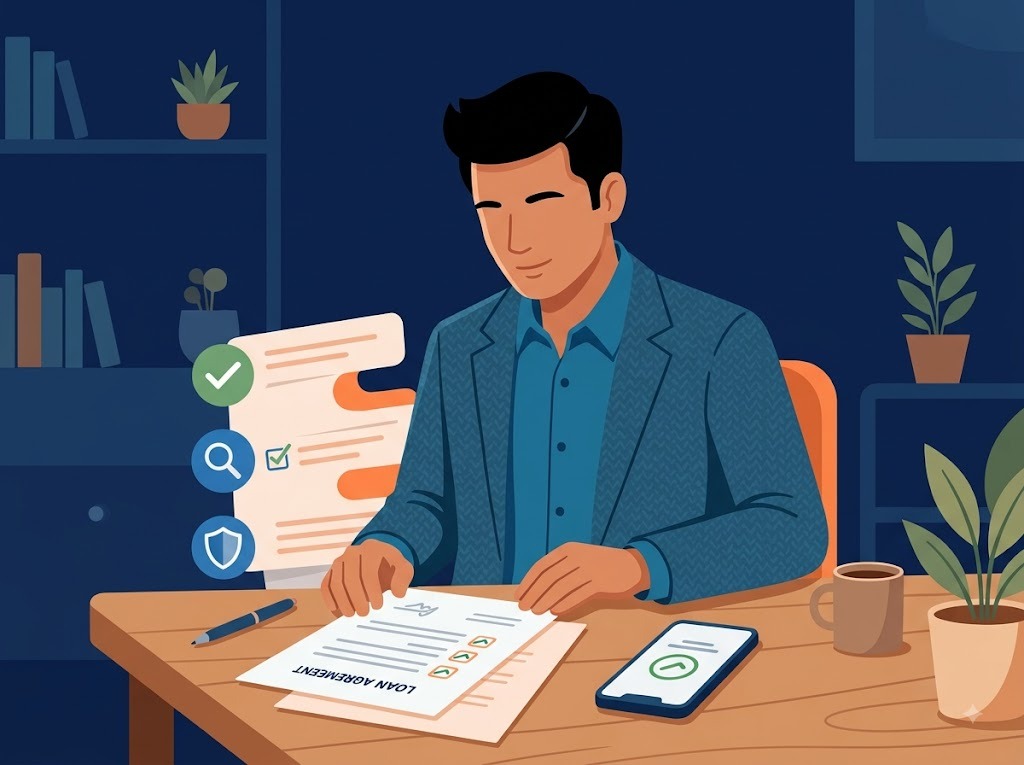
Step 4 - Review the Key Fact Statement. Check the true APR and total cost before you accept anything. A verbal quote of "12% flat" can work out to a meaningfully higher APR once fees are folded in, which is exactly what this document is meant to reveal.
Step 5 - Old debts are paid off directly. Depending on the lender and loan structure, the funds may be disbursed to your bank account or directly to the relevant beneficiary, in line with applicable RBI rules. Confirm the disbursal process before accepting the loan.
Step 6 - One EMI begins. A single EMI, one due date, one lender, replaces the multiple payments you were tracking before.
A company that skips the assessment step, or rushes you past it, is the first thing worth questioning. That leads directly into what to check before you actually sign.
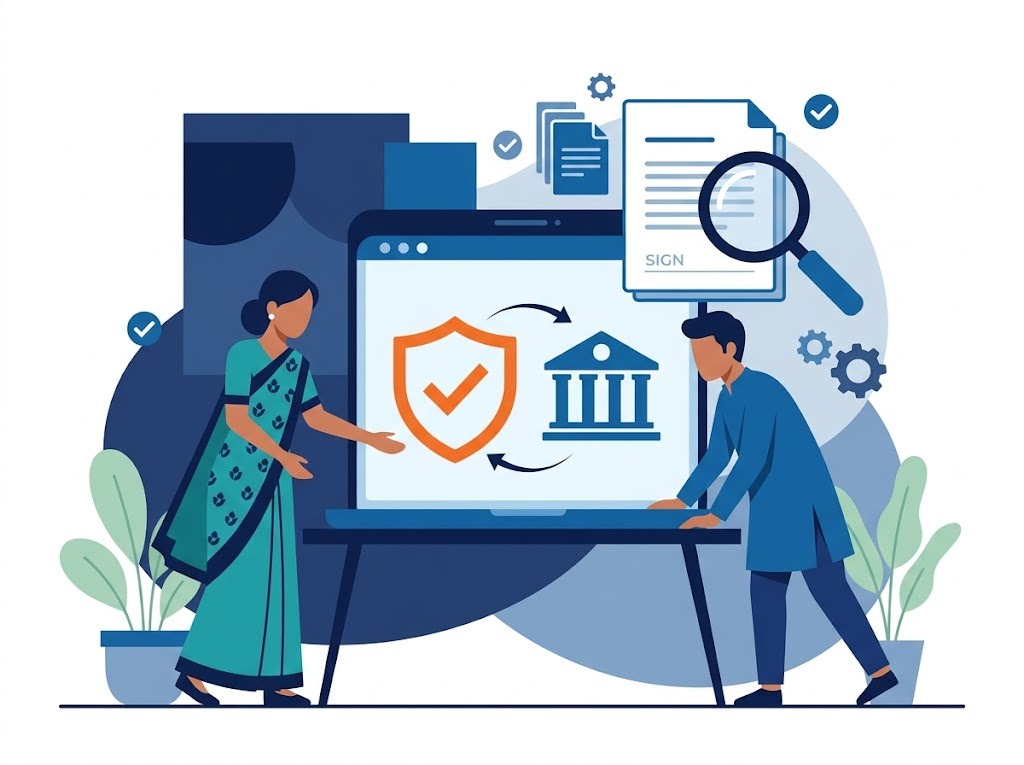
What to Check Before You Sign With a Debt Consolidation Company
What to Check | Legitimate Company | Red Flag |
Lending partner | Names the RBI-registered NBFC/bank clearly, on request and in writing | Refuses to name the actual lender, only shows its own app brand |
Fees | Clearly disclosed in writing, including when and how each fee is charged | Asks for a "processing fee" or "security deposit" before anything is disbursed |
Interest disclosure | Provides a Key Fact Statement with the true APR upfront | Quotes only a flat monthly rate, avoids stating APR |
Disbursal | Loan is disbursed according to RBI requirements, generally to the borrower’s bank account or directly to the end-beneficiary for a specified end use | Routes money through a third-party or "pass-through" account |
App permissions | Requests only KYC-standard access | Asks for contacts, photo gallery, or call log access |
Approach | Assesses your profile before offering terms | Guarantees approval or a specific saving before reviewing anything |
FREED states that it applies these checks while evaluating lending partners for its network.

Freed Expert Tip
Ask for the lending partner's name in writing before sharing any KYC documents, not just the app or platform's brand name.
Check your options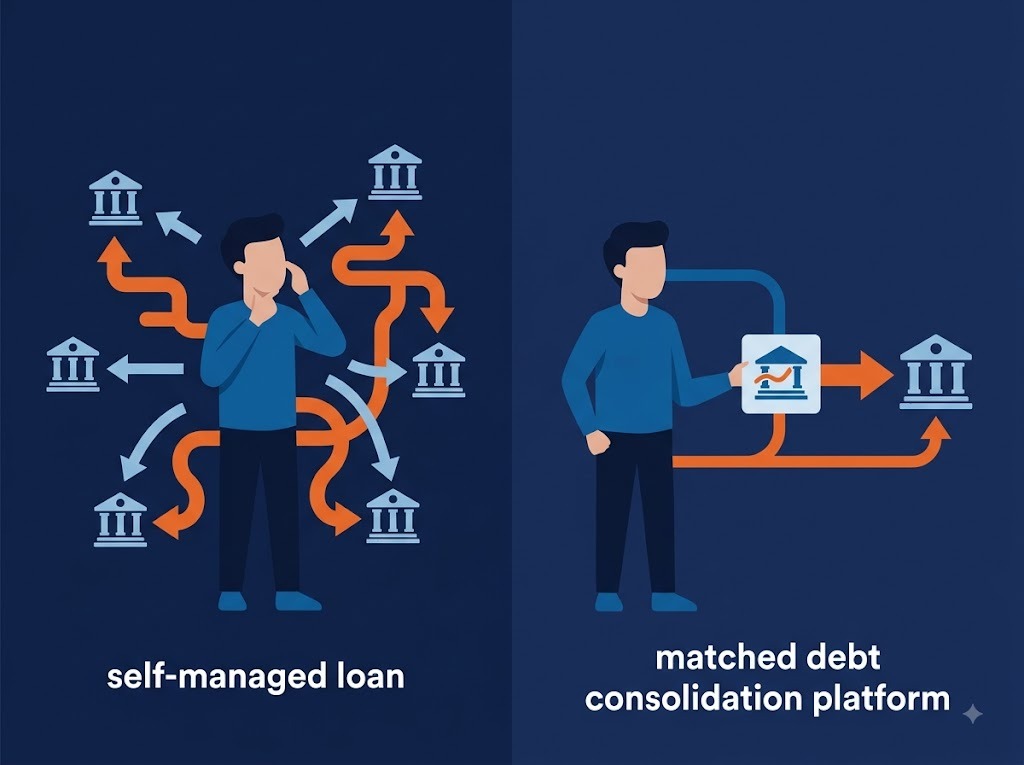
What Are Your Options
You have two routes once you've decided consolidation makes sense for you. The first is doing it yourself: approaching your existing bank, or another bank or NBFC, directly for a personal loan or balance transfer built to cover your other debts. This works best if your CIBIL score is strong and you're comfortable comparing lenders on your own terms, calling around, reading fine print, and negotiating rates. The trade-off is real: you have to run every check from the section above, for every lender you shortlist, on your own time, and repeat it each time a new offer comes in.
The second route is going through a platform that has already vetted its lending partner network, so the verification work happens once, upfront, rather than every time you consider a new offer. FREED's Loan Consolidation Plan works this way. It assesses your full financial profile, not just the one loan you happen to be focused on, and matches you to a suitable lending partner from its network.
Neither route is inherently better. A borrower with a strong score and the time to shop around may prefer doing it themselves. A borrower juggling several loans who wants the verification handled once, by someone who's already done it for other lending partners, is better served by a matched route.
Here's exactly how FREED's Loan Consolidation Plan works for the second route.

What the Law Says
RBI's Digital Lending Apps directory has been live since 1 July 2025, letting borrowers verify a lender's RBI-registered partner themselves, under the RBI (Digital Lending) Directions, 2025 issued on 8 May 2025.
Check your optionsHow FREED Helps
FREED's Loan Consolidation Plan, also called the Debt Consolidation Program or "Reduce My EMI", is built for people who can still repay but need a smarter way to manage their debt.
FREED assesses your financial profile, all your existing loans, your income, your monthly obligations and matches you to a lending partner from its vetted network. This means you don't have to run the seven-point checklist above on every lender individually; FREED conducts its own assessment of lending partners in its network; borrowers should still review the lender’s KFS and final terms before accepting an offer. Subject to approval and the lender’s terms, the matched lending partner may provide a new loan for eligible unsecured debts, potentially leaving you with one lender, one EMI, and one due date.
The effect of consolidation through FREED on your CIBIL score depends on lender reporting and your subsequent repayment behaviour. What helps it over time is straightforward and not unique to FREED: multiple accounts closing out, credit utilisation coming down, and a steady payment record on a single EMI instead of several scattered ones, reported the way any on-time repayment gets reported. FREED charges a success-based fee, only once the consolidation is actually completed, never upfront.
FREED matches and manages the process end-to-end. The lending partner is the one that lends

One EMI Instead of Five
See if FREED can consolidate your loans into one lower payment.
Start My Debt AssessmentWhat Helps You Stay on Track After Consolidating
Keep your new EMI on auto-debit. A missed payment on your consolidated loan works against the entire reason you consolidated in the first place, so this is the one habit worth automating completely.
Hold off on opening new credit cards or BNPL lines right after consolidating. The point of consolidation was one EMI. A new line building up quietly alongside it undoes the simplification you just paid to get.
Build a small monthly saving alongside repayment. Even ₹500 to ₹1,000 a month is a realistic starting point, and having that cushion means one bad month doesn't force you into a fresh loan to cover a gap.
Check your single EMI against your income every few months. Consolidating fixes the structure at the point you signed, but incomes and expenses shift, and it's worth confirming the fit still holds rather than assuming it's solved permanently.
Sources
Claim | Source |
RBI (Digital Lending) Directions, 2025, issued 8 May 2025, mandatory for REs, LSPs, and DLAs, covering disclosure, direct disbursal, and grievance redressal | RBI notification RBI/2025-26/36, dated 8 May 2025 https://rbidocs.rbi.org.in/rdocs/notification/PDFs/36NT8C402BE7C2A349E0BFFF3C526668CD7A.PDF |
RBI's Digital Lending Apps (DLA) directory operational from 1 July 2025, listing DLAs deployed by RBI-Regulated Entities | Reserve Bank of India, Database on Indian Economy data.rbi.org.in (Digital Lending Apps deployed by Regulated Entities) |

Mohit Juneja
Mohit Juneja writes educational content at FREED on debt management, credit scores, loan repayment, and borrowing best practices. His content is shaped by expert insights and industry knowledge, helping readers better understand their financial options and make informed decisions.
mohit.juneja@freed.care

FREED is India's trusted loan management platform. Founded in 2020 and headquartered in Gurugram, FREED has counselled 20 lakh+ people on personal loans, credit cards, and app loans. FREED charges fees only on successful settlement, not upfront. FREED does not handle secured loans (home loans, car loans, gold loans).
Media Mentions