Legal Notice for Recovery of Loan What It Means and How to Respond (2026 Guide)
A legal notice for recovery of loan is a formal written demand from a bank, NBFC, or their lawyer. It asks you to pay your outstanding dues within a fixed time, usually 15 to 30 days. It is the last warning before court action begins. It is not a court order itself. You still have time to respond, negotiate, or settle.
Mohit Juneja
Reviewed by FREED India, Debt Resolution Specialists
 4.7/5
4.7/5 ₹3,200Cr+
 20,000+
 20,00,000+4.7/5₹3,200Cr+20,000+20,00,000+
Key Takeaways

A notice is a warning, not a court order. You have not been taken to court yet.
You usually get 15 to 30 days to reply, depending on the type of notice.
Ignoring it makes things worse a court case can follow, your CIBIL score drops, and for secured loans like home or car loans, your asset is at risk.
You can reply, negotiate, or settle. All three are legal and valid options at this stage.
Settling the debt before court is almost always less expensive than fighting a case that can take 3 to 7 years.
What Should You Do in the First 48 Hours After a Legal Notice?
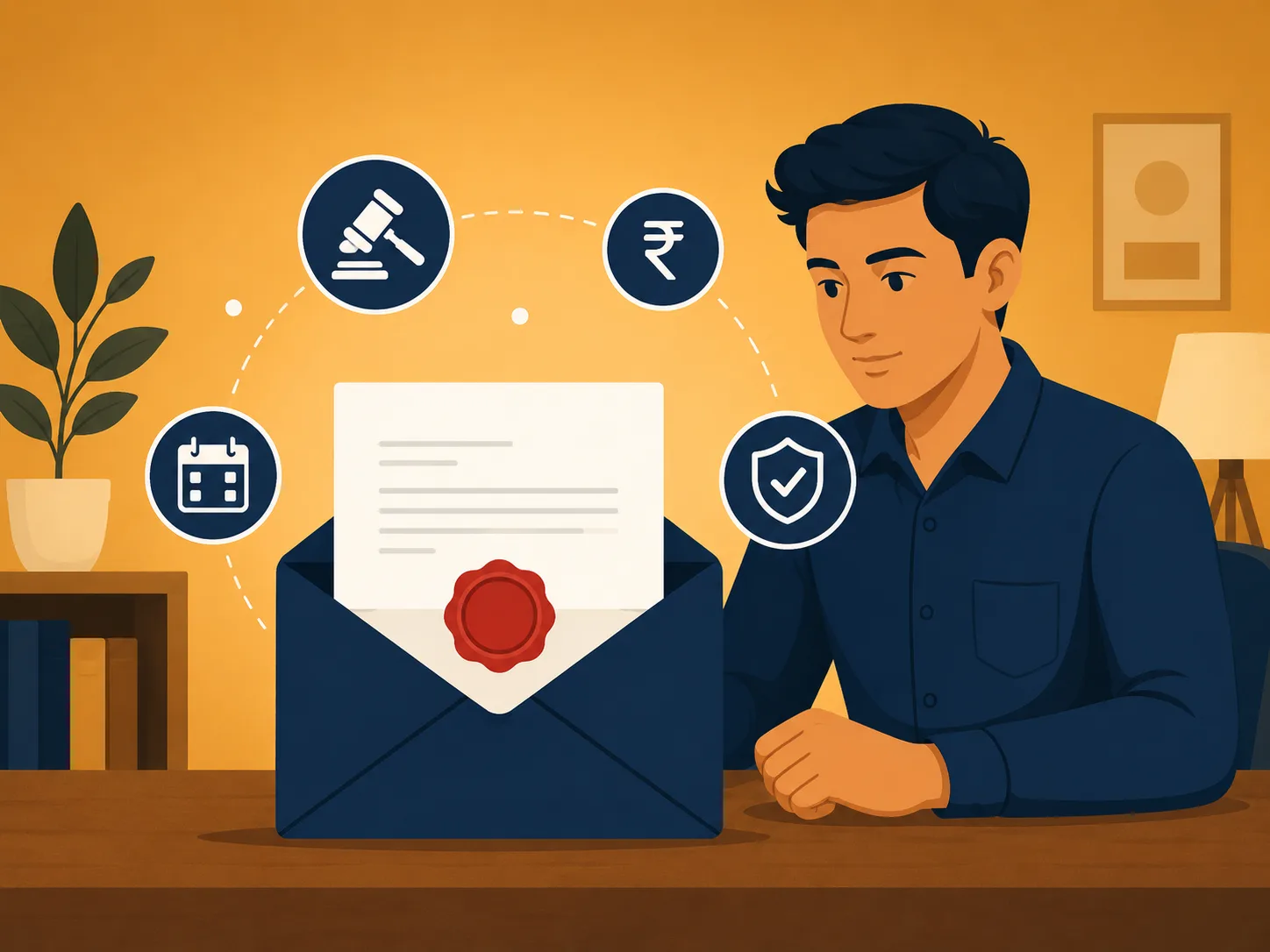
The envelope is open on the table and your stomach has dropped. Take a breath. A notice is a demand letter, not a court order, and you have time to respond properly. Do these six things first:
- Find out which type of notice it is. A bank's reminder, a lawyer's demand notice and a tribunal summons all need different replies. The table below helps you tell them apart.
- Note the reply deadline. Circle it on a calendar. Count from the day you received it, not the date printed on top.
- Collect your loan statement. Ask the bank for a full statement so you can check the amount it's claiming.
- Don't ignore it. Silence lets the bank say you never disputed the claim, and that can hurt you later.
- Reply in writing. Use email or registered post so you have proof of the date you replied.
- Get advice for any court or tribunal paper. A summons from a court or the DRT needs a lawyer. A demand letter usually doesn't, at first.

Not sure if your notice is genuine?
FREED's in-house legal team can check it and tell you whether it needs a reply.
Book My CallWhat Is a Legal Notice for Recovery of Loan?
A legal notice for recovery of loan is a formal letter sent by a bank, NBFC, or their lawyer.
It tells you that you have an outstanding amount due. It gives you a deadline to pay. It lists what happens if you don't respond.
The notice is sent under one of several laws. Under Section 80 of the Civil Procedure Code (CPC), it is a required step before a civil recovery suit can be filed. Under Section 138 of the Negotiable Instruments Act, it applies when a cheque you gave has bounced. Under the SARFAESI Act (law that lets banks take secured property on default), it applies to home loans and vehicle loans.
It can arrive for credit card dues, personal loan outstanding amounts, business loans, or unpaid EMIs that have been building up over time.
Most importantly: a legal notice is not a court order. No judge is involved yet. No case has been filed. This is the stage where you can still respond and resolve the matter without going to court.
Why Did You Get a Legal Notice for Loan Recovery?
A bank or NBFC sends a legal notice when repeated calls and written reminders have not resulted in payment. Here are the most common reasons:
- You missed 3 or more EMIs and the account has been marked NPA (loan marked as bad by the bank, usually after 90 days of missed payment).
- Your credit card payment has been overdue for 90 days or more.
- A cheque you gave for EMI payment bounced, which triggers a case under Section 138 of the Negotiable Instruments Act (cheque bounce law that can lead to criminal proceedings).
- The bank made a settlement offer earlier and received no response.
None of these mean the matter cannot be resolved. They mean the bank has moved to a formal step, and that now requires a formal response from you.
To see how a missed EMI turns into legal action step by step, read our guide on personal loan default and legal action.

Types of Legal Notices Lenders Send
| Notice | Who sends it | Usual reply or payment window | What it means for you | Read more |
|---|---|---|---|---|
| Reminder letter | Bank or NBFC | Set by the bank, often a week or two | A gentle push before formal steps | This page |
| Demand notice | The bank's lawyer | The date written in the notice | Formal demand; the bank may go to court next | This page |
| SARFAESI Section 13(2) notice | Bank, for secured loans only | 60 days to repay | The bank can move to take the pledged property after 60 days | Section 13 notices |
| Section 138 cheque bounce notice | Bank or lender | 15 days to pay | A bounced cheque can become a criminal complaint if unpaid | Section 138 demand notice |
| Section 25 payment systems notice | Bank or lender | 15 days to pay | A bounced auto-debit EMI can become a complaint if unpaid | Section 25 PSS Act |
| DRT summons | Debts Recovery Tribunal | 30 days to file your written reply, extendable by up to 15 days | A case has been filed for dues of ₹20 lakh or more | Debt Recovery Tribunal |
Only the last row is an actual case. Every row above it still leaves room to talk to the bank before anything reaches a court. FREED doesn't handle secured loans like home loans, so the SARFAESI row is here only to help you identify the notice.
What Happens If You Ignore a Legal Notice for Recovery of Loan?
Ignoring a loan recovery notice does not make the debt go away. Silence lets the bank say you never disputed the claim, and the missed EMIs behind the notice keep showing on your credit report for up to 7 years.
The bank can then move to the next formal step, such as a recovery suit or a tribunal case, and a summons from a court or the DRT cannot be ignored. A written reply at the notice stage keeps your options open: you can ask for a full statement, propose what you can pay, or open a settlement talk. Read more in our guide to personal loan default and legal action.
Want to know what is pulling your score down?
Check your credit report with FREED Credit Insights before you plan the next step.
Check My Credit InsightsHow to Respond to a Legal Notice for Recovery of Loan
A notice demands a response, not silence, not panic. Here is what to do, one step at a time.
Step 1: Read the Notice Fully and Note the Deadline Check the type of notice, the amount claimed, and the exact deadline to respond. Mark the reply-by date clearly.
Step 2: Verify the Amount Against Your Own Records Pull out your loan statements. Check whether the outstanding amount, interest added, and penalties match what the notice claims. Errors are common.
Step 3: Speak to a Debt Counsellor Before Responding Before you send a reply, get clarity on what you are responding to. A debt counsellor can review the notice alongside your loan statements, check whether the amount claimed is accurate, and tell you whether to dispute the figures, ask for more time, or start a settlement conversation with the bank. FREED's team does this for free on the first call, no commitment required. .
Step 4: Send a Written Reply Within the Deadline Acknowledge that you received the notice. If any amounts are incorrect, state this clearly and ask for documentation. If you need more time, say so in writing. A written reply shows good faith and stops automatic escalation.
Step 5: Open a Settlement Conversation With the Bank Settlement is not something you choose out of preference. Banks only consider it when there is a genuine inability to repay the full amount. When it applies, it can resolve the matter at less than the full outstanding. This conversation can begin at any stage before a court decree.
Step 6: Get the Settlement in Writing Before Paying Never pay based on a verbal promise. Ask for a Full and Final Settlement letter from the bank. After payment, collect the clearance letter (called NOC) and verify your CIBIL report is correctly updated within 30 to 45 days.


FREED Expert Tip
Keep a dated copy of every reply you send and every payment you make. If the bank's numbers and yours ever differ, these records settle it.
Check My Credit InsightsWhat Should Your Reply to a Bank's Legal Notice Cover?
This is an outline, not a legal document. Use it to plan what you write, and get a lawyer to review anything that goes to a court or tribunal.
- Acknowledge the notice and its date. Mention the notice's reference number and the day you received it.
- State your loan account number and your own figure. If the amount claimed looks wrong, say what you think the outstanding is and why.
- Ask for a full statement of account. Request the breakup of the amount you borrowed, interest added and charges, so both sides work from the same numbers.
- Say what you can pay or propose. A monthly amount you can manage, a short break, or a settlement discussion if repaying in full has become genuinely impossible.
- Ask for written confirmation of anything agreed. A phone promise from an agent doesn't protect you. A letter or official email does.
Keep the tone calm and factual. You don't need to explain your whole story, only what you can do next.
Want help drafting your reply?
FREED's in-house legal team helps borrowers draft replies to recovery notices.
Book My CallYour Rights as a Borrower When You Get a Legal Recovery Notice
Receiving a legal notice does not mean you surrender your rights. Here is what you are entitled to under Indian law.
- The right to receive all recovery demands in writing. Verbal threats do not have the same legal standing as a formal notice.
- The right to verify and dispute the amount claimed. If the figure includes calculation errors or incorrect charges, you can raise this formally in your written reply.
- The right to negotiate a settlement at any stage before a court decree. Banks are permitted to consider a settlement even after a notice is sent.
- The right to be free from harassment and abuse during the recovery process. This is protected under the RBI Fair Practices Code.
- The right to lodge a complaint with the Banking Ombudsman or the RBI if recovery agents or the bank violate these guidelines.
- The right to participate in Lok Adalat proceedings if your case reaches that stage, and to have any resolution reached there treated as final and legally binding. WHAT THE LAW SAYS
- Under Section 80 of the Civil Procedure Code, a legal notice must be sent before a civil suit can be filed against you. This is your window to act.
- Under Section 138 of the Negotiable Instruments Act (cheque bounce law, can lead to criminal proceedings), a cheque bounce notice gives you exactly 15 days to pay before a criminal complaint can be filed.
- Under the RBI Fair Practices Code, recovery agents cannot call before 8 AM or after 7 PM. They cannot threaten, abuse, or use force. They cannot contact your family, employer, or neighbours without your consent. Violations can be reported to the RBI Banking Ombudsman at cms.rbi.org.in.
For the wider rules on what lenders can and cannot do, see RBI guidelines for loan recovery.

What the Law Says
If a bank takes a loan case to the Debts Recovery Tribunal, you get 30 days from the summons to file a written reply. The tribunal can add up to 15 more days, but only in exceptional cases, so don't wait for the last date.
Talk to someone before the deadlineShould You Fight the Notice or Settle the Debt?
| Fight or dispute the notice when | Look at settlement when |
|---|---|
| The amount claimed is wrong, or charges were added that you never agreed to | You genuinely can't repay the full amount anymore |
| The loan isn't yours, or it was already paid | Your income has dropped and isn't coming back soon |
| The notice threatens things the law doesn't allow, like arrest for a missed EMI | You've already missed several EMIs and the dues keep growing |
Settlement is not something a borrower chooses out of preference. Banks only consider it when you are in genuine financial difficulty and can't repay in full. If you're stretched but still paying, settlement isn't for your situation. A lower EMI through consolidation or a longer repayment time keeps your credit report clean.
When settlement does fit, the bank can reduce your dues by up to 50%*, and the account shows as Settled on your report for up to 7 years.
*Rates and ranges shown are indicative. Final terms decided by the bank. FREED is not a Loan Provider. No outcome is guaranteed. Please verify directly with your bank.
Repaying in full no longer possible?
See how FREED's Loan Settlement Plan works with your banks.
Settle My LoansHow FREED Helps When You Have Received a Loan Legal Notice
For unsecured loans credit cards, personal loans, and app loans FREED's team can help you work through this from start to finish.
- We review your notice and loan documents to understand exactly what is being claimed.
- We help you figure out what a realistic settlement looks like based on your outstanding amount and your ability to pay.
- We handle the back-and-forth with the bank.
- We draft the written reply to the notice, including any amount disputes and requests for documentation.
- We work to get the Full and Final Settlement letter worded correctly with details that matter when your CIBIL report is updated.
- After settlement, we guide you on CIBIL repair steps so your score starts recovering as quickly as possible.
FREED has helped over 60,000 Indians resolve debt, including thousands who came to us after receiving a legal notice. There is no judgment here, and the first call is free.
Want to know what is pulling your score down?
Check your credit report with FREED Credit Insights before you plan the next step.
Check My Credit Insights
Mohit Juneja
Mohit Juneja writes educational content at FREED on debt management, credit scores, loan repayment, and borrowing best practices. His content is shaped by expert insights and industry knowledge, helping readers better understand their financial options and make informed decisions.
mohit.juneja@freed.care

FREED is India's trusted loan management platform. Founded in 2020 and headquartered in Gurugram, FREED has counselled 20 lakh+ people on personal loans, credit cards, and app loans. FREED charges fees only on successful settlement, not upfront. FREED does not handle secured loans (home loans, car loans, gold loans).
Media Mentions