Debt Consolidation Strategies: 6 Ways to Combine Your Debts
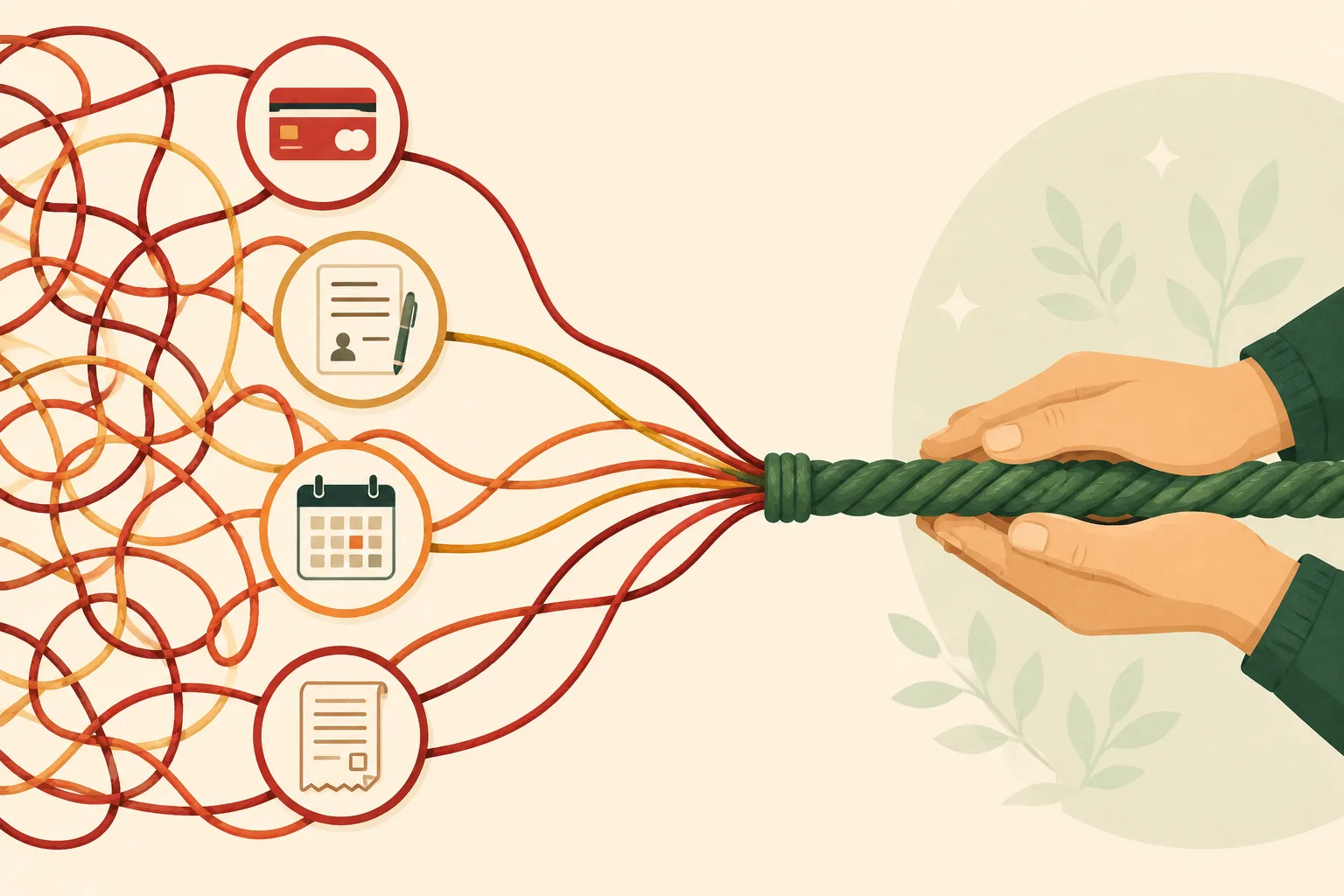
Debt consolidation strategies are the ways to move several debts into one, so you pay one EMI. Each way has a different cost and risk, and some ask you to put an asset at risk. The right one depends on what you owe, what you earn and what you can afford to lose.
Mohit Juneja
Reviewed by FREED India, Debt Resolution Specialists
 4.7/5
 ₹3,200Cr+
 20,000+
 20,00,000+4.7/5₹3,200Cr+20,000+20,00,000+
Key Summary

Debt consolidation strategies are six ways to turn several payments into one, each with its own cost and risk.
A lower EMI over a longer time can cost more in total.
In our example, ₹6 lakh costs about ₹1.70 lakh in interest over 36 months at 17%.
Secured routes can lower the rate, but you can lose the asset if you miss payments.
RBI requires a Key Facts Statement for digital loans. Read the total cost before you accept.
What Are Debt Consolidation Strategies in India?
A debt consolidation strategy is a way to pay off several dues with one new payment. There are six common ones. They differ in cost, in risk and in which debts they can take.
Here are all six in one table.
| Strategy | What it does | Best for | Main risk |
|---|---|---|---|
| Personal loan | One new loan pays off several dues | Mixed card and loan dues | A longer time can raise the total cost |
| Balance transfer card | Moves card dues to a new card | Card dues only | The offer ends, and fees apply |
| Top-up or loan transfer | Adds to, or moves, an existing loan | One strong existing loan | Puts more of your debt with one bank |
| Secured loan (property, gold, securities) | A new loan backed by an asset | Larger amounts | You can lose the asset |
| Family loan with written terms | Borrow from someone you trust | Short gaps | It can strain the relationship |
| A loan-matching platform | A partner matches you to a lender | Many dues, little time | Fees and offers vary |
One thing to know early. The cheapest route on paper isn’t always the safest. We compare the routes on the same debt in section 8, so you can see the cost for yourself.
This guide covers unsecured dues, such as credit cards, personal loans, buy now, pay later (BNPL) dues and loan app dues. One route above is secured, and we flag it clearly.
If you want the basics first, read our pillar guide on ways to combine several loans into one. Our post on types of debt consolidation lists the routes too. This page goes further, with a cost comparison and a table to match your situation.
Let’s start with the most common route.

Want Every Loan and Card on One Page?
See your accounts and balances in plain words before you pick a route.
Check My Credit InsightsStrategy 1: Use a Personal Loan to Pay Off Several Debts
This is the most common route, and it’s the easiest to compare. It works in three short steps.
- You apply for one personal loan.
- The money pays off your old dues.
- You repay one EMI (your fixed monthly payment) on one date.
It suits borrowers who are still paying on time and have a mix of cards, loans, BNPL and loan-app dues. One payment is easier to track than five. And a clear end date gives you a finish line.
Be honest about the limits. They matter as much as the benefits.
- The bank decides the rate. It looks at your credit report and your income. You can’t pick it.
- A longer time lowers the EMI but raises the total. Stretching the loan out feels like relief, but you pay interest for more months.
- You must pay the old dues right away. If the money comes to your account, pay the old loans and cards the same week. A balance left open keeps charging interest.
That last point trips up many people. The new loan clears nothing by itself if the cash sits in your account. Keep the payoff proof for each old account, and check your credit report a month or two later to see each one closed.
A personal loan is a good fit when your new rate is clearly lower than the average rate you pay now. If it isn’t, the route may only add a new loan to your pile.
For card dues in particular, our guide on using a personal loan to pay off credit cards goes deeper. And personal loan vs credit card debt consolidation compares two of the routes head to head.
Strategy 2: Move Card Dues With a Balance Transfer
A balance transfer moves what you owe on one card to another card. It often comes with a set period at a lower rate. For card borrowers, that can sound ideal. But it has clear limits.
- It usually takes card dues only. Personal loans and loan-app dues stay outside it.
- The new card’s limit must cover the amount. If your limit is smaller than your balance, only part can move.
- The offer period ends. When it does, the rate can change. Read what applies after, not only what applies at the start.
A transfer fee may also apply. Ask for it before you decide, and add it to your cost check.
A balance transfer may suit you when most of your debt is on credit cards and you can repay the transferred amount within the promotional period. Check the transfer fee, the interest rate after the offer expires and the repayment conditions. Avoid building new balances on the cards you have cleared. If you can’t clear the balance in time, you may end up paying a higher rate later.
Watch one trap in particular. A balance transfer doesn’t change your habits. If the old cards fill up again, you’ll carry the transferred balance and new dues together.
Also look at what’s left behind. Say you owe ₹1,00,000 on cards and ₹3,00,000 on personal loans. A transfer helps with the first amount only. The loans keep their separate EMIs and dates.
For more, read our guides on the balance transfer credit card in India and what balance transfer means.

FREED Expert Tip
Ask every bank for the total amount you’ll repay, not just the EMI. A smaller EMI spread over a longer time can cost much more.
Check My Credit InsightsStrategy 3: Take a Top-Up Loan or Move a Loan to Another Bank
Two routes sit under this one, and they’re easy to mix up.
A top-up adds money on top of an existing loan. You borrow a bit more from the same bank, and use the extra to clear other dues. A loan transfer moves one loan to a new bank, usually to get a lower rate.
Who does it fit? Someone with one loan in good standing, at a bank that’s willing to lend more. If you have a clean repayment record on that loan, a top-up can be a quick way to fold a small due into it.
But look at the limits.
- Banks often want a repayment record first. A recent loan, or one with late payments, may not qualify.
- A top-up can put more of your debt with one bank. That makes you more dependent on a single provider’s terms.
- Transferring a loan can carry costs. A foreclosure charge on the old loan and a processing fee on the new one can cut into the saving.
Neither route solves a spread of many dues. A top-up folds in a small one or two. A transfer swaps one lender for another. If you hold cards, loan apps and BNPL dues together, these routes alone may leave you with several payments still.
Here’s a simple test. Count how many payments you’d still make after the top-up or transfer. If the answer is still four or five, you haven’t really consolidated.
Prepayment charges are covered in section 12. For the transfer route, see our guides on personal loan balance transfer and whether a balance transfer is worth switching for.
See What Share of Your Salary Goes to EMIs
Know your number before you ask a bank for more.
Check My EMI ScoreStrategy 4: Use a Secured Loan Against Property, Gold or Securities
Let’s start with the risk, in plain words. With a secured loan, the bank holds your property, gold or investments. If you can’t repay, it can take them.
Why do people still choose it? Because the rate is often lower, and the amount can be larger. A bank takes less risk when it holds an asset, so it may charge less and lend more.
But a lower rate isn’t free money. You’ve turned debt that had no asset behind it into debt backed by something you own. If things go wrong, the loss isn’t only a credit mark. It can be your home, your gold or your savings.
Ask yourself these questions before you go near this route.
- Could I repay this if my income dropped? Think about a job loss or a medical bill, not only your best month.
- Is the saving worth the asset at stake? Put a rupee figure on it, and compare it with what you could lose.
- Would I have to sell the asset anyway if things go wrong? If the answer is yes, the “saving” may not be one.
Also check the paperwork. Valuation fees, legal checks and a longer process can add cost and time. And the loan usually runs longer, which raises the total interest, even at a lower rate.
A secured loan carries a serious risk because an asset is at stake. Consider it only after comparing the total repayment cost, the consequences of default and your ability to repay under less favourable financial conditions. Independent financial advice may help before you commit. Our guide on the unsecured debt consolidation decision guide covers the choice between secured and unsecured in full.
For clarity, FREED’s Loan Consolidation Plan is for unsecured dues only. It doesn’t cover home loans, car loans or other secured loans.
Strategies 5 and 6: Borrow From Family, or Use a Loan-Matching Platform
These two are very different, so take them one at a time.
Strategy 5: A family loan. A relative or close friend lends you the money to clear your dues. It can work for a short gap, when you know you can repay within a few months.
Protect the relationship by writing everything down. Put the amount, the monthly payment and the end date on one page, and both of you keep a copy. Pay on the same day each month. And remember that “no interest” isn’t the same as “no cost”. A missed payment can cost you more in trust than any bank would charge.
If you’re already missing payments, be especially careful about borrowing from family. Consider this route only if you have a realistic repayment plan and can agree on clear written terms. Otherwise, it may transfer the financial pressure to someone close to you without resolving the underlying problem.
Strategy 6: A loan-matching platform. A platform checks your profile and matches you to a lender, so you don’t apply to many banks one by one. That may save time, but it does not automatically prevent multiple credit enquiries. Ask the platform whether it shares your details with one lender or several, and whether each lender may make a separate credit enquiry before you consent.
Ask these questions before you agree to anything:
- Who is the lender, and what are its terms?
- What fee applies, and who pays it?
- Will the lender pay my old loans directly?
- Can I see the Key Facts Statement before I sign?
If a platform can’t answer, that tells you something.
For help with choosing, read our guides on debt consolidation companies and where to apply for a debt consolidation loan. FREED’s own process is explained in section 13.
Know What You Owe Before You Ask Anyone
Check how much of your salary your EMIs take.
Check My EMI ScoreWhich Debts Can Each Debt Consolidation Strategy Take?
Not every route can take every kind of debt. Here’s a quick map. It uses “usually”, because each bank or provider sets its own list.
| Debt | Personal loan | Balance transfer | Top-up or transfer | Secured loan | Family loan | Platform match |
|---|---|---|---|---|---|---|
| Credit card dues | Usually | Yes | Sometimes, if you take a top-up | Usually | Yes | Depends |
| Personal loans | Usually | No | Only the one you top up or move | Usually | Yes | Depends |
| Loan app dues | Usually | No | No | Usually | Yes | Depends |
| BNPL dues | Often | No | No | Often | Yes | Depends |
Three things stand out.
Balance transfers are narrow. They take card dues only. If cards are your only debt, that’s fine. If you also have loans and app dues, you’ll need another route for them.
Top-ups and loan transfers are narrow, too. They deal with one loan, or with a top-up amount on one loan. They don’t pull many dues into one.
Broad routes ask more of you. A personal loan, a secured loan and a platform match can take several kinds of debt at once. But they depend on your profile, and each provider has its own list.
Before you pick, write down your own debts by type. How much sits on cards? How much on personal loans? How much on apps and BNPL? Then match that list to this table. Many people find that one route covers most of what they owe, and another covers a small remainder.
One more point. The new loan has to cover the total you want to close. If it’s smaller than your dues, some will stay open. Add up the real payoff amounts first, using statements from the same day.
Which Debt Consolidation Strategy Costs Less on the Same ₹6 Lakh?
The lowest EMI isn’t the lowest cost. Let’s see it on one debt. This is an illustration with made-up rates. They aren’t offers.
Say you owe ₹6,00,000 across cards and loans. Here are three routes.
| Route | Rate | Time | EMI | Total repaid | Interest paid |
|---|---|---|---|---|---|
| A. Personal loan | 17% a year | 36 months | ₹21,392 | About ₹7,70,099 | About ₹1,70,099 |
| B. Same personal loan | 17% a year | 60 months | ₹14,912 | About ₹8,94,693 | About ₹2,94,693 |
| C. Secured loan | 11% a year | 60 months | ₹13,045 | About ₹7,82,727 | About ₹1,82,727 |
Rates and ranges shown are indicative. Final terms decided by the bank/lender. FREED is not a Loan Provider. No outcome is guaranteed. Please verify directly with your bank.
Three takeaways come out of this.
- A and B differ only in time. B’s lower EMI costs about ₹1,24,600 more in interest. That’s the price of stretching the loan from 36 to 60 months.
- C looks cheapest per month but needs an asset. Its EMI is the lowest at ₹13,045. But it needs property, gold or securities as security. And it still costs about ₹12,600 more in total than A.
- If you can afford A’s EMI, a shorter time wins. A has the highest EMI, but the lowest total cost of the three.
Notice something about C. Its rate is much lower than A’s. Yet over 60 months it costs more than A over 36. So a low rate alone isn’t enough. Time can undo the gain.
Your real rate depends on the bank and on your profile. So treat these as a way to learn the method, not as figures for your own loan. The method is to multiply the EMI by the months, then compare totals.
That’s also why it pays to ask for the total amount you’ll repay. A friendly EMI can hide a much bigger bill.

Combine Your Loans Into One Lower EMI
Depending on your outstanding dues, eligibility and the terms offered by the lending partner, FREED’s Loan Consolidation Plan may help reduce your monthly EMI burden.
Reduce My EMIHow Do Fees Change the Cost of Each Strategy?
The rate and the time aren’t the whole price. Fees can move the total, and they’re easy to miss.
Take route A from the example. Say the bank charges a 2% processing fee. On ₹6,00,000, that’s ₹12,000. It’s an illustration, so check your own offer.
If the bank takes the fee out of the loan, you receive ₹5,88,000, not ₹6,00,000. That leaves your old dues short by ₹12,000. If the lender deducts a 2% processing fee from the disbursed amount, a loan of approximately ₹6,12,245 would be needed to leave ₹6,00,000 available for closing the old dues. At an illustrative reducing-balance rate of 17% per year over 36 months, the EMI would be approximately ₹21,828. This is around ₹436 more per month than the original illustration. The additional repayment over the full tenure would be approximately ₹15,700, before considering any other applicable charges.
Now add the other costs to look for.
- Early-payoff charges on your old loans. Say an older loan charges 2% to close early. On a ₹2,00,000 balance, that’s ₹4,000.
- Transfer or top-up fees. These can apply to the second and third routes.
- Valuation and legal costs. Secured loans often add these.
- Late-payment charges. Know what you’d pay if you miss a due date.
- Optional add-ons. Some lenders add insurance. Ask if it’s optional.
So build one sheet for each offer. Write the rate, the time, the EMI, every fee and the total. Then compare the sheets side by side, not the headlines.
The Key Facts Statement helps here. It shows the rate, the fees, the APR (the all-in yearly cost) and the repayment schedule in one place. The APR counts the fees, so it’s a fairer comparison than the stated rate alone. It covers term loans, not credit card dues, so keep your card statements separately.
For what rates depend on, read our guide on debt consolidation interest rates.
Which Debt Consolidation Strategy Fits Your Situation?
Pick by your situation, not by the lowest number. Here’s an “if this, then that” table.
| If this is you | Then look at |
|---|---|
| You only have card dues | A balance transfer, or a personal loan |
| You have cards, loans and app dues together | A personal loan, or a platform match |
| You have one good loan and a small extra need | A top-up |
| You need a large amount, have steady income and an asset you can afford to risk | A secured loan, with great caution |
| You have a short gap you can close within months | A family loan with written terms |
| You’re unsure, or you have many dues | A platform that assesses your profile first |
Use the table as a starting point, not as a verdict. Two people with the same row can have different best routes. One may have a clean report, and the other may not.
A few extra questions help you choose.
- How many payments will I still make afterwards? The goal is one. Count honestly.
- Is the total lower, or only the EMI? Use the method from section 8.
- What happens if my income drops? A route that risks an asset hurts most here.
- Can I stop using the cleared cards? If you can’t, work on spending first.
If you aren’t sure which row you belong to, start with your own numbers. List your debts by type. Work out your EMI share, which is your total EMIs divided by your take-home pay. Then compare two routes on total cost.
For who qualifies, read our guides on whether you can consolidate your debt and debt consolidation eligibility.
When Is Debt Consolidation the Wrong Strategy?
Combining debts doesn’t fix a budget that spends more than it earns. In some cases, consolidation is the wrong move. Here are the main ones.
- Your debts are small, and one or two are nearly done. A payoff order may fit better. Our guide on the snowball and avalanche methods explains two of them.
- The new EMI would still be too big for your salary. A new loan doesn’t help if the payment is still too heavy to keep.
- The new total costs much more. If a lower EMI only comes from a far longer loan, as in route B, you may lose more than you gain.
- You’ve already missed payments. Applying for a new loan is unlikely to help, and each rejection can leave a mark on your credit report. Talking to your bank first is wiser.
Be honest about the last one. If you’ve missed payments, this guide isn’t the right next step. A new loan is built for people who can still repay.
If that’s you, FREED’s team can talk through your options without any pressure. They can look at your whole situation and explain what fits. You don’t have to work it out alone.
For everyone else, a quick check can save a lot of trouble. Ask: “Is the problem the number of payments, or the size of what I owe?” Consolidation helps with the first. It doesn’t fix the second.
Our pillar guide explains when consolidation is the wrong fit in more detail. And our post on the disadvantages of debt consolidation covers the full list of risks.
See What Your EMIs Take Today
Check your EMIs as a share of your salary before you decide.
Check My Credit InsightsWhat Should You Check Before You Sign a Consolidation Loan?
Approval isn’t the end. Before you accept, read what you’re given. For loans arranged digitally by banks, co-operative banks and NBFCs, RBI’s Digital Lending Directions, 2025 set clear rules.
- A Key Facts Statement. The lender must provide a KFS as per RBI’s April 2024 instructions, which means before you sign. Once you’ve signed, the signed documents, including the KFS and the sanction letter, should reach your registered email or SMS (para 8).
- A cooling-off option. You must be given an explicit option to exit a digital loan by paying the principal and the proportionate APR, without penalty. The lender’s Board sets the period, and it can’t be less than one day. A one-time processing fee may be kept on exit, but it must be shown upfront in the KFS (para 10).
- Money into your own account. The loan is generally paid into your own bank account, with limited exceptions such as payments made straight to the end beneficiary for a specific purpose. Repayment goes straight to the lender (para 9).
These rules cover digital lending by regulated lenders. They aren’t a promise about any one lender. So read your own papers.
Then ask these questions of any bank or platform:
- What is the total I’ll repay?
- What is the processing fee, and who collects it?
- Will you pay my old loans directly?
- What are the foreclosure charges on each old loan?
- What happens if I miss a payment?
Write the answers down. If a provider won’t put them in writing, stop and think.
Check how the loan reaches you, too. If anyone asks for money before approval, or asks you to pay an agent’s account, walk away. Real lenders show every fee in the Key Facts Statement.
For what rates depend on, read our guide on debt consolidation interest rates. And see what a good outcome looks like in our debt consolidation example.

What the Law Says
RBI’s Pre-payment Charges Directions say regulated lenders can’t charge a prepayment penalty on floating-rate loans to individuals for non-business purposes, if the loan is sanctioned or renewed on or after 1 January 2026. For other loans, your loan terms decide, and any charge must be disclosed. Check whether your loan is floating or fixed.
Reduce My EMIHow FREED Helps With Debt Consolidation
You can compare these routes yourself. FREED helps with the assessment and the process.
If most of your salary goes towards paying multiple EMIs, FREED’s Loan Consolidation Plan helps you combine multiple loans into a single monthly EMI. This can reduce your monthly EMI burden by up to 50%.* FREED is India’s trusted loan management platform, and over 20 lakh people trust it. It’s for people who can still repay but need a smarter way to manage their debt.
Here’s how it works:
- FREED assesses your financial profile. It looks at your loans, income and repayment record.
- FREED matches you to a lending partner from its network.
- The partner disburses one new loan. It pays off your existing eligible unsecured loans and card dues.
- FREED handles the process end to end, 100% online.
- You’re left with one loan, one EMI and one due date.
Debt consolidation does not guarantee a particular credit score outcome. Applying for a new loan may result in a hard enquiry, while opening or closing accounts can affect your credit profile. Timely repayments may support your credit history over time. The new loan can only be used to pay off your existing eligible debt. FREED’s fee is success-based and charged only after the consolidation completes. The lending partner’s own fees may apply, so check the Key Facts Statement.
The plan covers unsecured debt, such as personal loans, credit card dues, BNPL and app loans. It doesn’t cover home loans, car loans or other secured loans.
What does FREED look at, and what papers does it need? FREED’s team confirms this during the assessment. Not sure if you qualify? The team can look at your situation and tell you what options are available. You can also read the Loan Consolidation Plan page, or go back to our pillar guide on what loan consolidation is.
Rates and ranges shown are indicative. Final terms decided by the bank/lender. FREED is not a Loan Provider. No outcome is guaranteed. Please verify directly with your bank.
Combine Your Loans Into One EMI With FREED
One monthly EMI instead of several, with the process handled for you.
Reduce My EMI
Mohit Juneja
Mohit Juneja is FREED’s Content & Communication Lead with 12+ years of experience across content, media, advertising and digital communications. He holds a postgraduate diploma in Communications from Xavier Institute of Communications, Mumbai, and has worked with organisations including NDTV, The Indian Express, McCann Worldgroup and NABARD.
At FREED, he leads content and communication across loan management, debt resolution, debt consolidation and financial well-being. His work combines research, storytelling and consumer-focused communication to make complex financial topics easier to understand and act on. He has also scripted and produced 11 documentaries on rural development and agriculture for NABARD, with film's selected for the Mumbai International Film Festival.
mohit.juneja@freed.care

FREED is India's trusted loan management platform. We help India settle their loans, consolidate their EMIs, improve their credit score, and manage their loans better. Over 20 lakh people trust FREED. We have managed more than ₹3,500 crore in loans and saved our users over ₹450 crore.
Media Mentions