What Is CIBIL? A Plain-Language Guide to India's Credit Bureau
CIBIL is Credit Information Bureau (India) Limited, the country's oldest credit bureau, now operating as TransUnion CIBIL. It collects your loan and credit card repayment data from banks and NBFCs every two weeks and turns it into your CIBIL score, a 3-digit number between 300 and 900 that lenders check before approving any loan or card.
Mohit Juneja
Reviewed by FREED India, Debt Resolution Specialists

 4.7/5
4.7/5 ₹3,200Cr+
 20,000+
 20,00,000+4.7/5₹3,200Cr+20,000+20,00,000+
KEY TAKEAWAYS

What is CIBIL? It's Credit Information Bureau (India) Limited, founded in 2000, now branded TransUnion CIBIL.
CIBIL turns your loan and repayment history into a 3-digit score between 300 and 900.
CIBIL is one of 4 RBI-licensed credit bureaus in India, alongside Experian, Equifax, and CRIF High Mark.
Under RBI's current rule, lenders must report your credit data every 15 days, and you get one free full report a year.
Payment history and credit utilisation are among the key factors that affect your score.
What Is CIBIL? (Full Form, Meaning, and Who Runs It)
CIBIL stands for Credit Information Bureau (India) Limited. It's India's first credit bureau, founded in Mumbai in August 2000, and still the most recognised name in the country when it comes to credit scores.
Here's what it actually does. Banks and NBFCs (non-banking financial companies) send CIBIL your loan and card repayment data. CIBIL compiles that into a Credit Information Report, then runs it through a model that produces your score.
TransUnion, the US credit bureau, bought a majority stake, 92.1%, in 2016. That's why the company now goes by TransUnion CIBIL, though most people in India still just say "CIBIL."
CIBIL isn't a government body. It's a private company, licensed and regulated by the RBI under the Credit Information Companies (Regulation) Act, 2005. RBI sets the rules. CIBIL runs the business.
And CIBIL is one of four credit bureaus licensed by the RBI, not the only one, something a lot of people don't realise until two different numbers show up for the same person.
That's the confusion this piece exists to untangle. People say "CIBIL" to mean the company, the score, and the report, all in one breath. They're three different things, and the next two sections pull them apart.

How Does CIBIL Calculate Your Score?
The process runs in four steps.
- Banks and NBFCs report your activity to CIBIL. Under RBI's current rule, this happens every 15 days, on the 15th and the last day of the month. That's a change from the old monthly cycle.
- CIBIL compiles it into your Credit Information Report. Every account, every payment date, every enquiry, all in one document.
- A proprietary algorithm weighs five factors against that history. The result is your score.
- A lender pulls the score only when you apply for credit. Or you pull it yourself, any time.
Key factors that affect your score include payment history, credit utilisation, credit history, credit mix, and credit enquiries.
Payment history and utilisation together make up more than half your score. They're also the two factors most people underestimate when the number won't move.
One thing to be clear about: your score doesn't update the moment you make a payment. It updates on the reporting cycle, every 15 days, so a change you made yesterday might not show up for a while yet.
This is also why the same person can see two different numbers depending on which bureau checked them.

Freed Expert Tip
Space loan and credit card applications 3-4 months apart. Each hard enquiry can cost 5-10 points, and a cluster of them reads as financial stress even when you're not in any.
Check My CreditCIBIL Score vs CIBIL Report vs Other Credit Bureaus in India
Bureau | Full Name | Score Range | Notable For |
CIBIL (TransUnion CIBIL) | Credit Information Bureau (India) Limited | 300–900 | India's oldest and most widely checked bureau by lenders |
Experian Credit Information Company of India | 300–900 | Basis for FREED's Credit Insights report | |
Equifax Credit Information Services | 300–900 | RBI-licensed since 2010 | |
CRIF High Mark | CRIF High Mark Credit Information Services | 300–900 | Strong data coverage in microfinance and rural lending |
FREED's Credit Insights pulls from Experian's report specifically. So the number it shows might not match a CIBIL check exactly. Both are correct. They're measuring the same history, just through separate methods.
A gap of a few points between bureaus is normal. It's not a sign something's broken.

How to Check Your CIBIL Score for Free
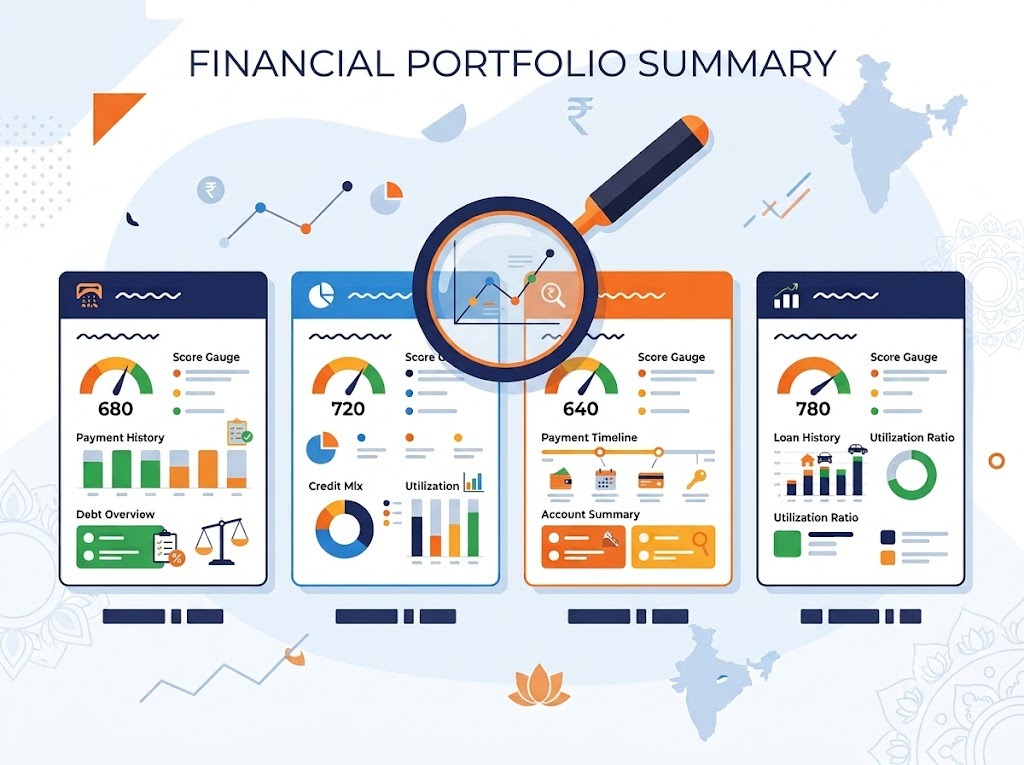
Three real ways to see your own number, no cost involved.
- The official route. CIBIL.com gives you one free full report per calendar year. You'll need your PAN and basic KYC details, and OTP verification takes a few minutes. It's a legitimate, genuinely free option, not a hassle to avoid.
- Your bank's own app. Most major bank apps now show a free score check built right in.
- FREED's Credit Insights. This pulls an Experian-based report instead of CIBIL's. It's open to anyone, whether or not you're already a FREED customer, with no income floor or score minimum required to check it.
One fear worth killing outright: checking your own score is always a soft enquiry. It has zero impact on your number, no matter how often you check. Only a hard enquiry, triggered when a lender pulls your report because you applied for something, can affect your score
The right holds across all four bureaus too, not just CIBIL. One free full report a year, from each one, under RBI's current rule.
Want to see what a specific action would do to your number, not just where you stand today? The CIBIL Impact Simulator below runs that for you.

What the Law Says
RBI's Master Direction requires lenders to report your credit data to bureaus at least every 15 days and gives every borrower one free full credit report per bureau each calendar year.
Check your optionsHow FREED Helps You Track and Improve Your CIBIL Score
Credit Insights is FREED's own tool for this, and it's open to everyone. You don't need to be enrolled in any FREED program, and there's no minimum income or score to subscribe. It runs ₹249 for a 3-month subscription.
Here's what it gives you: your credit score, what's specifically pulling it down in your case rather than a generic list, and step-by-step recommendations you can actually act on.
Be clear about the boundary here too. Credit Insights can't manually edit or rebuild your score. No legitimate service can. What it does instead is show you exactly where to focus, instead of guessing at it yourself.
It pulls from Experian, not CIBIL, tying back to the bureau breakdown earlier. And correcting a genuine error is free and doesn't need FREED at all; that's always the first thing to try.
If what Credit Insights turns up points to something heavier than habits, an EMI load that's genuinely become unmanageable, FREED's Debt Consolidation Program or Loan Settlement Plan exists as a separate, further option, depending on whether repayment is still possible for you.
Tips to Build and Protect a Good CIBIL Score
Understanding what CIBIL is gets you halfway there. The rest comes down to a handful of habits, kept up over months, not a quick fix.
- Pay every EMI and card bill on time. Still the single biggest factor in your score.
- Keep utilisation under 30% of your total available limit across all cards.
- Don't close your oldest credit account just because you've stopped using it. Age matters.
- Space out new credit applications. A cluster of them in a short window reads as stress to a lender, even when it isn't.
- Check your own report every few months, not just when something feels wrong. A self-check never costs you anything.
None of this is complicated. It's just consistency, applied for longer than most people expect.
Sources
Claim | Source |
Lenders must report credit data to bureaus at least every 15 days (fortnightly, on the 15th and last day of each month), and every borrower gets one free full credit report per bureau each calendar year | RBI Notification RBI/2024-25/60, DoR.FIN.REC.No.32/20.16.056/2024-25, "Frequency of Reporting of Credit Information by Credit Institutions to Credit Information Companies," dated August 8, 2024: https://www.rbi.org.in/Scripts/NotificationUser.aspx?Id=12718&Mode=0 (verified live, full text fetched and confirmed to match exactly) |

Mohit Juneja
Mohit Juneja writes educational content at FREED on debt management, credit scores, loan repayment, and borrowing best practices. His content is shaped by expert insights and industry knowledge, helping readers better understand their financial options and make informed decisions.
mohit.juneja@freed.care

FREED is India's trusted loan management platform. Founded in 2020 and headquartered in Gurugram, FREED has counselled 20 lakh+ people on personal loans, credit cards, and app loans. FREED charges fees only on successful settlement, not upfront. FREED does not handle secured loans (home loans, car loans, gold loans).
Media Mentions