Raise Your Credit Score: A Month by Month Action Plan
To raise your credit score, you need to fix report errors first, then lower credit card utilisation, then keep every payment on time going forward, and finally resolve any old settled or written off accounts still dragging the number down. Each of these moves at a different speed.
Mohit Juneja
Reviewed by FREED India, Debt Resolution Specialists
 4.7/5
4.7/5 ₹3,200Cr+
 20,000+
 20,00,000+4.7/5₹3,200Cr+20,000+20,00,000+
Key Takeaways

Raise your credit score by tackling the fastest fixes first, report errors and utilisation, before the slower ones.
Credit bureaus update reports after lenders submit fresh information, and reporting frequency varies by lender.
Payment history is generally considered one of the most important factors lenders evaluate.
Old settled or written off accounts remain part of your credit history and may influence how future lenders assess your credit profile until their status is appropriately updated.
Recovery timelines vary depending on an individual's credit history, repayment behaviour, and lender reporting.
What Does It Actually Mean to Raise Your Credit Score?
Raising your credit score isn't one action, it's a sequence of smaller ones, and each works at its own speed. Some fixes show up in your very next report cycle. Others take months of consistent behaviour before the number moves at all. That's not a flaw in the system, it's simply how credit bureaus are built: they're tracking a pattern of behaviour over time, not reacting to any single good decision the moment you make it.
This is worth saying plainly, because a lot of the frustration people feel around their credit score comes from expecting a quick fix that doesn't exist. There's no single trick, no app, no phone call that jumps your score by 100 points in a week. What actually works is a realistic sequence, and it looks roughly like this: fix what's immediately fixable, build habits that compound quietly over the following months, and separately resolve any old account still sitting on your report that's dragging the number down no matter how well you behave going forward.
Think of it less like flipping a switch and more like turning a large ship. The direction changes the moment you act, but the visible distance travelled takes time to show. Someone starting from a badly damaged score, say in the low 600s or below, is looking at a longer runway than someone whose score dipped slightly from one missed payment. Both are recoverable, but the timeline and the specific steps involved differ.
This blog walks through that sequence month by month, starting with what to do in week one, moving through the mid-recovery stretch where old debt often becomes the real bottleneck, and ending with what keeps your score climbing once it's finally moving in the right direction. Read it in order. Each stage genuinely builds on the one before it.

Want to know exactly where your score stands right now?
Get a clear picture before you start the plan.
Check My CreditWhy Does Your Score Drop in the First Place?
Before fixing anything, it helps to understand what actually pulls a score down, and none of this is really about being a "bad" borrower. Most drops trace back to a small, repeatable set of patterns, and recognising which one applies to you changes where you should focus first.
Missed EMIs are the single most direct cause. A missed payment may affect how future lenders assess your credit profile.
High credit utilisation, meaning how much of your available credit card limit you're actually using each month, is the second major driver. Someone using ₹45,000 of a ₹50,000 limit is sending a very different signal to lenders than someone using ₹10,000 of that same limit, even if both pay their bill in full every month. High utilisation reads as financial stress, whether or not that's actually the case.
Applying for too many loans or cards in a short window adds a third layer. Multiple loan or credit card applications create multiple hard enquiries that future lenders may consider during credit assessments.
And finally, old unresolved accounts, a settled or written off loan still marked as such on your report, keep weighing the score down long after the original issue is behind you in your day-to-day life. This is the one people most often forget about, since it feels like the past, but the bureau doesn't see it that way until the record itself is updated.
Most people reading this are dealing with more than one of these at once. That's normal, and it's exactly why this plan is structured in stages rather than as a single checklist.
Month 1: What to Fix First
Start here, in order, and don't skip ahead even if one step feels more urgent than another. The sequence matters.
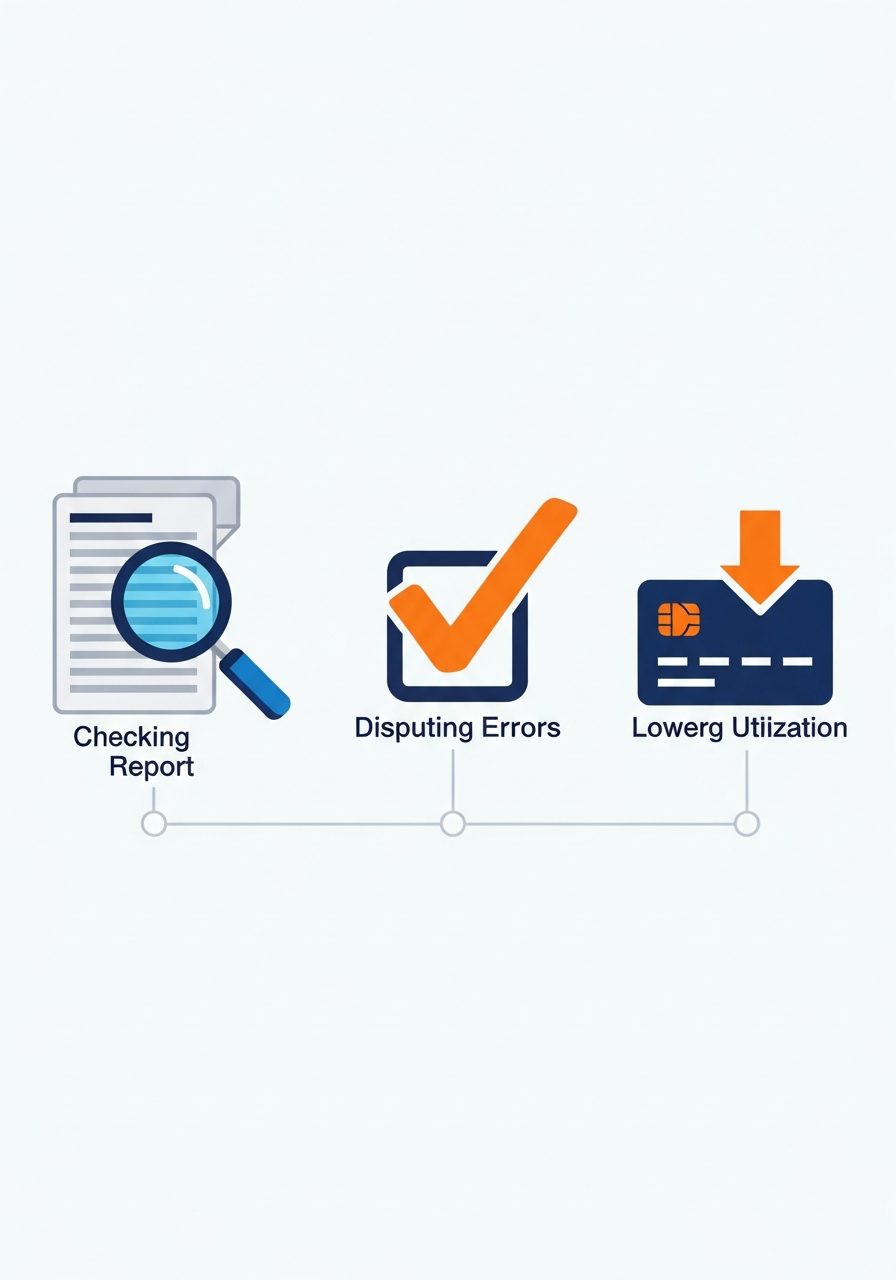
- Pull your CIBIL report. You genuinely can't fix what you haven't looked at. Get your current, full report, not just the three-digit score, and read through every account listed on it, including old ones you'd forgotten about.
- Check for errors and dispute them. This step alone recovers meaningful ground for a surprising number of people. Look specifically for accounts that aren't yours, a loan marked active that you actually closed two years ago, a payment marked late that you know you made on time, or a co-applicant loan you're not actually responsible for. Raise a formal dispute with the bureau for anything incorrect, and keep a written record of when you filed it.
- Calculate your current utilisation. Add up your outstanding balances across every credit card and divide by your total combined limit across those cards. Maintaining responsible credit utilisation is generally considered good credit practice.
- Pay down your highest-utilisation balance first, not necessarily your highest-amount balance. If you're carrying ₹20,000 on a card with a ₹25,000 limit (80% utilisation) and ₹30,000 on a card with a ₹1,00,000 limit (30% utilisation), the first card is doing more damage per rupee paid down, even though its balance is smaller in absolute terms.
These four steps are the fastest realistic levers available to you, and they're the ones most likely to show visible movement in your very next report cycle.

What the Law Says
You're entitled to one free credit report per year from each bureau, CIBIL, Experian, Equifax, and CRIF High Mark.
Check My ScoreMonths 2 to 3: Building the Habit
Once the immediate fixes from Month 1 are underway, this stretch is about consistency, not new dramatic actions. This is often the least exciting part of the whole plan, and also the part most people quietly abandon, which is exactly why it's worth calling out explicitly.
- Automate your EMI and credit card payments. A missed payment because you simply forgot the date is the single most avoidable mistake in this entire process, and it's disproportionately common. Set up auto-debit through your bank wherever it's available, for every recurring payment, not just the ones you consider important.
- Avoid new loan applications during this window. It's tempting to "diversify" or take on a small loan to show activity, but every application is a hard enquiry, and stacking several close together works directly against the recovery you're trying to build. Let this window pass with zero new applications if you can manage it.
- Keep old accounts open, even ones you barely use. Keeping long-standing accounts open may contribute to a longer credit history, which lenders may consider during credit assessment. Closing it removes both benefits at once.
- Track your report every cycle, not just once. CIBIL and other bureaus typically update every 30 to 45 days, so checking monthly, rather than waiting for a big milestone, lets you catch a new issue, a fresh error, a payment that didn't get reported correctly, while it's still easy to fix.
This is the quietest stretch of the plan, and the one most people underestimate. Consistency here, month after month with no dramatic action, is genuinely what compounds into the score improvement you're aiming for by Month 6.
Months 4 to 6: What Still Needs Work
By this point, if you've corrected errors and brought your utilisation down and kept up consistent payments, you should start seeing some real movement in your score. But there's one category of problem that habits alone don't fix, no matter how long you wait: an old settled or written off account still sitting on your report.
Here's why this matters so much, and why it trips up so many people who are otherwise doing everything right. Paying every EMI on time for six straight months is genuinely good behaviour, and the bureau does register it. An unresolved settled or written-off account remains part of your credit history and may continue to influence future lending decisions. It doesn't fade with time just because the original event is behind you, and it doesn't average out against your good new habits. It sits there as its own separate weight until the record itself is corrected.
This is genuinely the stage where a lot of people get stuck without realising why. They've done the report check, fixed the errors, brought utilisation down, automated payments, and three or four months later the score has crept up only marginally, if at all. Almost always, when this happens, there's an old account in the background still marked incorrectly or still sitting unresolved.
If that's your situation, this is the point to shift your attention specifically toward that account rather than assuming more months of good behaviour will eventually outweigh it. Confirm exactly what's showing on your report for that account, its current status, the amount, when it was settled or written off, and start looking into what it would actually take to get the correct, updated status reflected. This is a fundamentally different kind of fix than anything in Months 1 through 3. It usually needs a deliberate, active step, not just patience.
What If Your Score Still Isn't Moving After 6 Months?
Situation After 6 Months
Situation After 6 Months | Likely Cause | Right Next Step |
Score still flat despite good habits | Old settled or written off account still open | Resolve the account, then let CIBIL update |
Score rising slowly but EMIs feel heavy | Multiple loans stretching the budget | Consider consolidating into one lower EMI |
Score rising steadily | Habits are working | Stay consistent, avoid new credit applications |
Score dropped again | A new missed payment or hard enquiry | Get current immediately, avoid further applications |
FREED is not a Loan Provider and cannot guarantee any specific score increase. Results depend on your credit history and the bank's reporting timeline.
The table above is really a diagnostic tool, not just a status update. Two of the four rows, an old unresolved account and multiple stretched EMIs, point toward specific, concrete next steps that go beyond just "keep doing what you're doing." The third row confirms you're on track and should simply stay the course. The fourth is a warning sign that something new has gone wrong and needs immediate attention before the rest of the plan can work again. Take a moment to honestly place yourself in one of these four rows before moving forward, since the right next step genuinely differs depending on which one applies.
Are You in a Loan Trap? Quick Check
Move the slider to your total EMIs as a % of monthly salary. See your debt stress level instantly.
EMIs as % of Monthly Salary
How FREED Helps When Old Debt Is Blocking Your Score Recovery
If Months 4 to 6 revealed an old settled or written off account that's still continuing to influence your credit profile. , this is where FREED's role becomes genuinely relevant, and it's worth being precise about which situation calls for which program, since they're built for two entirely different problems and shouldn't be confused with each other.
Settlement is not something a borrower chooses out of preference. For an old account that's already gone to settlement or write-off status, where the borrower was not, at the time, in a position to repay the full original amount, FREED's in-house team works directly with the lender to negotiate a formal settlement agreement on the borrower's behalf. Once that agreement is reached and honoured, FREED follows up specifically to ensure CIBIL reflects the corrected, updated status, which is exactly the piece that habits alone can't fix, since no amount of on-time payment on other accounts changes what's recorded against this one until the record itself is updated. This path is specifically for debt that's already gone unresolved into default or settlement, not for someone who is current on every payment.
Debt Consolidation may combine eligible debts into a single repayment, depending on the approved loan terms, repayment behaviour, and lender reporting. Unlike the settlement path, this route does not hurt the CIBIL score, and it tends to help it improve over time as the borrower's history shifts toward one clean, consistently paid account instead of several scattered ones.
It's worth repeating plainly: these are two different programs for two different situations, an old unresolved default versus a current-but-overstretched borrower, and neither should be assumed to cover the other's use case. Both work on a success-based fee structure, meaning there's no cost to the borrower unless FREED's team is actually able to help resolve the specific situation they were brought in for.
Old settled or written off loan still open on your report?
See how FREED can help resolve it properly.
Book My Free Call
What Helps You Stay on Track Once Your Score Starts Improving
Once your score starts genuinely moving in the right direction, the goal quietly shifts from fixing problems to protecting the progress you've already made, and this stage deserves just as much attention as the earlier fixes, even though it feels less urgent.
Keep your utilisation low every single month, not just in the specific month you happened to check your report before applying for something. Treat the 30% threshold as a standing rule for how you use your cards, not a one-time correction you make and then forget.
Resist the urge to close old accounts once your score improves, even accounts you barely use anymore. A longer average credit history and more total available credit both work in your favour, and closing an account undoes both benefits immediately, sometimes causing a small dip right after you've finally started seeing progress.
Check your report on a quarterly rhythm rather than either ignoring it for a year or checking it anxiously every week. Quarterly is frequent enough to catch a new error, a stalled update, or an account that's slipped back into a problem status, without turning report-checking into a source of ongoing stress.
And avoid taking on new credit just to "look active" or diversify your credit mix, a piece of advice that circulates a lot but doesn't hold up well in practice. A stable, steadily improving score doesn't need new activity to keep climbing. It needs the same consistent, unglamorous behaviour that got it moving in the first place, sustained for long enough that it simply becomes how you manage credit, not a temporary project you're working through.

Mohit Juneja
Mohit Juneja writes educational content at FREED on debt management, credit scores, loan repayment, and borrowing best practices. His content is shaped by expert insights and industry knowledge, helping readers better understand their financial options and make informed decisions.
mohit.juneja@freed.care

FREED is India's trusted loan management platform. Founded in 2020 and headquartered in Gurugram, FREED has counselled 20 lakh+ people on personal loans, credit cards, and app loans. FREED charges fees only on successful settlement, not upfront. FREED does not handle secured loans (home loans, car loans, gold loans).
Media Mentions