Low CIBIL Score: Why It Happens, What It Costs You, and How to Fix It
A low CIBIL score generally means a three-digit number under 650, on the 300 to 900 scale kept by TransUnion CIBIL. It tells banks that your repayment history carries some risk, which makes loan approvals harder and interest rates higher. Bureaus typically group lower scores into bands like "poor" and "below average," but the exact cutoffs can vary by lender and by bureau. Both are fixable with the right steps.
Mohit Juneja
Reviewed by FREED India, Debt Resolution Specialists
 4.7/5
4.7/5 ₹3,200Cr+
 20,000+
 20,00,000+4.7/5₹3,200Cr+20,000+20,00,000+
KEY TAKEAWAYS

A CIBIL score below 650 leads to loan rejections or much higher interest rates on personal loans, credit cards, and most unsecured credit.
Payment history and credit utilisation are among the important factors considered when assessing a credit profile. A few missed EMIs can pull your score down noticeably
Credit utilisation above 30% of your total limit is the second most common reason for a low CIBIL score.
A "Settled" status can pull your score down noticeably and stays on your report for up to 7 years.
Paying on time, lowering your credit utilisation, and avoiding new loan applications can show real improvement within 6 to 12 months.
What Is Considered a Low CIBIL Score in India?
Your CIBIL score sits somewhere between 300 and 900. Where you fall on that scale decides how banks treat your loan application.
A score between 300 and 549 is called poor. At this level, most unsecured credit, personal loans, and credit cards, gets rejected outright by mainstream banks.
A score between 550 and 649 is below average. You may still get approved, but banks charge more for the risk. Data from Shriram Finance shows borrowers in this band can pay interest rates of 18% to 22% per year, well above what a strong-score borrower pays.
A score between 650 and 749 is the grey zone. Most banks will consider you, but often at a higher rate or a smaller loan amount than you asked for.
Many lenders generally prefer applicants with stronger credit profiles, although eligibility varies by institution."At this level, you usually get the best rates and the fastest approvals.
Knowing exactly where you sit on this scale is the first step. It tells you whether you're a small fix away from a better rate, or whether you need a longer plan to climb back up.

Not sure where your score stands?
FREED's Credit Insights pulls your Experian report and breaks down exactly what's pulling your score down.
Check Your ScoreWhat Causes a Low CIBIL Score?
Most people don't miss an EMI because they want to. Life gets in the way, a job loss, a medical bill, a slow month. Here are the reasons your score drops, in order of how much damage each one does.
Payment history is one of the biggest factors in your score. Even a few EMIs slipping over a few months, or entries showing Days Past Due (DPD, how many days a payment is overdue), can bring your score down in a real way.
High credit utilisation comes next, carrying 30% weight. If you're regularly using more than 30% of your total credit limit across all cards, this alone can keep your score low even if you pay every bill on time.
Too many hard enquiries in a short window is next. Every time you apply for a loan and get rejected, that rejection itself lowers your score a little further.
An unsecured-heavy credit mix, several personal loans and cards with no secured loan to balance it, can also weigh on your score.
A "Settled" or "Written Off" tag on any account causes a serious drop, according to Bajaj Finserv Markets data.
Finally, report errors, a paid loan still showing as active, or an account that isn't even yours, can pull your score down by 50 to 100 points without you doing anything wrong.
The good news is most of these causes are fixable, and knowing yours is the first step.

FREED Expert Tip
Not sure what's pulling your score down? FREED's Credit Insights pulls your Experian report and gives you a step-by-step breakdown of exactly which accounts are hurting you most.
Check your Credit Insights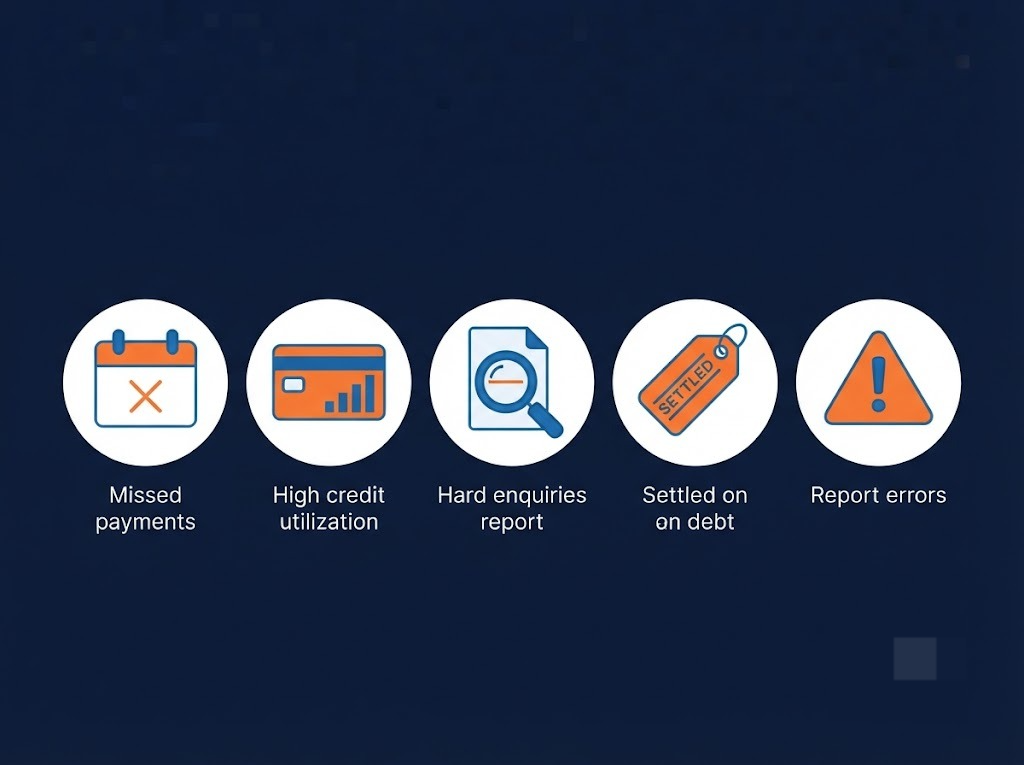
What Are the Real Risks of Having a Low CIBIL Score?
A low score isn't just a number. It shows up in your wallet, month after month.
The most obvious risk is loan rejection, especially for personal loans and credit cards, where banks lean heavily on the score to decide fast.
If you do get approved, expect a higher interest rate. Borrowers with scores below 650 may pay 18% to 22% per year on a personal loan, against roughly 12% for a strong-score borrower. On a loan of ₹3 lakh, that gap alone can add tens of thousands of rupees in extra interest over the loan's life.
Home loans are hit hard too. Bajaj Housing Finance data shows borrowers below 650 may be offered financing of only around 40% of the property's value, against the standard 75% to 80% for well-scored borrowers. That means arranging a much larger down payment yourself.
Banks also apply stricter eligibility checks and may cut your existing credit card limit if your score drops while you hold the card.
The most painful part is how this compounds. Applying for a loan despite a low score leads to a hard enquiry. Each new application creates a hard enquiry that becomes part of your credit history. This makes your next application even harder to get approved. One rejection can snowball into several, each one a little worse than the last.
FREED finds at least one error in roughly 4 out of 10 CIBIL reports it reviews, so before assuming the worst, it's worth checking if part of your score drop is even accurate.
Don't know what's pulling your score down?
FREED's Credit Insights shows your full credit picture with step-by-step fixes.
Check Your ScoreWhat Are the Most Common Mistakes That Keep Scores Low?
Some habits quietly keep a score stuck low, even when you think you're doing the right things. These aren't obvious traps, but they are traps.
Paying only the minimum due on a credit card feels responsible, but the rest of the balance rolls forward and collects interest of 30% to 42% per year, according to Finnovate. Maintaining a high outstanding balance may affect how lenders assess your credit profile
Closing old credit cards feels like tidying up, but it does the opposite of what you want. It shortens your credit history and instantly raises your utilisation ratio on your remaining cards, since your total available limit just shrank.
Applying for multiple loans right after a rejection is a natural reaction, you want an answer fast. But every fresh application is a hard enquiry, and a string of them in a short window signals credit hunger to banks, not stability.
Ignoring a report error because the dispute process looks complicated is common, but it means living with a score that's lower than it should be, for no real reason.
Taking a new personal loan to pay off a credit card, without checking whether consolidating all your debts into one lower EMI would serve you better, can also leave you juggling more accounts than you need to.

What the Law Says
Under RBI's 2025 guidelines on credit information reporting, banks and financial companies must inform borrowers if a loan is rejected due to a low or inaccurate CIBIL score. You have the right to know the reason.
Read more about your rightsHow Do You Fix a Low CIBIL Score?
Fixing a low score works best when you tackle it in the right order, fastest wins first.
Start by fixing report errors. This is the quickest lever you have. CIBIL must resolve a dispute within 30 days, and your score usually reflects the correction within 5 to 7 days after that. If an error is dragging your score down, this alone can lift it without you changing a single habit.
Stop applying for new credit immediately. Every fresh application is a hard enquiry, and each one nudges your score lower while you're trying to recover.
Pay every due on time from this point forward, including the minimum due on every card. This protects your score while you work on the rest.
Bring your credit utilisation below 30% by paying down your card balances. If your spending can't come down right now, ask your bank for a credit limit increase, this alone lowers your utilisation ratio without changing your spending.
Avoid closing old accounts. A card you've held for years, paid on time, strengthens your credit history. Closing it does the opposite.
Build a better credit mix over time, a healthy balance of secured and unsecured credit, as your situation allows.
Your score updates as banks report to the bureau, generally on the 15th and the last day of each month. Consistent, responsible repayment behaviour is what moves your score over time. Note that settlement is not a fix here, it moves the score in the wrong direction, which is covered in the section below.
What If a Low Score Is Caused by Too Much Debt?
Sometimes a low score isn't about one habit. It's about carrying too many EMIs at once.
If you're still paying every EMI, but barely, your score is likely low because your utilisation is high and you're one unexpected expense away from a missed payment. If your total EMIs already eat up more than 50% of your take-home salary, that's a sign the real problem is structural, not behavioural. Individually paying on time and lowering utilisation helps, but it doesn't fix an EMI load that's too heavy to carry long-term.
This is exactly where debt consolidation can help. FREED's Debt Consolidation Program brings all your existing eligible loans and credit card dues together into one new loan, at a lower EMI, from one bank, on one date. Debt Consolidation may simplify repayments for eligible borrowers, depending on repayment behaviour and lender reporting.
If instead you've already missed EMIs and genuinely cannot repay what you owe, the picture is different. Settlement is not something a borrower chooses out of preference. Banks and financial companies only consider it when you are in genuine financial difficulty and are truly unable to repay the full amount.
FREED helps borrowers settle their unpaid/overdue loans at up to 50% less*. *, through a structured savings process. The account is reported as 'Settled' on your credit report. The reporting period is determined by the credit bureau's policies.
*Rates and ranges shown are indicative. Final terms decided by the bank. FREED is not a Loan Provider. No outcome is guaranteed. Please verify directly with your bank.
Are You in a Loan Trap? Quick Check
Move the slider to your total EMIs as a % of monthly salary. See your debt stress level instantly.
EMIs as % of Monthly Salary
How to Fix a Low CIBIL Score
- 1
Pull your latest credit report and read it carefully.
Go to cibil.com or use FREED's Credit Insights to get your Experian report. Look line by line for errors, wrong tags, or accounts you don't recognise, this is your starting map.
- 2
Dispute every error you find.
File a dispute at cibil.com. CIBIL must resolve it within 30 days, and your score reflects the correction 5 to 7 days after that. This step alone can recover points you never actually lost fairly.
- 3
Stop applying for new credit immediately.
Every fresh application triggers a hard enquiry that lowers your score further. Pause all applications until your score has had time to recover.
- 4
Pay every existing due on time, starting now.
Even minimum due payments protect your score from further damage. Set up auto-pay or a reminder so nothing slips through while you're focused on the fix.
- 5
Bring your credit card utilisation below 30%.
Pay down balances before your billing date each month. If your spending can't come down, ask your bank for a credit limit increase, this reduces your utilisation ratio right away.
- 6
Do not close old credit accounts.
Old accounts with a clean repayment history add to your credit age, one of the things that strengthens your score. Closing them shortens your history and can spike your utilisation on the cards left behind.
- 7
If multiple EMIs are the root problem, talk to FREED.
FREED's team can assess whether debt consolidation can lower your total EMI and stabilise your score before it drops any further.
Low CIBIL Score: Cause, Impact, and Fix
Cause | Score Impact | Fix |
Missed or late EMI payments | High, DPD entries stay on report | Pay every due on time going forward; older late payments fade with consistent good behaviour |
High credit utilisation (above 30%) | Medium to high, visible every month | Pay down card balances; keep spending under 30% of your total limit |
Too many hard enquiries | Low to medium, each enquiry dips the score slightly | Stop applying for new credit; space out future applications |
"Settled" account tag | High, 75 to 150 point drop, stays up to 7 years | Cannot be removed if genuine; rebuild through consistent payments on other accounts |
Report error from a bank | Medium to high, 50 to 100 point drop possible | File a dispute at cibil.com; resolved within 30 days |
No credit history | Score shows as NH or NA | Build credit with a secured credit card or small personal loan; repay on time |
This table is worth sitting with for a minute. Notice that only two rows, a settled tag and a report error, cause damage in a single event. Everything else builds up slowly, which also means it can be undone slowly, with the right habits.
Sources
Claim | Source |
CIBIL disputes must be resolved within 30 calendar days | RBI Master Direction – Credit Information Reporting Directions, 2025 (rbidocs.rbi.org.in PDF) |
Credit bureaus update records on the 15th and last day of each month | RBI Master Direction – Credit Information Reporting Directions, 2025 (rbidocs.rbi.org.in PDF) |
Banks must inform borrowers of the reason for a loan or data-correction rejection | RBI Master Direction – Credit Information Reporting Directions, 2025 (rbidocs.rbi.org.in PDF) |
Note: Interest rate ranges (Shriram Finance), home loan financing share (Bajaj Housing Finance), credit card carry-forward interest (Finnovate), and the "Settled" score-drop range (Bajaj Finserv Markets) are industry data points, not RBI regulation, and are left out of this table per sourcing rules. These are phrased as "may" or "can" in the body rather than as guaranteed figures.

Mohit Juneja
Mohit Juneja writes educational content at FREED on debt management, credit scores, loan repayment, and borrowing best practices. His content is shaped by expert insights and industry knowledge, helping readers better understand their financial options and make informed decisions.
mohit.juneja@freed.care

FREED is India's trusted loan management platform. Founded in 2020 and headquartered in Gurugram, FREED has counselled 20 lakh+ people on personal loans, credit cards, and app loans. FREED charges fees only on successful settlement, not upfront. FREED does not handle secured loans (home loans, car loans, gold loans).
Media Mentions