Single Debt Management: Combining Dues Into One Plan
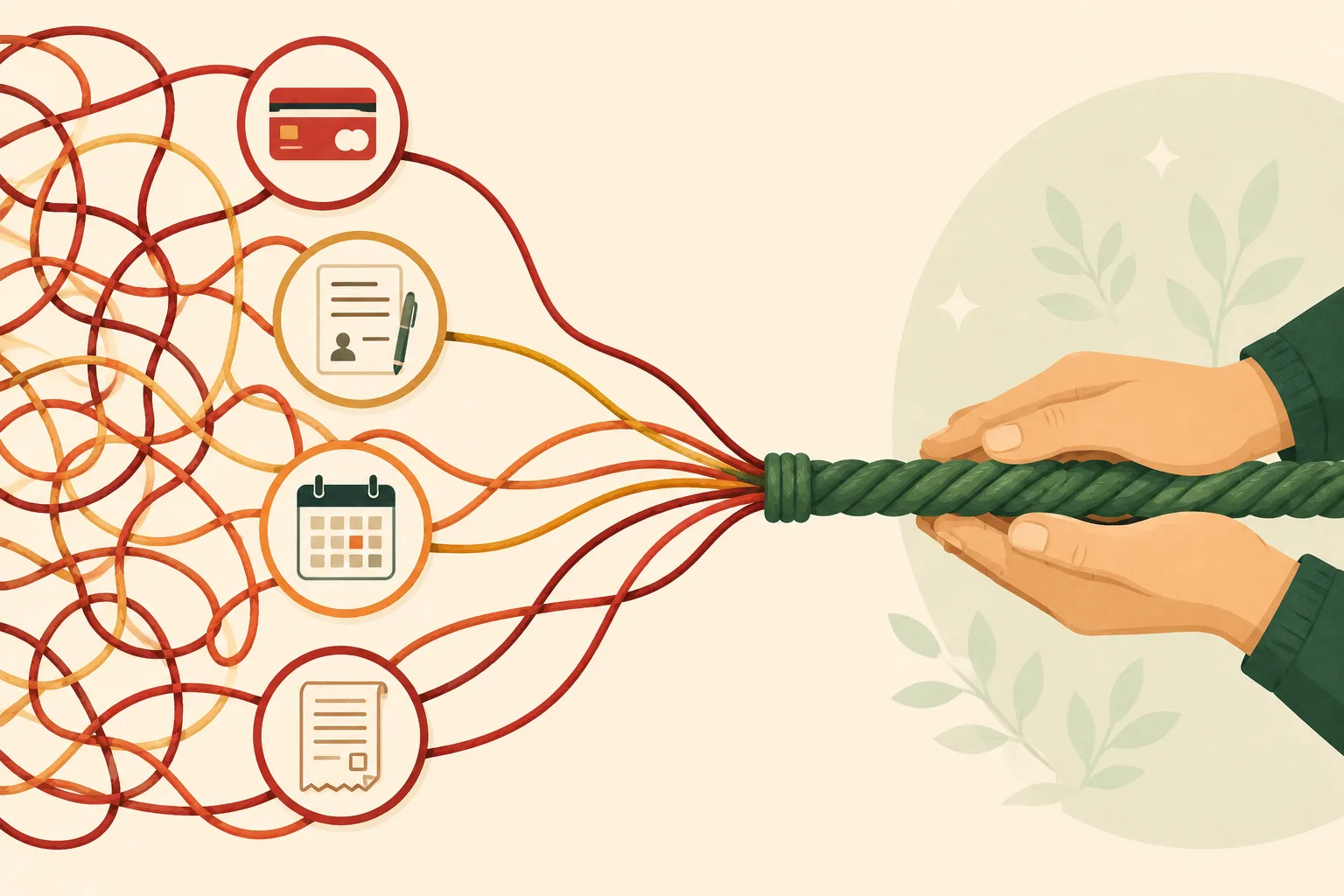
Single debt management is handling all your dues through one plan, with one list, one order of repayment and, where it fits, one EMI. It can mean planning on your own, asking a bank to change a loan plan, or taking one new loan that pays off the rest.
Mohit Juneja
Reviewed by FREED India, Debt Resolution Specialists
 4.7/5
 ₹3,200Cr+
 20,000+
 20,00,000+4.7/5₹3,200Cr+20,000+20,00,000+
Key Summary

Single debt management means running all your dues through one plan; there are several routes, not one scheme.
We found no RBI rule that defines a debt management plan in India.
Banks must give a Key Facts Statement with the all-in yearly cost, for retail loans sanctioned from 1 October 2024.
Lenders report to credit bureaus at least every 15 days, so a new plan shows up quickly.
RBI bars prepayment charges on floating-rate personal loans sanctioned or renewed from 1 January 2026.

Juggling Several EMIs Every Month?
FREED’s Loan Consolidation Plan combines multiple loans into one EMI.
Reduce My EMIWhat Is Single Debt Management?
Single debt management means putting all your dues under one plan. Instead of tracking three or four EMIs, each with its own date, rate and bank, you work from one list, in one order, and where it fits, with one monthly payment. It’s the difference between juggling and planning.
Here’s the part many articles skip. Single debt management isn’t a scheme, a product or a licence. In India, we found no RBI rule that defines a “debt management plan”. So there’s no official plan to sign up for. What you’ll find instead is several routes to the same goal, and each suits a different situation. Some you can do alone. Some need a bank’s agreement. One needs a new loan.
A single plan gives you three things:
One list of every due. Each loan, card and BNPL (buy now, pay later) plan, with its EMI, yearly rate and due date. Most people are surprised by what turns up when it’s all in one place.
One order for paying them. You decide which due gets extra money, rather than letting each bank’s reminder decide for you.
Where it fits, one EMI instead of several. Not every situation needs this, and it isn’t always the cheapest route. The next sections explain when it helps.
This guide covers unsecured loans, cards and BNPL. Secured loans such as home or car loans follow different rules, so the steps here won’t apply to them.
A good starting point is understanding where planning ends and other help begins. Here’s what credit counselling can and can’t do. And for the basics of the idea, see what debt management is.
FREED’s Loan Consolidation Plan is one route to a single EMI, and we’ll explain how it fits later on. First, which routes are open to you?
What Are the Ways to Combine Your Dues Into One Plan?
Each route fits a different situation, and some combine well. Here’s how they compare:
Route | What you get | Who it suits | Credit report effect |
|---|---|---|---|
Your own payoff plan | One list and one order | Paying on time, able to pay a bit more | None directly; on-time payments help |
Loan consolidation | One new loan, one EMI; old loans closed | Still paying, EMIs too heavy | Old accounts close, one new account; score tends to improve |
Card balance transfer | One card’s balance moved to a new offer | Card debt only | New card account; check the transfer terms |
Ask your bank to change a loan plan | Same loan, new schedule | One bank’s loan | Bank-specific; ask how it will be reported |
Credit counselling | Help to plan | Unsure where to start | None; it isn’t credit |
Settlement (last resort) | A reduced final amount agreed with each bank | Genuinely can’t repay in full | “Settled” for up to 7 years |
This is a general guide. Terms vary by bank and loan.
A few things to keep in mind as you read the table:
Most people start with the first row, then add a route if the numbers don’t work. A payoff plan costs nothing to try. If your EMIs are still too heavy after it, that’s when a second route makes sense.
Only one route produces one EMI: a new loan that pays off the old ones. That’s consolidation. The others help you manage several dues better, but you still pay several.
Settlement is the last row for a reason. It’s for people who genuinely can’t repay in full, and it isn’t a way to combine dues. It leaves a lasting mark on your report.
For how consolidation works in detail, here’s what loan consolidation is. If your debt is mostly on cards, see how a balance transfer credit card works in India. And for the full step-by-step on consolidating, there’s a guide to consolidating debt into one payment.
Whichever route you pick, start with the same thing: a one-page sheet of what you owe.
Not Sure What You Can Afford Each Month?
See how much of your salary your EMIs take.
Check My EMI ScoreHow to Build a Single Debt Management Plan on One Page
A single debt management plan starts with one sheet of paper, or one note on your phone. It takes about half an hour, and it shows you more than a month of reminders ever will.
Your sheet needs six columns: lender name, what you still owe, EMI or minimum due, yearly interest rate, due date, and any late fee. Then follow these 5 steps:
List every due. Include BNPL plans and small app loans. These are the ones people forget.
Add up the EMIs and minimum dues. That’s what leaves your account each month.
Divide the total by your take-home salary. If it’s above half, you’re carrying a heavy load.
Mark the highest-rate due. That one costs you the most every month, even if its EMI looks small.
Decide the route from the table above. The numbers on your sheet usually point to it.
Here’s how it looks with real figures. Say your take-home pay is ₹36,000, and your sheet reads like this:
Due | You owe | EMI or minimum | Yearly rate | Monthly interest |
|---|---|---|---|---|
Personal loan A | ₹2,00,000 | ₹9,500 | 16% | about ₹2,667 |
Credit card B | ₹90,000 | ₹4,500 | 40% | ₹3,000 |
Personal loan C | ₹1,20,000 | ₹6,000 | 18% | ₹1,800 |
Total | ₹4,10,000 | ₹20,000 | about ₹7,467 |
Your EMIs and minimum dues add up to ₹20,000, which is about 56% of your ₹36,000 salary. That means more than half of the monthly take-home pay is already committed to debt repayments, leaving less room for household expenses and unexpected costs. And look at the last column. The card has the smallest balance of the three, but it costs you the most in interest each month, because of its 40% rate.
This example is illustrative. Rates and figures are for explanation only.
That’s the kind of insight the sheet gives you. In this case, an own plan would put every spare rupee on the card first. Here’s how the snowball and avalanche methods compare for choosing an order. But with 56% of salary already committed, a payoff order alone may not leave enough room. So when does combining everything into one loan make sense?

FREED Expert Tip
Write down every due on one page before calling anyone, including small BNPL and app loans. Missing one makes any plan too tight.
Reduce My EMIWhen Does Combining Dues Into One Loan Make Sense?
Combining dues into one loan is for people who can still repay, but need a smarter way to manage their debt. Think of someone who pays every EMI on time, but finds the load heavy and the dates hard to track. Here’s how common situations line up:
Your situation | Better route | What to know |
|---|---|---|
Paying every EMI, but they take over half your take-home pay | Consolidation | One EMI; score tends to improve |
Paying on time, high rate on one card | Balance transfer | Check fees and the offer period |
Paying on time, can pay a bit more | Own payoff plan | Start with the highest rate |
Missed one or two EMIs | Talk to FREED’s team about your options | Consolidation isn’t suggested after default |
Can’t repay in full | A different path; see the section on missed EMIs below | Settlement is a last resort |
This is a general guide. Your loan terms and bank’s rules decide the details.
A few points to weigh:
If EMIs take over half your take-home pay, one lower EMI may help. Half is a rough warning line, not a rule. If you’re at 55%, you have less room for a bad month.
Consolidation doesn’t drop your credit score, and it tends to improve it. Old accounts show as closed after payoff, and the new loan builds fresh on-time history. That’s very different from settlement, which leaves a “Settled” mark.
A lower EMI over a longer time can cost more overall. A smaller monthly amount feels lighter, but extra months add extra interest. Look at the total you’ll pay, not just the EMI.
For the effect on your score in more detail, here’s how debt consolidation affects your credit score.
If you’re unsure whether you qualify, FREED’s team can assess your situation and let you know what options are available.
Planning Which EMI Fits Your Salary?
See how much EMI your salary can comfortably carry.
Check My EMI ScoreWhat Does Combining Dues Do to Your Credit Report?
When you combine dues with a consolidation loan, your report changes in a predictable way. The old accounts show as closed after payoff, and a new account appears. Credit institutions now submit credit information on four reference dates each month: the 9th, 16th, 23rd and the last day of the month, or at shorter intervals agreed with the credit bureau. The date an update becomes visible can also depend on the bureau’s processing time.
Here’s how to keep an eye on it:
Check your report before you start, and again about 4 to 6 weeks after. The first check shows what’s on file. The second confirms the old accounts show as closed, with nothing left outstanding.
You’re entitled to one free full report per bureau per year. RBI requires every bureau to provide it. Here’s how to get your free annual credit report.
A consolidation doesn’t mark an account “Settled”. Settled is a status for loans paid for less than the full amount. A consolidation pays the old loans in full.
A missed EMI on the new loan hurts just as much as a missed EMI on an old one. One new loan means one new thing to protect. Set a reminder for the date.
For more on what to expect, see how debt consolidation affects your credit score.
If you’d like to see each account’s status in plain words, FREED’s Credit Insights reads your Experian report and refreshes monthly. That makes the before-and-after check easy.
Want to Know Exactly How Your Report Will Look?
Your report in plain words, with steps to rebuild.
Check My Credit InsightsWhat Should You Check Before You Accept a Consolidation Offer?
Say you have an offer for one loan that pays off all the others. It looks simple: one EMI, one date. But the offer is only as good as its terms. Run these 5 checks before you sign:
Ask for the Key Facts Statement (KFS) before you sign. The KFS is a one-page summary of the loan’s cost. RBI requires it for retail loans sanctioned from 1 October 2024, and the bank must explain it to you before the contract is signed.
Read the APR, not just the interest rate. APR is the all-in yearly cost, including charges. It’s the fairest number for comparing offers, and it should appear in the KFS.
Check for fees outside the KFS. Under RBI’s rules, a fee not stated in the KFS can’t be charged without your explicit consent. If something shows up later, ask where it was disclosed.
Check what your old loans charge to close. RBI bars prepayment charges on floating-rate personal non-business loans sanctioned or renewed from 1 January 2026. Many personal loans are fixed-rate, and older loans follow their own agreements, so check each one.
Ask for closure letters and dates for each old loan. You want written proof each one is closed, and a date by which that will happen.
Here’s why this matters in numbers. Say you consolidate ₹3,50,000, and the new loan has a 2% processing fee, which is ₹7,000. One of your old loans has ₹1,00,000 outstanding, with a 3% closure charge in its agreement, which is ₹3,000. Your upfront cost is ₹10,000. Compare that with what you’d save, and with the total you’ll pay over the new loan’s term. A lower EMI doesn’t always mean a cheaper loan.
This example is illustrative. Figures are for explanation only. Final terms decided by the bank.
For more on rates, see our guide to debt consolidation interest rates.

What the Law Says
RBI’s prepayment directions bar banks and NBFCs from charging prepayment fees on eligible floating-rate loans taken by individuals for non-business purposes.
Reduce My EMIWhat Can a Credit Counsellor Do for a Single Debt Plan?
A credit counsellor can help you work through your list, see what you can afford, and pick a route. That’s useful if you’re unsure where to start, or if looking at your own numbers feels overwhelming. Think of it as a second pair of eyes on your sheet.
But be clear about the limit. Counselling helps you plan. It doesn’t, by itself, combine your loans or negotiate with each bank for you.
What it can do. Go through your dues and income, and suggest an order for paying them. It can also explain the routes in this guide and help you choose.
What it can’t do. Change a loan’s terms, or pay off a loan. For that, you need a consolidation loan or your bank’s agreement.
What to ask. Is there a cost, and what happens after the session? A genuine counsellor answers both clearly.
Counselling is where many people begin. When a plan alone isn’t enough, it’s worth knowing what comes after credit counselling. And here’s a plain explanation of how credit counselling works.
A note on cost. RBI says its financial literacy camps are free of charge, but its page doesn’t describe credit counselling. So don’t assume a counselling session is free. Ask upfront.
What If You Have Already Missed EMIs?
If you’ve already missed EMIs, a single plan has to deal with that first. And the honest picture is different from the one above. Settlement may be considered when a borrower is unable to repay the full outstanding amount and the lender is willing to accept a reduced amount as full and final settlement. Approval depends on the lender’s applicable policy and assessment. It is not a guaranteed option.
Here’s what to keep in mind:
Consolidation isn’t suggested after default. A new loan generally needs a clean recent payment record. If you’ve missed EMIs, talk to FREED’s team about your options.
Penal charges on loans must be separate charges. Since 2024, RBI doesn’t allow banks to add penalties to the interest rate, or charge interest on them. Credit cards follow different rules. Ask for a breakdown of what you owe.
Recovery agents can’t call before 8 am or after 7 pm. They also can’t threaten or harass you. The bank stays responsible for its agents.
Keep a log of every call and letter. Date, time, number and what was said. If you complain later, that log is your evidence.
How FREED Shield helps
If you are facing recovery agent harassment, FREED helps you understand your legal rights as a borrower, report inappropriate recovery practices, and raise complaints with your lender. Where harassment is frequent, our experts speak to recovery agents on your behalf. And if you receive a legal notice about your loan, FREED helps you understand your options and draft a suitable reply. FREED Shield is available to everyone, whether or not you’re on a FREED plan.
Legitimate recovery calls continue until the dues are paid or settled. The rules stop harassment, not the bank’s right to ask for its money. Here’s the full RBI complaint process for recovery agent harassment.
If you’re weighing settlement against managing your debts, here’s a plain comparison of settlement versus debt management.
What the Law Says
Under RBI rules, recovery agents can’t call before 8 am or after 7 pm, and they can’t threaten or harass you.
Get FREED Shield SupportWhat Helps Once Your Single Plan Is Running?
A plan only works if you keep it running. Here’s a simple 30, 60 and 90-day rhythm.
First 30 days. Pay every due on its date, and keep your one-page sheet up to date. If you took a new loan, check its first statement against the KFS, to make sure the charges match what you were told.
By day 60. Recheck your credit report. Confirm the old accounts show as closed, and the new one shows correctly. If anything’s wrong, raise it now, while the paperwork is fresh.
By day 90. Review your sheet. If your EMIs now take under half your take-home pay, start building a small emergency fund. Here’s why an emergency fund matters.
Four habits make the plan last:
No new loans while the plan runs. Each one changes your numbers and adds a hard enquiry to your report.
Set reminders for every date. One missed payment can undo weeks of progress.
Keep every letter and email. One folder, on paper and a scan.
Recheck your sheet monthly. It takes ten minutes, and it catches problems early.
FREED’s Credit Insights refreshes monthly, so the day-60 check is easy to repeat.
Want Your Credit Report Checked Again After Day 60?
See how your accounts show now, in plain words.
Check My Credit InsightsHow FREED Helps With Single Debt Management
If most of your salary goes towards paying multiple EMIs, FREED’s Loan Consolidation Plan helps you combine multiple loans into a single monthly EMI. This can reduce your monthly EMI burden by up to 50%.*
That’s the route in the table that produces one EMI. FREED is India’s trusted loan management platform, and over 20 lakh people trust it. Here’s how the Loan Consolidation Plan works:
FREED assesses your financial profile. It looks at your loans, income and repayment record.
FREED matches you to a lending partner from its network. You don’t have to shop around for an offer on your own.
The lending partner disburses one new loan. That loan pays off your existing loans, so they’re cleared in one go.
You’re left with one EMI. One monthly amount, one date, instead of several.
FREED handles the process end to end. You don’t have to chase each old loan’s closure yourself.
Your credit score doesn’t drop because of consolidation, and it tends to improve as you pay the new loan on time.
Use the checks from the section above on the offer you get: the KFS, the APR, and any fees outside it.
If you genuinely cannot repay your loans, FREED negotiates with your lenders to settle them for less than 50%* of your outstanding dues. That’s FREED’s Loan Settlement Plan, and it’s for a different situation from the one in this guide.
FREED handles unsecured loans only, like personal loans, credit cards, BNPL and app loans.
*Rates and ranges shown are indicative. Final terms decided by the bank. FREED is not a Loan Provider. No outcome is guaranteed. Please verify directly with your bank.
Combine Your Loans Into One EMI With FREED
One monthly EMI instead of several, with the process handled for you.
Reduce My EMI
Mohit Juneja
Mohit Juneja is FREED’s Content & Communication Lead with 12+ years of experience across content, media, advertising and digital communications. He holds a postgraduate diploma in Communications from Xavier Institute of Communications, Mumbai, and has worked with organisations including NDTV, The Indian Express, McCann Worldgroup and NABARD.
At FREED, he leads content and communication across loan management, debt resolution, debt consolidation and financial well-being. His work combines research, storytelling and consumer-focused communication to make complex financial topics easier to understand and act on. He has also scripted and produced 11 documentaries on rural development and agriculture for NABARD, with film's selected for the Mumbai International Film Festival.
mohit.juneja@freed.care

FREED is India's trusted loan management platform. Founded in 2020 and headquartered in Gurugram, FREED has counselled 20 lakh+ people on personal loans, credit cards, and app loans. FREED charges fees only on successful settlement, not upfront. FREED does not handle secured loans (home loans, car loans, gold loans).
Media Mentions