Consolidate Debt Into One Payment: Step-by-Step
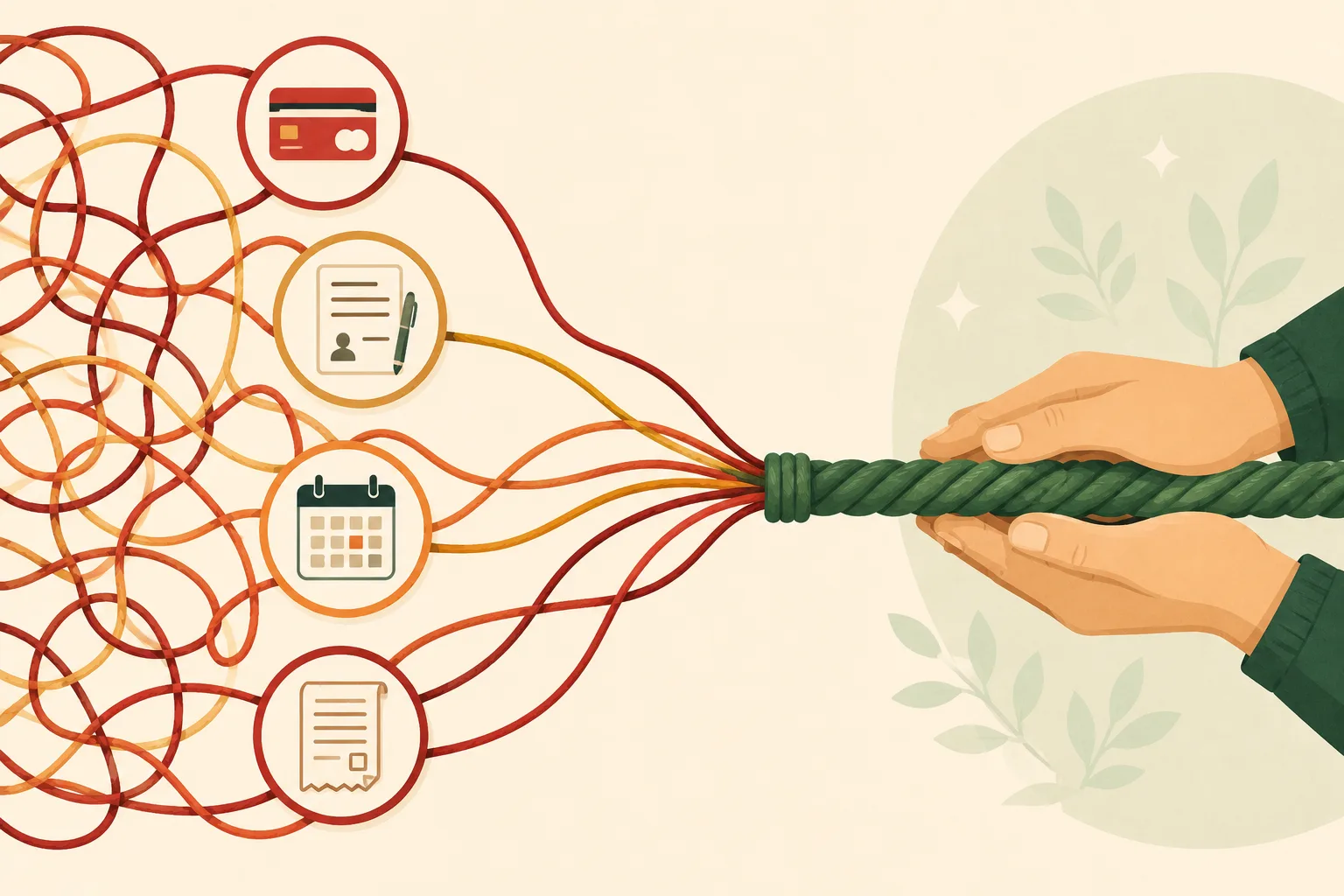
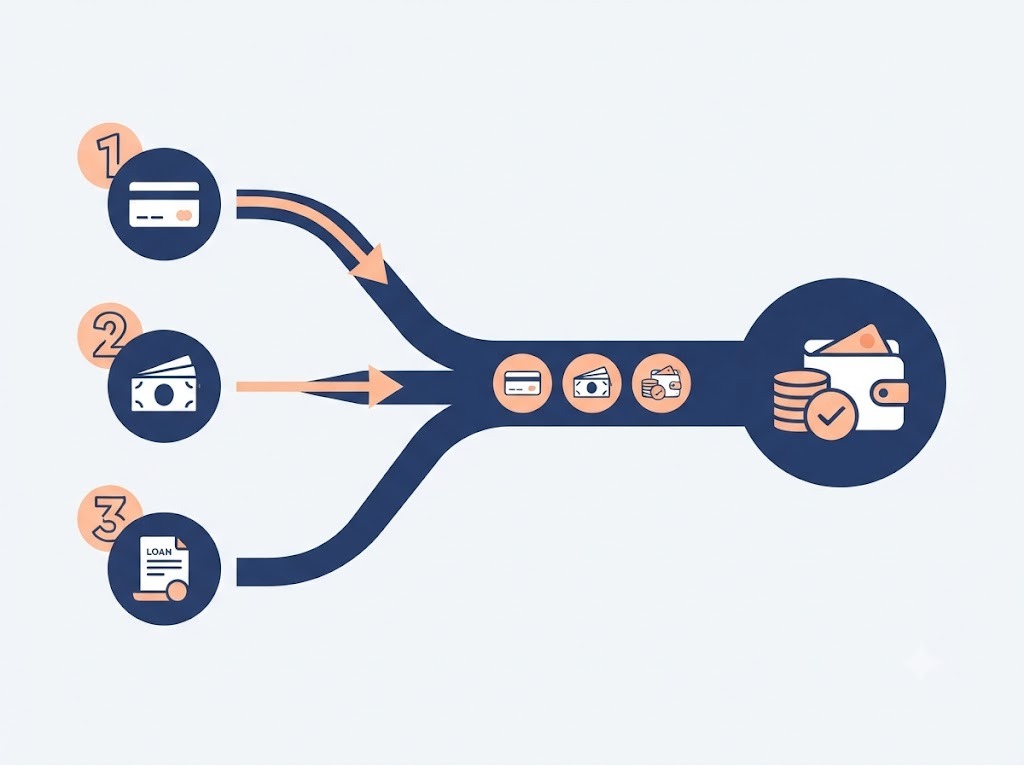
Consolidating debt into one payment means replacing several separate loans or cards, personal loans, credit cards, BNPL, with a single new loan and one monthly EMI. This guide walks through the actual steps using a worked example, so each one is concrete rather than abstract.

Mohit Juneja
Reviewed by Mohit Juneja, Debt Resolution Specialists
 4.7/5
4.7/5 ₹3,200Cr+
 20,000+
 20,00,000+4.7/5₹3,200Cr+20,000+20,00,000+
KEY TAKEAWAYS

Consolidating into one payment means combining your existing unsecured debts into a single new loan with one EMI.
The process runs: list your debts, check eligibility, compare the new loan's real cost, apply, get old debts paid off, confirm closure, start one EMI.
RBI requires credit information to be updated fortnightly from January 1, 2025. However, the time for a paid-off account to appear as closed can vary depending on the lender's reporting and the bureau's processing.
The most avoidable mistake is stopping old payments before confirming the old accounts are actually closed, the second most avoidable is applying to several lenders at once.
The Example We'll Use Throughout This Guide
To make this genuinely useful rather than a generic checklist, one concrete borrower's numbers will carry through every step below.
Say a salaried borrower is currently paying three separate unsecured debts: a personal loan EMI of ₹9,500, a credit card with a ₹4,200 minimum due, and a BNPL instalment of ₹1,800. That's ₹15,500 a month, spread across three different lenders and three different due dates. This is illustrative only, not a guarantee of what your own numbers or outcome will look like, every situation differs based on income, credit profile, and the specific lenders involved.
What loan consolidation actually is worth reading first if you haven't already decided this is the right direction, this piece assumes that decision and focuses purely on the mechanics. Here's exactly what to check before approaching anyone about consolidating a situation like this one.

Freed Expert Tip
Write your own three numbers down the same way, right now, before reading further. Following the steps means nothing if you haven't first pinned down your actual starting point. Want the Full Explanation Too?
Talk to FREEDBefore You Start: Checklist
Four things worth confirming before the process itself begins, each with the reasoning behind it.
- List every debt with lender, current balance, interest rate, and remaining tenure. For the worked example, that's three lines in a notebook or spreadsheet, personal loan, credit card, BNPL, not three separate things held in memory across different apps.
- Check your current credit score. Eligibility varies by lender and may depend on factors such as income, existing obligations, repayment history, credit profile and the amount requested.
- Total your combined current EMI. ₹15,500 in the worked example. Use this as a baseline for comparison, but also compare the new loan's interest rate, fees, tenure and total repayment, not just the EMI.
- Confirm nothing is significantly overdue. If possible, keep existing accounts current while exploring consolidation, as recent repayment behaviour can affect lender assessment.
The Step-by-Step Process
Here's the worked example carried through all seven steps, concretely.
- List and total your debts. ₹9,500 plus ₹4,200 plus ₹1,800, ₹15,500 total, across three different lenders and three different due dates.
- Check eligibility. Either apply directly with banks and NBFCs, or through a consolidation program that matches you based on income and credit profile. Some lenders assess fixed obligations against income using measures such as FOIR, with acceptable levels varying by lender, loan type and borrower profile.
- Compare the true cost. A new consolidated loan's EMI, plus any processing fee, needs to be weighed against the ₹15,500 baseline, not just its headline interest rate on its own.
- Apply. Income proof, the last 3 to 6 months of bank statements, and standard KYC documents, the same paperwork any personal loan application would ask for.
- Get disbursed and pay off the three old debts. Either the new lender pays each one directly, or the borrower does so using the disbursed amount.
- Get written closure confirmation from all three old lenders. This is an important step because it gives you documentary confirmation that the old accounts were actually closed.
- Start the single new EMI. One payment, one due date, replacing three separate ones.
Common Roadblocks During the Process
A few specific things can stall or derail this partway through, distinct from general mistakes, these are points where the process itself gets stuck.
- One of the three old lenders is slow to confirm closure. Follow up in writing with a specific reference number rather than waiting passively for it to happen on its own.
- The new loan's approved amount comes in lower than the full ₹15,500-equivalent needed. This happens when income documentation doesn't fully support the requested amount, worth checking eligibility estimates before applying rather than discovering the gap after.
- A gap opens between the old EMI due date and the new loan's disbursement. If a payment falls due in that gap, pay it as scheduled, don't assume the timing will simply work itself out.
- One debt turns out to be a secured loan (home, car) rather than unsecured. This specific step-by-step process doesn't apply to it, that needs a different route entirely.
The different types of consolidation loans and where each genuinely fits is worth a closer read if the cost comparison in step 3 feels unclear.
What Happens Afterward
Once the three old debts in the worked example are paid off, each lender updates its own records internally, but this doesn't reach the credit report the same day.
Since January 2025, RBI requires credit information to be updated fortnightly. The exact timing for a paid-off account to appear as closed can vary based on lender submission and bureau processing. The lender may record a credit enquiry as part of the application. Avoid making multiple unnecessary applications, as several recent enquiries may be considered in future lender assessments.
The new arrangement can simplify repayment by replacing several due dates with one EMI. Its effect on your overall borrowing cost and future credit profile will depend on the new loan terms and how you manage the account. Once a credit-card balance is paid off and the lender reports the updated balance, the reported utilisation for that card may fall accordingly.

What the Law Says
Since January 2025, RBI requires fortnightly rather than monthly credit reporting, so a paid-off debt typically shows closed within about 15 days. Wondering Why It Hasn't Updated?
Book My CallHow FREED Helps
Depending on eligibility, FREED's Debt Consolidation Program can help coordinate the consolidation process, including working with a partner lender and supporting the transition from multiple unsecured debts to a single repayment. It matches the borrower to a partner lender and coordinates payoff and closure across all three, rather than leaving that coordination to the borrower to chase individually across three separate conversations.
This covers unsecured debt only. No specific rate, approved amount, or lending partner can be guaranteed, actual terms depend entirely on the borrower's own profile and the lender they're matched to.
Quick Tips
A few habits worth carrying through, whether or not the numbers exactly match the worked example above.
- Don't stop old payments until closure is confirmed in writing.
- Don't apply to more than one consolidation option at the same time.
- Avoid unnecessary new borrowing immediately after consolidation, especially if it could undermine the repayment plan.
- Consider checking your credit report after the lender has had time to report the closures, and compare the entries with your closure confirmations.
- If a due date falls during the transition, pay it as scheduled rather than assuming timing will work out on its own.
Freed Expert Tip
Set a calendar reminder for 30 days after disbursement specifically to check your credit report, that's enough time for the fortnightly reporting cycle to have caught up. Ready to Start?
Start My Free AssessmentSources
Claim | Source |
RBI requires fortnightly (roughly 15-day) credit information reporting, effective January 1, 2025 |

Mohit Juneja
Mohit Juneja writes educational content at FREED on debt management, credit scores, loan repayment, and borrowing best practices. His content is shaped by expert insights and industry knowledge, helping readers better understand their financial options and make informed decisions.
mohit.juneja@freed.care

FREED is India's trusted loan management platform. Founded in 2020 and headquartered in Gurugram, FREED has counselled 20 lakh+ people on personal loans, credit cards, and app loans. FREED charges fees only on successful settlement, not upfront. FREED does not handle secured loans (home loans, car loans, gold loans).
Media Mentions