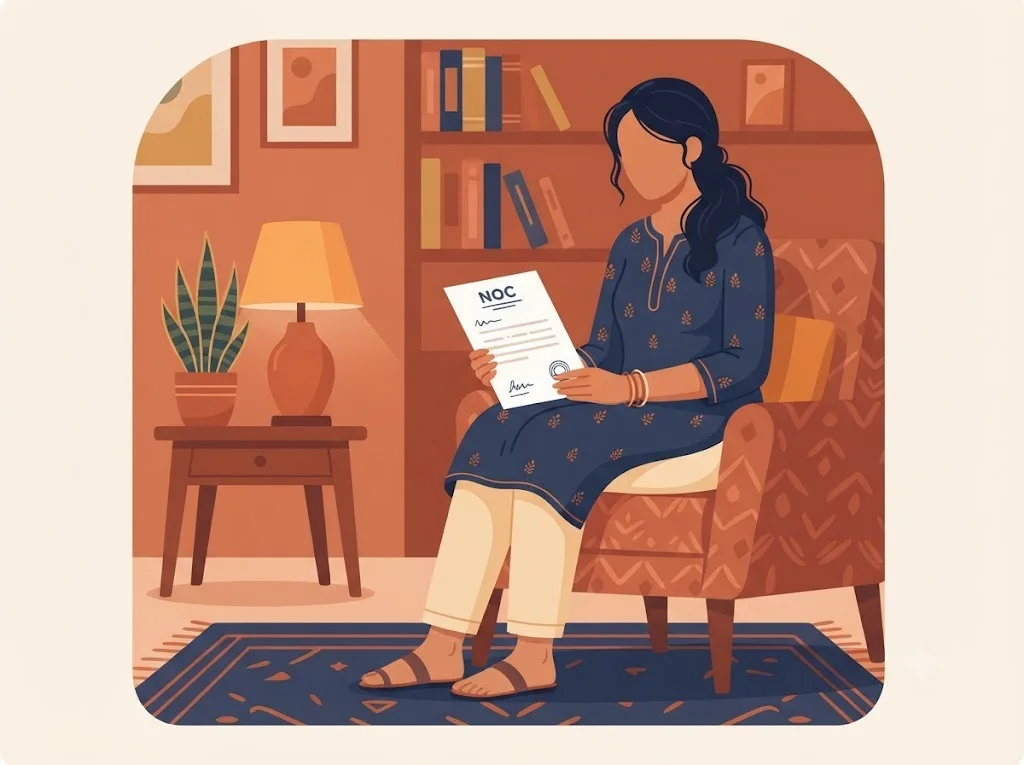
NOC After Loan Settlement: How to Get It and What It Must Say
A NOC or no-dues certificate is written confirmation from a lender that the agreed settlement conditions for a particular loan account have been completed and no further amount is due under those terms. The document’s name, format and issue process can vary by lender. Check the settlement agreement and ask the lender how it will confirm completion.
Mohit Juneja
Reviewed by FREED India, Debt Resolution Specialists
 4.7/5
 ₹3,200Cr+
 20,000+
 20,00,000+4.7/5₹3,200Cr+20,000+20,00,000+
KEY TAKEAWAYS

A NOC should name the account, the settled amount, the payment date, and say no dues remain.
RBI’s 30-day rule covers property documents. It sets no verified NOC deadline for unsecured loans.
RBI’s framework gives ₹100 a day if a credit report fix takes longer than 30 days.
A Settled status can stay on your credit report for up to 7 years.
Get every document in writing, and never pay into a personal account.
What Is a NOC After Loan Settlement?
You paid the settled amount. The bank confirmed it on a call. So why does everyone keep telling you to get a NOC?
Because a phone call proves nothing later. A NOC after loan settlement is a clearance letter (called NOC, short for No Objection Certificate) from your bank or NBFC. Some banks call it a no-dues certificate after settlement. A NOC or no-dues certificate can provide written evidence that the lender considers the agreed settlement conditions completed. Check its wording against the settlement letter and payment records to confirm which account and obligations it covers.
Loan settlement involves asking a lender to accept an agreed amount that may be lower than the full outstanding balance. Approval is not guaranteed and depends on the lender’s assessment and applicable policy. Borrowers should understand the financial and credit-report implications and consider available alternatives before agreeing to settle.
So by the time you reach this stage, you have already been through a hard stretch. The NOC is the paper that lets that account finally rest.
People often mix up 3 different documents. They come at different times, from different places:
Settlement letter. This is the bank’s offer, or its confirmation of the amount it agreed to accept. It usually comes before you pay. Our guide on the final settlement letter format shows what it typically contains.
NOC or no-dues letter. This comes after your payment clears. It confirms the money is received and no dues remain on that account.
Credit report update. This is not a letter at all. It is the change the credit bureau makes when the bank reports the account as Settled.
Keep all three where available: the settlement letter records the agreed terms, payment proof shows what you paid, and the NOC or no-dues certificate documents the lender’s confirmation. The credit report separately records how the lender reported the account.
One word matters here. A settled account is “settled” or “resolved.” It is not the same as a loan repaid in full, and your papers should not pretend it is. If you want to see how a one-time settlement offer is usually worded, read what a one-time settlement letter includes.
The NOC or equivalent written confirmation is an important record to retain after settlement.

Thinking About Loan Settlement?
Share your loan details and get a personalised plan from FREED’s counsellors.
Start My Debt AssessmentWhy Does a NOC Matter After Loan Settlement?
Think of the NOC as the receipt for the hardest payment you made. Most of the time it sits in a folder. Then one day, you need it badly.
Here are the 4 situations where it earns its place:
It proves the account cannot be pursued for more. Once the bank confirms no dues remain, it should not ask you for the waived amount again. Without the letter, it becomes your word against a system record.
It helps if calls or notices continue by mistake. Bank systems do not always talk to each other. A collections team or an outside agency may still have your old file. Sending the NOC and settlement letter to the lender’s grievance or collections team may help resolve mistaken follow-ups. Keep copies of your communication and escalate if the issue continues. Our guide on what to do if you get calls after your loan is settled covers this in detail.
It is evidence if your credit report shows the wrong status. Say the account still shows as overdue 3 months after you paid. The NOC, with your payment receipt, is the proof you attach to a dispute.
Future lenders may ask for it. When you apply for credit later, a lender may see the Settled account and ask for proof it is resolved. Handing over a clean NOC answers that question in one step.
A NOC after loan settlement also has limits, and it helps to know them early.
It protects only the account it names. If you have 3 loans and settled one, the NOC covers that one loan. The other 2 still need their own handling.
A NOC does not automatically remove accurate settlement information from your credit report. If the report contains incorrect or outdated information, raise a dispute with the credit bureau and the lender. The NOC simply proves the settlement was completed, which is what a lender wants to see next to that status.
What Must a NOC After Loan Settlement Say?
RBI has not prescribed one fixed format for a NOC after loan settlement. Each bank uses its own template. What follows are the commonly expected details, the ones that make the letter useful when you need it.
Detail to check | Why it matters |
Your name and the bank’s or NBFC’s name | Matches your loan records exactly |
Loan account number and loan type | Ensures the letter is for the right account |
Settled amount and date of payment | Proof of what you paid, and when |
A line saying no dues remain | Confirms nothing further can be demanded on that account |
Status wording: “settled”, not “fully repaid” | Matches how the credit report will show it |
Date of the letter | Shows when the bank confirmed it |
Signature, stamp or system mark of the bank | Makes the letter valid |
Reference to credit bureau reporting | Tells you the bank will update the status |
Here is what this looks like with example figures. Say your personal loan account ending 4721 had ₹2,40,000 outstanding. The bank agreed to accept ₹1,30,000, and you paid it on 14 August. Your NOC should show the account number, ₹1,30,000, the date 14 August, and a line that no further dues remain on that account.
Now the small things. They cause big problems later.
Check the spelling of your name, letter by letter. Check every digit of the account number against your loan statement. Check the account number carefully. If it is incorrect, request a corrected document before relying on it in a dispute.
Check the status wording too. If the letter says “fully repaid” while the bureau shows “Settled,” the mismatch will raise questions. You want both to tell the same story.
If something is missing, ask for a corrected copy straight away. It is much easier to fix a letter in the first week than a year later.
For the wider picture on clearance letters from banks, read our guide on the CIBIL clearance letter.
Want to See How Your Settled Account Shows Up?
Get your score, what is pulling it down and steps to improve it.
Check My Credit InsightsHow to Get a NOC After Loan Settlement Step by Step?
You can make the process easier by keeping the settlement terms and payment proof ready, requesting written confirmation through an official channel and checking the document when it arrives.
Before you start, it helps to know what your settlement terms said. Our guide on how to read a loan settlement agreement explains the clauses to look for.
One safety rule first. Pay the settled amount only into the bank’s official account or through its official channel. Never pay into a personal account, even if someone claiming to be from the bank asks you to.
Confirm the payment has cleared.
Check your bank statement for the settled amount going out.Keep the payment receipt.
Save the screenshot, UTR number or bank reference.Request the NOC in writing.
Send an email or letter to the bank’s loan or collections team.Quote your account number and settlement letter.
This helps the bank find and check your file faster.Check every detail on the NOC.
Use the table above, line by line.Save digital and paper copies.
Keep them in 2 separate places.Check your credit report later.
Make sure the account shows as Settled, not overdue.
A short request is enough for step 3. Mention your name, loan account number, the settled amount, the date you paid and the payment reference. Attach the settlement letter and the receipt. Ask for the NOC after loan settlement and the date by which the bank will send it.
Keep a copy of what you sent, with the date. If you need to follow up, you will want to show exactly when you first asked
How Long Does a NOC Take, and What Does RBI Say?
This is the question most people search, and it is where many answers online go wrong. So here it is plainly, point by point.
The 30-day rule is about property documents. RBI’s 2023 circular on releasing property documents says lenders must return original property papers within 30 days after full repayment or settlement. They must also remove any registered charge in that time. If the lender causes a delay, it must pay ₹5,000 for each day of delay.
This rule is about property documents. So it mainly concerns secured loans, such as a loan against property. Do not assume that the 30-day property-document rule creates a universal NOC deadline for unsecured loans. Check the applicable directions and your lender’s process.
For unsecured loans, no verified RBI deadline was found. Your bank may have its own internal timeline. Ask for it in writing when you request the NOC. If the date passes, follow up with your earlier request attached.
Credit report fixes do have a clear RBI timeline. This is a separate rule, and it is useful. If your credit report shows the wrong status after settlement, you can raise a dispute. Under RBI’s 2023 framework, the complaint should be resolved within 30 days. The bank gets 21 of those days to send corrected data to the bureau.
The RBI framework provides for compensation at ₹100 per day in qualifying cases where a credit-information complaint remains unresolved beyond the prescribed period, subject to the applicable conditions.
Here is how that works with an example. You raise a dispute on 1 March. It gets fixed on 15 April. That is 45 days, so 15 days over the limit. The compensation works out to ₹1,500.
RBI is also moving lenders to weekly reporting of credit data. So once the bank sends the corrected status, it may show up on your report sooner than before.
Updating your report is a topic of its own. Our guide on updating your CIBIL score after a loan ends walks through the steps.

Freed Expert Tip
Ask for the NOC and the settlement letter together, and keep your payment receipt with them.
Book My Free CallWhat If Your NOC Is Missing, Late or Wrong?
First, breathe. If your NOC is late or contains an error, start by making a written request or complaint and attaching the relevant settlement and payment records. Which steps to take depends on what went wrong.
If the NOC is late:
Send a written reminder to the same team you asked first.
Attach your settlement letter, payment proof and the date of your first request.
Ask for a specific date by which the NOC will be sent, and note it down.
If the NOC has wrong details:
Point to the exact error, such as a wrong account digit or a misspelt name.
Ask for a corrected copy, not a handwritten correction on the old one.
Keep the wrong copy too, in case you need to show what was issued first.
If the bank refuses or ignores you:
Write to the bank’s grievance officer, with all your proofs attached.
Give the bank the period it states for a reply.
If there is still no fair answer, you can file a complaint with the RBI Ombudsman. Keep copies of everything at each step.
Now the credit report side. Sometimes the NOC arrives fine, but the report still shows the account as overdue or unpaid. In that case, raise a dispute with the credit bureau. Attach the NOC and your payment receipt. The 30-day framework from the section above applies here.
A note for readers who also have other loans. If those loans are still being paid on time but feel heavy, debt consolidation may fit them better than settlement. You can check how much of your salary goes to EMIs with the EMI Score, and read more on FREED’s Loan Consolidation Plan.
Are You in a Loan Trap? Quick Check
Move the slider to your total EMIs as a % of monthly salary. See your debt stress level instantly.
EMIs as % of Monthly Salary
How Does FREED Handle Loan Settlement?
FREED’s Loan Settlement Plan is for borrowers who genuinely cannot repay their unsecured loans in full. It is not for someone who is managing, even with effort. It is for the point where full repayment is no longer possible.
The plan helps you move from financial distress to a structured path for resolving your debt. It works in 4 stages:
FREED assesses your full financial situation. This covers your loans, monthly income, essential expenses and what you can realistically pay.
You get a personalised plan. It sets a monthly savings amount that fits your actual budget.
You build savings in a Special Purpose Account (SPA). The SPA is held in your name by an independent trustee, not by FREED. FREED cannot touch the money without your approval.
FREED negotiates with the bank once the fund is large enough. You see the offer and decide to accept or decline it. On acceptance, you pay the agreed amount and receive the settlement letter from the bank.
This takes time. Savings build first, and negotiation comes after. Nothing about it happens overnight, and any plan promising instant resolution should make you careful.
Waivers can go up to 50%*, depending on the bank and your situation. A Settled status then stays on your credit report for up to 7 years.
Be clear on one point. The NOC and the credit report update come from the bank and the bureau. So after each settlement, you collect the NOC, check it against the table above and keep it safe.
On fees, FREED charges its fee only when a settlement is completed. If a bank refuses to settle, FREED does not charge its service fee for that account.
So far, FREED has settled 20,000+ accounts, counselled 20,00,000+ customers and managed ₹3,200 Cr+ of debt. You can read more on the Debt Resolution Program page.
Rates and ranges shown are indicative. Final terms decided by the bank. FREED is not a Loan Provider. No outcome is guaranteed. Please verify directly with your bank.
How Does a Settled Loan Show on Your Credit Report After the NOC?
Your credit report shows a settled account as Settled. That is different from an account repaid in full, and lenders read the two differently.
A fully repaid loan tells a lender you paid everything you borrowed. A Settled loan tells them the bank accepted less than the full amount. Both mean the account has ended. But the second one makes a new lender more careful.
The Settled status can stay on your report for up to 7 years. During that time, any lender who checks your report can see it. So new credit may be harder to get for a while, or it may come at a higher rate. Our guide on how lenders view settled accounts explains what they look for.
Here is where the NOC after loan settlement fits. It does not remove the Settled status, and no letter can. What it does is prove the account is resolved, with nothing left to chase. A lender seeing “Settled” plus a clean NOC knows the matter is finished. A lender seeing “Settled” with no proof may wonder whether something is still pending.
What helps your report after settlement is time and a clean record on everything else. On-time payments on any remaining loans or cards slowly add positive history around the old mark.
For what your loan options look like after this point, read our guide on loans after settlement and next steps. And to see your report’s current state, with step-by-step suggestions, FREED’s Credit Insights can help.
Cannot Repay Your Loans in Full?
See how a structured loan settlement plan could work for you.
Settle My LoansWhat Helps After Your Loan Is Settled?
Settling a loan ends one chapter, but the papers stay with you. A few simple habits now protect you for years.
Keep the NOC, settlement letter and payment receipt together. Store them as one set, in one folder, for at least 7 years. If any question comes up, you hand over all 3 at once.
Save a digital copy in 2 places. Your phone and your email are a good pair. If one is lost, the other survives.
Check your credit report after 1 or 2 reporting cycles. Make sure the account shows as Settled, not overdue. If it is wrong, dispute it with the NOC attached.
Keep paying your other loans on time. Every on-time EMI adds fresh, positive history to your report. Over time, it carries more weight than the old mark.
Build credit slowly with small, regular payments. A small credit line, used lightly and paid in full each month, can help. Our guide on improving your credit card score after loan settlement has more ideas.
Keep a call log if calls continue. Note the date, time, number and what was said. If calls about a settled account continue, this log and your NOC make a strong complaint.
Most calls after settlement are system mix-ups, and the NOC sorts them out. But if a call ever turns abusive or threatening, you do not have to face it alone. FREED Shield is open to everyone, enrolled or not. It helps you understand your rights and document and report harassment through the right channels.
The settlement was the hard part. With the NOC after loan settlement in your folder and your report checked, you are on firm ground.
Sources
Claim | Source | Link |
Release of original property documents and removal of charges within 30 days after full repayment or settlement (para 2); ₹5,000 a day for lender-caused delay (para 6); applies to documents due on or after Dec 1, 2023 (para 9) | RBI/2023-24/60, Release of Movable/Immovable Property Documents on Repayment/Settlement of Personal Loans, Sept 13, 2023 | https://www.rbi.org.in/Scripts/NotificationUser.aspx?Id=12535&Mode=0 |
30-day resolution limit; 21 days for the bank; ₹100 a day beyond 30 days | RBI/2023-24/72, Framework for compensation for delayed credit information updation, Oct 26, 2023 | https://www.rbi.org.in/Scripts/NotificationUser.aspx?Id=12554 |
Board-approved settlement policy; terms set by the regulated entity | RBI/2023-24/40, Framework for Compromise Settlements and Technical Write-offs, June 8, 2023 | https://www.rbi.org.in/Scripts/NotificationUser.aspx?Id=12513 |
RBI moving lenders to weekly credit data submission | RBI press release, Dec 4, 2025 | https://rbi.org.in/Scripts/BS_PressReleaseDisplay.aspx?prid=61742 |

Mohit Juneja
Mohit Juneja writes educational content at FREED on debt management, credit scores, loan repayment, and borrowing best practices. His content is shaped by expert insights and industry knowledge, helping readers better understand their financial options and make informed decisions.
mohit.juneja@freed.care

FREED is India's trusted loan management platform. Founded in 2020 and headquartered in Gurugram, FREED has counselled 20 lakh+ people on personal loans, credit cards, and app loans. FREED charges fees only on successful settlement, not upfront. FREED does not handle secured loans (home loans, car loans, gold loans).
Media Mentions