How to Improve Credit Card Score After Loan Settlement
Experts suggest that you should never use the whole portion of credit unless it is unavoidable. For instance, if your credit card limit is 10,000, you should ideally use only 30-40% of the amount.
Mohit Juneja
Reviewed by FREED India, Debt Resolution Specialists
 4.7/5
4.7/5 ₹3,200Cr+
 20,000+
 20,00,000+4.7/5₹3,200Cr+20,000+20,00,000+
Key Takeaways

To improve CIBIL score after settlement, first check that the account shows "Settled" with a zero balance.
Every credit information company must give you one free full credit report each year.
Wrong entries must be corrected within 21 days. Unresolved complaints past 30 days attract ₹100 per day compensation.
From 1 July 2026, banks report four times a month (9th, 16th, 23rd and last day), so progress shows sooner.
A "Settled" status can stay on your report for up to 7 years, so rebuilding is gradual.
What Happens to Your CIBIL Score After a Loan Settlement?
Settlement is not something a borrower chooses out of preference. It usually happens when someone genuinely cannot pay the full amount because of a job loss, an illness or a sudden drop in income.
"Settled" means the bank or NBFC accepted less than the full amount you owed and recorded that on your account.
Take Ramesh, a 34-year-old sales executive. He lost his job and fell behind on a ₹2,00,000 personal loan. After a few months, he settled it for ₹1,40,000. On his credit report, the bank now shows that ₹60,000 of the loan was not repaid.
Why the score falls after settlement:
The loan was not repaid in full. Future banks see that you paid less than you owed.
Missed EMIs usually came first. Most people miss several payments before they settle, and each one has already pulled the score down.
The status stays visible. Any bank or NBFC that checks your report can see the "Settled" tag.
A drop of 75 to 100 points is commonly reported, but this is only an illustration. It varies by starting score and history. The "Settled" status typically stays visible for up to 7 years.
The good news is that the drop is not permanent. Your score responds to what you do from here. If your settlement was on a credit card, read the steps to improve your CIBIL score after credit card settlement for the card-specific route.
The first step is to check what your report actually says.

Check Your Credit Report Free
See your score, settled accounts and utilisation in one place.
Check NowWhat Should You Check on Your Credit Report First?
Many people have their settlement letter safely filed away but have never compared it with their credit report. This is where mistakes hide.
Before you start, keep your written settlement or closure letter next to you. It is your proof of what was agreed.
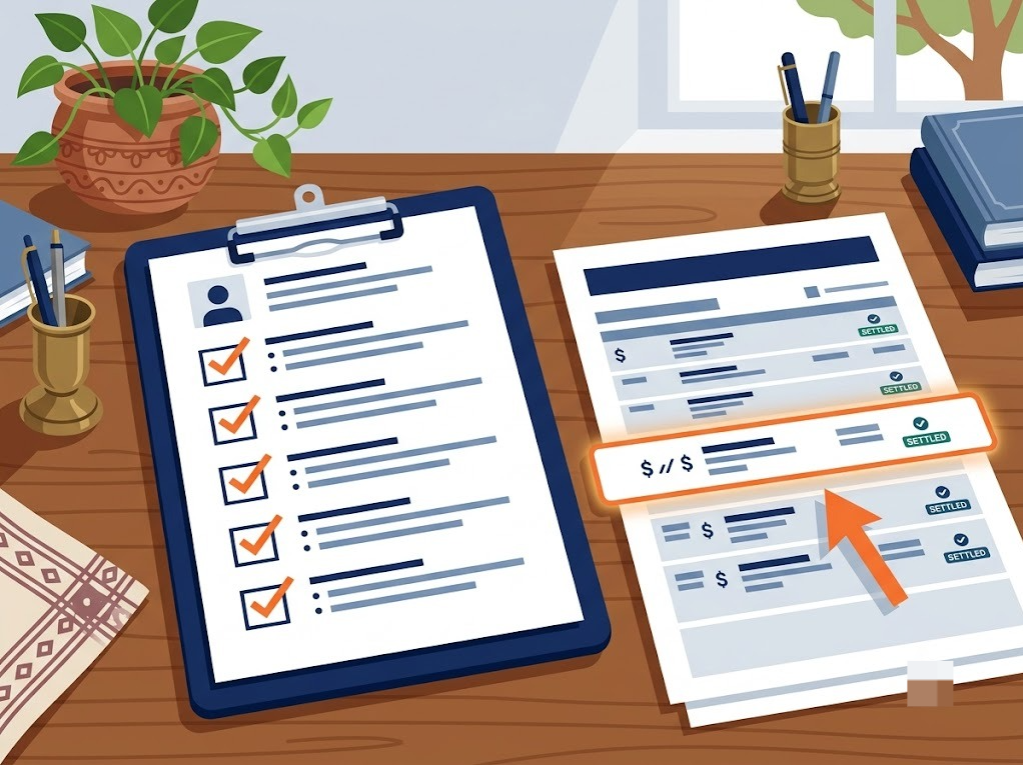
Check these five things:
The account shows "Settled", not "Written Off" or "Overdue". A wrong status makes the account look worse than it is.
The outstanding balance reads zero. If any amount still shows as due, the report has not been updated correctly.
There are no new late-payment marks after the settlement date. Once the account is settled, no fresh missed payments should appear on it.
There are no duplicate entries for the same loan. The same loan listed twice can make your debt look bigger than it is.
The settlement amount matches your written letter. The figure on the report should be the same as the one the bank or NBFC agreed to in writing.
You don't need to pay to do this check. Every credit information company must give you one free full credit report each year. You can request it directly from each of them.
You can also view your report through Check Credit Insight. It uses a soft enquiry, so checking does not affect your score.
If everything matches, you can move straight to rebuilding. If anything looks wrong, the next section shows you how to fix it.
What If Your Settled Account Is Reported Wrongly?
A common problem: you paid the settlement amount months ago, but your report still shows an outstanding balance. This is fixable, and you have clear rights.
How to fix it:
Raise the dispute with the bank or NBFC first. Attach your written settlement letter as proof.
Also lodge the dispute with the credit information company. Do this on their website, so both sides know about the error.
Track your reference number. Note the date you raised each dispute.
Escalate if there is no reply. Use the bank or NBFC's grievance process, and keep copies of everything.
Your rights: Wrong credit data must be corrected within 21 days. If your complaint is still unresolved after 30 days, you are entitled to compensation of ₹100 per day.
Example: If an error stays unresolved 10 days past the 30-day mark, the compensation is 10 x ₹100 = ₹1,000.
Remember, only wrong entries can be corrected. An accurate "Settled" status cannot be removed by a dispute.
If you are still getting recovery calls after your settlement, read our guide to bank loan recovery rules. FREED Shield can help you understand your rights and prepare a complaint if the calls cross the line.
Once your report is correct, you are ready to start rebuilding.

What the Law Says
Banks and NBFCs must fix wrong credit data within 21 days. Unresolved complaints past 30 days attract ₹100 per day compensation.
Talk to FREED's TeamHow Do You Rebuild Your CIBIL Score Step by Step?
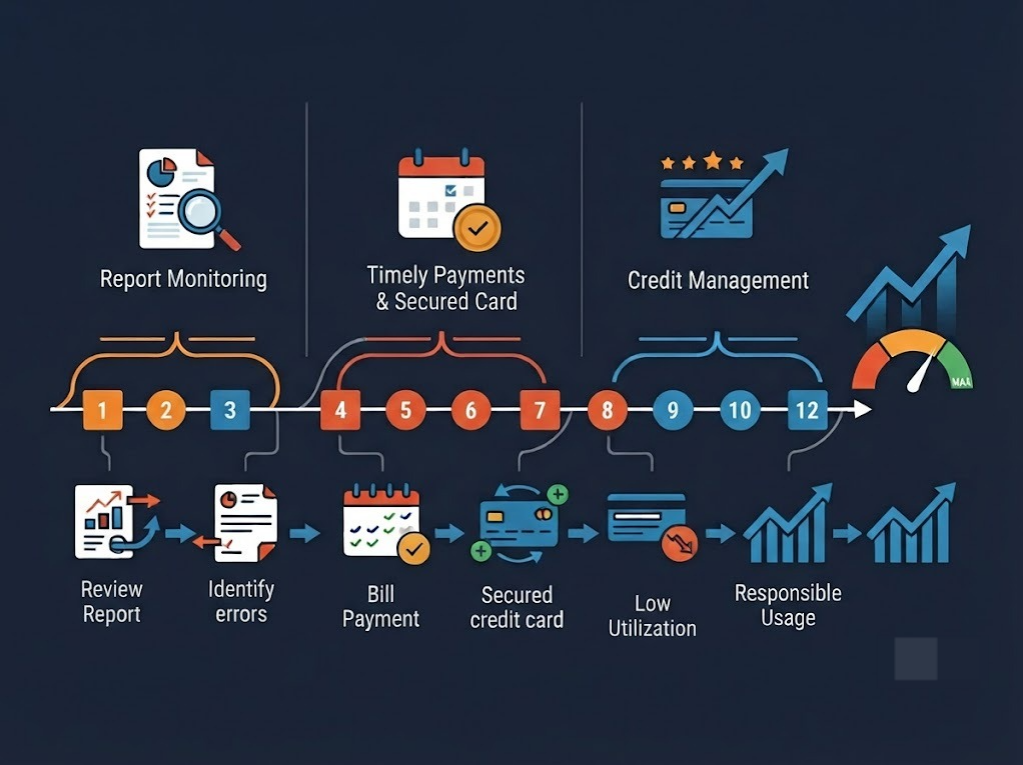
Rebuilding works best in three phases. Each phase builds on the one before.
Phase 1: The First 45 Days
1. Verify your report within 45 days.
Match every settled account against the written letter.
2. Dispute wrong entries.
Raise it with the bank or NBFC and the credit information company.
Hold off on any new credit applications during this phase.
Phase 2: Months 2 to 6
3. Pay every due date on time.
Set auto-pay so one missed date never happens.
4. Bring utilisation under 30%.
Pay card balances before the statement date.
Phase 3: Months 6 to 12 and Beyond
5. Add a secured credit card.
Use a fixed-deposit-backed card lightly and pay in full.
6. Apply for new credit slowly.
Wait until the score has stabilised before a new loan.
Why the order matters. If your report has errors, everything you do later rests on wrong data, so fixing it comes first. On-time payments then build a fresh record. Only after that record exists does new credit help rather than hurt. Applying too early can mean rejections, and each rejection adds another enquiry to your report.
Keeping utilisation under 30% is a common guideline, not an RBI rule.
Wondering when you can borrow again? Read loan after settlement: CIBIL impact and next steps.
How Does Credit Utilisation Affect Your Score After Settlement?
Here is a situation many people face. You pay your full card bill on the due date, but your report still shows a high balance. Why?
Credit utilisation is the share of your card limit you use. Using a large share makes you look dependent on credit, even if you pay in full.
Card limit | Balance | Utilisation |
₹1,00,000 | ₹60,000 | 60% |
₹1,00,000 | ₹25,000 | 25% |
₹30,000 (secured card) | ₹6,000 | 20% |
Figures are illustrative.
Bringing the balance down from ₹60,000 to ₹25,000 drops your utilisation from 60% to 25%. On a small secured card with a ₹30,000 limit, keeping spending near ₹6,000 keeps you at 20%.
The timing trick. The balance on your statement date is usually what gets reported, not the balance after you pay. So if you pay before the statement date, a lower figure goes to the credit bureau.
From 1 July 2026, banks report four times a month: on the 9th, 16th, 23rd and the last day. This means a lower balance can show up on your report sooner.
Before taking on any new EMI while you rebuild, check whether an extra EMI is affordable with your EMI Score.
Are You in a Loan Trap? Quick Check
Move the slider to your total EMIs as a % of monthly salary. See your debt stress level instantly.
EMIs as % of Monthly Salary
What Habits Help Your Score Recover After Settlement?
Say you have paid every bill on time for two months and wonder if it is working. It is. Score recovery is slow, but these habits keep it moving.
Check your report on a fixed day each month. This helps you spot changes and errors early.
Keep one card active with a small recurring bill on auto-pay. A phone or OTT bill paid automatically builds a steady record of on-time payments.
Space credit applications at least several months apart. Each application adds an enquiry, and too many together make banks cautious.
Keep old accounts in good standing open. A longer credit history works in your favour.
Treat any "score repair" service that promises to delete a Settled status as a warning sign. Accurate entries cannot be removed on request, however much you pay.
You may hear that paying the waived amount can change "Settled" to "Closed". If this comes up, confirm any such option in writing with the bank or NBFC before paying anything.
If you have other loans that are not settled yet: If you are still paying those EMIs but they feel heavy, FREED's Debt Consolidation Program may combine eligible loans into one EMI. If repayment has become genuinely impossible, FREED's Debt Resolution Program is one option, as a last resort.
How Long Does It Take to Improve CIBIL Score After Settlement?
There is no fixed date. Anyone who promises one is guessing.
Three things decide how fast your score recovers:
Your starting score. Where you were after settlement affects how far you have to climb.
Your payment history since settlement. Every on-time payment adds to a new, positive record.
Your utilisation. Low card balances help your score respond faster.
Factor | Closed | Settled | Written Off |
Meaning | Loan repaid in full | Bank or NBFC accepted less than full amount | Bank or NBFC treats the dues as a loss |
Effect on score | Positive or neutral | Negative | Most negative |
Bank/NBFC view | Favourable | Cautious | Highly cautious |
Can it be corrected | Not needed | Only if reported incorrectly | Only if reported incorrectly |
Status and effect vary by bank, NBFC and credit information company. This is general information, not financial advice.
Reading the table: A settled account sits between a closed loan and a written-off one. It is not the best record, but it is better than a write-off.
When can you borrow again? Banks and NBFCs see the Settled tag when they check your report. In the first year after settlement, approval is usually harder and rates are higher.
Is the impact permanent? Not exactly. The "Settled" status can stay visible for up to 7 years. But your score is a separate thing. It can rise with positive activity even while the status is still showing. So score recovery and status visibility move on different timelines.
With reporting now four times a month, you can track progress more often.

Freed Expert Tip
Pay your card bill a few days before the statement date, not on the due date. The lower balance is what gets reported.
Check My EMI ScoreHow Can FREED Help You Track and Rebuild Your Score?
Rebuilding is easier when you can see what is changing. FREED shows you what changed and what to fix.
Check Credit Insight lets you check your score and report for free. It uses a soft enquiry, so it does not affect your score. You can see your score on the 300 to 900 scale, along with the factors behind it:
Payment history
Credit utilisation
Credit mix
Hard enquiries
This helps you confirm your settled account is reported correctly, and track each month whether your rebuild plan is working.
EMI Score is a different tool. It is not a credit score. It is a score from 0 to 100 that shows whether your income can safely carry an extra EMI. It looks at your income, savings, monthly EMIs and existing loans.
Healthy: 80 to 100
Moderate: 50 to 79
High Risk: 0 to 49
Use it before you take any new loan during your rebuild.
FREED cannot remove a Settled tag from your report. No one can remove an accurate entry.
If you have other loans that are still unsettled, FREED's Loan Settlement Plan is one option to discuss with a specialist.
Talk to a FREED Specialist About Your Other Loans
Talk to a FREED Specialist About Your Other Loans
Book My Free CallSources
Claim | Source |
One free full credit report per year; 21-day correction; ₹100 per day compensation after 30 days | RBI Master Direction on Credit Information Reporting, 2025 |
Reporting on 9th, 16th, 23rd and last day from 1 July 2026 (commercial banks) | RBI/DOR/2025-26/110, 4 Dec 2025 |

Mohit Juneja
Mohit Juneja writes educational content at FREED on debt management, credit scores, loan repayment, and borrowing best practices. His content is shaped by expert insights and industry knowledge, helping readers better understand their financial options and make informed decisions.
mohit.juneja@freed.care

FREED is India's trusted loan management platform. Founded in 2020 and headquartered in Gurugram, FREED has counselled 20 lakh+ people on personal loans, credit cards, and app loans. FREED charges fees only on successful settlement, not upfront. FREED does not handle secured loans (home loans, car loans, gold loans).
Media Mentions