How to Build a Credit Score: What Counts and Your First 12 Months
How to build credit score comes down to one thing: borrowing a small amount and repaying it on time, every time, so banks can see your record. Your credit score is built from credit accounts reported by lenders to credit bureaus. If you have no credit history, a first credit card or loan that is reported and repaid responsibly can help establish one. The time taken for a score to appear varies by lender reporting and bureau requirements.

Mohit Juneja
Reviewed by FREED India, Debt Resolution Specialists
 4.7/5
 ₹3,200Cr+
 20,000+
 20,00,000+4.7/5₹3,200Cr+20,000+20,00,000+
Key Summary

Learning how to build credit score starts with one small loan or card in your name.
Rent, UPI payments, salary and debit card spends don’t build a credit score.
Since July 2026, banks report your repayments to credit bureaus 4 times a month.
Keep card use under 30% of the limit and pay the full bill on time.
Each bureau must give you one free full credit report every calendar year.
What Does It Mean to Build a Credit Score?
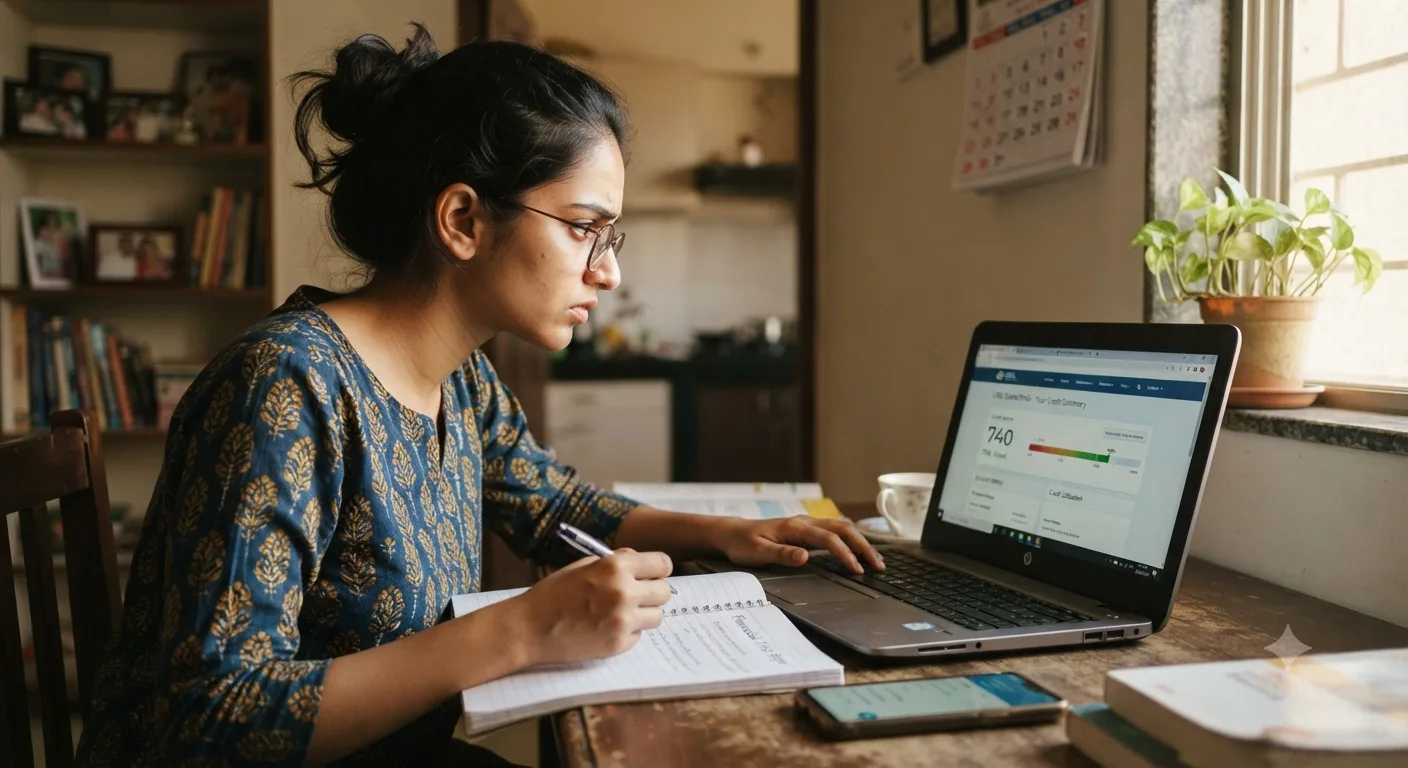
A credit score is a 3-digit number between 300 and 900. Credit bureaus work it out only from loans and cards that banks report in your name. So building one means creating that record from nothing. If you’ve been searching how to build credit score with no loans or cards behind you, that blank record is where you start.
Already have a score and want it higher? Our guide on how to improve your credit score fast covers that stage.
Your report may show “NH” or “-1” right now. That means no history, which is a long way from bad history. Here’s more on what NH means on a CIBIL score.
Once a score forms, it lands in a band. On the CIBIL score range, 750 and above is commonly viewed as strong, though no regulator sets that cut-off.
So what decides the number? Credit scores can be influenced by several aspects of your credit history, including payment history, credit utilisation, credit mix, the age of your accounts and recent credit enquiries. Credit bureaus do not disclose the exact weight assigned to each factor in their scoring models. For someone starting from scratch, making payments on time and managing credit balances responsibly are sensible habits to build.
But it tells a new builder something useful. Two habits, paying on time and using little of your limit, make up most of the score.
Before the steps, it helps to see why so many people start at zero.

See Where Your Credit Stands Today
Free check, soft enquiry, no effect on your score.
Check My Credit Score FreeWhy Do So Many People Start With No Credit Score?
Here’s a situation that plays out all the time. Someone has paid rent on the 1st of every month for 5 years. Every phone bill and every UPI payment went out on time. Then they apply for their first credit card and get a one-line rejection: “no credit history”. It feels unfair, and in a way it is.
But it’s also very common, and it says nothing bad about you. Most people working out how to build credit score without credit history hit this same wall, for one of three reasons.
- India runs on cash, UPI and debit cards. All three use your own money, so there’s no loan for a bank to report. You can pay perfectly for years and the bureau still sees an empty file.
- Many people avoid loans on purpose. That’s a sensible money habit, and plenty of families live by it. The only catch is that the bureau has nothing to read.
- Credit often isn’t offered yet. Young earners on a first salary, and self-employed people without salary slips, are usually the last to get card offers. So the first account simply takes longer to arrive.
Here’s the reassuring part. Starting at zero is the easier problem to have. A blank file has no missed EMIs and no default to explain. Someone rebuilding after a default needs months of steady payments to outweigh old marks, while you only need to add good ones.
And the next step costs nothing. Find out what’s already on your file, because some people discover an old card or a small loan they’d forgotten. If you check and find nothing at all, here’s what to do when you don’t have a CIBIL score. FREED’s Credit Insights also runs a free soft check on your Experian report, so you’ll see right away whether a record exists in your name.
Find Out If You Have a Credit Record Yet
A soft check takes a few minutes and has no effect on your score.
Check My Credit FileWhen Should You Start Building Your Credit Score?
If you expect to apply for a major loan, consider building your credit history well in advance. A credit score may take time to appear, and lenders may want to see a consistent repayment record. Starting 12 to 18 months ahead can give you time to establish that history, although individual outcomes vary.
Treat that window as a practical guideline, since every bank reads files its own way.
Most people searching how to build credit score for the first time match at least one of these 5 signals.
- You’ve just got your first salary. Salary slips make an entry-level card much easier to get. Starting now means your score is ready when bigger needs come along.
- You plan a home, vehicle or education loan in the next 1 to 2 years. Big loans lean heavily on your score when the bank sets your interest rate. A year of clean record behind you puts you in a stronger spot.
- Your credit report shows “NH” or “-1”. That’s the clearest sign there’s nothing to build on yet. Check your current status first with your PAN before you apply anywhere.
- A card or loan was rejected for “no history”. That rejection is about an empty file, and nothing else. A starter product made for first-timers is the usual next move.
- You’re self-employed and want business credit later. Business loans often look at your personal credit record too. Building it now saves a scramble later.
If a big loan is on your list, check one more thing before you start: whether its EMI will fit your budget. FREED’s EMI Score is a free 0 to 100 check that reads your monthly earnings, savings, current EMIs and what you still owe. It has no effect on your credit score.
Ready? Here’s the order that works.
Planning a Big Loan in the Next Year or Two?
See whether the EMI would fit your income before you apply.
Check My EMI ScoreHow to Build Credit Score, Step by Step
These 6 steps work for anyone starting from zero, and they’re the core of how to build credit score for beginners.
- Check your credit report first. Confirm you have no history, or spot an old account you forgot.
- Pick one starter product. A secured card against a fixed deposit is the easiest approval.
- Use only a small part of the limit. A common guideline is to stay under 30% of your limit.
- Pay the full bill before the due date. Set up auto-pay so a busy month never causes a miss.
- Wait before applying for anything else. Give the first account 6 months to build a record.
- Add a second credit type later. A small EMI loan repaid on time shows you can handle more than one kind of credit.
Here’s step 3 in rupees. On a ₹50,000 card limit, staying under 30% means keeping your statement balance below ₹15,000. On a secured card, a ₹20,000 FD commonly gets you a limit of about ₹15,000 to ₹18,000, which is roughly 75% to 90% of the deposit. So on that card, your 30% line sits near ₹4,500 to ₹5,400 a month.
That’s how to build credit score in practice. Small spends, full payments and a lot of patience.
Secured-card limits vary by bank. Rates and ranges shown are indicative. Final terms decided by the bank. FREED is not a Loan Provider. No outcome is guaranteed.
FREED Expert Tip
Set your card’s auto-pay to the full bill amount, not the minimum due. One missed payment early on is harder to recover from than a slow start.
What Counts Towards Your Credit Score and What Doesn’t?
A credit score reads only one thing: how you handle borrowed money. It doesn’t see how careful you are with your own. That’s the part most guides on how to build credit score skip, so here it is in one table.
| Payment or product | Builds your credit score? | Why |
|---|---|---|
| Credit card (regular or secured) | Yes | Bank reports it to bureaus |
| Personal loan or consumer durable EMI | Yes | Reported as a loan account |
| BNPL (buy now, pay later) | Often yes | Many providers report; check the terms |
| Rent paid by UPI or bank transfer | No | Not a loan, so not reported |
| Electricity, phone, OTT bills | No | Not reported to bureaus in India |
| UPI and debit card spending | No | It’s your own money, not credit |
| Salary credits and savings | No | Banks see them, bureaus don’t |
| Add-on card on a parent’s account | Usually no for you | The main cardholder’s record builds |
Rates and ranges shown are indicative. Final terms decided by the bank. FREED is not a Loan Provider. No outcome is guaranteed.
Your bills still matter, just indirectly. When you apply for credit, banks often check your income and bank statements, and steady paid bills look good there. BNPL and small app loans do build history when they’re reported. But a missed payment on them gets reported too, and it hurts the same way. For the full picture, here’s how a credit score is calculated, factor by factor.
One change from July 2026 speeds all of this up. Banks now report your credit information to bureaus as of the 9th, 16th, 23rd and last day of each month. So a good payment can reach your record sooner, and so can a missed one.
Wondering if your first card has reached your file yet? FREED’s Credit Insights lists every loan and card on your Experian report. One look tells you whether your new account is being reported.
See Which Accounts Are on Your Report
Confirm your first card or loan is showing on your file.
Check My Credit InsightsWhich First Credit Product Should You Choose?
Pick the one product that fits your income and habits, not the one with the biggest limit. There’s no single answer to how to build credit score, but there’s usually one right first product for you.
| Option | Best for | What you need | What to watch |
|---|---|---|---|
| Secured card | No income proof yet, or a past rejection | An FD with the bank | The FD stays locked while the card is active |
| Entry-level card | Salaried first-timers | Salary slips | Annual fee |
| Small consumer durable EMI | A planned purchase you were making anyway | KYC and income | Don’t buy just to build credit |
| Small personal loan | A genuine need only | Income proof | Interest cost |
Rates and ranges shown are indicative. Final terms decided by the bank. FREED is not a Loan Provider. No outcome is guaranteed.
Whichever you pick, take only what you’d use anyway. Buying a phone on EMI just to build a score adds interest you never needed to pay. A secured card does the same job with no loan at all.
Weighing a small EMI loan anyway? Run it through FREED’s EMI Score first. A result in the Healthy band (80 to 100) means the new commitment sits well within your capacity. Moderate (50 to 79) or High Risk (0 to 49) is a signal to wait or borrow less.
Why is all this patience worth it? Look ahead to a real loan. On a ₹2 lakh loan over 24 months, the EMI is about ₹9,508 at 13% and about ₹10,179 at 20%. That’s roughly ₹670 more every month, and about ₹16,100 more over the loan. A strong score often decides which of those rates you’re offered.
The 13% and 20% rates are illustrative only. Rates and ranges shown are indicative. Final terms decided by the bank. FREED is not a Loan Provider. No outcome is guaranteed.
Already have a low score rather than none? These steps that raise an existing score sooner will suit you better. And if you’re rebuilding after a default or settlement, start with our guide to building your credit score after debt.
What the law says
RBI requires every credit bureau to give you one free full credit report, including your score, once each calendar year.
How FREED Helps While You Build Your Credit Score
FREED is India’s trusted loan management platform, and over 20 lakh people trust it with their loans. For someone new to credit, that help is about two things: seeing your record clearly, and borrowing only what fits. Here’s how FREED supports each stage while you work out how to build credit score.
1. Tracking the score as it forms.
Credit Insights shows your score and full report, then explains what’s affecting it. FREED turns that into a personalised action plan with step-by-step actions. The report refreshes every month, and if something looks wrong, you can raise a dispute in a few steps.
You also get a 24x7 AI Credit Expert. Ask it something plain, like “what’s affecting my score the most?”, and it answers from your own report. Over 30,000 people trust Credit Insights. It’s a soft enquiry, and it uses Experian’s report, so its number may not match CIBIL’s site.
One honest note. A score only exists once a bank reports an account, so no app can show one before that, Credit Insights included. Once your first card is reported, it’s there to track every month.
2. Checking a first loan fits before you apply.
A good score gets you approved. It can’t tell you whether you can comfortably pay. FREED’s EMI Score fills that gap with a free 0 to 100 score built from your monthly earnings, savings, current EMIs and what you still owe. It’s separate from your credit score and has no effect on it.
3. If EMIs pile up later.
If your repayments ever climb past 50% of your take-home pay, FREED’s Loan Consolidation Plan can combine eligible loans into one lower EMI.
What Helps Your Credit Score Grow in the First 12 Months?
Patience does most of the work here. This is what a typical first year looks like for someone learning how to build credit score from scratch.
| Months | Focus | What to expect (typical) |
|---|---|---|
| 0 to 1 | Check report, pick one starter product | No score yet, or “NH” |
| 1 to 6 | Small spends, full on-time payments | Score often appears around here |
| 6 to 9 | Keep usage low; no new applications | Score usually settles into a range |
| 9 to 12 | Consider a second credit type if needed | A steady record lenders can read |
This timeline is typical, and it varies by person and bank. If your report still shows NH, start with these first steps if your report shows NH.
A few habits keep that first year on track:
- Keep your oldest card open. Account age is part of your score, and your first card is your oldest. Closing it later shortens your history overnight.
- Space out your applications. Each one is a hard enquiry, and several close together can pull a new score down. Here’s why soft and hard enquiries are treated so differently.
- Read your report every few months. Errors happen, even on new files. Credit Insights refreshes monthly, so a quick look takes a minute.
- Never let a small due slide. A ₹300 BNPL instalment that’s missed gets reported just like a big EMI. Small dues deserve the same auto-pay as the large ones.
That’s the whole plan for how to build credit score: one product, small spends, every bill paid in full. Give it a year, and the bank on the other side of your next application will see someone it can trust.
Thinking About Your First Loan?
Check whether a new EMI fits your income before you apply.
See If My EMI Fits
Mohit Juneja
Mohit Juneja is FREED’s Content & Communication Lead with 12+ years of experience across content, media, advertising and digital communications. He holds a postgraduate diploma in Communications from Xavier Institute of Communications, Mumbai, and has worked with organisations including NDTV, The Indian Express, McCann Worldgroup and NABARD.
At FREED, he leads content and communication across loan management, debt resolution, debt consolidation and financial well-being. His work combines research, storytelling and consumer-focused communication to make complex financial topics easier to understand and act on. He has also scripted and produced 11 documentaries on rural development and agriculture for NABARD, with film's selected for the Mumbai International Film Festival.
mohit.juneja@freed.care

FREED is India's trusted loan management platform. Founded in 2020 and headquartered in Gurugram, FREED has counselled 20 lakh+ people on personal loans, credit cards, and app loans. FREED charges fees only on successful settlement, not upfront. FREED does not handle secured loans (home loans, car loans, gold loans).
Media Mentions