How to Check CIBIL Score by PAN Card
Checking your CIBIL score by PAN card means using your Permanent Account Number as the identifier to pull your credit score and report from CIBIL or another bureau. Your PAN links all your loans and credit cards to one financial identity. That's why it's the fastest route to your score online, alongside basic details and an OTP.
Mohit Juneja
Reviewed by FREED India, Debt Resolution Specialists
 4.7/5
4.7/5 ₹3,200Cr+
 20,000+
 20,00,000+4.7/5₹3,200Cr+20,000+20,00,000+
Key Takeaways

Your CIBIL score is free to check using your PAN card, name, date of birth, and mobile number, verified through OTP.
PAN alone won't get you there. OTP verification is mandatory on every legitimate platform.
Checking your own score never lowers it. That's true no matter how often you do it.
CIBIL gives you one detailed free report per year directly. Several authorised platforms offer free monthly checks on top of that.
Recently corrected or reissued your PAN? Your PAN number stays the same either way, but the bureau's records may take a while to fully sync your updated details.
Why Your PAN Card Is Used to Check Your CIBIL Score
Your PAN is tied to you and only you. It's issued once, it doesn't expire, and it stays the same whether you switch banks, move cities, or change your phone number five times over the years. That permanence is exactly what makes it useful here.
Every loan and credit card you've ever taken, a personal loan from one bank, a credit card from another, a two-wheeler loan from an NBFC three years ago, gets reported back to CIBIL, and each of those reports carries your PAN as the tag. So instead of your financial history sitting scattered across a dozen separate institutions with no way to connect the dots, it all lands in one place, under one profile, the moment someone pulls a report using your PAN.
Names get shared constantly. India has thousands of people named Rahul Sharma or Priya Patel, and a bureau matching purely on name and date of birth would risk pulling up the wrong person's report, or missing accounts entirely. PAN doesn't have that problem. It's a single, unique number assigned by the Income Tax Department, and that's the real reason bureaus lead with it instead of relying on your name or phone number alone. It's the one identifier reliable enough to pull the correct report in seconds, without ambiguity.
This is also why keeping your PAN linked correctly across all your accounts matters more than people realise. If a bank reports your loan under a slightly different name spelling, or an old address that doesn't match your PAN records, it can create a fragmented picture instead of one clean profile, something worth keeping in mind if your report ever looks incomplete.

Why Your PAN Card Is Used to Check Your CIBIL Score
Your PAN is tied to you and only you. It's issued once, it doesn't expire, and it stays the same whether you switch banks, move cities, or change your phone number five times over the years. That permanence is exactly what makes it useful here.
Every loan and credit card you've ever taken, a personal loan from one bank, a credit card from another, a two-wheeler loan from an NBFC three years ago, gets reported back to CIBIL, and each of those reports carries your PAN as the tag. So instead of your financial history sitting scattered across a dozen separate institutions with no way to connect the dots, it all lands in one place, under one profile, the moment someone pulls a report using your PAN.
Names get shared constantly. India has thousands of people named Rahul Sharma or Priya Patel, and a bureau matching purely on name and date of birth would risk pulling up the wrong person's report, or missing accounts entirely. PAN doesn't have that problem. It's a single, unique number assigned by the Income Tax Department, and that's the real reason bureaus lead with it instead of relying on your name or phone number alone. It's the one identifier reliable enough to pull the correct report in seconds, without ambiguity.
This is also why keeping your PAN linked correctly across all your accounts matters more than people realise. If a bank reports your loan under a slightly different name spelling, or an old address that doesn't match your PAN records, it can create a fragmented picture instead of one clean profile, something worth keeping in mind if your report ever looks incomplete.
Step by Step, How to Check Your CIBIL Score Using PAN Card
Here's the process broken down properly, since each step has a small detail worth getting right.
1. Go to an authorised platform.
CIBIL's own website works, and it's the most direct route since you're going straight to the source. Alternatively, another RBI-authorised bureau, or a bank's net banking portal or app offering free checks, works just as well. What matters is that the platform is genuinely authorised, not a random third-party site that showed up in a search result.
2. Enter your PAN with basic details.
You'll need your PAN number, your full name exactly as printed on the card, your date of birth, and a valid mobile number. This part trips up more people than you'd expect. If your PAN card says "Rajesh Kumar Verma" and you type "Rajesh K Verma," the system may not find a match, even though it's obviously the same person to a human reading it. Take a moment to look at your physical card before typing anything in.
3. Verify with OTP.
Enter the OTP sent to the mobile number registered with the platform or used during the verification process. Type it in within the given time window. If you don't receive it within a minute or two, check whether the mobile number on file with your bank or PAN record is actually current, since an outdated number is a common reason for this step to stall.
4. Answer security questions if asked.
Some platforms add an extra layer here, two or three questions pulled from your own credit history. Something like "which of these banks have you taken a loan from" or "what type of account was opened in the last two years." These aren't meant to trip you up, they exist purely to confirm you're actually the person the report belongs to, since credit data is sensitive enough to warrant that extra check.
5. View your score and report.
Once verified, your score and report show up instantly on screen. Don't stop at just noting the number, download the full report as well. You'll want it later, whether to check for errors, to compare against a future check, or simply to keep a personal record of where you stood at this point in time.
Most people get through this entire process in under five minutes, assuming their details match on the first attempt. If they don't, it's almost always one of the small mismatches covered further down in this guide.

FREED Expert Tip
Match your name, date of birth, and mobile number to your PAN card exactly before you hit submit. A single typo is behind most failed attempts on the first go.
Talk to a FREED Expert Instead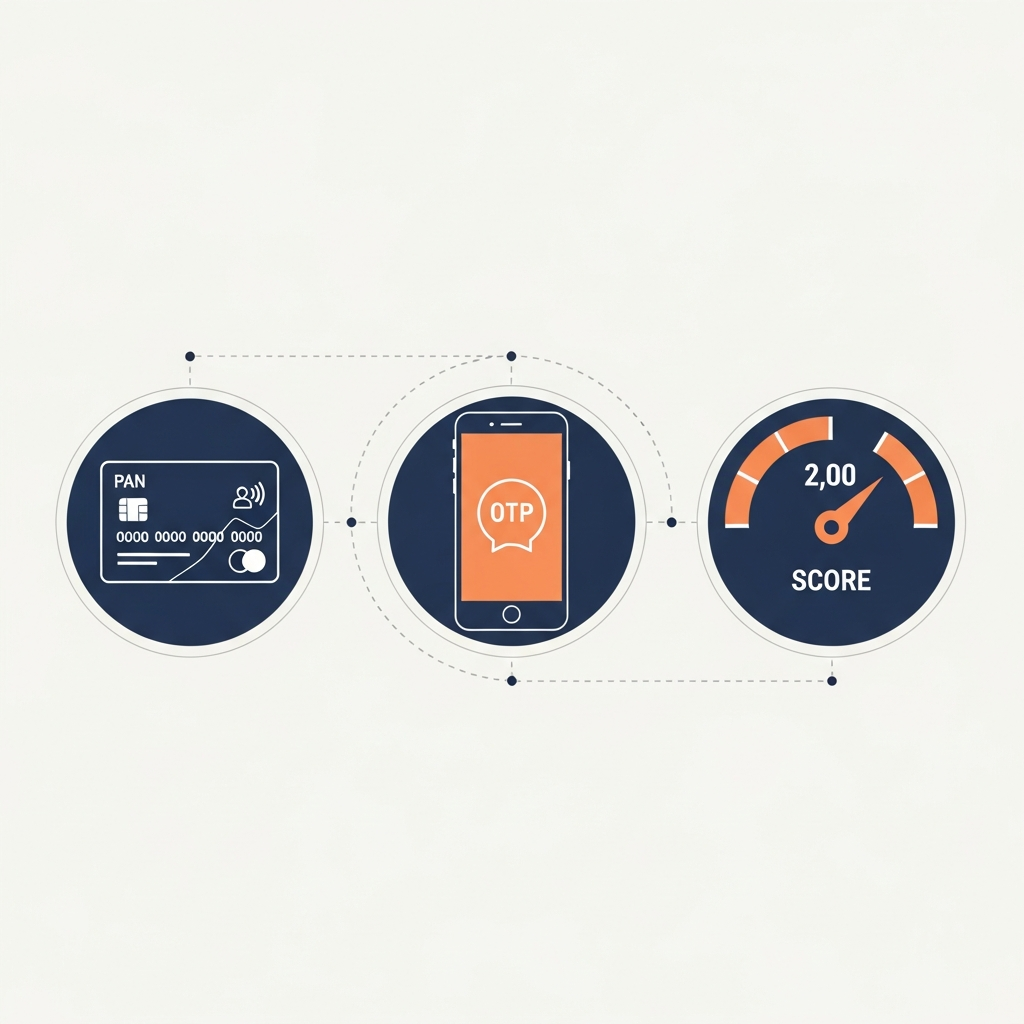
Where You Can Check It, Bureau Site vs Bank App vs Other Platforms
Three real categories exist here, and each one serves a slightly different purpose.
CIBIL's own site gives you one detailed free report a year, straight from the source. This is the most complete version you'll get for free, covering your full score alongside the underlying report, every account, every enquiry, every reported detail, in one place. Because it comes directly from CIBIL rather than a third party pulling the same data, it's often the version worth using when you want the most authoritative, unfiltered picture of where you stand.
Your bank's net banking or mobile app often provides monthly free checks, since a lot of banks have direct tie-ups with CIBIL or another bureau to offer this to existing customers at no extra cost. This is convenient if you're already logging into your banking app regularly, since you don't need to create a separate account elsewhere. The trade-off is that some banks show a simplified version of the score without the full detailed report, so it's worth checking whether your bank's version gives you the underlying report too, not just the number.
Other RBI-authorised bureau platforms, outside CIBIL specifically, are worth knowing about as well. India licenses four credit bureaus in total, and each is entitled to give you one free report a year, independently of the others. A free check on one of these platforms might pull a score from a different bureau entirely, and it can read slightly different from your CIBIL number, sometimes by a noticeable margin, because the underlying data each bureau holds and the exact scoring methodology can differ. This isn't a sign that one number is wrong and the other right, it's simply how multiple, independently calculated scores work.
Whatever you pick, take a moment to confirm it's genuinely authorised before you type in your PAN and other personal details. A quick way to check is looking for the bureau's name and official branding clearly stated on the platform, and avoiding any site that asks for payment before showing you anything at all, since the free check should never require money upfront.
Does Checking Your Own CIBIL Score Lower It
No. This one stops a lot of people from checking as often as they should, so it's worth clearing up properly.
Your own check counts as a soft inquiry. It's logged in your report, but it carries zero weight in how your score is calculated. Check it ten times a month if you genuinely wanted to, and your score wouldn't move an inch because of it. What actually moves the needle is a hard inquiry, and that only happens when a lender pulls your report because you've formally applied for new credit, a loan, a credit card, sometimes even a buy-now-pay-later limit.
String together too many hard inquiries in a short window, applying to five different lenders in two weeks, for instance, and lenders reading your report may interpret that pattern as credit-hungry behaviour, since it can look like you're scrambling for credit from multiple places at once. That combination can dent your score slightly. Your own checks live in a completely different bucket from this, and confusing the two is one of the more common misconceptions people carry around credit scores.
In fact, checking regularly is one of the better financial habits you can build. It lets you catch errors early, notice fraud before it spreads, and see the real effect of your repayment behaviour over time, rather than being surprised by a number you haven't looked at in over a year.

What the Law Says
Checking your own credit score counts as a soft inquiry under RBI-recognised bureau practice. It does not affect your score, no matter how many times you check.
Get a Free Credit Review from FREEDCan You Check It Without OTP
Seen a service promising a CIBIL check with "just your PAN, no OTP"? Treat that as a warning sign, not a shortcut worth taking. OTP exists to confirm the person asking for the report is actually the person it belongs to. A credit report carries sensitive financial data tied directly to your identity, every loan you've taken, every default, every enquiry, and that's exactly the kind of information that shouldn't be accessible to anyone who simply types in a PAN number they found or guessed.
CIBIL doesn't skip this step. Neither does your bank, nor any other genuinely authorised bureau platform. It's a baseline requirement, not an optional add-on some platforms choose to include and others don't. A platform that skips it isn't offering you convenience, it's skipping a check that exists specifically to protect you from someone else accessing your financial history using nothing more than a PAN number.
If you come across a service making this claim, whether through an ad, a forwarded message, or a site that looks official but isn't clearly branded, be cautious before entering any personal details at all. When in doubt, go directly to CIBIL's own site or your bank's official app instead.
What If Your PAN Details Don't Match
First attempt failed? Two situations explain most of these cases.
- A name mismatch is the most common cause. An extra initial, a different spelling, a missing middle name, any small variation between what you type and what's printed on your PAN card can cause the system to reject the entry outright, even though it's clearly the same person to anyone looking at it manually. This is frustrating, but it's also the easiest thing to fix. Pull out your physical card and match every character exactly, spacing included.
- A recent PAN correction is the second common cause. If you've recently corrected a spelling error on your PAN or received a reissued card, your PAN number itself stays exactly the same, only the printed details or the physical card change. But the updated details can take time to sync across the bureau's records. During this window, your report might look thinner than expected, missing accounts you know exist, or showing an incomplete history, not because that history has vanished, but because the correction hasn't fully synced with the bureau yet.
If you've confirmed your details are accurate and it's still not working, don't keep resubmitting the same form repeatedly, since that rarely fixes anything and can sometimes trigger additional verification delays. Instead, contact the platform's support team directly, explain the specific mismatch you're seeing, and let them walk you through what's actually happening on their end.
What to Do After You See Your Score
Seeing the number is only step one. A lot of people check their score, feel a flicker of relief or disappointment depending on what they see, and close the tab without going any further. That's a missed opportunity, because the score alone doesn't tell you why it looks the way it does.
Open the full report and actually read through it. A lower-than-expected score has a reason behind it somewhere in that document, and it could be one of several things: a genuine repayment gap you're already aware of, a payment marked late that you actually made on time, an account still showing as active when you closed it months ago, or in more serious cases, an account that was never yours to begin with. Each of these calls for a different response, and you won't know which one applies to you until you actually look.
Our guide on [How to Check Your Correct CIBIL Score & Dispute Errors] walks through reading the report properly, spotting the difference between a real issue and a bureau error, and disputing whatever's wrong, so we won't repeat that ground here. Worth reading in full if your number came in lower than you expected.
Surprised by Your Credit Score?
If the number surprised you, the reason is usually fixable."
Talk to a FREED CounsellorHow FREED Helps If Your Score Needs Work
A low score from a genuine debt struggle is a fundamentally different conversation than a low score from a clerical error somewhere in your report. If you've already ruled out the second, and what you're actually looking at is real repayment pressure, that's where a broader conversation becomes useful.
FREED can sit down with your credit report and review your credit report to identify the factors lenders may consider during credit assessment. Rather than guessing at what's wrong, this kind of review looks at the actual data behind your score.
From there, it depends entirely on where you stand financially. FREED's Debt Consolidation Program may combine eligible unsecured debts into a single repayment, depending on the approved loan amount, tenure, and lender terms. If repayment has genuinely become unmanageable, even with restructuring, the Debt Resolution Program exists for that situation instead. Neither one fits everyone, and that's not a sales pitch, it's how FREED's counsellors actually approach the first call: they'll tell you plainly which category, if any, your situation falls into, before recommending anything at all.
Score Lower Than You Expected
Talk to FREED about what's affecting it, no obligation.
Book My Free CallSteps: How to Check Your CIBIL Score Using PAN Card
- 1
Go to an Authorised Platform
Visit CIBIL's official site or another RBI-authorised bureau or bank platform.
- 2
Enter Your PAN and Basic Details
Provide your PAN, name, date of birth, and mobile number exactly as they appear on your PAN card.
- 3
Verify with OTP
Enter the OTP sent to your registered mobile number to confirm your identity.
- 4
Answer Security Questions if Asked
Some platforms confirm identity with 2 to 3 questions based on your credit history.
- 5
View Your Score and Report
Your CIBIL score and report appear instantly, download the full report for your records.

Mohit Juneja
Mohit Juneja writes educational content at FREED on debt management, credit scores, loan repayment, and borrowing best practices. His content is shaped by expert insights and industry knowledge, helping readers better understand their financial options and make informed decisions.
mohit.juneja@freed.care

FREED is India's trusted loan management platform. Founded in 2020 and headquartered in Gurugram, FREED has counselled 20 lakh+ people on personal loans, credit cards, and app loans. FREED charges fees only on successful settlement, not upfront. FREED does not handle secured loans (home loans, car loans, gold loans).
Media Mentions