How Is Credit Score Calculated?
Your credit score is built from data in your credit report, mainly your payment history, how much of your available credit you're using, how long and varied your credit accounts are, and how often you've applied for new credit recently. Payment history carries the most weight by a wide margin, so paying on time matters more than any other single habit.

Mohit Juneja
Reviewed by FREED India, Debt Resolution Specialists
 4.7/5
4.7/5 ₹3,200Cr+
 20,000+
 20,00,000+4.7/5₹3,200Cr+20,000+20,00,000+
KEY TAKEAWAYS

Payment history is the single biggest factor in credit score calculation, generally carrying the most weight of any category.
Keeping credit utilisation relatively low (often around 30% or below) is widely considered a healthy practice.
The length and mix of your credit history make up a meaningful chunk of the score too.
Recent hard inquiries and new credit accounts play a smaller, but still real, role.
The exact formula is proprietary. Bureaus disclose the broad factors, not the precise calculation behind them.
What Goes Into Calculating Your Credit Score?
Nobody outside the credit bureaus knows the exact formula. That's worth saying upfront, because a lot of what circulates online sounds more precise than it actually is. What bureaus do disclose, and what industry sources consistently point to, are four broad categories that feed into the score.
Payment history sits at the top: whether you've paid your EMIs and card bills on time, month after month. Credit utilisation comes next: how much of your available credit limit you're actually using at any given point. Then there's the length and mix of your credit history: how old your accounts are, and whether you're handling a healthy variety of credit types or just one. Last is new credit and recent inquiries: how often you've applied for fresh credit lately, and whether that pattern looks steady or hurried.
These four categories aren't equally weighted. Payment history pulls the most influence, followed by utilisation, with history length and mix and recent inquiries splitting the remainder. The specific percentages you'll see quoted across different websites vary a bit from source to source, because none of it comes from an official published formula. Treat the numbers as a useful approximation of what matters most, not a precise recipe.
Credit Score Factors and Their Approximate Weight
Factor | Approximate Weight | What It Measures |
Payment history | 30–35% | Timeliness of EMI and bill payments |
Credit utilisation | 25–30% | How much of your available credit you're using |
Credit history length and mix | 25% | Age of accounts and variety of credit types |
New credit and inquiries | 10–20% | Recent applications and hard inquiries |
Figures shown are indicative, based on publicly available industry information, not an official bureau formula. FREED is not a Loan Provider.
Why Does Payment History Matter So Much?
Payment history matters most because it's the closest thing a bureau has to direct evidence. Utilisation and account mix are useful signals, but repayment behaviour is the actual thing lenders care about: will you pay back what you borrow, on time, without them having to chase you.
This covers everything reporting to your credit file: EMIs on personal loans, home loans, car loans, and minimum or full payments on credit cards. The gap between paying on time and paying even a few weeks late is significant. Missed repayments may affect your credit history and may be considered by future lenders during credit assessment.
This isn't about judging character. A rough patch, one bounced EMI during a genuinely hard month, doesn't erase everything else on your report. But because this factor carries so much weight, staying consistent here does more for your score than almost anything else you could optimise.

What the Law Says
As per RBI's Credit Information Reporting Directions, lenders currently report your repayment data to credit bureaus every 15 days (twice a month), a rule in force since January 1, 2025. RBI has also proposed moving to weekly reporting from July 1, 2026, which would make your payment behaviour, good or bad, show up in your report even faster.
See your latest report before it changes again
What Is Credit Utilisation and Why Does It Matter?
Credit utilisation is simply how much of your available credit limit you're currently using, expressed as a percentage. It's one of the important factors considered in credit scoring.
Here's a concrete example. Say your total credit card limit is ₹1,00,000. If your outstanding balance sits at ₹30,000, your utilisation is 30%, right at the edge of what's generally considered healthy. Push that balance to ₹60,000 and utilisation jumps to 60%, which reads as heavy reliance on borrowed money even if you're paying it off in full every month.
That last part trips people up. Even if you clear your card bill completely each cycle, if the statement generates while your balance is high, that high figure is what gets reported, not the zero you land at after paying. One practical fix is making a payment before your statement date, so the balance reported is lower than what you actually spent that month.
Keeping utilisation under 30% across all your cards combined, not just one, is the general guideline most sources point to.
How Do Credit History Length and Mix Affect Your Score?
Length and mix work together, but they're measuring slightly different things.
Length is about how long your accounts have been open and active, particularly your oldest account and the average age across all of them. A longer history simply gives lenders more data to judge you by, which tends to work in your favour, assuming that history is largely clean. Closing your oldest credit card may affect the length of your credit history, which lenders may consider during credit assessment.
Mix looks at variety, whether you're handling a blend of credit types, say a personal loan alongside a credit card, rather than relying on just one. A healthy mix signals you can manage different kinds of credit responsibly. This doesn't mean you should go open new accounts purely to diversify. It means an existing mix, built naturally over time, tends to read better than a file with only one type of credit on it.

Freed Expert Tip
Keep your oldest credit card active even if you barely use it. Keeping older credit accounts active may help maintain a longer credit history, which lenders may consider during credit assessment.
Check what's currently helping or hurting your historyHow Do New Credit and Inquiries Affect Your Score?
Every time you formally apply for a loan or credit card, the lender pulls your report, and that's recorded as a hard inquiry. Every formal credit application creates a hard enquiry that future lenders may consider during credit assessment. The problem is what a cluster of them signals.
Several applications close together, even for legitimate reasons, read as risk-seeking behaviour to a lender, as if something has gone wrong and you're scrambling for credit wherever you can get it. This is different from checking your own score, which is a soft inquiry and carries no weight at all in the calculation. The distinction between the two trips a lot of people up, and it's worth being clear on before you assume checking your own report is doing you any harm.
Does the Exact Formula Ever Get Published?
No, and it's unlikely to be. TransUnion CIBIL, along with the other three bureaus operating in India, treats the precise algorithm behind the score as proprietary. What gets disclosed publicly is the broad category list: payment history, utilisation, history and mix, and new credit.
This is fairly standard practice globally, not something unique to India. Credit scoring models everywhere tend to guard the exact math, partly to prevent people from gaming the system by optimising for the formula rather than genuinely managing credit well. So when you see a website quoting precise percentages down to the decimal, treat it as an informed estimate drawn from industry patterns, not a leaked official document.
How Can You Use This to Improve Your Score?
Each factor above translates into a specific, doable habit.
- 1
Pay every EMI and bill on time, every cycle.
This carries the most weight of any factor lenders look at. Consistent, on-time repayment is the clearest signal of responsible credit management, and it's what future lenders rely on most when assessing a new application.
- 2
Keep utilisation under 30% across all your cards combined.
If your total limit is ₹2,00,000 across two cards, try to keep your combined outstanding balance under ₹60,000 at any given point.
- 3
Keep older accounts open, even unused ones.
If a card carries no annual fee, using it once every few months to keep it active protects your average account age. Space out new applications. Apply for credit only when you actually need it, and leave a gap of a few months between applications rather than applying to several lenders at once.
- 4
Check your report regularly for errors.
A wrongly reported account or an already-closed loan showing as active is a reporting error, not a reflection of your actual repayment behaviour. Getting it corrected keeps your credit report accurate, which matters because lenders read that report closely when they assess a future application. Combined with consistent, on-time repayment, an accurate report gives lenders a true picture of how
How FREED Helps You Understand What Is Affecting Your Score
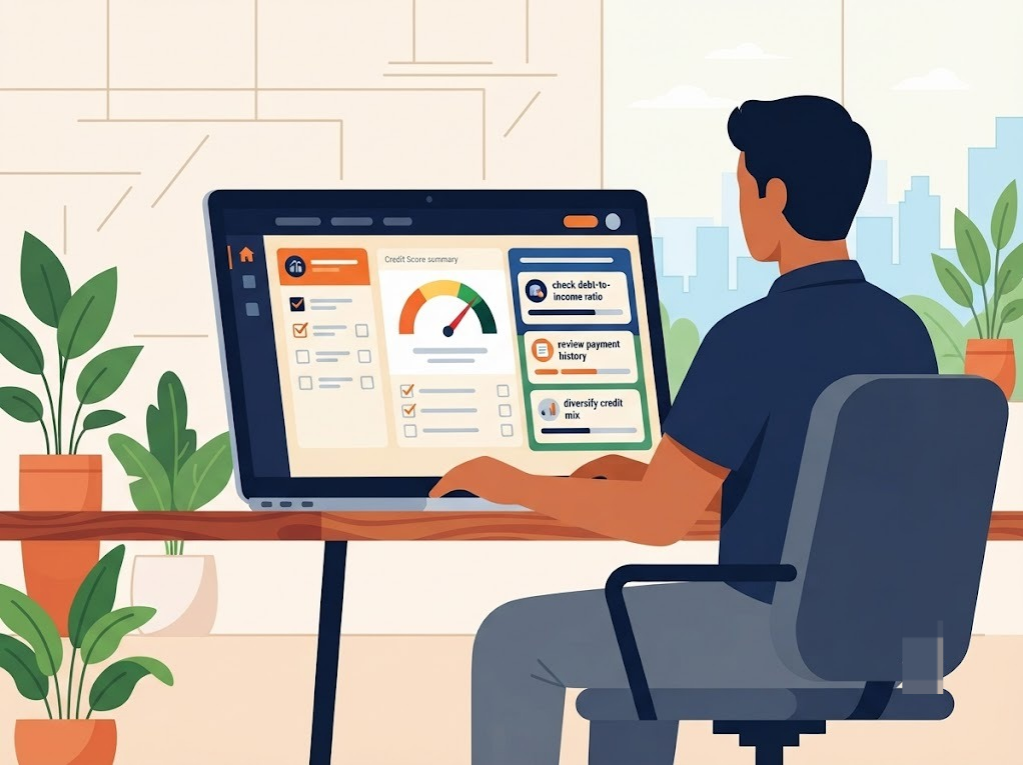
Everything above explains the general factors. What it can't tell you is which of these is actually dragging your specific score down. That's where FREED's Credit Insights, the "Check My Credit" subscription, comes in, and it's available to everyone, whether or not you're enrolled in any FREED program.
Credit Insights pulls your report from Experian, one of the four bureaus operating under the same RBI framework as CIBIL. Get flat 50% off on subscription or if you avail the subscription at a flat 50% off, you get three things: your score, a plain-language breakdown of a personalised explanation of the factors reflected in your credit report, along with practical recommendations to help you better understand and manage your credit profile.
Instead of reading a general list of four broad factors and guessing which one applies to you, Credit Insights turns that list into something personal: is it your utilisation that's off, a recent inquiry pattern, an account that's aging you don't realise, or something else entirely. That specificity is the real difference between reading an article and actually knowing where you stand

See Exactly What Is Affecting Your Score
Get your score, the reasons behind it, and clear next steps.
Get a Free AssessmentMultiple Loans Making the Calculation Harder to Control?
vEverything explained above assumes a fairly straightforward credit picture: a card or two, maybe one loan. If you're juggling several loans across different banks, keeping utilisation low and payment history spotless gets a lot harder, simply because there's more surface area for something to slip.
FREED's Debt Consolidation Program may combine eligible unsecured debts into a single repayment, depending on the approved loan amount, tenure, and lender terms. If you're not sure whether this fits your situation, FREED's team can walk through it with you on a free call, no pressure either way.
Are You in a Loan Trap? Quick Check
Move the slider to your total EMIs as a % of monthly salary. See your debt stress level instantly.
EMIs as % of Monthly Salary

Mohit Juneja
Mohit Juneja writes educational content at FREED on debt management, credit scores, loan repayment, and borrowing best practices. His content is shaped by expert insights and industry knowledge, helping readers better understand their financial options and make informed decisions.
mohit.juneja@freed.care

FREED is India's trusted loan management platform. Founded in 2020 and headquartered in Gurugram, FREED has counselled 20 lakh+ people on personal loans, credit cards, and app loans. FREED charges fees only on successful settlement, not upfront. FREED does not handle secured loans (home loans, car loans, gold loans).
Media Mentions