What Is an EMI and How Does It Work? A Beginner's Guide
EMI (Equated Monthly Instalment) is the fixed amount you pay every month to repay a loan, covering both a part of what you borrowed and the interest on it. The amount stays the same every month, but the mix behind it shifts over time, more interest early on, more principal later. Home loans, car loans, personal loans, and EMI-based purchases all use this structure.

Mohit Juneja
Reviewed by FREED India, Debt Resolution Specialists
 4.7/5
4.7/5 ₹3,200Cr+
 20,000+
 20,00,000+4.7/5₹3,200Cr+20,000+20,00,000+
KEY TAKEAWAYS

EMI stands for Equated Monthly Instalment, the fixed monthly amount you pay toward any loan or EMI purchase.
Your EMI is calculated from three inputs: loan amount, interest rate, and tenure.
Under the standard reducing-balance method, early EMIs are mostly interest, later ones are mostly principal.
RBI requires lenders to let floating-rate borrowers choose a higher EMI, a longer tenure, or a mix, whenever the interest rate resets.
A 50% EMI-to-income level is sometimes used as a rough affordability rule of thumb, but there is no universal threshold. Your other expenses, dependants, income stability and existing debt also matter.
What Is an EMI?
EMI stands for Equated Monthly Instalment. Every payment does two jobs at once, part clears the interest on your loan, part clears the principal, the amount you originally borrowed.
The split between those two changes every month. An EMI is the scheduled amount you pay periodically toward a loan. For a standard fixed-rate loan, the EMI generally remains the same throughout the tenure, while the proportion going toward principal and interest changes over time. That's the "equated" part, one predictable number on your bank statement, month after month, even as what it's paying for underneath keeps shifting.
Home loans. Car loans. Personal loans. Education loans. Many home, car, personal and education loans use EMIs, while some credit-card and BNPL purchases can also be converted into instalment plans. Bought a phone "on EMI"? Signed for a car loan? You've already used it.
EMI is one of several terms worth knowing before you sign for anything, alongside interest rate types and tenure. Lenders didn't land on this structure by accident, either. There's a real reason they built repayment this way instead of asking for the full amount upfront.
Why Do Loans Use the EMI Structure?
A lump-sum repayment isn't realistic for most people. Spreading a ₹40 lakh home loan, or an ₹8 lakh car loan, into equal monthly pieces is what makes either one possible on a regular salary.
It works for the lender too. Predictable cash flow, spread-out risk. One sentence covers it, because this isn't the interesting part.
The interesting part is the word "equated." The number on your statement never moves for the length of the loan. What's underneath it does, every month, without you noticing. That's the part most guides skip past.
Managing one predictable EMI is one thing. Juggling several, across separate lenders and separate due dates, turns into a problem of its own.
Is Your EMI Too High? Signs to Watch For
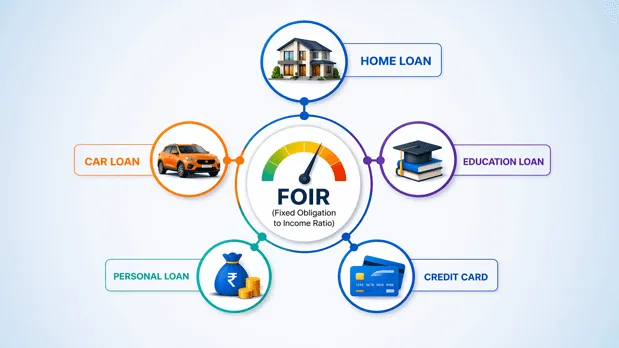
Most financial planners use a rough gut-check here. If your total EMIs cross about 50% of your take-home income, you're likely in a stress zone. It's a commonly used threshold, not a strict rule. But it's a useful one to know.
A few behavioural signs to watch for:
- Dipping into savings or a credit card to cover an EMI, instead of your regular income covering it.
- Delaying other bills so an EMI goes out on time.
- A knot in your stomach every month as the due date gets close.
- Taking a new loan partly to manage an existing one. This one especially tends to snowball.
One bad month, where you stretch a little, is normal. Life happens. A recurring pattern of relying on savings or new borrowing to meet EMIs is a stronger warning sign that the debt load may be unsustainable.
A missed payment carries its own costs too, worth understanding before it gets there.
A manageable EMI load is something to check for. Not guess at.

Freed Expert Tip
Add up every EMI you pay across all lenders, not just the newest one. It's easy to lose track of the total when payments go out to multiple banks.
Check My Credit
How Is Your EMI Calculated?
Three numbers decide your EMI. Principal, what you're borrowing. Interest rate, what the lender charges annually. Tenure, how many months you'll take to repay it.
The formula lenders use, under the standard reducing-balance method, looks like this:
EMI = P × R × (1+R)^N ÷ [(1+R)^N − 1]
P is the principal. R is the monthly interest rate, your annual rate divided by 12, divided by 100. N is the number of months.
Here's how that plays out with real numbers. Say you take a ₹5,00,000 personal loan at 12% annual interest, over 3 years, 36 months.
- Monthly rate: 12 ÷ 12 ÷ 100 = 0.01, or 1% a month.
- Plug that into the formula with P = 5,00,000, R = 0.01, N = 36.
- The result: an EMI close to ₹16,607.
- Over the full 36 months, total repayment comes to about ₹5,97,858, which puts total interest at ₹97,858.
Change one input and the number moves. Stretch the same loan to 5 years instead of 3, and the EMI drops, but total interest climbs. Shorten it, and the opposite happens: a heavier EMI, less paid in interest overall.
Run these same numbers with a different rate or tenure and you'll see exactly where that trade-off lands for your own loan.
What's behind that number, how much is interest versus principal each month, depends on which calculation method your lender uses.
Fixed-Rate vs Reducing-Balance EMI, and What Happens When Rates Change
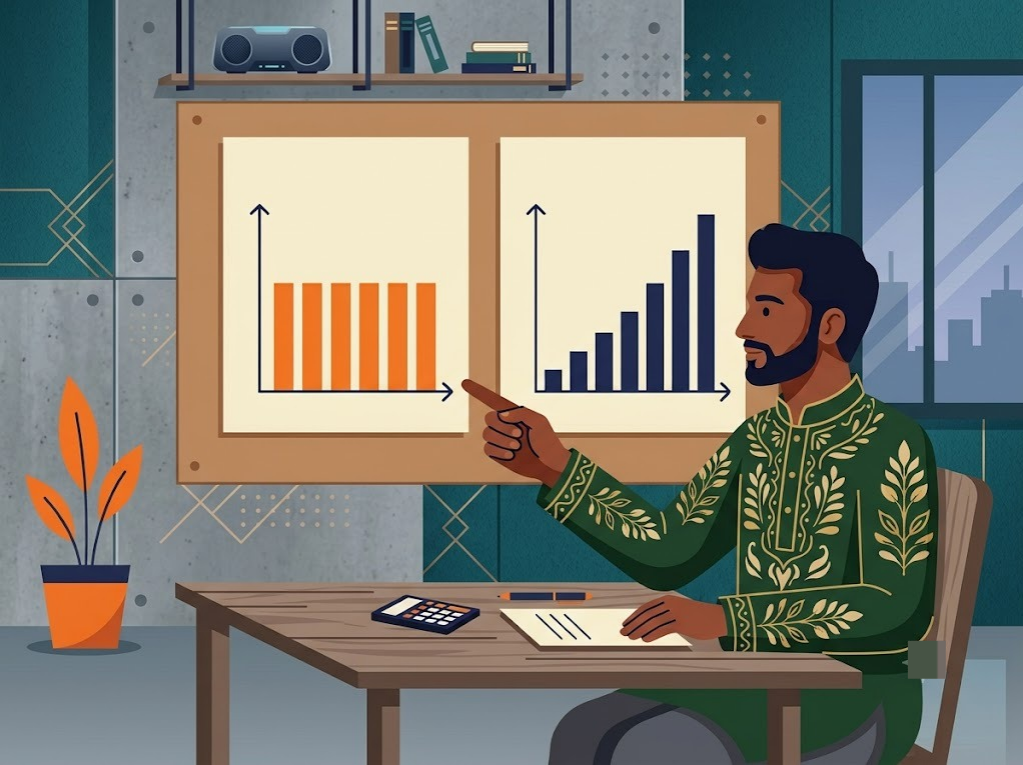
Two methods decide how interest gets calculated. Under a flat-rate method, interest is calculated on the original principal rather than the declining outstanding balance. This can produce a higher effective borrowing cost than a reducing-balance loan at the same stated rate.
Reducing-balance calculations are widely used for conventional bank and NBFC loans. Interest applies only to what's still outstanding, so as you repay, the interest portion shrinks and the principal portion grows. That's why your EMI splits unevenly across the loan, heavier on interest in month 1, heavier on principal by month 30, even though the total number never moves.
On a floating-rate loan, when the benchmark rate rises, something has to absorb it. Either the EMI goes up, or the tenure stretches to keep the EMI where it was.
For applicable floating-rate EMI-based personal loans, RBI rules require lenders to communicate the impact of a rate reset and provide specified options relating to EMI, tenure or a combination of both. The applicable rules also address prepayment options, subject to the scope and conditions of the regulatory framework.The option to switch from a floating rate to a fixed rate is subject to the lender's applicable policy and the terms of the loan. Prepayment, part or full, has to be allowed at any time too. This isn't a courtesy. It's a mandatory right.
One thing changed since then, though. As of a September 2025 amendment, offering a switch from floating to fixed rate became optional for the lender, not compulsory. Don't confuse the two: the switch-to-fixed option is now the lender's call, but the EMI-or-tenor choice at rate reset is still yours by right.
Checking what your credit profile shows helps before a rate negotiation, so you're not assuming there's nothing you can do about a reset.

What the Law Says
Since August 2023, RBI has required lenders to let floating-rate EMI borrowers choose a higher EMI, a longer tenure, or a mix, whenever the interest rate resets, and to allow part or full prepayment at any time.
Talk to FREED's TeamWhat Are Your Options If Your EMI Feels Unmanageable?
Start with the lender you already have. Ask about restructuring, or use the RBI-mandated EMI-or-tenor choice covered above if your loan is floating-rate. This costs nothing but a phone call.
A balance transfer is the next lightest option, moving your loan to another lender at a better rate. This works well if your credit profile has improved since you first borrowed, a better score or steadier income both make you a stronger candidate elsewhere.
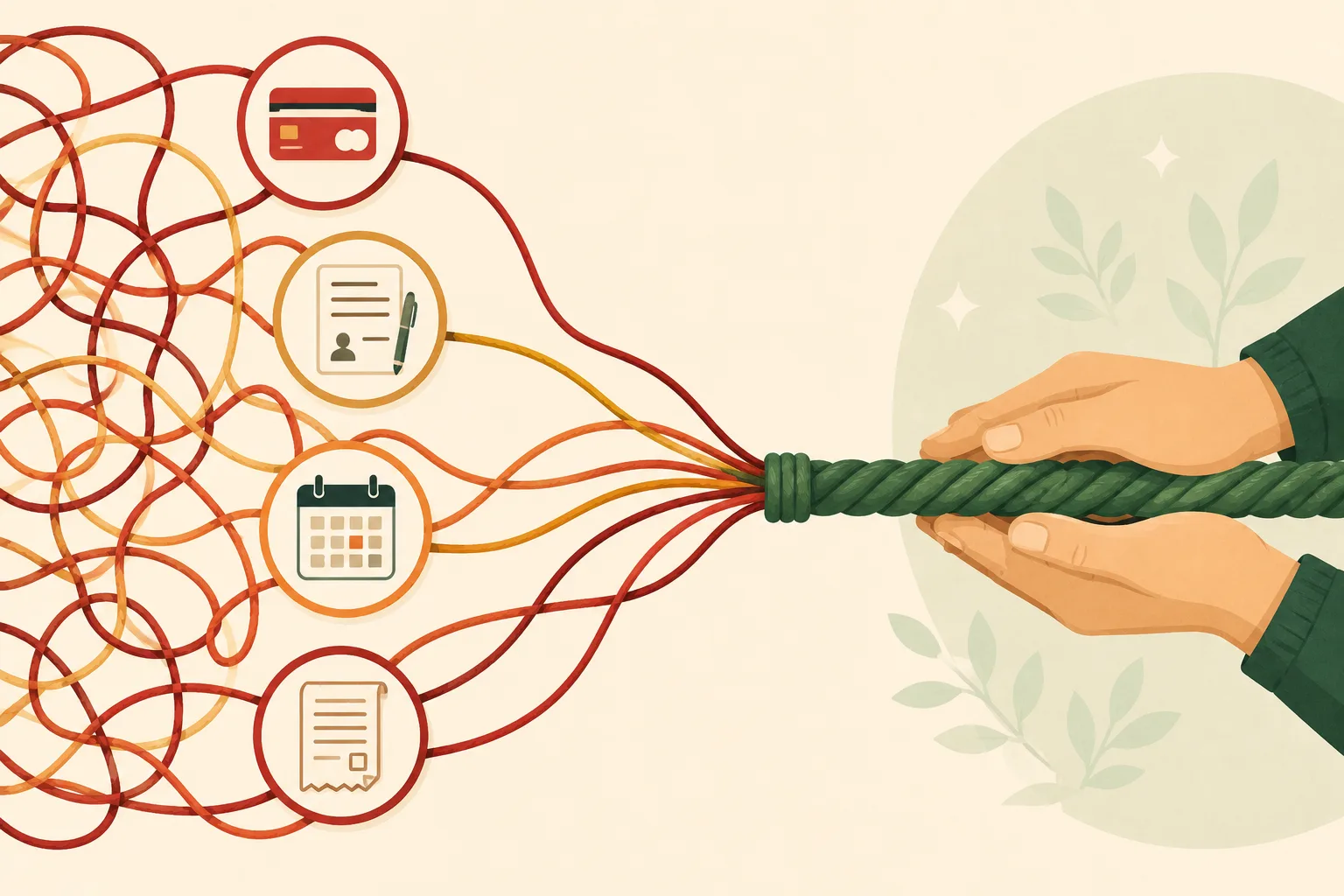
If you're juggling multiple unsecured EMIs across several lenders, consolidation combines them into one new loan, a single EMI instead of several scattered across different due dates and banks.
Settlement sits at the far end. Settlement is generally considered when a borrower cannot reasonably repay the full outstanding amount and the lender is willing to accept a negotiated settlement. Settlement can result in the account being reported as ‘Settled’ rather than ‘Closed’ or ‘Paid in Full,’ which may affect future lending decisions.
None of these fit every situation the same way. A borrower who's current but stretched needs a different answer than one who's already missed payments. Matching the option to where you stand matters more than picking the "best" one in the abstract.

How FREED Helps With EMI Overload
This section is for one specific person: still paying every EMI on time, but stretched thin across two, three, sometimes four loans and cards at once.
FREED's Debt Consolidation Program, Reduce My EMI, matches you to a lending partner from its network. The new loan is used to repay eligible existing unsecured debts, subject to the lending partner's process. Where approved, the program can combine eligible unsecured debts into one new loan and may reduce the monthly EMI.
Because consolidation is intended for borrowers who are still current on their payments, it can help simplify repayment without the ‘Settled’ status associated with debt settlement. Consistent, on-time repayment can support your credit profile over time. That's the key difference from settlement, and it's why consolidation works as a preventative step, not a recovery step. It's built for someone who hasn't missed a payment yet, not someone trying to recover from one.
One thing to be clear about: this only covers unsecured debt. Home loans and car loans aren't part of it.
For the smaller group unable to repay anything at all, FREED's Debt Resolution Program exists as a separate, later-stage option. That's a separate conversation from the one most readers here are having.
Curious what the actual process looks like once you start? Here's a tool to see roughly where you'd land.
Are You in a Loan Trap? Quick Check
Move the slider to your total EMIs as a % of monthly salary. See your debt stress level instantly.
EMIs as % of Monthly Salary
Practical Tips for Managing Your EMIs Wisely
A few habits go a long way here, whether you're managing existing EMIs or about to take on a new one.
- Keep total EMIs under about 50% of take-home income whenever you take on a new loan, not just when managing the ones you already have.
- Set up auto-debit for salary day, or right after. Don't leave it to a manual reminder you might forget.
- Build a small buffer before taking on anything new. Even one month's EMI set aside changes how a rough patch feels.
- Review your loans once a year. Rates change. Your income and credit profile change too. What made sense two years ago might not now.
- Don't take a new loan to cover an existing EMI. That's often the first step into a spiral, and it's better said plainly than danced around.
If your income drops for a stretch, a payment pause is something to understand before you assume a new loan is the only option.
Sources
Claim | Source |
Continued missed EMI payments lead to NPA classification after sustained non-payment (typically 90 days overdue) | RBI Notification, Prudential Norms on Income Recognition, Asset Classification and Provisioning: https://www.rbi.org.in/commonman/Upload/English/Notification/PDFs/74MIR010714FL.pdf (verified live) |

Mohit Juneja
Mohit Juneja writes educational content at FREED on debt management, credit scores, loan repayment, and borrowing best practices. His content is shaped by expert insights and industry knowledge, helping readers better understand their financial options and make informed decisions.
mohit.juneja@freed.care

FREED is India's trusted loan management platform. Founded in 2020 and headquartered in Gurugram, FREED has counselled 20 lakh+ people on personal loans, credit cards, and app loans. FREED charges fees only on successful settlement, not upfront. FREED does not handle secured loans (home loans, car loans, gold loans).
Media Mentions